
Have you ever written a sentence and felt stuck using the words “able to” again and again? I remember editing a paragraph and realizing almost every line had the same phrase. It made the writing sound boring and repetitive. If this has happened to you, don’t worry — it’s very common.
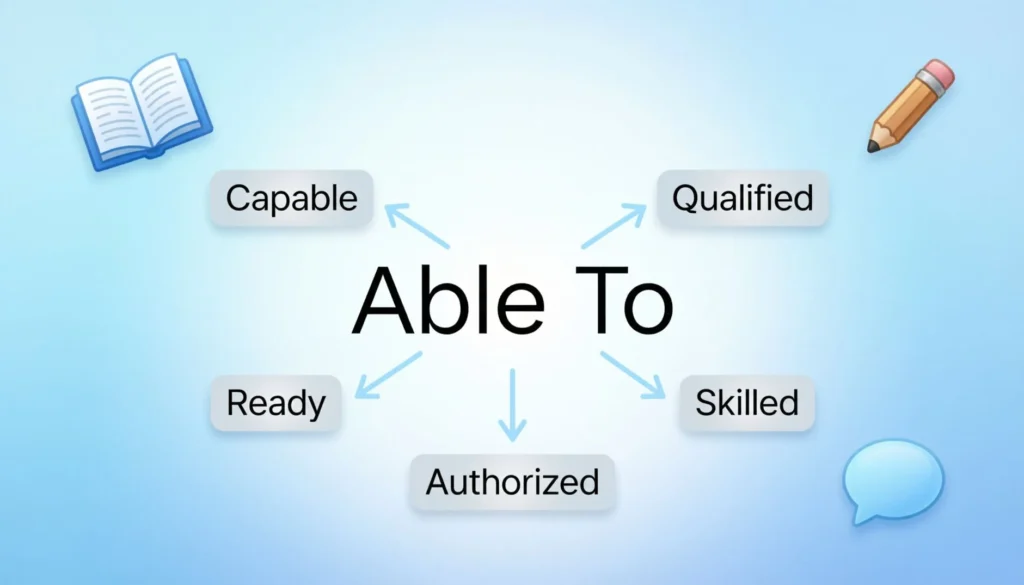
The phrase able to synonyms helps you replace “able to” with better, more natural words. These alternatives make your writing stronger and more interesting.
If you’re a student, blogger, freelancer, or someone learning English, knowing these synonyms can improve how you speak and write. In this guide, you’ll learn simple and clear synonyms for able to, plus real-life examples you can use right away.
What Does Able To Synonyms Mean?
Able to synonyms are words or phrases that have the same meaning as “able to.”
- They describe having the power or skill to do something.
- They help avoid repeating the same phrase in writing or speech.
- They make sentences sound smoother and more natural.
When and How to Use Able To Synonyms
You can use able to synonyms in many everyday situations:
- Writing essays: Makes your sentences less repetitive
- Blogging: Improves readability and flow
- Emails: Sounds more professional
- Daily conversation: Adds variety to speech
Examples:
- I am capable of solving this problem.
- She is free to choose her path.
- They are equipped to handle the task.
Tip: If your sentence feels repetitive, replace “able to” with a synonym that fits the tone (formal or casual).
50 Synonyms for Able To (With Meanings & Examples)
| Synonym Word | Meaning | Examples |
| Capable of | Having the skill to do something | She is capable of solving puzzles. / I am capable of learning fast. |
| Can | Simple way to show ability | I can swim well. / He can fix bikes. |
| Competent to | Skilled enough for a task | She is competent to lead the team. / He is competent to teach math. |
| Qualified to | Having proper training | She is qualified to drive. / He is qualified to apply. |
| Equipped to | Having tools or skills | We are equipped to travel. / They are equipped to help. |
| Fit to | Suitable for doing something | He is fit to work. / She is fit to lead. |
| Ready to | Prepared to act | I am ready to start. / She is ready to speak. |
| Free to | Allowed or open to do | You are free to go. / She is free to choose. |
| In a position to | Having the chance or power | I am in a position to help. / He is in a position to decide. |
| Prepared to | Mentally ready | She is prepared to try. / I am prepared to learn. |
| Strong enough to | Having strength | He is strong enough to lift it. / She is strong enough to continue. |
| Skilled at | Having learned ability | She is skilled at drawing. / He is skilled at cooking. |
| Talented enough to | Naturally gifted | She is talented enough to sing. / He is talented enough to paint. |
| Adept at | Very good at something | She is adept at coding. / He is adept at writing. |
| Proficient in | Highly skilled | She is proficient in English. / He is proficient in math. |
| Gifted enough to | Naturally strong skill | She is gifted enough to lead. / He is gifted enough to teach. |
| Strong in | Good ability in area | She is strong in science. / He is strong in sports. |
| Efficient at | Good and quick at task | She is efficient at work. / He is efficient at solving issues. |
| Clever enough to | Smart ability | He is clever enough to escape. / She is clever enough to solve it. |
| Smart enough to | Having intelligence | She is smart enough to learn. / He is smart enough to decide. |
| Allowed to | Having permission | We are allowed to play. / She is allowed to speak. |
| Permitted to | Formal permission | He is permitted to enter. / She is permitted to join. |
| Authorized to | Official permission | He is authorized to sign. / She is authorized to lead. |
| Eligible to | Meeting requirements | She is eligible to vote. / He is eligible to apply. |
| Empowered to | Given authority | She is empowered to act. / They are empowered to speak. |
| Licensed to | Legal permission | He is licensed to drive. / She is licensed to practice. |
| Entitled to | Having rights | You are entitled to rest. / She is entitled to benefits. |
| Open to | Possible option | I am open to learn. / She is open to change. |
| Set to | Ready and planned | We are set to launch. / She is set to begin. |
| Bound to | Likely to happen | He is bound to win. / She is bound to succeed. |
| Destined to | Expected future | She is destined to shine. / He is destined to lead. |
| Meant to | Intended purpose | You are meant to grow. / She is meant to teach. |
| Likely to | High chance | He is likely to pass. / She is likely to win. |
| Positioned to | Strategically ready | They are positioned to grow. / We are positioned to expand. |
| Primed to | Fully ready | She is primed to perform. / He is primed to start. |
| Trained to | Learned skill | She is trained to teach. / He is trained to fight fires. |
| Built to | Designed for purpose | This car is built to last. / He is built to lead. |
| Designed to | Made for a goal | The tool is designed to cut. / This app is designed to help. |
| Formed to | Created for ability | The team is formed to win. / The group is formed to learn. |
| Made to | Natural purpose | He is made to inspire. / She is made to create. |
| Able enough to | Having enough ability | He is able enough to help. / She is able enough to manage. |
| Good enough to | Sufficient skill | He is good enough to play. / She is good enough to win. |
| Strong-willed to | Determined ability | She is strong-willed to succeed. / He is strong-willed to try. |
| Brave enough to | Courage ability | She is brave enough to speak. / He is brave enough to stand. |
| Bold enough to | Confident ability | He is bold enough to ask. / She is bold enough to lead. |
| Flexible enough to | Adaptable ability | She is flexible enough to adjust. / He is flexible enough to learn. |
| Quick enough to | Fast ability | He is quick enough to react. / She is quick enough to respond. |
| Mature enough to | Emotional ability | He is mature enough to decide. / She is mature enough to handle it. |
| Wise enough to | Thoughtful ability | She is wise enough to wait. / He is wise enough to choose. |
| Ready and able | Fully capable | We are ready and able to help. / They are ready and able to start. |
Categorized Synonym Clusters
| Category | Synonyms |
| Formal | Qualified, Authorized, Competent, Eligible, Licensed |
| Informal | Can, Ready to, Good enough, Smart enough, Free to |
| Academic | Proficient, Adept, Capable, Skilled, Competent |
| Technical | Equipped, Positioned, Primed, Designed, Built |
Antonyms of Able To
| Antonym | Meaning | Examples |
| Unable to | Cannot do something | I am unable to attend. / She is unable to speak. |
| Incapable of | Lacking ability | He is incapable of lying. / She is incapable of running. |
| Powerless to | No control | He is powerless to stop it. / She is powerless to help. |
| Unfit to | Not suitable | He is unfit to lead. / She is unfit to work. |
| Incompetent | Lacking skill | He is incompetent at math. / She is incompetent at driving. |
| Unqualified | No training | He is unqualified to teach. / She is unqualified to apply. |
| Helpless to | No ability to act | She is helpless to stop it. / He is helpless to move. |
| Weak to | Lacking strength | He is weak to fight. / She is weak to stand. |
Able To vs Similar Words (Simple Comparison)
“Able to” is the most neutral and common phrase. It works in almost any situation.
“Capable of” sounds slightly more formal and emphasizes skill.
“Can” is casual and used mostly in speaking.
“Qualified to” suggests official training or certification.
“Free to” focuses on permission rather than skill.
For example:
- I am able to drive. (neutral)
- I am qualified to drive. (formal, licensed)
- I can drive. (casual)
FAQs
1. What is the best synonym for able to?
“Capable of” is the closest and most flexible synonym.
2. Is “can” a synonym of able to?
Yes, but it is more informal and used in speech.
3. Which synonym sounds professional?
Use words like qualified, competent, or authorized.
4. Are able to synonyms useful in writing?
Yes, they reduce repetition and improve readability.
5. Should I use different synonyms in SEO content?
Yes, using variations helps SEO and keeps readers engaged.
Mini Vocabulary Growth Section
Learning able to synonyms helps you grow faster in English.
- Better writing: Your sentences become less repetitive
- Stronger speaking: You sound more confident and fluent
- Higher readability: Blogs become easier and more engaging
- Authority boost: You sound smarter and more expressive
Small vocabulary upgrades can make a big difference.
Conclusion
Using different able to synonyms is one of the easiest ways to improve your English. Instead of repeating the same phrase, you can choose better words that match the tone and situation.
Try using these synonyms in your emails, essays, blog posts, and even daily conversations. The more you practice, the more natural they will feel. Start small, replace “able to” once or twice in your next paragraph.
Over time, your writing will sound smoother, smarter, and more professional. Keep exploring new words and building your vocabulary step by step. You’re already on the right path!