You are writing an email to your manager explaining why a project is taking longer than expected. You want to say the task is “difficult,” but that word feels too plain, too weak for the situation.
So you write: “This has been a challenging process due to several unforeseen complications.” Suddenly, it sounds more professional, more precise, and more credible.
That is exactly why knowing synonyms for difficult matters. The right word does not just replace another it adds tone, context, and personality to your message.
What Does “Difficult” Mean?
“Difficult” describes something that requires effort, skill, or patience to do, understand, or deal with. It can refer to tasks, situations, people, or problems. It is a neutral, everyday word that works in both formal and informal settings, though it can sometimes feel overused or too general when a more specific word would communicate your meaning more clearly.
Meaning, Tone, and Context
At its core, “difficult” means “not easy.” However, the tone shifts depending on how you use it. In professional writing, it sounds measured and objective “The negotiation was difficult.” In casual conversation, it can feel understated “That exam was difficult” might not fully capture the frustration you felt.
“Difficult” carries a neutral to slightly formal tone. It works well across most contexts: academic writing, workplace communication, everyday conversation, and even emotional situations when describing a hard personal experience. However, it rarely conveys urgency or emotional weight on its own, which is why stronger or more specific synonyms often work better in context.
When and How to Use “Difficult”
Use “difficult” when you want a safe, universally understood word that fits both written and spoken English. It is especially useful when you are unsure of your audience’s vocabulary level or when you want to keep your tone neutral.
For example:
- “This is a difficult decision.” (neutral, professional)
- “She had a difficult childhood.” (emotional, personal)
- “The math problem was difficult.” (academic, factual)
However, if you are writing an essay, a business report, or even a social media post, swapping “difficult” for a more precise word can make your writing noticeably stronger. Instead of saying “The situation was difficult,” consider: “The situation was complex,” “The situation was grueling,” or “The situation was overwhelming,” depending on what you actually mean.
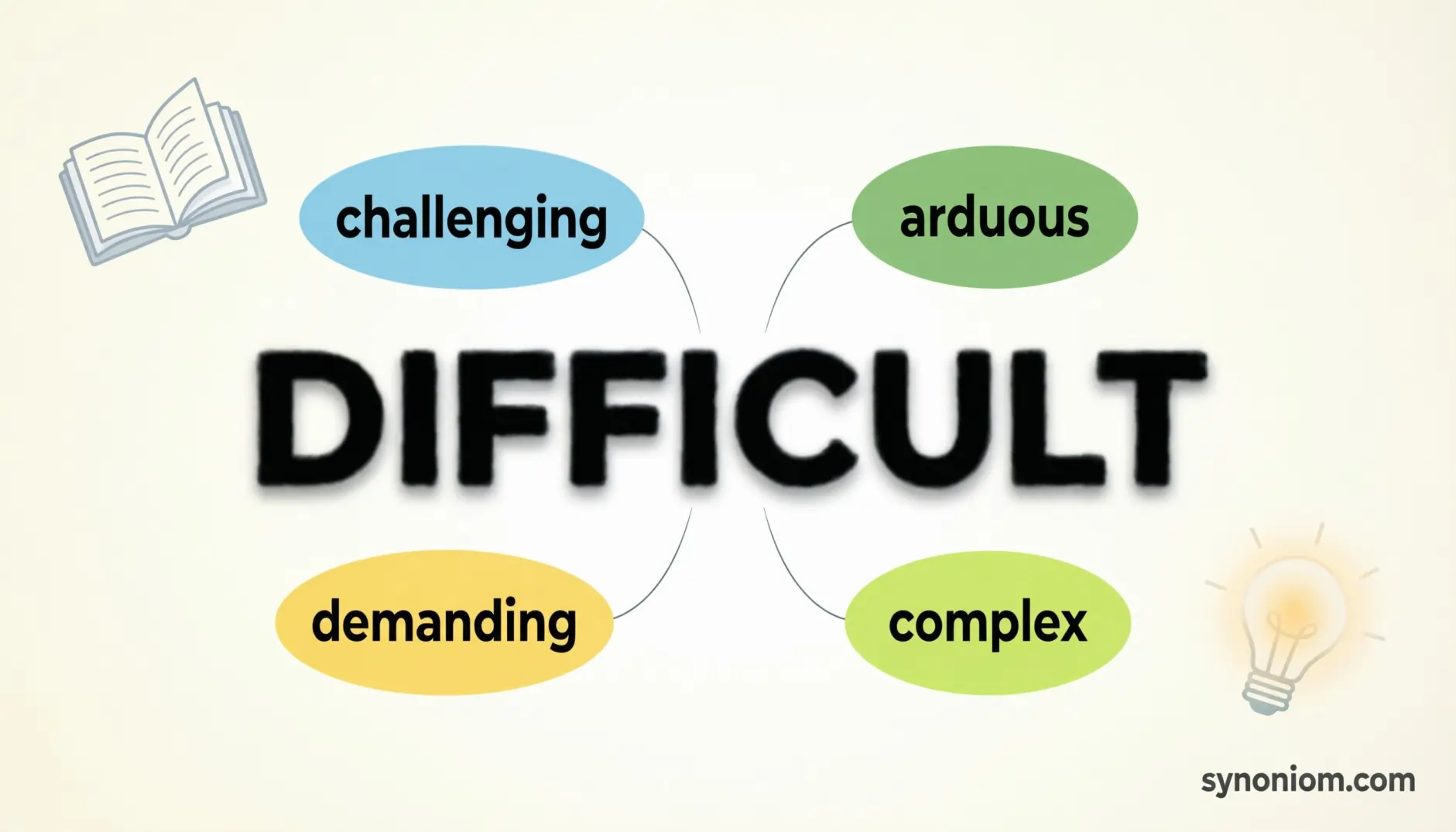
50 Synonyms for “Difficult”
| Synonym | Simple Meaning | Example Sentence |
|---|---|---|
| Challenging | Requires effort and pushes your limits | The hike was challenging but rewarding. |
| Hard | Not easy; requires work | This test is hard to prepare for in one night. |
| Tough | Strong resistance; demanding | It was a tough week at the office. |
| Complex | Has many parts that are hard to understand | The legal document was complex and confusing. |
| Complicated | Involves many steps or details | The recipe looks complicated at first glance. |
| Demanding | Requires a lot of time, energy, or skill | Teaching young children is a demanding job. |
| Strenuous | Physically or mentally exhausting | Running a marathon is a strenuous activity. |
| Arduous | Long, tiring, and extremely hard | The journey through the mountains was arduous. |
| Laborious | Requires much time and effort | Editing the manuscript was a laborious task. |
| Grueling | Exhausting and very intense | The training schedule was grueling. |
| Taxing | Draining your energy or patience | The long meeting was mentally taxing. |
| Formidable | Intimidating because of difficulty | The opponent was formidable in every debate. |
| Daunting | Makes you feel nervous or discouraged | Starting a new business feels daunting at first. |
| Onerous | Burdensome and too much effort | The onerous paperwork delayed the process. |
| Intricate | Full of fine details and complexity | The watch mechanism is intricate and precise. |
| Thorny | Full of problems; tricky | The budget cuts created a thorny situation. |
| Tricky | Hard to manage or solve | The question was tricky but interesting. |
| Uphill | Going against resistance; hard progress | Convincing the board was an uphill battle. |
| Problematic | Involves difficulties | His late arrivals became problematic for the team. |
| Perplexing | Confusing and hard to figure out | The symptoms were perplexing to doctors. |
| Puzzling | Hard to understand | Her resignation was puzzling to everyone. |
| Baffling | Completely confusing | The instructions were baffling even to experts. |
| Knotty | Complicated and hard to solve | The contract had knotty clauses. |
| Troublesome | Causes difficulty | The bug was troublesome to fix. |
| Inconvenient | Causing practical difficulty | The change was inconvenient for everyone. |
| Painstaking | Requires careful effort | The restoration was painstaking work. |
| Exhausting | Very tiring | The shift was exhausting. |
| Overwhelming | Too much to handle | The information felt overwhelming. |
| Brutal | Extremely harsh or hard | The exam was brutal. |
| Backbreaking | Physically very hard work | Farming is backbreaking labor. |
| Steep | Hard learning curve | The software has a steep learning curve. |
| Unmanageable | Too hard to control | The workload became unmanageable. |
| Resistant | Does not give in easily | The material is resistant to cutting. |
| Relentless | Continuous pressure | The pressure was relentless. |
| Rigorous | Very strict and thorough | The process was rigorous. |
| Severe | Extreme and harsh | The weather was severe. |
| Cumbersome | Heavy and awkward | The system was cumbersome. |
| Winding | Long and not direct | The approval path was winding. |
| Rocky | Full of problems | Their relationship was rocky. |
| Painful | Emotionally or physically hard | Losing the job was painful. |
| Exacting | Demands precision | Surgery is exacting work. |
| Herculean | Extremely difficult effort | It was a Herculean task. |
| Nerve-wracking | Causes stress | The interview was nerve-wracking. |
| Mind-bending | Extremely complex | The concept was mind-bending. |
| Head-scratching | Confusing | The error was head-scratching. |
| No walk in the park | Not easy | Getting a visa is no walk in the park. |
| An uphill struggle | Constant difficulty | Starting a business is an uphill struggle. |
| Heavy going | Slow and tiring | The report was heavy going. |
| A tall order | Very hard task | Finishing in a week is a tall order. |
| Not for the faint-hearted | Requires courage | This job is not for the faint-hearted. |
Important Synonym Groups
Formal Synonyms
These work well in academic papers, official reports, and professional documents: arduous, laborious, onerous, formidable, rigorous, exacting, painstaking, strenuous
Informal Synonyms
These feel natural in everyday conversation and casual writing: tough, hard, tricky, rocky, brutal, heavy going
Academic Synonyms
These carry an intellectual tone and fit university level writing: complex, intricate, problematic, perplexing, baffling, multifaceted
Professional Synonyms
These are appropriate in workplace communication, emails, and business writing: demanding, challenging, taxing, cumbersome, unmanageable, inconvenient
Emotional Synonyms
These capture the feeling behind the difficulty: painful, overwhelming, daunting, nerve wracking, grueling, exhausting
Conversational Synonyms
These work in spoken English, texting, or informal writing: tough, no walk in the park, tricky, not for the faint hearted, an uphill struggle
Slang / Very Informal
These appear in casual speech and social media: brutal, a beast, heavy going, a tall order, head scratching
Antonyms of “Difficult”
| Antonym | Meaning | Example |
|---|---|---|
| Easy | Requires little effort | The first quiz was easy. |
| Simple | Not complicated | The instructions are simple to follow. |
| Straightforward | Clear and without obstacles | The repair turned out to be straightforward. |
| Effortless | Done without strain | Her speech sounded effortless and natural. |
| Manageable | Possible to handle comfortably | The workload feels manageable this week. |
| Uncomplicated | Free of complexity | The form is short and uncomplicated. |
| Smooth | No problems or friction | The transition was smooth. |
| Painless | Causes no difficulty | The check-in process was painless. |
Comparison: Difficult vs. Related Words
Many learners use “difficult,” “hard,” “challenging,” “tough,” and “complex” as if they mean exactly the same thing. They are close, but each carries a slightly different meaning and tone.
Difficult vs. Hard:
Both are neutral and widely used, but “hard” is slightly more informal and physical in tone. “The math was hard” sounds more casual, while “the negotiation was difficult” sounds more professional. In everyday speech, they are largely interchangeable, though “hard” is more common in American English.
Difficult vs. Challenging:
“Challenging” often carries a positive undertone it implies that the difficulty is worth attempting and may lead to growth. Therefore, “a challenging project” sounds motivating, whereas “a difficult project” sounds like a complaint or warning.
Difficult vs. Complex:
“Complex” refers specifically to something that has many layers, parts, or details that are hard to understand. A problem can be complex without being emotionally or physically hard. “Difficult” covers a broader range of hardness.
Difficult vs. Tough:
“Tough” is more informal and often implies resilience or physical or emotional endurance. “It was a tough year” suggests you survived something hard. “It was a difficult year” is more neutral and observational.
Difficult vs. Demanding:
“Demanding” specifically refers to high requirements of time, effort, or skill. A demanding job takes a lot from you. A difficult job may simply be hard to do. “Demanding” sounds more professional and intentional.
Common Phrases and Expressions
“A tough nut to crack” used for a problem or person that is very hard to deal with or understand. Example: “The encryption code turned out to be a tough nut to crack.”
“An uphill battle” describes a situation where success feels hard to achieve because of constant obstacles. Example: “Winning back customer trust after the scandal was an uphill battle.”
“In deep water” means facing a very difficult situation, often unexpectedly. Example: “After missing three deadlines, she found herself in deep water with her supervisor.”
“Bite off more than you can chew” take on more than you can realistically handle. Example: “He bit off more than he could chew by agreeing to manage three projects at once.”
“Between a rock and a hard place” stuck between two equally difficult options. Example: “With no budget left and a tight deadline, the team was between a rock and a hard place.”
“No easy feat” something that takes significant effort to accomplish. Example: “Raising three children while running a business is no easy feat.”
Common Mistakes to Avoid
Using “complex” when you mean “hard”: “Complex” means many layered or intricate not necessarily hard. A simple task can still be complex if it involves many steps. Avoid saying “the test was complex” when you mean “the test was hard.”
Overusing “challenging” in professional writing: “Challenging” has become so common in resumes, emails, and reports that it has lost impact. If every situation is “challenging,” nothing stands out. Try “demanding,” “rigorous,” or “arduous” instead.
Using “difficult” for people in the wrong context: Saying someone is “difficult” usually means they are uncooperative or stubborn, not that they are hard to understand. Be careful “a difficult person” is often a gentle way of saying someone is problematic or exhausting to work with.
Confusing “hard” with “harsh”: “Hard” describes effort required, while “harsh” describes severity or unkindness. A harsh criticism is not the same as a hard criticism.
Applying emotional synonyms in neutral contexts: Words like “grueling,” “brutal,” and “excruciating” carry strong emotional weight. Using them in formal reports or academic writing can sound dramatic or unprofessional unless the context genuinely calls for intensity.
FAQs
What is the most professional synonym for “difficult” in a work email?
A: “Challenging” and “demanding” are both safe, professional choices. However, “challenging” implies effort with potential reward, while “demanding” emphasizes high expectations. For a business email, “challenging” is typically the most polished and widely accepted option.
Is “tough” formal enough for academic writing?
A: Generally, no. “Tough” is informal and works better in spoken English or casual writing. For academic papers, prefer “arduous,” “laborious,” “complex,” or “demanding,” depending on what type of difficulty you mean.
What is the difference between “difficult” and “complicated”?
A: “Difficult” is broader it means something is hard to do, understand, or manage. “Complicated” specifically means something has many parts or steps that make it confusing. A task can be complicated (many steps) without being emotionally or physically difficult.
Can I use “daunting” in a positive sense?
A: Yes, “daunting” often appears in contexts where people acknowledge a challenge but still choose to take it on. “The goal seemed daunting, but we were ready” shows awareness of difficulty with a determination to proceed. It works well in motivational writing and personal narratives.
What is a good synonym for “difficult” in a resume or CV?
A: Avoid “difficult” entirely on a resume. Instead, use words like “complex,” “demanding,” “high pressure,” “rigorous,” or “multifaceted” to describe environments or tasks. These words sound more sophisticated and convey a stronger professional impression.
Conclusion
Building your vocabulary is less about memorizing long lists and more about knowing which word fits which moment. “Difficult” is a perfectly good word, but as you have seen, English gives you dozens of more precise, more colorful, and more powerful options.
If you want to sound more professional in a work email, more vivid in creative writing, or simply more natural in conversation, choosing the right synonym makes a real difference.
Start small. Pick two or three words from this article maybe “demanding,” “daunting,” and “arduous” and try using them this week. Read them in articles, notice them in emails, and use them yourself.
Over time, your vocabulary will grow naturally, and you will find that finding the perfect word becomes less difficult and a lot more rewarding.

Hi, I’m George Philip—an English language enthusiast who enjoys uncovering the nuances of words. I write about synonyms, vocabulary, and everyday language tips so readers can improve their communication and express themselves effectively. Learning new words should be fun, practical, and inspiring! synonympilot.com