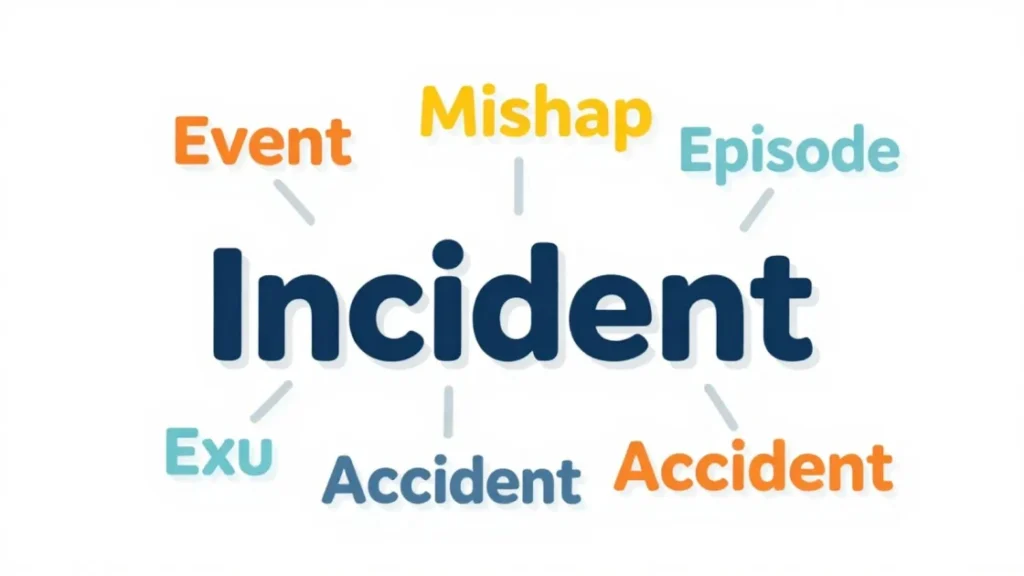
Have you ever written a story or email and found yourself overusing the word incident? Maybe you wanted a fresh way to describe an event or a happening without sounding repetitive. That’s exactly why knowing the synonyms of incident is so valuable.
In simple terms, an incident is something that happens, usually something noteworthy or unusual. It could be a small mishap, an accident, or even a minor event.
Understanding its synonyms helps students, bloggers, freelancers, and daily English users make writing more varied and engaging.
By learning these words, you can easily describe experiences, accidents, or events in your essays, blogs, or social media captions.
This guide will clearly explain synonyms of incident, give practical examples, and show how to use them naturally in everyday writing.
Featured Snippet Definition
What Is the Definition of “Incident”?
- Incident – an event or occurrence, often unexpected or unusual.
- Incident – a minor event that may cause trouble or interest.
- Incident – something that happens in a specific situation or context.
Example:
- A small incident occurred at the park.
- The teacher handled the classroom incident quickly.
Contextual Usage
When and How to Use “Incident”
The word incident is used in writing, emails, blogs, and conversation when referring to events, accidents, or noteworthy occurrences.
Practical examples:
- In blogging: “This recent incident sparked a lot of discussion online.”
- In student writing: “The science lab incident taught us an important lesson.”
- In daily conversation: “Did you hear about the traffic incident on Main Street?”
Tip:
👉 Use incident for events that are noticeable or significant, not for everyday, routine actions.
📘 50 Synonyms of Event (With Meaning + Example)
| Synonym | Meaning | Example |
|---|---|---|
| Event | Something that happens | The concert was a big event. |
| Occurrence | Instance of happening | The occurrence surprised us. |
| Happening | Something that takes place | A strange happening occurred. |
| Episode | Part of a sequence | That episode was memorable. |
| Incident | Notable occurrence | The incident was reported. |
| Occasion | Special event | The wedding was a joyful occasion. |
| Affair | Public or notable matter | It became a public affair. |
| Case | Specific situation | The case needs attention. |
| Situation | Condition of events | It’s a difficult situation. |
| Circumstance | Surrounding condition | Under these circumstances, wait. |
| Experience | Something lived through | It was a great experience. |
| Adventure | Exciting event | The trip was an adventure. |
| Encounter | Meeting or event | I had a strange encounter. |
| Confrontation | Conflict event | The confrontation was tense. |
| Outbreak | Sudden occurrence | The outbreak spread quickly. |
| Accident | Unexpected mishap | A minor accident happened. |
| Mishap | Small mistake or accident | A mishap delayed us. |
| Development | New event or progress | A new development occurred. |
| Proceeding | Formal event | Court proceedings began. |
| Ceremony | Formal occasion | The ceremony was beautiful. |
| Function | Organized event | The school function was fun. |
| Gathering | Group meeting | A family gathering took place. |
| Celebration | Joyful event | The celebration lasted hours. |
| Festivity | Festival or celebration | Festivities filled the town. |
| Milestone | Important event | Graduation is a milestone. |
| Turn | Change of events | The story took a turn. |
| Twist | Unexpected change | The plot twist shocked us. |
| Development | Progress or change | The development was positive. |
| Case study | Specific example event | The case study was useful. |
| Instance | Specific occurrence | This is a rare instance. |
| Manifestation | Visible event | The issue is a manifestation. |
| Phenomenon | Observable event | It’s a natural phenomenon. |
| Incident case | Specific happening | The incident case is noted. |
| Occurrence case | Particular event | This occurrence case matters. |
| Scenario | Possible event situation | Consider this scenario. |
| Eventuality | Possible event | Prepare for any eventuality. |
| Sequence | Series of events | The sequence was confusing. |
| Chain | Linked events | A chain of events followed. |
| Passage | Event over time | The passage of events matters. |
| Phase | Stage of event | This phase is critical. |
| Step | Part of process | This step is important. |
| Moment | Short event | It was a proud moment. |
| Point | Specific moment | At that point, we left. |
| Occasion event | Special happening | It was a rare occasion event. |
| Gathering event | Social meeting | The gathering event was fun. |
| Public event | Open event | A public event is planned. |
| Social event | Community gathering | It was a social event. |
| Major event | Important happening | This is a major event. |
| Minor event | Small happening | It was a minor event. |
| Turning point | Critical event | It became a turning point. |
📊 Categorized Synonym Clusters – Event
| Category | Words |
|---|---|
| Formal | Occurrence, Episode, Affair, Circumstance, Proceeding |
| Informal | Happening, Adventure, Encounter, Mishap, Gathering |
| Academic | Situation, Experience, Incident, Phenomenon, Instance |
| Technical | Accident, Outbreak, Development, Scenario, Sequence |
🔁 Antonyms of Event
| Antonym | Meaning | Example |
|---|---|---|
| Routine | Normal, expected | School is routine. |
| Regularity | Usual pattern | Life follows regularity. |
| Stability | No sudden change | The system shows stability. |
| Normality | Ordinary state | Life returned to normality. |
| Predictability | Easy to expect | The results show predictability. |
| Calm | No disturbance | The night was calm. |
| Order | Organized state | Everything is in order. |
| Peace | No conflict | The region enjoys peace. |
| Consistency | Unchanging pattern | His work shows consistency. |
| Regular | Happens often | His visits are regular. |
Comparison Section
- Incident vs Event – Incident is often unexpected; event can be planned.
Example: A car incident happened. / The concert event was scheduled. - Incident vs Mishap – Mishap is usually minor or accidental; incident can be serious.
Example: Kitchen mishap burned the toast. / Train incident delayed travel. - Incident vs Episode – Episode fits in a series; incident can be standalone.
Example: Last TV episode was exciting. / The street incident caused chaos. - Incident vs Experience – Experience focuses on personal involvement; incident is the occurrence.
Example: Her experience in Paris was great. / The minor incident shocked her. - Incident vs Accident – Accident is unplanned and negative; incident can be neutral or positive.
Example: Car accident damaged the vehicle. / A small incident occurred at school.
Examples of “Incident” in Everyday Sentences
- A traffic incident blocked the highway.
- The school handled the playground incident quickly.
- A minor incident occurred during the trip.
- The police reported the incident to the public.
- She wrote about the incident in her blog.
Examples of Use in Phrases
- Report an incident
- Handle the incident carefully
- Prevent workplace incidents
- Minor incident at school
- Unexpected incident on the road
FAQs
- What is an incident in simple words?
An incident is something that happens, often unexpected or unusual. - What are some common synonyms of incident?
Event, occurrence, mishap, episode, adventure, or accident. - Can incident be positive?
Yes, not all incidents are negative; some are neutral or exciting events. - How do I use incident in writing?
Use it for noteworthy events, accidents, or occurrences in essays, blogs, or reports. - What is the difference between incident and accident?
Accidents are unplanned and often negative, while incidents can be neutral or positive.
Mini Vocabulary Growth Section
Learning the synonyms of incident helps you:
- Improve writing and speaking
- Make blogs and content more engaging
- Strengthen communication and vocabulary authority
👉 The more synonyms you know, the easier it is to describe events clearly and creatively.
Conclusion
Mastering the synonyms of incident opens up a world of expressive writing.
If you’re drafting emails, essays, blogs, or social media posts, these alternatives help you avoid repetition and make your language vibrant.
Start practicing today replace one word in a paragraph with a synonym, and see how your writing improves.
Over time, your ability to describe events with precision and creativity will grow, boosting your confidence in English every day.
Keep exploring these synonyms and watch your vocabulary expand naturally!

Hi, I’m Camron White, a word lover who enjoys exploring the beauty of the English language. I write about synonyms, meanings, and everyday vocabulary to help readers express themselves more clearly and confidently. My goal is to make learning new words simple, fun, and useful in real-life conversations. synonympilot.com