Your friend shows you a photo from their weekend trip and says, “This place was perfect.” You smile and reply, “Wow, it looks flawless!” Then later, describing a meal, you say, “That pasta was absolutely exquisite.”
Same general idea something was excellent but each word adds a slightly different flavor to how you express it.
“Perfect” is one of those words we reach for constantly, sometimes without even realizing how often we repeat it. Once you learn its alternatives, your descriptions become richer and far more interesting.
What Does “Perfect” Mean?
“Perfect” describes something that has no flaws, mistakes, or faults something that is exactly right or as good as it can possibly be. It can describe objects, people, situations, performances, or experiences. It is a strongly positive word that works in nearly every type of conversation.
Meaning, Tone, and Context
At its core, “perfect” means flawless or exactly right for the situation. The tone is overwhelmingly positive, enthusiastic, and often emotional. It works comfortably in casual conversation, creative writing, marketing, and personal expression.
“Perfect” sounds most natural in everyday speech and informal writing “this is perfect,” “you’re perfect for the role,” “perfect timing.” In academic or professional writing, however, “perfect” can sound too absolute or even slightly unrealistic, since very few things are genuinely without flaw. In those contexts, words like “ideal,” “optimal,” or “exemplary” often communicate excellence with more credibility and precision.
“Perfect” also carries a strong emotional charge. Saying “this moment was perfect” expresses genuine feeling, not just a factual description which is part of why it appears so often in personal writing, social media captions, and conversation.
When and How to Use “Perfect”
Use “perfect” when you want to express strong approval, satisfaction, or a sense that something matches an ideal completely. It works especially well in emotional or enthusiastic contexts.
Here are natural examples:
- “The weather was perfect for a picnic.” (casual, descriptive)
- “She gave a perfect performance at the recital.” (admiring, emotional)
- “This is the perfect opportunity to apply what we learned.” (professional, situational)
- “He’s not perfect, but he tries his best every day.” (personal, emotional)
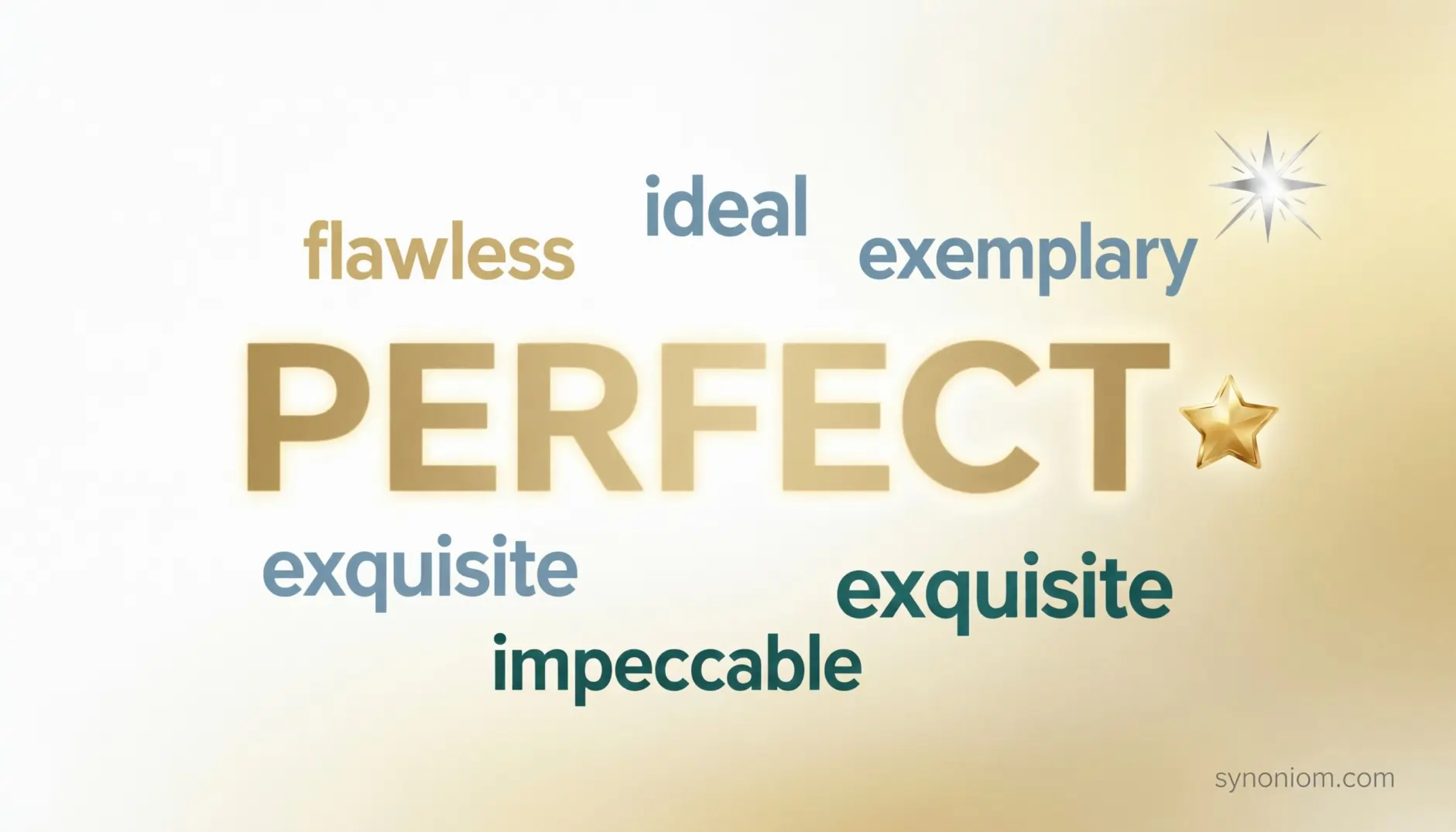
However, when your writing calls for more precision or a less absolute tone, a synonym works better. “Ideal” suggests something fits a standard well without claiming flawlessness. “Exemplary” highlights excellence as a model for others. “Flawless” emphasizes the complete absence of errors, which suits technical or performance based descriptions.
50 Synonyms for “Perfect”
| Synonym | Simple Meaning | Example Sentence |
|---|---|---|
| Flawless | Without any mistakes or imperfections | Her flawless performance earned a standing ovation. |
| Ideal | Exactly what is needed or wanted | This apartment is ideal for remote work. |
| Exemplary | Serving as an excellent example | His exemplary work ethic impressed the team. |
| Impeccable | Perfect in every detail | She has impeccable manners. |
| Faultless | Completely without errors or defects | The translation was faultless from start to finish. |
| Excellent | Extremely good; very high quality | The customer service was excellent. |
| Superb | Outstandingly good or impressive | The chef prepared a superb meal. |
| Exquisite | Extremely beautiful or finely made | The exquisite detail amazed every visitor. |
| Optimal | The best possible under the circumstances | This is the optimal time to launch the campaign. |
| Pristine | In perfect original condition | The vintage car remained pristine. |
| Immaculate | Perfectly clean or orderly | Her office was immaculate. |
| Polished | Refined and smooth | The final presentation felt polished. |
| Spotless | Completely clean | The kitchen was spotless after cleaning. |
| Unblemished | Without marks or flaws | His reputation remained unblemished. |
| Textbook | A perfect example | That was a textbook landing. |
| Outstanding | Exceptionally good | The students delivered an outstanding presentation. |
| Top-notch | Of the highest quality | The mechanic did a top-notch job. |
| First-rate | Among the very best | The hotel offered first-rate service. |
| Sublime | Deeply impressive or beautiful | The mountain view was sublime. |
| Supreme | Highest in quality or degree | Her supreme attention to detail stood out. |
| Unrivaled | Better than all others | His expertise is unrivaled. |
| Peerless | Without equal | Her talent is peerless. |
| Matchless | Beyond comparison | The scenery was matchless. |
| Consummate | Showing complete skill and mastery | She is a consummate professional. |
| Masterful | Demonstrating great expertise | The artist gave a masterful performance. |
| Dead on | Exactly correct (informal) | Your prediction was dead on. |
| Spot on | Precisely accurate | Her analysis was spot on. |
| Idyllic | Extremely peaceful and pleasant | They enjoyed an idyllic holiday. |
| Heavenly | Wonderfully enjoyable | The dessert tasted heavenly. |
| Divine | Extremely pleasing | The aroma was divine. |
| Pure | Complete and free from flaws | It was a moment of pure happiness. |
| Complete | Having everything needed | The collection is now complete. |
| Whole | Entire and undamaged | She finally felt whole again. |
| Right | Exactly suitable or correct | This is the right solution. |
| Apt | Exactly appropriate | His comment was an apt observation. |
| Fitting | Appropriate for the occasion | The tribute was a fitting conclusion. |
| Suited | Well matched to a purpose | The role is perfectly suited to her skills. |
| Untarnished | Not damaged in quality or reputation | His record remained untarnished. |
| Mint condition | As good as new | The comic book was in mint condition. |
| A perfect ten | The highest possible rating | The judges awarded a perfect ten. |
| Crystal clear | Completely clear and understandable | The instructions were crystal clear. |
| Picture-perfect | Visually flawless | The garden looked picture-perfect. |
| Word-perfect | Exactly correct from memory | She delivered the speech word-perfect. |
| Letter-perfect | Completely accurate in every detail | His pronunciation was letter-perfect. |
| Tip-top | In excellent condition | The equipment is in tip-top shape. |
| Stellar | Exceptionally impressive | The team delivered a stellar performance. |
| Gold standard | The best example of quality | The software is the industry’s gold standard. |
| Magnificent | Impressively excellent | The palace was magnificent. |
| Phenomenal | Remarkably outstanding | Sales growth this year was phenomenal. |
| Exceptional | Unusually excellent | She showed exceptional leadership skills. |
Important Synonym Groups
Formal Synonyms
Best for academic writing, official reports, and professional documents:
exemplary, optimal, consummate, impeccable, unrivaled, peerless, faultless
Informal Synonyms
Natural in everyday conversation, social media, and casual writing:
top notch, spot on, dead on, heavenly, divine, tip top, mint condition
Academic Synonyms
Appropriate for essays, research, and scholarly analysis:
exemplary, optimal, consummate, unrivaled, faultless, peerless
Professional Synonyms
Work well in business writing, performance reviews, and workplace communication:
exemplary, first rate, polished, outstanding, top notch, masterful, gold standard
Emotional Synonyms
Carry deep feeling and suit personal or descriptive writing:
sublime, idyllic, heavenly, divine, pure, whole, picture perfect
Conversational Synonyms
Fit naturally in spoken English and casual writing:
spot on, dead on, top notch, textbook, tip top, a perfect ten
Slang / Very Informal
Found in casual speech and social media:
heavenly, divine, mint condition, a perfect ten, on point
Antonyms of Perfect
| Antonym | Meaning | Example |
|---|---|---|
| Flawed | Having faults or imperfections | The original design was flawed and needed major revisions. |
| Imperfect | Not perfect; having faults | Even imperfect plans can succeed with the right effort. |
| Defective | Having a fault that prevents proper functioning | The store replaced the defective product immediately. |
| Mediocre | Average or below-average in quality | The food at the new restaurant was disappointingly mediocre. |
| Inadequate | Not good enough for the purpose | The training provided was inadequate for the new system. |
| Subpar | Below an acceptable standard | The hotel room was subpar compared to what was advertised. |
| Lacking | Missing something necessary | The proposal was lacking in concrete details. |
| Faulty | Containing errors or defects | A faulty wire caused the entire system to shut down. |
Comparison:
Perfect vs. Related Words
These words often substitute for “perfect,” but each carries a slightly different shade of meaning, formality, or emotional tone.
Perfect vs. Ideal
“Ideal” suggests something is exactly right for a particular purpose, without necessarily claiming it has zero flaws. “This is the ideal location for the office” means it fits the needs perfectly, even if the building itself has minor issues. “Perfect” is more absolute it implies nothing could be better in any way. “Ideal” sounds more measured and realistic, especially in professional contexts.
Perfect vs. Flawless
“Flawless” focuses specifically on the absence of mistakes or defects often used for performances, skin, technical work, or execution. “A flawless presentation” means no errors occurred. “A perfect presentation” could also mean the content, timing, and delivery were all exactly right a broader judgment. “Flawless” is more technical; “perfect” is more emotional and general.
Perfect vs. Exemplary
“Exemplary” means something serves as an excellent model for others to follow it carries an instructional quality. “Her exemplary behavior set the standard for the rest of the team” suggests others should learn from it. “Perfect” simply describes quality without that instructional element. “Exemplary” sounds more formal and is common in professional evaluations and academic writing.
Perfect vs. Excellent
“Excellent” is strong praise but does not claim total flawlessness. Something excellent is very good, but there might still be small areas for improvement. “Perfect” claims there is nothing to improve at all. “Excellent” feels more achievable and realistic, which makes it common in professional feedback and reviews.
Perfect vs. Optimal
“Optimal” is a more technical, analytical word meaning the best possible option given specific conditions or constraints. “The optimal solution given our budget” acknowledges limitations. “Perfect” suggests an absolute best without considering constraints. “Optimal” fits business, scientific, and academic writing far better than “perfect,” which can sound too idealistic in those contexts.
Common Phrases and Expressions
“Practice makes perfect” repeated effort and practice lead to improvement and mastery over time.
Example: “She struggled with the piece at first, but practice makes perfect, and now she plays it beautifully.”
“Nobody’s perfect” everyone has flaws, and that is normal and acceptable.
Example: “Don’t be too hard on yourself for the mistake nobody’s perfect.”
“Perfect timing” something happens at exactly the right moment.
Example: “You called just as I was about to leave perfect timing!”
“A perfect match” two things or people that go together exceptionally well.
Example: “Their skills and personalities make them a perfect match for this project.”
“Picture perfect” so visually pleasing it looks like a photograph or scene from a film.
Example: “The little village looked picture perfect covered in fresh snow.”
“In perfect harmony” working or existing together smoothly and without conflict.
Example: “The team worked in perfect harmony to meet the tight deadline.”
Common Mistakes to Avoid
Using “perfect” too literally in professional writing:
Claiming something is “perfect” in a report or review can sound unrealistic or even untrustworthy, since almost nothing is truly without flaw. “Exemplary,” “excellent,” or “highly effective” sound more credible and professional.
Confusing “ideal” with “perfect”:
“Ideal” describes the best fit for a specific purpose, not an absolute standard. Saying “the ideal candidate” does not mean a flawless person it means someone who fits the role exceptionally well. Mixing these up can create unrealistic expectations.
Overusing “perfect” in casual writing:
When everything from a sandwich to a vacation to a haircut is “perfect,” the word starts to feel meaningless. Mixing in “lovely,” “fantastic,” “spot on,” or “ideal” keeps your descriptions feeling genuine rather than exaggerated.
Using “flawless” for things that involve judgment, not just execution:
“Flawless” works best for technical accuracy a flawless performance, a flawless translation. Using it for subjective things like “a flawless personality” can sound odd, since personality involves opinion, not measurable correctness.
Treating “exemplary” as interchangeable with “perfect” in casual speech:
“Exemplary” sounds formal and slightly stiff in everyday conversation. Saying “this pizza is exemplary” sounds unnatural. Save “exemplary” for behavior, performance, or work in more formal contexts.
FAQs
What is the most professional synonym for “perfect” in a performance review?
A: “Exemplary,” “outstanding,” and “first rate” all work very well. “Her exemplary attention to detail consistently exceeds expectations” sounds professional, specific, and credible far more than simply saying someone’s work is “perfect.”
Is “flawless” stronger than “perfect”?
A: They are very close, but “flawless” focuses specifically on the absence of errors, while “perfect” is broader and can include emotional or subjective judgments. “A flawless routine” emphasizes technical execution. “A perfect day” includes feelings, atmosphere, and overall experience.
What is the difference between “perfect” and “ideal” when describing a job candidate?
A: “Ideal candidate” means someone who fits the role’s specific requirements extremely well. “Perfect candidate” suggests they have no weaknesses at all, which can sound unrealistic. “Ideal” is the more commonly used and more credible choice in hiring contexts.
Can “perfect” be used sarcastically?
A: Yes, very often. “Oh, perfect, now we’re locked out” uses “perfect” to express frustration, not approval. The tone of voice and context make the sarcastic meaning clear, and this usage is extremely common in everyday English.
What is a good synonym for “perfect” when describing weather or scenery?
A: “Idyllic,” “picture perfect,” and “sublime” all work beautifully for weather and scenery. “Idyllic” suits peaceful, charming settings. “Picture perfect” suits visually stunning scenes. “Sublime” suits deeply moving, almost overwhelming natural beauty.
Conclusion
“Perfect” carries so much enthusiasm and positivity that it’s no wonder we reach for it constantly but that also means it can lose its impact through overuse.
With fifty alternatives at your fingertips, you can match your words more precisely to what you actually mean, whether that’s flawless execution, an ideal fit, or a deeply emotional moment.
Try picking out a few words this week maybe “ideal” for describing what suits a situation, “exemplary” for praising someone’s work, and “idyllic” for describing a beautiful place. Use them in conversations, emails, or writing, and notice how each one shifts the feeling of your sentence slightly.
Vocabulary grows through use, not memorization, so the more naturally you weave these words into daily life, the more they’ll become part of how you express yourself.

Hi, I’m Theo John, a passionate word explorer who loves diving into the beauty of the English language. I write about synonyms, word meanings, and practical vocabulary tips to help readers communicate with confidence. synonympilot.com