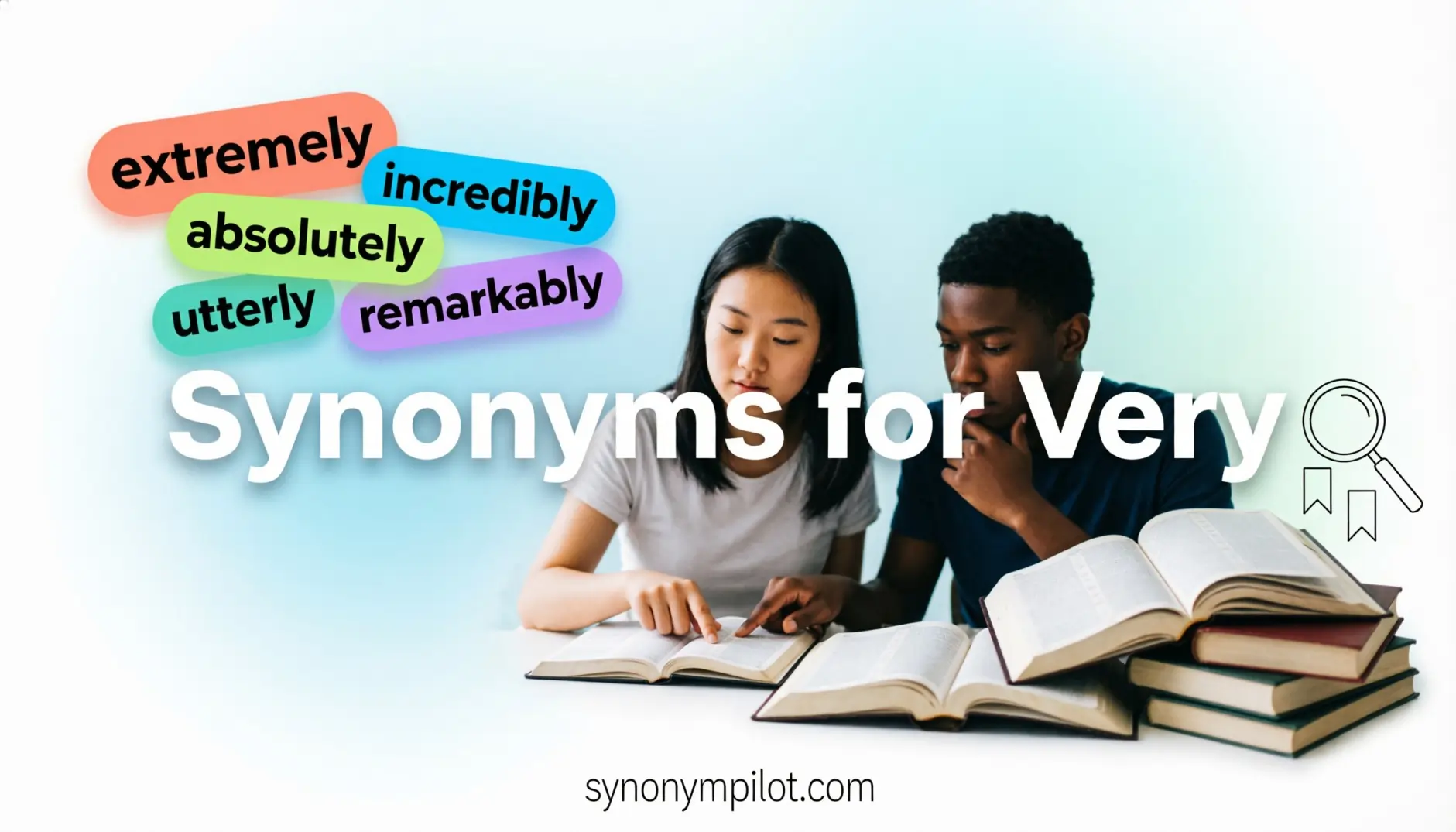
Do you use the word “very” all the time?
Maybe you say:
- “very happy”
- “very tired”
- “very good”
- “very big”
There’s nothing wrong with using “very,” but repeating it too often can make your English sound basic or repetitive. Native speakers usually replace “very + adjective” with stronger and more specific words.
For example:
- “very tired” → “exhausted”
- “very happy” → “thrilled”
- “very small” → “tiny”
Learning better alternatives helps you sound more natural, confident, and fluent in conversations, writing, school assignments, emails, and social media posts.
In this guide, you’ll learn useful synonyms for “very,” how to use them correctly, common mistakes to avoid, and real life examples that are easy to understand.
Featured Snippet Definition
The phrase “synonyms for very” refers to stronger or more descriptive words that replace “very + adjective” combinations.
Instead of saying “very cold,” you can say “freezing.” Instead of “very funny,” you can say “hilarious.” These alternatives make your English clearer, more natural, and more expressive.
Meaning, Tone & Context
What Does “Very” Mean?
“Very” is an intensifier. It adds strength or emphasis to an adjective or adverb.
Examples:
- very fast
- very smart
- very loud
It tells the listener or reader that something is stronger than normal.
Tone of the Word “Very”
The word “very” is:
- neutral
- common
- beginner friendly
- conversational
- acceptable in formal and informal English
However, advanced English speakers often avoid repeating it too much because stronger vocabulary sounds more polished.
Where “Very” Sounds Natural
You can use “very” in:
- daily conversation
- text messages
- emails
- essays
- business communication
- school assignments
Examples:
- “I’m very busy today.”
- “The movie was very interesting.”
- “She speaks English very clearly.”
When & How to Use “Very”
Use “very” when you want to increase the intensity of something.
In Conversations
- “I’m very hungry.”
- “That was very kind of you.”
- “Your room is very clean.”
In Writing
- “The results were very surprising.”
- “The teacher gave very helpful feedback.”
In Professional Communication
- “We are very pleased with the project.”
- “The meeting was very productive.”
In Online Communication
- “This video is very useful.”
- “I’m very excited for the event!”
Although these sentences are correct, replacing “very” with stronger words often improves style.
Examples:
- very useful → valuable
- very excited → thrilled
- very productive → efficient
Synonyms for “Very”
| Synonym | Simple Meaning | Example Sentence |
|---|---|---|
| Extremely | To a very high degree | “The test was extremely difficult.” |
| Highly | Very much | “She is highly skilled.” |
| Really | Truly or very | “I’m really tired today.” |
| So | To a great degree | “The movie was so funny.” |
| Totally | Completely | “I totally agree with you.” |
| Absolutely | Fully or completely | “The food was absolutely amazing.” |
| Truly | Honestly or genuinely | “He was truly grateful.” |
| Deeply | Strongly emotionally | “She was deeply upset.” |
| Exceptionally | Unusually | “He is exceptionally talented.” |
| Remarkably | Surprisingly | “The team performed remarkably well.” |
| Particularly | Especially | “This lesson is particularly useful.” |
| Seriously | Strongly | “I’m seriously confused.” |
| Incredibly | Extremely | “The book was incredibly interesting.” |
| Terribly | Extremely | “I’m terribly sorry.” |
| Awfully | Very | “It’s awfully cold outside.” |
| Hugely | Greatly | “The app became hugely popular.” |
| Greatly | Considerably | “Your support is greatly appreciated.” |
| Intensely | Strongly | “She was intensely focused.” |
| Immensely | Extremely | “I immensely enjoyed the trip.” |
| Tremendously | Very greatly | “Sales increased tremendously.” |
| Excessively | Too much | “He talks excessively.” |
| Extraordinarily | Unusually great | “She is extraordinarily creative.” |
| Supremely | To the highest level | “The actor was supremely confident.” |
| Entirely | Completely | “I entirely understand your point.” |
| Especially | More than usual | “I especially liked the ending.” |
| Mighty | Very (informal) | “That’s mighty kind of you.” |
| Real | Very (casual speech) | “The test was real hard.” |
| Super | Extremely | “She’s super friendly.” |
| Ultra | Extremely | “This phone is ultra fast.” |
| chaotic | Extremely (slang) | “That game was chaotic fun.” |
| Ridiculously | Extremely | “The bag was ridiculously expensive.” |
| Wildly | Extremely | “The show became wildly successful.” |
| Dead | Completely (informal British English) | “I’m dead tired.” |
| Fully | Completely | “We fully support the decision.” |
| Strongly | Firmly | “I strongly recommend this book.” |
| Quite | Fairly or very | “The exam was quite easy.” |
| Unusually | Not normally | “The weather is unusually warm.” |
| Massively | Greatly | “The company grew massively.” |
| Profoundly | Deeply | “He was profoundly affected.” |
| Considerably | By a large amount | “Prices increased considerably.” |
| Enormously | Extremely | “The athlete is enormously talented.” |
| Fantastically | In a wonderful way | “The event was fantastically organized.” |
| Wonderfully | Extremely well | “She sings wonderfully well.” |
| Badly | Very much | “I badly need a vacation.” |
| Dreadfully | Extremely | “The room was dreadfully hot.” |
| Overly | Too much | “He’s overly sensitive.” |
| Fiercely | Strongly | “They are fiercely competitive.” |
| Utterly | Completely | “I was utterly shocked.” |
| Perfectly | Completely | “That’s perfectly fine.” |
Important Synonym Groups
Formal Alternatives
These work well in essays, academic writing, and business communication.
- extremely
- highly
- exceptionally
- remarkably
- considerably
- tremendously
- profoundly
Example:
- “The research was exceptionally detailed.”
Informal Alternatives
These sound natural in everyday conversation.
- really
- so
- super
- totally
- chaotic
Example:
- “That restaurant is super popular.”
Academic Alternatives
Useful for reports, presentations, and formal analysis.
- significantly
- particularly
- remarkably
- substantially
- notably
Example:
- “Student performance improved significantly.”
Professional Alternatives
Common in workplace communication.
- highly
- greatly
- strongly
- especially
- fully
Example:
- “We highly appreciate your feedback.”
Emotional Alternatives
These express strong feelings.
- deeply
- intensely
- profoundly
- truly
- terribly
Example:
- “She was deeply disappointed.”
Conversational Alternatives
Natural for daily speaking.
- really
- so
- super
- pretty
- quite
Example:
- “I’m pretty busy right now.”
Slang Alternatives
Mostly used online or casually with friends.
- chaotic
- wildly
- ridiculously
- wildly
Example:
- “That concert was wildly good.”
Antonyms of “Very”
| Antonym | Meaning | Example |
|---|---|---|
| Slightly | A little | “I’m slightly tired.” |
| Barely | Almost not | “He barely noticed the mistake.” |
| Hardly | Almost not | “She hardly speaks in meetings.” |
| Somewhat | To some degree | “The movie was somewhat interesting.” |
| Moderately | Fairly | “The weather is moderately warm.” |
| Partly | Not completely | “The road is partly closed.” |
| Little | Small amount | “I have little interest in sports.” |
| Minimally | Very slightly | “The design changed minimally.” |
| Scarcely | Almost not | “We scarcely had enough time.” |
| Faintly | Weakly | “I could faintly hear music.” |
Comparison Section
“Very” vs “Extremely”
“Extremely” is stronger and more formal than “very.”
- “The room is very cold.”
- “The room is extremely cold.”
Use “extremely” when you want stronger emphasis.
“Very” vs “Really”
“Really” sounds more conversational.
- “I’m very happy.”
- “I’m really happy.”
Both are common, but “really” feels more natural in casual speech.
“Very” vs “Too”
“Too” means more than necessary and often has a negative meaning.
- “The bag is very heavy.” → just strong emphasis
- “The bag is too heavy.” → impossible or difficult to carry
“Very” vs “So”
“So” often adds emotion or excitement.
- “The movie was very funny.”
- “The movie was so funny!”
“So” sounds more expressive in conversation.
“Very” vs Strong Adjectives
| Very + Adjective | Better Word | Example Sentence |
|---|---|---|
| Very tired | Exhausted | “After work, I was exhausted.” |
| Very hungry | Starving | “We were starving after the trip.” |
| Very small | Tiny | “She found a tiny key.” |
| Very big | Huge | “They live in a huge house.” |
| Very funny | Hilarious | “The movie was hilarious.” |
| Very scared | Terrified | “He felt terrified during the storm.” |
| Very smart | Brilliant | “She’s a brilliant student.” |
| Very angry | Furious | “The customer was furious.” |
| Very clean | Spotless | “The kitchen looked spotless.” |
| Very bad | Awful | “The weather was awful yesterday.” |
Common Phrases & Expressions
Very well
Meaning: In a good or successful way
Example:
- “She speaks English very well.”
Very much
Meaning: A lot
Example:
- “Thank you very much.”
Very soon
Meaning: In a short time
Example:
- “I’ll call you back very soon.”
Very often
Meaning: Frequently
Example:
- “We don’t eat fast food very often.”
Very likely
Meaning: Probably
Example:
- “It’s very likely to rain tonight.”
Very few
Meaning: A small number
Example:
- “Very few people knew the answer.”
Very little
Meaning: A small amount
Example:
- “I had very little free time this week.”
Common Mistakes to Avoid
Using “Very” Too Often
Incorrect style:
- “The movie was very good and very funny and very exciting.”
Better:
- “The movie was exciting, hilarious, and excellent.”
Using “Too” Instead of “Very”
Incorrect:
- “I’m too happy today.”
Correct:
- “I’m very happy today.”
Use “too” for negative excess.
Mixing Formal and Slang Vocabulary
Avoid using slang in professional writing.
Too casual:
- “The presentation was chaotic good.”
Professional:
- “The presentation was exceptionally good.”
Repeating Weak Adjectives
Instead of:
- very nice
- very bad
- very big
Use stronger words:
- wonderful
- terrible
- enormous
FAQs
What is a better word for “very”?
It depends on the context. Words like “extremely,” “highly,” “really,” and “absolutely” are common alternatives. Sometimes one strong adjective works even better.
Is it wrong to use “very” in English?
No. “Very” is a correct and common English word. However, using stronger vocabulary can make your speaking and writing sound more natural and advanced.
What can I say instead of “very good”?
You can say:
- excellent
- amazing
- outstanding
- fantastic
- impressive
What is the difference between “very” and “really”?
Both add emphasis. “Really” sounds more conversational, while “very” sounds slightly more neutral and formal.
Why do teachers tell students to avoid “very”?
Teachers often encourage students to use stronger vocabulary because it improves clarity, style, and writing quality.
Conclusion
The word “very” is useful, simple, and common in everyday English. But learning stronger alternatives can make your vocabulary richer and your communication more engaging.
Instead of always saying “very happy” or “very tired,” try using words like “thrilled” or “exhausted.” Small vocabulary improvements can make a big difference in conversations, writing, emails, and school work.
The best way to improve is through daily practice. Read more, notice how native speakers express emphasis, and try replacing “very” with stronger words whenever possible. Over time, your English will sound more confident, natural, and expressive.

Hi, I’m Theo John, a passionate word explorer who loves diving into the beauty of the English language. I write about synonyms, word meanings, and practical vocabulary tips to help readers communicate with confidence. synonympilot.com