Quick Answer
“Wonderful” means extremely good, impressive, or pleasing something that fills you with delight, admiration, or a sense of something beyond the ordinary. It describes people, places, experiences, and moments that stand out positively and leave a strong impression.
The word carries a warm, enthusiastic tone and works in both everyday conversation and personal writing. You come home from a weekend trip and a colleague asks how it was. You say, “It was absolutely wonderful.”
Everyone knows exactly what you mean something genuinely good happened, something that exceeded expectations and left you feeling happy and full. But what if you are writing a travel article about that same trip, and you have already used “wonderful” twice in the opening paragraph?
Or you are writing a professional recommendation and want to describe a colleague’s performance with more precision and weight? Knowing the right synonym for the right moment is what separates forgettable writing from writing that actually stays with people.
Meaning, Tone, and Context
“Wonderful” combines two ideas: something is very good, and it fills you with a sense of wonder or delight. Originally, the word meant something worthy of wonder almost miraculous. Today, it functions as a strong general term of praise and admiration, though it has softened slightly from its original intensity.
The tone is warm, enthusiastic, and emotionally positive. “Wonderful” suits personal writing, conversation, travel writing, reviews, speeches, thank you messages, and creative stories. It sounds most natural when the emotion behind the praise is genuine and the context is personal or descriptive.
In very formal or academic writing, “wonderful” can occasionally sound too casual or gushing in those contexts, “remarkable,” “exceptional,” or “outstanding” carry more measured credibility. In professional performance reviews, “wonderful” may feel slightly informal compared to “excellent” or “exceptional.” However, in most everyday writing and conversation, “wonderful” is a perfectly strong and natural choice.
When and How to Use “Wonderful”
Use “wonderful” when you want to express genuine admiration or delight when something made you feel that life is good, that people are capable of great things, or that an experience exceeded what you hoped for.
Here are natural everyday uses:
- “We had a wonderful time at the festival the food, the music, everything was perfect.”
- “She gave a wonderful performance that moved half the audience to tears.”
- “It is wonderful to see how much he has grown as a writer over the past year.”
- “The volunteers did wonderful work throughout the entire three day event.”
Notice that “wonderful” always points toward something genuinely positive and worth celebrating. It suits occasions where simple praise like “good” or “nice” would feel inadequate, but where intensely formal language like “exceptional” might feel stiff.
Another Word for Wonderful
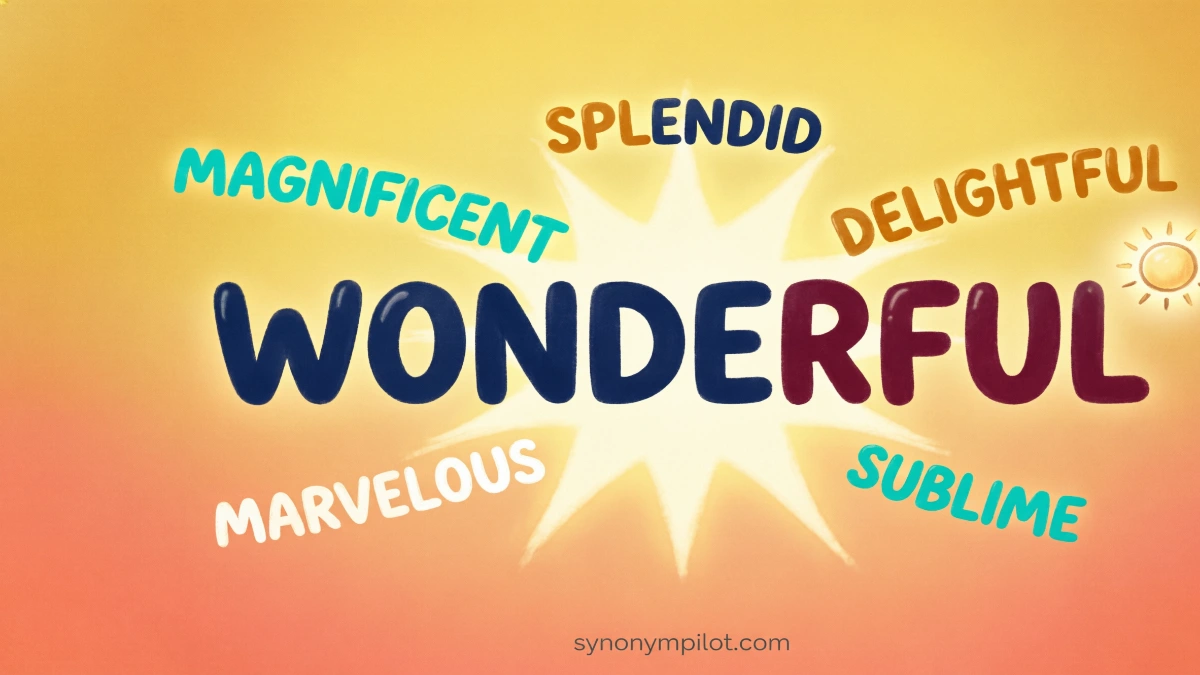
The most natural and commonly used synonyms for “wonderful” are magnificent, marvelous, splendid, superb, and delightful. “Magnificent” adds grandeur and visual scale. “Marvelous” is close in tone but slightly more old fashioned and British in flavor. “Splendid” is formal and warm simultaneously. “Superb” carries professional credibility. “Delightful” captures genuine pleasure without overwhelming the moment. Together these give you a range from formal to warm across every writing context.
When Not to Use This Word
Avoid “wonderful” in formal academic writing, legal documents, scientific reports, or very serious professional contexts it sounds too emotionally warm for those registers. Also, do not reach for “wonderful” when what you actually need is a more specific word: was the food delicious? Was the performance technically brilliant? Was the person kind and thoughtful? A more precise word always serves your reader better than a general term of praise.
Additionally, overusing “wonderful” across a single piece of writing dulls its impact significantly. Like all praise words, it loses power through repetition which is precisely why this vocabulary matters.
Words Commonly Confused With Wonderful
“Wonderful” and “amazing” are frequently treated as identical, but they carry slightly different emphases. “Amazing” focuses on surprise and the degree to which something surpasses expectation it carries more shock. “Wonderful” focuses on the feeling of delight and admiration the experience creates. Both are enthusiastic, but “wonderful” is warmer and “amazing” is more surprised.
“Magnificent” and “wonderful” overlap, but “magnificent” carries a specific visual grandeur it describes things on a large, impressive scale. A person can be wonderful; a cathedral is more naturally magnificent. The distinction is subtle but worth knowing in precise writing.
“Marvelous” and “wonderful” are almost interchangeable in meaning, but “marvelous” has a slightly old fashioned or British English flavor that makes it feel more formal or literary in American contexts.
Best Synonym by Context
| Context | Best Synonym | Why It Works Best |
|---|---|---|
| Academic Essay | Remarkable / Exceptional | Formal, precise, and credible |
| Performance Review | Excellent / Outstanding | Professional and measurable |
| Travel Writing | Magnificent / Breathtaking | Vivid, visual, and emotionally rich |
| Personal Letter | Delightful / Splendid | Warm, sincere, and natural |
| Creative Fiction | Sublime / Glorious | Elevated, literary, and emotionally layered |
| Social Media | Amazing / Incredible | Modern, energetic, and widely understood |
| Children’s Writing | Fantastic / Brilliant | Simple, joyful, and enthusiastic |
| Speech or Tribute | Extraordinary / Magnificent | Grand, public-facing, and memorable |
Which Synonym Should You Choose?
Think about the emotional temperature and the formality level of what you are writing. For warm personal writing and conversation, “delightful,” “splendid,” and “marvelous” feel natural and genuine. Whereas For formal professional contexts, “exceptional,” “outstanding,” and “remarkable” add credibility without losing the underlying admiration. For literary or creative writing, “sublime,” “glorious,” and “magnificent” paint the biggest, most emotionally resonant pictures. For casual modern writing and social media, “fantastic,” “amazing,” and “incredible” feel alive and current.
Real Life Examples of “Wonderful” in Sentences
School:
“The teacher told her class that the art project had produced some truly remarkable work several pieces were genuinely exhibition worthy.”
Workplace:
“The client described the team’s presentation as exceptional and said it was the most professionally delivered proposal they had seen all year.”
Writing:
“The garden in early June was glorious every bed overflowing with color, the air thick with the scent of roses warming in the afternoon sun.”
Conversation:
“You have to go the restaurant is absolutely fantastic. I cannot believe we waited so long to try it.”
Best Synonym by Context
| Context | Best Synonym | Why It Works Best |
|---|---|---|
| Academic Essay | Exceptional / Remarkable | Formal, precise, and credible |
| Business Writing | Outstanding / Excellent | Professional and results-focused |
| Performance Review | Outstanding / Stellar | Highlights achievement and excellence |
| Travel Writing | Magnificent / Breathtaking | Creates vivid visual imagery |
| Creative Writing | Sublime / Transcendent | Rich, literary, and expressive |
| Personal Letter | Delightful / Heartwarming | Warm, sincere, and natural |
| Speech or Tribute | Extraordinary / Inspiring | Powerful and memorable |
| Social Media | Amazing / Incredible | Modern, energetic, and widely understood |
| Children’s Writing | Fantastic / Magical | Simple, imaginative, and engaging |
| Food Reviews | Divine / Exquisite | Emphasizes taste and quality |
| Nature Descriptions | Radiant / Picturesque | Highlights beauty and scenery |
| Hotel & Hospitality Reviews | Charming / First-rate | Positive, polished, and trustworthy |
| Entertainment Reviews | Spectacular / Dazzling | Expresses excitement and admiration |
| Motivational Content | Inspiring / Uplifting | Encourages positivity and action |
| Luxury Products | Exquisite / Resplendent | Conveys elegance and premium quality |
| Emotional Stories | Moving / Stirring | Captures deep emotional impact |
| Formal Praise | Superb / Peerless | Strong and sophisticated approval |
| Casual Conversation | Wonderful / Fabulous | Friendly, natural, and versatile |
| Historical or Cultural Sites | Awe-inspiring / Magnificent | Reflects grandeur and significance |
| Special Experiences | Magical / Dreamy | Suggests a memorable, unique feeling |
Synonym Groups and Usage Differences
Formal and Professional Synonyms
“Exceptional,” “outstanding,” “remarkable,” “superb,” “first rate,” “peerless,” and “stellar” suit performance reviews, professional references, formal reports, and business writing. They convey genuine admiration with measured credibility that “wonderful” alone sometimes lacks in those registers.
Literary and Elevated Synonyms
“Sublime,” “resplendent,” “transcendent,” “exquisite,” “magnificent,” and “glorious” belong in creative fiction, speeches, literary essays, and personal memoirs. They carry emotional weight and visual richness each one does more than name quality, it creates a feeling.
Warm and Personal Synonyms
“Delightful,” “charming,” “heartwarming,” “idyllic,” “magical,” and “enchanting” suit personal letters, travel writing, thank you notes, and intimate conversation. They are warm without being dramatic, sincere without being stiff.
Modern and Conversational Synonyms
“Fantastic,” “amazing,” “brilliant,” “incredible,” “stunning,” and “fabulous” feel natural and alive in social media, casual emails, text messages, and everyday speech. They communicate enthusiasm immediately and are widely understood across all ages and backgrounds.
Strongest vs. Softer Synonyms
Strongest in intensity and impact: “transcendent,” “magnificent,” “sublime,” “peerless,” “awe inspiring,” “breathtaking.” Softer but still genuinely positive: “pleasant,” “delightful,” “charming,” “gratifying,” “rewarding.” Matching the intensity of your word to the actual scale of the experience keeps your language honest and effective.
Antonyms of Wonderful
| Antonym | Meaning | Example |
|---|---|---|
| Terrible | Extremely bad and unpleasant | The weather on the day of the outdoor event was absolutely terrible. |
| Dreadful | Causing great distress or disappointment | The dreadful performance received the worst reviews the theater had seen in years. |
| Awful | Very bad, unpleasant, or of poor quality | The service at the hotel was awful, slow, indifferent, and completely unacceptable. |
| Mediocre | Neither good nor bad; below what was hoped for | The sequel was mediocre at best, offering nothing new to those who had loved the original. |
| Disappointing | Failing to meet expectations | The exhibition was deeply disappointing, far smaller and less curated than the publicity had suggested. |
| Dull | Uninteresting and without energy or quality | The lecture was dull from start to finish, despite a fascinating topic. |
| Poor | Below an acceptable standard | The quality of the materials used in the renovation was poor and showed within the first year. |
| Unpleasant | Not enjoyable or agreeable | The interaction left an unpleasant impression that was hard to shake throughout the rest of the day. |
Comparison Section
Wonderful vs. Magnificent
“Magnificent” describes something on a grand, impressive scale usually visual and often large in scope. “Wonderful” is broader and more personal it describes how something made you feel as much as what it looked like. A sunset can be both, but a kind gesture is wonderful rather than magnificent.
Wonderful vs. Marvelous
These two words are very close in meaning, but “marvelous” carries a slightly more old fashioned British flavor. In American English, “marvelous” can sound a touch formal or literary. Both express enthusiastic admiration, but “wonderful” feels more universally modern and natural across all contexts and English dialects.
Wonderful vs. Fantastic
“Fantastic” is more casual and energetic it carries the enthusiasm of everyday speech. “Wonderful” has slightly more warmth and emotional depth. “Fantastic” is what you say in the moment; “wonderful” is what you say when you are reflecting on something that genuinely moved you or exceeded your expectations in a lasting way.
Wonderful vs. Sublime
“Sublime” is the most elevated of these synonyms it describes something so beautiful or impressive that it surpasses normal categories of experience. It appears in philosophical and literary writing to describe experiences that create awe beyond simple pleasure. “Wonderful” is accessible and warm; “sublime” is reserved for the genuinely transcendent.
Common Phrases and Expressions
A wonderful time
The most common collocation describes an experience that was genuinely enjoyable and fulfilling. Example: “We had a wonderful time at the reunion it felt like no time had passed at all.”
Wonderful news
Used to express delight at hearing something positive. Example: “That is wonderful news I am so happy the surgery went well.”
Work wonders
To achieve impressively good results. Example: “A few days of genuine rest can work wonders for your concentration and creativity.”
It would be wonderful if
A polite, warm way to make a request or express a hope. Example: “It would be wonderful if you could join us for the closing dinner on Friday evening.”
A wonderful opportunity
Describes a chance that is genuinely valuable and worth taking. Example: “This is a wonderful opportunity to work with a team that is genuinely leading the field.”
Simply wonderful
A phrase adding emphasis to sincere admiration. Example: “The way the whole community came together was simply wonderful generous, organized, and completely genuine.”
Common Mistakes to Avoid
Do not confuse “wonderful” with “wondrous.” Both come from the same root, but “wondrous” specifically means inspiring a sense of wonder it is more literary and old fashioned than “wonderful.” “A wondrous sight” is poetic; “a wonderful evening” is natural and modern. Using “wondrous” in everyday conversation sounds unnatural.
Avoid repeating “wonderful” across a single piece of writing. The word is so positively associated with good experiences that overusing it makes your writing feel undifferentiated and imprecise. If everything is wonderful, nothing stands out. Use synonyms deliberately to give different moments different textures.
Many learners use “wonderful” in formal professional contexts where a more precise word fits better. In a performance review, “exceptional,” “outstanding,” or “excellent” all carry more professional weight than “wonderful,” which can sound too personal or informal for that register.
Be careful with “divine” and “heavenly” both are legitimate informal synonyms for wonderful, but they carry a religious connotation for some readers and a slightly campy or theatrical tone for others. They suit food writing and casual personal contexts well but can feel out of place in more serious or formal writing.
FAQs
What is a more formal synonym for wonderful in professional writing?
“Exceptional” and “outstanding” are the strongest formal choices because they convey both high quality and a measurable standard of excellence. “Remarkable” adds the sense that something is genuinely worthy of notice. All three appear regularly in performance reviews, award citations, and professional recommendations.
Is wonderful the same as amazing?
They are close but not identical. “Amazing” focuses on surprise and the degree to which something surpasses what you expected. “Wonderful” focuses more on the warmth and delight the experience creates. “Amazing” is more spontaneous and surprised; “wonderful” is more reflective and warm. In most everyday situations, they are interchangeable, but in careful writing the difference adds precision.
What is the adverb form of wonderful?
“Wonderfully” and it works beautifully as an intensifier: “She played wonderfully,” “the event went wonderfully well,” “he writes wonderfully clearly.” It is a natural and expressive adverb that suits both personal and professional writing.
What word means wonderful in a calm, quiet way?
“Delightful” and “charming” both describe something pleasantly wonderful without dramatic intensity. “Idyllic” works for peaceful, beautiful experiences. “Lovely” is simple, warm, and widely understood in that quiet register. “Gratifying” captures the satisfaction of something quietly wonderful rather than dramatically impressive.
Can wonderful describe a person as well as an experience?
Absolutely. “She is a wonderful teacher,” “he is a wonderful friend,” and “they are wonderful people” are all natural and warm. When describing a person, “wonderful” focuses on the overall positive impression they make and the good they bring to others it is one of the most generous compliments you can give in everyday English.
Conclusion
Expanding your vocabulary around “wonderful” gives you the tools to match your language precisely to the experience you are describing. “Magnificent” for grand visual beauty, “sublime” for transcendent moments, “delightful” for quiet pleasures, “exceptional” for professional excellence, and “enchanting” for places that feel almost magical each word does something slightly different, and that difference is what makes writing genuinely alive.
The best way to make these synonyms feel natural is to start noticing how strong writers use them in books, articles, and speeches, and then try building your own sentences around three or four that feel right for your own voice. Vocabulary grows through use, not just study.
Every time you choose a precise, fitting word over a convenient general one, you are giving your reader exactly what they deserve language that truly matches the moment.

Hi, I’m J.D. Salinger—a language lover who enjoys uncovering the nuances of words. I write about synonyms, meanings, and vocabulary tips to help readers express themselves more clearly and confidently. My goal is to make learning new words fun, simple, and practical. synonympilot.com