Quick Answer: “During” means within the time that something else is happening it shows that one event occurs at the same time as, or at some point within, another event or period.
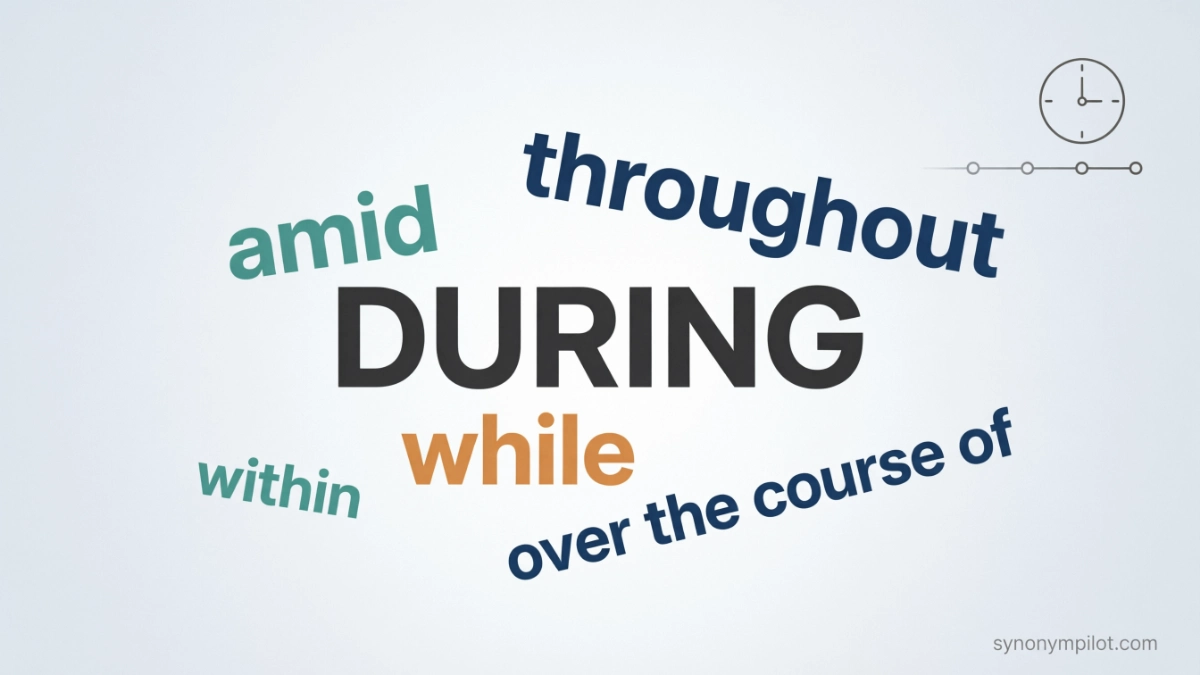
Words like “throughout,” “amid,” or “in the course of” can replace “during” depending on if you mean the entire time span or just a point within it.
You’re writing a report and you type “Sales increased during the holiday season” four times across different paragraphs, describing different periods. It’s correct every time, but it reads repetitively.
So you revise: “Sales increased throughout the holiday season… amid growing consumer demand… over the course of the campaign…” Suddenly the writing feels more varied and professional, without losing any clarity.
That’s exactly the kind of small but meaningful upgrade this article will help you make.
What Does “During” Mean?
“During” is a preposition that shows when something happens in relation to a period of time or another event. It tells you that one thing occurred within the time span of something else either throughout the whole period or at some point inside it. It’s one of the most commonly used time related words in English.
Meaning, Tone, and Context
At its core, “during” connects an action or event to a specific time frame, showing that it happened within that period. The tone of “during” is neutral and works comfortably across every type of writing casual conversation, academic essays, business reports, and storytelling.
“During” sounds natural in everyday speech (“I’ll call you during my lunch break”), academic writing (“the population declined during the recession”), professional contexts (“please remain seated during the presentation”), and narrative writing (“during the storm, the power went out three times”).
Because “during” is so frequently used, especially in academic and professional writing where time periods are constantly referenced, repeating it throughout a document can feel monotonous. A more specific synonym “throughout,” “amid,” or “over the course of” often adds variety while clarifying if you mean the entire period or just a moment within it.
When and How to Use “During”
Use “during” when you want a simple, clear way to show that something happened within a specific time period or alongside another event.
Here are natural examples across different situations:
- “She fell asleep during the movie.” (casual, conversational)
- “The company expanded rapidly during the past decade.” (professional, business)
- “Several reforms were introduced during his presidency.” (academic, historical)
- “Please turn off your phone during the performance.” (formal, instructional)
When you want to express if the action happened continuously across the entire period, or just briefly at some point within it, a more specific synonym communicates that distinction more precisely.
Another Word for During
If you need one quick, reliable alternative depending on context:
- For the entire span of time → throughout or all through
- For something happening in the middle of an event → amid or in the midst of
- For formal or academic writing → over the course of or in the course of
- For describing a specific occasion → at the time of or on the occasion of
- For casual conversation → while or in
There is no single “best” replacement for “during” the right word depends on if you mean the whole time period, a moment within it, or a more formal description of timing.
When Not to Use This Word
Avoid “during” when you actually need “while,” which connects two ongoing actions happening at the same time using a clause rather than a noun. “During she was cooking, the phone rang” is incorrect “during” needs a noun or noun phrase after it (“during dinner”), not a full clause. “While she was cooking, the phone rang” is the correct structure.
Avoid repeating “during” multiple times in close proximity within the same paragraph, especially in formal or academic writing. Varying with “throughout,” “amid,” or “over the course of” creates smoother, more professional sounding prose.
Avoid using “during” when you mean “for” a duration of time. “I lived there during five years” is incorrect “during” doesn’t pair naturally with a specific duration like this. “I lived there for five years” is correct, since “for” measures duration while “during” identifies a time period.
Words Commonly Confused With During
During vs. While:
“During” is followed by a noun or noun phrase (“during the meeting”). “While” is followed by a clause with a subject and verb (“while we were meeting”). This is the most common grammar mistake learners make. “During the storm, we stayed inside” is correct. “While the storm happened, we stayed inside” is also correct, but “during the storm happened” is not.
During vs. For:
“During” identifies when something happens within a time period. “For” measures the duration or length of time something lasts. “I waited during the meeting” tells you when. “I waited for two hours” tells you how long. They can work together: “I waited for two hours during the meeting.”
During vs. Throughout:
“Throughout” emphasizes that something happened continuously across the entire period, without interruption. “During” is more neutral and doesn’t specify if the action was continuous or just happened at some point. “It rained during the trip” could mean it rained briefly at some point. “It rained throughout the trip” means it rained the entire time.
During vs. Amid:
“Amid” (or “amidst”) often implies that something is happening in the middle of a chaotic, busy, or complicated situation it carries a slightly more dramatic or literary tone than “during.” “She remained calm during the crisis” is neutral. “She remained calm amid the chaos” emphasizes the surrounding turmoil more vividly.
Best Synonym by Context
| Context | Best Synonym | Why It Fits |
|---|---|---|
| Academic/Formal Writing | Throughout, Over the Course of | Sounds precise, professional, and analytical. |
| Describing Continuous Action | Throughout, All Through | Emphasizes the entire time span from beginning to end. |
| Describing a Chaotic Situation | Amid, In the Midst of | Adds dramatic, vivid, or literary emphasis. |
| Formal Occasions | At the Time of, On the Occasion of | Polished, ceremonial, and appropriate for formal contexts. |
| Casual Conversation | While, In | Natural, simple, and easy to use in everyday speech. |
| Historical or Narrative Writing | Throughout, Amid, In the Course of | Creates a smooth and engaging storytelling style. |
| Business/Professional Writing | Over the Course of, Throughout | Sounds structured, objective, and professional. |
Which Synonym Should You Choose?
Ask yourself these quick questions before picking a replacement for “during”:
1. Did this happen continuously, or just at some point within the period? “Throughout” emphasizes the entire span. “During” and “amid” can describe a single moment within a longer period.
2. Is the surrounding situation chaotic or significant? “Amid” and “in the midst of” suit dramatic, busy, or complicated situations. “During” is more neutral.
3. How formal is the writing? “Over the course of” and “in the course of” suit formal or academic writing. “While” and “in” suit casual conversation.
4. Is what follows a noun or a full clause? “During” and “throughout” need a noun phrase. “While” needs a clause with a subject and verb.
Real Life Examples of “During” in Sentences
School
“Please remain quiet during the exam.”
“The students learned about ancient Egypt during their history unit.”
Workplace
“Productivity dropped slightly during the transition to the new system.”
“All staff must complete the training during the onboarding period.”
Writing
“During the war, the city was completely transformed.”
“The character undergoes a major change during the second act of the story.”
Conversation
“I’ll text you during my break.”
“She got really sick during her trip to Thailand last year.”
25+ Synonyms for During
| Synonym | Simple Meaning | Example Sentence |
|---|---|---|
| Throughout | For the entire duration of something | The team stayed motivated throughout the entire project. |
| Amid | In the middle of a situation | The company grew amid economic uncertainty. |
| Amidst | A more formal version of amid | She remained focused amidst constant interruptions. |
| In the midst of | Right in the middle of something | They made the decision in the midst of negotiations. |
| Over the course of | Across a period of time | Trust was built over the course of several years. |
| In the course of | Within the process or period of something | Several changes occurred in the course of the investigation. |
| While | At the same time as | She read a book while waiting for her appointment. |
| As | At the same time as | He answered emails as the meeting began. |
| In | Within a particular period | The economy grew significantly in the early 2000s. |
| Throughout the course of | Across an entire extended period | Throughout the course of the semester, her writing improved. |
| In the period of | Within a specific span of time | Progress was made in the period of one year. |
| At the time of | At a particular moment | At the time of the announcement, shares surged. |
| At the same time as | Simultaneously with something | The events happened at the same time as the storm. |
| For the duration of | For the whole length of time | Visitors must wear masks for the duration of the tour. |
| Over | Across a span of time | The team improved steadily over the final weeks. |
| Within | Inside a time frame | The report must be submitted within the review period. |
| Pending | While awaiting a decision | The contract remains under review pending approval. |
| On the occasion of | At a particular event or moment | The speech was given on the occasion of the anniversary. |
| In conjunction with | Together with something else | The launch happened in conjunction with the conference. |
| Simultaneously with | Happening at exactly the same time | The announcements were released simultaneously. |
| Concurrently with | Happening at the same time (formal) | Training ran concurrently with regular work. |
| In tandem with | Alongside and coordinated with | The campaign launched in tandem with the product release. |
| Through | Across an entire period | They supported each other through difficult years. |
| All through | Continuously throughout a period | She stayed calm all through the presentation. |
| In the wake of | Following a significant event | New regulations appeared in the wake of the crisis. |
| Coinciding with | Happening at the same time, often by chance | The launch coincided with a holiday weekend. |
Synonym Groups and Usage Differences
Formal
Over the course of, in the course of, pending, on the occasion of, concurrently with suit academic essays, formal reports, legal writing, and official correspondence. They communicate timing with structure and precision.
Informal
While, in, all through, through sound natural in everyday conversation and casual writing.
Academic
Throughout, over the course of, in the period of, concurrently with appear frequently in research papers, historical writing, and analytical essays, especially when describing trends or developments across time periods.
Professional
Throughout, over the course of, in conjunction with, simultaneously with suit business reports, project updates, and workplace communication.
Conversational
While, in, during (the original word itself works well here too) are the most natural choices in spoken English and informal writing.
Stronger / More Dramatic
“Amid” and “amidst” carry a slightly more dramatic, literary tone, often used to emphasize chaos, tension, or significant surrounding circumstances. “During” remains neutral and doesn’t carry that same emphasis.
Antonyms of During
| Contrasting Concept | Meaning | Example |
|---|---|---|
| Before | Earlier than a specific time or event | The meeting was rescheduled to happen before the holiday break. |
| After | Later than a specific time or event | They went out for dinner after the concert ended. |
| Outside of | Not within a particular time period or context | Personal calls should be be made outside of working hours. |
| Beyond | Past a particular point or period | The project extended well beyond the original deadline. |
| Prior to | Before a specific time (formal) | All forms must be submitted prior to the application deadline. |
| Following | After a specific event or period | Following the announcement, shares rose by ten percent. |
Comparison: During vs. Related Words
During vs. While
“During” is followed by a noun (“during the meeting”). “While” is followed by a clause with a subject and verb (“while we were meeting”). This grammar distinction trips up many learners. “During the flight, she read three chapters” is correct. “While she flew, she read three chapters” is also correct, but the two words cannot simply replace each other without adjusting the sentence structure.
During vs. Throughout
“Throughout” specifically emphasizes that something happened continuously across the entire period, without interruption. “During” is more neutral and doesn’t specify if the action was constant or occasional. “She felt nervous during the interview” could mean at some point. “She felt nervous throughout the interview” means the entire time, start to finish.
During vs. Amid
“Amid” (or “amidst”) often carries a more dramatic or literary tone, frequently describing a chaotic, busy, or emotionally significant surrounding situation. “During” is neutral and doesn’t carry that emotional weight. “Sales grew during the recession” is factual. “Sales grew amid the chaos of the recession” emphasizes the difficult surrounding circumstances more vividly.
During vs. Over
“Over” can describe a span of time, similar to “during,” but often implies gradual change or development across that time. “Changes happened during the year” is neutral. “Changes happened over the year” suggests gradual development across that period. “Over” pairs especially well with verbs describing growth, decline, or transformation.
During vs. In the Course of
“In the course of” is more formal than “during” and often implies that something happened as part of an ongoing process, investigation, or sequence of events. “Several errors were found during the review” is neutral. “Several errors were found in the course of the review” sounds more formal and process oriented, fitting legal, academic, or official writing.
Common Phrases and Expressions
“During the course of”
A slightly more formal way of saying “during,” often used to emphasize an extended process or period.
Example: “During the course of the investigation, several new details emerged.”
“In the heat of the moment”
Describes something happening during an intense, often emotional situation.
Example: “He said things in the heat of the moment that he later regretted.”
“Throughout the years”
A common phrase describing something that happened consistently across a long period of time.
Example: “Their friendship remained strong throughout the years, despite living in different countries.”
“In the thick of it”
Describes being right in the middle of a busy, demanding, or chaotic situation.
Example: “During exam season, students are right in the thick of it with deadlines and revision.”
“Day in, day out”
Describes something happening continuously, every single day, often used to emphasize repetition during an ongoing period.
Example: “She practiced piano day in, day out during her years at music school.”
“At every turn”
Describes obstacles or events that occurred repeatedly throughout a period or process.
Example: “During the renovation, they faced delays at every turn.”
Common Mistakes to Avoid
Using “during” with a clause instead of a noun:
“During she studied, the lights went out” is grammatically incorrect. “During” must be followed by a noun phrase, like “during her studies” or “during the exam.” Use “while” when you need a full clause with a subject and verb.
Confusing “during” and “for” when describing duration:
“I lived in Paris during three years” is incorrect. “During” identifies a time period, not a length of time. “I lived in Paris for three years” correctly uses “for” to measure duration.
Overusing “during” repeatedly in formal writing:
Using “during” multiple times in the same paragraph, especially in academic or business writing, can feel repetitive. Varying with “throughout,” “over the course of,” or “amid” creates more polished, professional prose.
Using “amid” for neutral, non dramatic situations:
“Amid” carries a slightly dramatic or literary tone, often implying chaos or significant surrounding circumstances. Using it for routine, everyday situations “she ate lunch amid her workday” can sound overly intense or stylistically mismatched.
Confusing “during” and “throughout” when describing continuity:
“During” doesn’t necessarily mean the entire time period it can describe a single moment within it. “Throughout” specifically means the entire span, without interruption. Using them interchangeably can create ambiguity about how long something actually lasted.
FAQs
What is the difference between “during” and “while”?
A: “During” is followed by a noun or noun phrase (“during the meeting”). “While” is followed by a clause containing a subject and verb (“while we were meeting”). This is the most common grammar confusion with these two words, so checking what follows the word helps you choose correctly.
Can “during” be used with a specific duration, like “during five years”?
A: No. “During” identifies a time period, not a measured length of time. For duration, use “for” instead: “I worked there for five years,” not “during five years.” However, “during the five years I worked there” is correct, since it refers to that specific time period as a defined unit.
What is a more formal synonym for “during” in academic writing?
A: “Throughout,” “over the course of,” and “in the course of” are all strong formal alternatives. “Significant developments occurred over the course of the study” sounds more analytical and polished than repeated use of “during.”
Is “amid” the same as “during”?
A: They’re closely related, but “amid” carries a more dramatic or literary tone, often implying that something is happening within a chaotic, busy, or emotionally significant situation. “During” is neutral and works in any context, while “amid” suits more vivid, descriptive writing.
What is the difference between “during” and “throughout”?
A: “During” is neutral and can describe something that happened at any point within a time period, if briefly or continuously. “Throughout” specifically emphasizes that something happened across the entire period, without interruption, from start to finish.
Conclusion
“During” is a small, essential word that does important work in English connecting actions to the time periods in which they happen. But because it’s used so frequently, especially in academic and professional writing, knowing when to reach for “throughout,” “amid,” or “over the course of” instead can make your writing feel more varied, precise, and polished.
This week, try noticing how often “during” appears in your own writing. Ask yourself: did this happen continuously, or just briefly within the period?
Was the surrounding situation calm or chaotic? Then choose the synonym that captures that nuance. With a little practice, these small grammar distinctions will become second nature, and your writing will flow with much more natural variety.

Hi, I’m George Philip—an English language enthusiast who enjoys uncovering the nuances of words. I write about synonyms, vocabulary, and everyday language tips so readers can improve their communication and express themselves effectively. Learning new words should be fun, practical, and inspiring! synonympilot.com