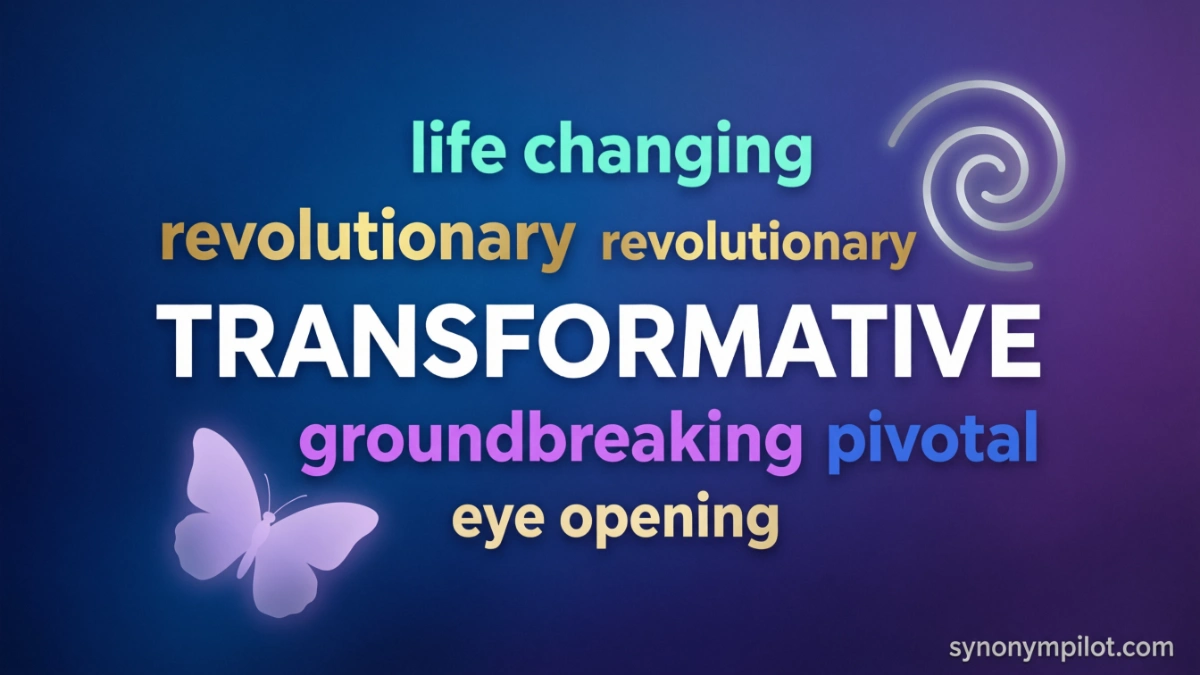
Quick Answer: “Transformative” means having the power to cause a major, often positive change in someone or something. It describes experiences, decisions, technologies, or events that fundamentally alter how something works or how someone thinks.
Words like “life changing,” “groundbreaking,” or “revolutionary” can replace “transformative” depending on the type and scale of change involved.
You’re writing a recommendation letter for a former student and you type “Studying abroad was a transformative experience for her.”
It’s accurate, but it’s also become one of those words that appears in nearly every personal statement and recommendation letter today. So you revise: “Studying abroad fundamentally reshaped how she saw the world.”
The new sentence feels more specific, more personal, and less like a phrase pulled from a template.This article helps you find that kind of precision.
What Does “Transformative” Mean?
“Transformative” describes something that causes deep, often fundamental change in a person, organization, system, or situation. It implies that whatever happened wasn’t just an improvement, but a genuine shift in identity, structure, or perspective. The word appears frequently in education, business, personal development, and technology writing.
Meaning, Tone, and Context
At its core, “transformative” signals that change has occurred at a deep level not surface level improvement, but something that reshapes the fundamental nature of a person, system, or situation. The tone is positive, formal to semi formal, and often appears in reflective, professional, or academic writing.
“Transformative” sounds natural in personal essays (“the internship was a transformative experience”), business writing (“the company underwent transformative growth”), academic contexts (“transformative learning theory examines how adults change their worldview”), and technology discussions (“artificial intelligence is having a transformative impact on healthcare”).
Because “transformative” has become extremely popular in college essays, corporate mission statements, and self help writing, it now risks sounding like a buzzword used so often that it loses specificity. A more precise synonym often communicates the actual type and scale of change more clearly and convincingly.
When and How to Use “Transformative”
Use “transformative” when you want to express that something caused deep, fundamental change not just a small improvement, but a genuine shift in how something works or how someone sees the world.
Here are natural examples across different situations:
- “Becoming a parent was a transformative experience for him.” (personal, emotional)
- “The company’s digital strategy has been transformative for its growth.” (business, professional)
- “Transformative learning encourages students to question their assumptions.” (academic, educational)
- “The new policy could have a transformative effect on public transportation.” (formal, analytical)
When you want your writing to feel more specific and less like a buzzword, a more precise synonym “life changing,” “groundbreaking,” or “paradigm shifting” often communicates the exact nature and scale of the change more convincingly.
Another Word for Transformative
If you need one quick, reliable alternative depending on context:
- For personal experiences → life changing or eye opening
- For business or technology → revolutionary or disruptive
- For academic or research contexts → paradigm shifting or groundbreaking
- For gradual but significant change → formative or influential
- For casual conversation → game changing or eye opening
There is no single “best” replacement for “transformative” the right word depends on whether you mean personal growth, technological disruption, or fundamental systemic change.
When Not to Use This Word
Avoid “transformative” for changes that are simply useful or convenient rather than fundamentally significant. “This new app is transformative for my grocery list” overstates a minor convenience. “This app is really helpful” or “this app has made grocery shopping easier” fits the actual scale of impact.
Avoid using “transformative” repeatedly throughout an essay, application, or report. Because the word has become so common in personal statements and corporate writing, repeating it multiple times can make your writing sound generic rather than genuinely reflective.
Avoid “transformative” when describing change that hasn’t actually happened yet or is purely speculative. “This technology could be transformative” is reasonable when there’s real evidence. Overusing “transformative” for unproven, hypothetical potential can sound like marketing language rather than genuine analysis.
Words Commonly Confused With Transformative
Transformative vs. Revolutionary:
“Revolutionary” implies a sudden, dramatic break from what came before often associated with innovation or upheaval. “Transformative” can describe gradual or sudden change, and doesn’t necessarily imply breaking entirely from the past. “The technology was revolutionary” suggests a complete departure from previous methods. “The technology was transformative” suggests deep, significant change, which could be gradual or sudden.
Transformative vs. Influential:
“Influential” means having an effect on someone’s thinking or decisions, without necessarily implying fundamental change. “Transformative” implies the change goes deeper it reshapes identity or structure. “Her mentor was influential in her career” suggests guidance and impact. “Her mentor’s advice was transformative” suggests it fundamentally changed her path or perspective.
Transformative vs. Disruptive:
“Disruptive” specifically implies that something interrupts or challenges an existing system, often in business or technology contexts. “Transformative” is broader and doesn’t necessarily imply disruption it can describe positive change without upheaval. “Disruptive technology” often displaces older systems. “Transformative technology” describes deep impact, which could include disruption but isn’t limited to it.
Transformative vs. Life changing:
“Life changing” is more personal and informal, typically describing individual experiences. “Transformative” works in both personal and institutional contexts it can describe a company, a policy, or a society, not just an individual life. “The trip was life changing for me” is personal. “The policy had a transformative effect on the region” applies to a broader, less personal context.
Best Synonym by Context
| Context | Best Synonym | Why It Fits |
|---|---|---|
| Personal Essays / Applications | Life-changing, Eye-opening, Formative | Personal, reflective, and emotionally resonant. |
| Business / Technology | Revolutionary, Disruptive, Game-changing | Common industry terms for major innovation and impact. |
| Academic / Research Writing | Paradigm-shifting, Groundbreaking | Analytical, precise, and widely used in scholarly contexts. |
| Social or Policy Impact | Far-reaching, Fundamental, Sweeping | Emphasizes broad influence and significant change. |
| Education Contexts | Formative, Eye-opening, Enlightening | Highlights learning, growth, and new understanding. |
| Casual Conversation | Game-changing, Eye-opening | Natural, relatable, and easy to understand. |
| Medical / Scientific Contexts | Groundbreaking, Breakthrough | Commonly used for important discoveries and innovations. |
Which Synonym Should You Choose?
Ask yourself these quick questions before picking a replacement for “transformative”:
1. Is this personal or institutional? “Life changing” and “formative” suit individual experiences. “Revolutionary” and “disruptive” suit businesses, technologies, or systems.
2. Was the change sudden or gradual? “Revolutionary” implies a sudden break. “Formative” and “influential” can describe more gradual development over time.
3. How formal is the writing? “Paradigm shifting” and “groundbreaking” suit academic and formal writing. “Game changing” and “eye opening” suit casual or conversational contexts.
4. Does the change involve disruption of an existing system? “Disruptive” specifically implies challenging or displacing something established. “Transformative” can describe positive change without necessarily disrupting anything.
Real Life Examples of “Transformative” in Sentences
School
“Studying philosophy was a transformative experience that changed how she approached every subject afterward.”
“The teacher’s mentorship had a transformative effect on the student’s confidence.”
Workplace
“The merger has been transformative for the company’s market position.”
“Leadership training had a transformative impact on how the team communicates.”
Writing
“The memoir explores the transformative power of forgiveness.”
“Critics described the film as a transformative experience, not just entertainment.”
Conversation
“Honestly, that conversation with her was completely transformative for me.”
“Moving to a new city was transformative I see everything differently now.”
40+ Synonyms for Transformative
| Synonym | Simple Meaning | Example Sentence |
|---|---|---|
| Life-changing | Significantly altering someone’s life | The surgery was life-changing for her ability to walk without pain. |
| Revolutionary | Causing a dramatic break from the past | The invention of the internet was revolutionary for global communication. |
| Groundbreaking | Innovative and highly significant | The research was groundbreaking in renewable energy. |
| Game-changing | Significantly altering how something is done | The new software was a game-changing development. |
| Paradigm-shifting | Changing the basic framework of a field | Her theory was paradigm-shifting in cognitive science. |
| Disruptive | Challenging established systems | The startup’s model was disruptive to the taxi industry. |
| Formative | Strongly influencing development | Her years in journalism were formative. |
| Influential | Having a major effect on decisions or thinking | His mentor was influential in his career choice. |
| Far-reaching | Having wide-ranging effects | The policy had far-reaching economic consequences. |
| Profound | Deep and significant in effect | The experience had a profound impact on her outlook. |
| Eye-opening | Revealing new understanding | Volunteering abroad was eye-opening. |
| Enlightening | Providing greater insight | The lecture was enlightening and informative. |
| Pivotal | Crucial to a major change | That meeting was pivotal in her career. |
| Defining | Shaping character or identity | College was a defining period of his life. |
| Watershed | Marking an important turning point | The ruling was a watershed moment in history. |
| Breakthrough | A major advance or discovery | The breakthrough improved treatment outcomes. |
| Seismic | Extremely significant and wide-ranging | The merger caused a seismic shift in the market. |
| Sweeping | Broad and comprehensive | The reforms introduced sweeping changes. |
| Radical | Fundamental and dramatic | The company made a radical shift in strategy. |
| Fundamental | Affecting the core structure | The discovery led to a fundamental rethinking. |
| Reformative | Bringing positive improvement | Reformative policies improved conditions. |
| Restorative | Promoting healing and renewal | The retreat had a restorative effect. |
| Catalytic | Triggering major change | Her speech was catalytic in launching reform. |
| Metamorphic | Causing dramatic transformation | The experience was metamorphic. |
| Generative | Producing growth or new ideas | The workshop was highly generative. |
| Reshaping | Changing structure or direction | AI is reshaping many industries. |
| Reinventing | Making something essentially new | The company spent years reinventing itself. |
| Reorienting | Changing focus or direction | The crisis forced a reorienting of strategy. |
| Reawakening | Renewing passion or interest | Travel sparked a reawakening of creativity. |
| Empowering | Increasing confidence and control | The program was empowering for participants. |
| Liberating | Creating a sense of freedom | Leaving the job felt liberating. |
| Awakening | Bringing new awareness | The documentary was an awakening for viewers. |
| Epoch-making | Beginning a significant new era | The discovery was epoch-making in medicine. |
| Era-defining | Shaping an entire period | Smartphones became era-defining technology. |
| Trailblazing | Pioneering and innovative | Her trailblazing work inspired others. |
| Innovative | Introducing important new ideas | The innovative approach improved patient care. |
| Momentous | Extremely important | The decision was momentous for the family. |
| Consequential | Having long-lasting effects | The ruling was consequential for future policy. |
| Sea Change | A profound shift or transformation | There has been a sea change in public opinion. |
| Earth-shattering | Extremely significant or shocking | The news was earth-shattering for everyone involved. |
Synonym Groups and Usage Differences
Formal
Paradigm shifting, epoch making, consequential, profound, fundamental suit academic writing, research papers, formal essays, and policy analysis. They communicate significance with appropriate analytical weight.
Informal
Game changing, earth shattering, eye opening sound natural in casual conversation, blog writing, and everyday speech. “Game changing” especially appears across both casual and business contexts.
Academic
Paradigm shifting, formative, consequential, generative, catalytic appear frequently in research writing, particularly in education, sociology, and psychology, where describing the depth and nature of change matters.
Professional / Business
Disruptive, revolutionary, game changing, innovative, reshaping suit business writing, technology discussions, and strategic communication. “Disruptive” specifically suits discussions of market change.
Personal / Emotional
Life changing, eye opening, liberating, awakening, restorative, empowering carry deep personal resonance, ideal for personal essays, memoirs, and reflective writing about individual growth.
Strongest vs. Weaker
“Seismic,” “earth shattering,” and “epoch making” describe extremely significant, often historic change stronger than everyday “transformative.” “Influential” and “formative” describe meaningful but somewhat gentler, more gradual impact.
Modern vs. Established
“Disruptive” and “game changing” feel modern and frequently appear in current business and technology writing. “Epoch making” and “sea change” carry a slightly more traditional, literary feel.
Antonyms of Transformative
| Antonym | Meaning | Example Sentence |
|---|---|---|
| Stagnant | Showing no change, growth, or development | The industry remained stagnant for nearly a decade before innovation occurred. |
| Negligible | So small that it has little or no effect | The policy’s impact on local employment was negligible. |
| Insignificant | Too small to have meaningful importance | The design change was insignificant to the user experience. |
| Inconsequential | Having no important effect or result | The update was inconsequential compared to the major overhaul. |
| Static | Not changing or developing | The company’s strategy remained static despite market shifts. |
| Unremarkable | Not noteworthy or significant | The presentation was unremarkable and quickly forgotten. |
| Superficial | Affecting only the surface, not the core | The reforms were superficial and failed to solve the real problems. |
| Minor | Small in significance or effect | It was only a minor adjustment to the existing process. |
Comparison: Transformative vs. Related Words
Transformative vs. Revolutionary
“Revolutionary” implies a sudden, often dramatic break from the past a complete departure from previous methods or systems. “Transformative” can describe gradual or sudden change, and doesn’t necessarily require a complete break from what came before. “The vaccine was revolutionary” suggests it changed medicine almost overnight. “The vaccine was transformative for public health” emphasizes deep, lasting impact, regardless of how quickly it happened.
Transformative vs. Influential
“Influential” describes something that affects someone’s thinking or decisions, without necessarily implying fundamental change. “Transformative” implies the change runs deeper reshaping identity, structure, or perspective entirely. “Her teacher was influential” suggests guidance and impact. “Her teacher was transformative” suggests something deeper actually changed within her because of that influence.
Transformative vs. Disruptive
“Disruptive” specifically implies interrupting or challenging an existing system, often used in business and technology. “Transformative” is broader and doesn’t require disruption change can be transformative without displacing or challenging anything established. “Disruptive innovation” usually threatens existing players in a market. “Transformative innovation” describes deep impact, which may or may not involve disruption.
Transformative vs. Life Changing
“Life changing” is personal and informal, almost always describing an individual’s experience. “Transformative” works across personal, institutional, and societal contexts. “The trip was life changing” centers on one person’s experience. “The trip was transformative for the entire community” extends the impact beyond just an individual.
Transformative vs. Groundbreaking
“Groundbreaking” specifically implies innovation doing something that has never been done before. “Transformative” describes the depth of impact, which doesn’t necessarily require originality. Something can be transformative without being groundbreaking (a well known method applied in a new context can be deeply transformative without being innovative), and something groundbreaking might not yet have proven transformative impact.
Common Phrases and Expressions
“A transformative journey”
A common phrase describing a process of significant personal growth or change over time.
Example: “Her recovery has been a transformative journey, both physically and emotionally.”
“Transformative power of (something)”
Used to emphasize how something has the capacity to create deep change.
Example: “The novel explores the transformative power of forgiveness and second chances.”
“Catalyst for transformation”
Describes something or someone that triggers significant change.
Example: “The new CEO became a catalyst for transformation across the entire organization.”
“Turning point”
A moment that marks the beginning of significant change closely related to “transformative” but used as a noun phrase.
Example: “Losing her job became an unexpected turning point that led her toward a more fulfilling career.”
“Paradigm shift”
A fundamental change in basic assumptions, beliefs, or approach.
Example: “The new research represents a genuine paradigm shift in how we understand memory.”
“Sea change”
An idiomatic phrase describing a substantial and often surprising transformation.
Example: “There has been a sea change in attitudes toward mental health in the workplace.”
Common Mistakes to Avoid
Overusing “transformative” in personal statements and essays:
Because the word appears so frequently in college applications and recommendation letters, repeating it can make writing sound generic. Be specific about what actually changed “I learned to advocate for myself” communicates more than “it was transformative.”
Using “transformative” for minor improvements:
Calling a small productivity app “transformative” overstates its actual impact. Reserve the word for genuinely significant, identity level, or structural change, and use “helpful” or “useful” for smaller improvements.
Confusing “transformative” with “disruptive” in business writing:
Not all transformative change is disruptive, and not all disruption is necessarily transformative in a positive sense. Using these interchangeably can blur important distinctions, especially in strategic or analytical business writing.
Treating “revolutionary” and “transformative” as identical:
“Revolutionary” implies a sudden, dramatic break from the past. “Transformative” can describe gradual change just as easily. Using “revolutionary” for slow, incremental improvements can sound exaggerated.
Using vague claims of transformation without evidence:
Simply stating something was “transformative” without explaining how or why weakens your writing. Strong writing pairs the word (or its synonyms) with specific, concrete examples of what actually changed.
FAQs
What is a more specific synonym for “transformative” in a college essay?
A: “Eye opening,” “formative,” and “life changing” all work well and sound less like overused application language. Pairing any of these with a specific, concrete example of what changed makes your essay far more convincing than the word alone.
What is the difference between “transformative” and “revolutionary”?
A: “Revolutionary” implies a sudden, dramatic break from previous methods or systems. “Transformative” describes deep, significant change that can happen gradually or suddenly. Something can be transformative without being revolutionary, especially if the change builds gradually over time.
Is “transformative” overused in business writing?
A: Yes, it has become quite common in corporate mission statements and marketing materials, sometimes losing specificity as a result. Using more precise alternatives like “disruptive,” “game changing,” or describing the actual measurable impact often communicates more credibly.
What is a good synonym for “transformative” when describing a teacher or mentor’s impact?
A: “Formative” and “influential” both work beautifully in this context. “Formative” especially captures the sense of shaping someone’s development over time, which fits naturally with descriptions of mentorship and education.
Can “transformative” be used for negative change?
A: Generally, “transformative” carries a positive or at least significant, meaningful connotation, even when describing difficult experiences (like illness or loss) that ultimately led to growth. For purely negative, destructive change without any positive outcome, words like “devastating” or “destructive” are more accurate.
Conclusion
“Transformative” is a genuinely powerful word when it’s used with precision and real substance behind it. Because it has become so common in personal statements, business writing, and self help language, learning when to use it deliberately, and when a more specific synonym fits better, makes your writing feel more authentic and convincing.
This week, look back at writing where you’ve used “transformative” and ask yourself: what specifically changed? Was it personal, sudden, gradual, or systemic? Then choose a word “eye opening,” “formative,” “disruptive,” or “groundbreaking” that captures that specific nature of change.
With practice, your writing will communicate genuine impact instead of relying on a word that has started to feel like a placeholder.

Hi, I’m Camron White, a word lover who enjoys exploring the beauty of the English language. I write about synonyms, meanings, and everyday vocabulary to help readers express themselves more clearly and confidently. My goal is to make learning new words simple, fun, and useful in real-life conversations. synonympilot.com