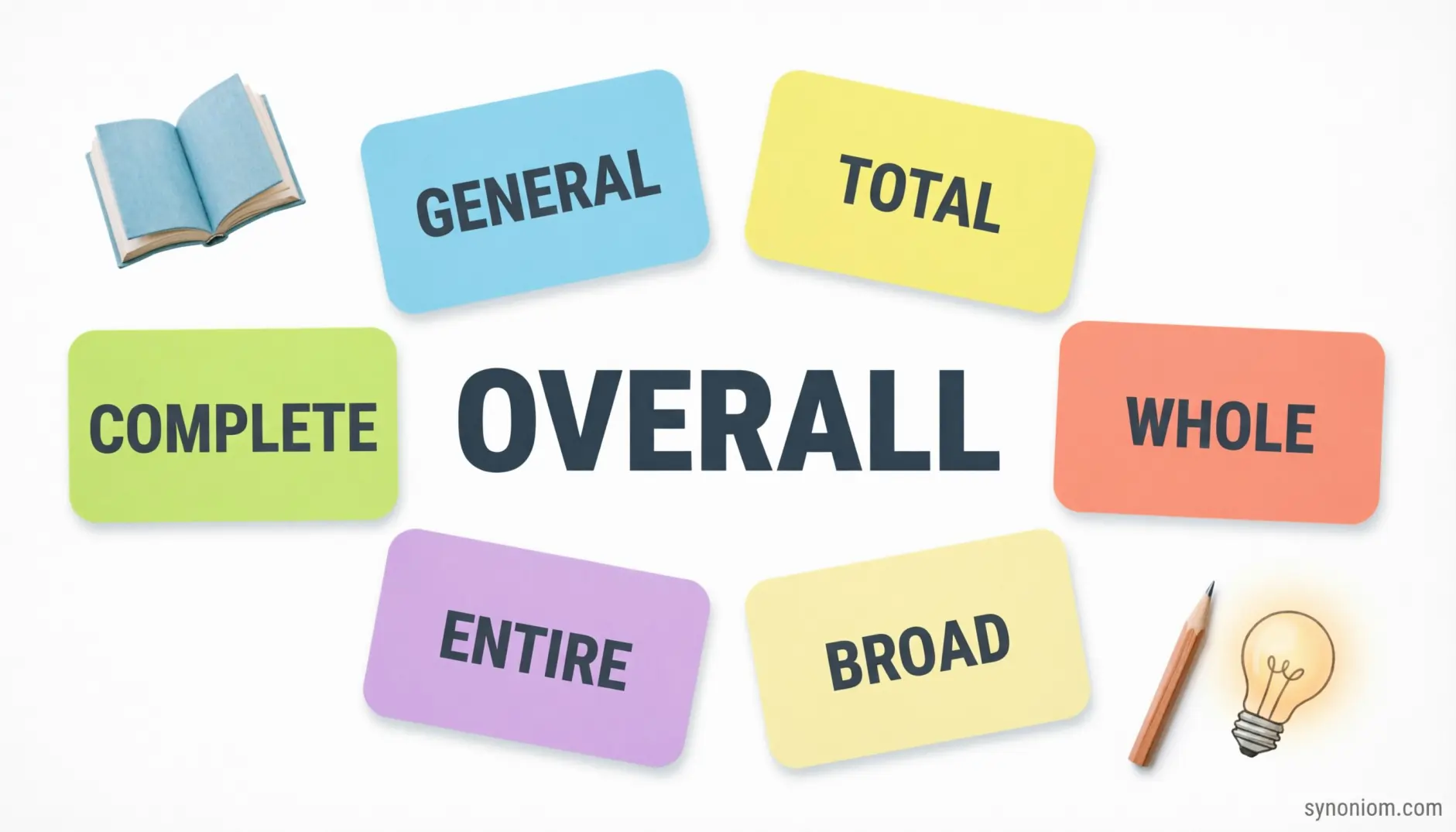
You just finished writing a report. You want to wrap things up, so you write: “Overall, the project was a success.” It sounds fine. But what if your teacher, your boss, or your reader has already seen that word three times in your document? That is exactly when knowing strong synonyms for “overall” saves you.
If you are writing an academic essay, a business email, or a casual blog post, having different ways to say “overall” makes your writing feel more natural, more polished, and more confident.
Let us explore what “overall” really means, when to use it, and which alternatives actually work in real life.
What Does “Overall” Mean? (Featured Snippet)
“Overall” means considering everything together, not just one part. You use it when you want to give a general conclusion or summarize a situation as a whole. It signals to your reader that you are stepping back and looking at the big picture rather than focusing on specific details.
Meaning, Tone, and Context of “Overall”
At its core, “overall” expresses a broad, summarizing view. It tells the reader or listener: “Now I am going to give you the general picture.”
In terms of tone, “overall” sits comfortably in the middle. It works in formal writing, professional emails, academic papers, and casual conversations alike. That flexibility is exactly why people overuse it, but it also means its synonyms span a wide range of registers.
For example, in an academic paper you might prefer “on the whole” or “in summary.” In a business report, “generally speaking” or “in totality” fits well. In everyday conversation, “all in all” or “at the end of the day” sounds completely natural.
So before you replace “overall,” ask yourself: What tone am I going for? That answer will guide which synonym you choose.
When and How to Use “Overall”
You typically use “overall” in three situations.
First, when you are summarizing a report, essay, or presentation. For example: “Overall, the marketing campaign performed better than expected.”
Second, when you are giving a general opinion about something you have evaluated. For example: “Overall, I enjoyed the movie, even though the ending was weak.”
Third, when you want to bring multiple ideas together into one conclusion. For example: “Overall, the new policy benefits both employees and the company.”
Notice that “overall” usually appears at the beginning of a sentence, followed by a comma. However, you can also place it mid-sentence: “The experience was overall very positive.”
50 Synonyms for “Overall”
| Synonym | Simple Meaning | Example Sentence |
|---|---|---|
| In general | Speaking broadly | In general, students performed well this semester. |
| On the whole | Considering everything | On the whole, the trip was enjoyable. |
| All in all | Taking everything into account | All in all, it was a productive meeting. |
| In summary | Giving a brief conclusion | In summary, the results were encouraging. |
| In conclusion | Ending a discussion | In conclusion, we recommend the new strategy. |
| Generally | Most of the time or in most cases | Generally, prices rise during summer. |
| Broadly | In a wide or general sense | Broadly, the feedback was positive. |
| Altogether | Taking all things together | Altogether, the event was a great success. |
| In totality | As a complete whole | In totality, the project cost more than planned. |
| As a whole | Viewed as a single unit | As a whole, the team worked efficiently. |
| At large | In a general sense | The community at large supports the decision. |
| By and large | Mostly, with few exceptions | By and large, customers are satisfied. |
| For the most part | Mostly, not entirely | For the most part, the plan went smoothly. |
| In the main | Mainly, largely | In the main, the students followed instructions. |
| Essentially | At the most basic level | Essentially, both options lead to the same result. |
| Fundamentally | At the deepest level | Fundamentally, the issue is about trust. |
| Largely | To a great extent | The event was largely a success. |
| Predominantly | Mainly, more than anything else | The audience was predominantly young professionals. |
| Primarily | Mainly, first in importance | The course focuses primarily on grammar. |
| Principally | Mostly, in the main | The problems were principally caused by poor planning. |
| Chiefly | Most importantly | The book is chiefly about leadership. |
| Mainly | In the largest part | He mainly works from home. |
| Mostly | More often than not | The feedback was mostly positive. |
| Generally speaking | When speaking broadly | Generally speaking, winters here are mild. |
| Taking everything into account | Considering all factors | Taking everything into account, it was worth it. |
| All things considered | After weighing everything | All things considered, she made the right choice. |
| On balance | After considering pros and cons | On balance, the benefits outweigh the risks. |
| Net net | Final outcome after all factors | Net net, we saved money this quarter. |
| At the end of the day | When everything is settled | At the end of the day, results matter most. |
| When all is said and done | After everything is finished | When all is said and done, teamwork wins. |
| In the final analysis | After deep consideration | In the final analysis, quality beats speed. |
| Ultimately | In the end, most importantly | Ultimately, the customer is always right. |
| In broad terms | In a general, non-specific way | In broad terms, the plan is solid. |
| In essence | Getting to the core meaning | In essence, we need to cut costs. |
| To sum up | To give a short final summary | To sum up, the year was challenging but rewarding. |
| In brief | In a short way | In brief, the project succeeded. |
| In short | Getting to the point quickly | In short, we need a new plan. |
| To summarize | To pull key points together | To summarize, the data shows growth. |
| Comprehensively | Covering all parts | The report comprehensively reviews all options. |
| Universally | Applying to all cases | This rule is universally accepted. |
| Globally | Across the entire situation or world | The trend is growing globally. |
| Collectively | Together as a group | Collectively, the team achieved great results. |
| In aggregate | When combining all figures | In aggregate, sales increased by 20%. |
| Taken together | When all parts are combined | Taken together, the evidence is strong. |
| Viewed as a whole | Looking at the complete picture | Viewed as a whole, the strategy makes sense. |
| Across the board | In all areas without exception | Prices dropped across the board. |
| Without exception | Applying to every case | All students, without exception, passed the test. |
| Holistically | Considering the complete system | The doctor approached the case holistically. |
| In a broad sense | In a general, wide meaning | In a broad sense, health includes mental wellbeing. |
| On the whole of it | Considering the full scope | On the whole of it, the season was disappointing. |
Important Synonym Groups
Formal Synonyms
Use these in academic papers, professional reports, or official documents.
- In totality
- Fundamentally
- In the final analysis
- Comprehensively
- Principally
These words carry weight and signal careful, analytical thinking. They sound educated and deliberate, which is exactly what formal writing demands.
Informal and Conversational Synonyms
These work perfectly in everyday speech, casual writing, or friendly emails.
- All in all
- At the end of the day
- When all is said and done
- Mostly
- By and large
They feel relaxed and approachable without sounding sloppy.
Academic Synonyms
These fit well in essays, research papers, and academic discussions.
- On balance
- In the main
- Taken together
- In aggregate
- Broadly
Professional Synonyms
These are ideal for business emails, presentations, and workplace reports.
- Across the board
- Net net
- On the whole
- Generally speaking
- Collectively
Slang / Very Casual
- At the end of the day (this phrase has become so common it now borders on cliché in casual speech)
- All in all (very relaxed, feels like a conversation)
Antonyms of “Overall”
| Antonym | Meaning | Example |
|---|---|---|
| Specifically | Focusing on one detail | Specifically, the third chapter needs revision. |
| In particular | Highlighting one thing | In particular, the design was impressive. |
| Partially | Only in part, not fully | The plan was only partially successful. |
| Individually | One at a time, separately | Each student will be evaluated individually. |
| Narrowly | In a limited, specific way | The law is narrowly focused on tax fraud. |
| Selectively | Choosing only certain parts | The data was selectively presented. |
| Locally | In a specific place or area | The problem exists locally, not nationwide. |
| Separately | Apart from others | The reports were reviewed separately. |
| Distinctly | As separate parts | The issues should be discussed distinctly. |
| Exclusively | Limited to one thing only | This offer is exclusively for members. |
| Solely | Only, and nothing else | The decision was based solely on cost. |
| Particularly | More than anything else | I particularly enjoyed the final chapter. |
| Individuated | Treated as separate individuals | Students were individuated for assessment. |
| Item by item | Considering each item separately | The budget was reviewed item by item. |
| Piece by piece | Looking at each part individually | We examined the proposal piece by piece. |
Comparison:
“Overall” vs. Similar Words
Many people confuse “overall” with words that feel similar but carry different weight. Here is how they actually differ.
Overall vs. Generally
Both signal a broad view, but “generally” often means “most of the time” while “overall” means “considering everything together.” For example, “Generally, the weather is warm” talks about frequency. “Overall, the weather was good this trip” talks about a complete assessment. Use “generally” for patterns and “overall” for conclusions.
Overall vs. Ultimately
“Ultimately” points to the final result or most important outcome. It carries a sense of priority or resolution. “Overall” simply summarizes. So “ultimately, trust matters most” is a stronger, more final statement than “overall, trust matters.”
Overall vs. In summary
“In summary” works best at the end of a structured piece of writing where you are condensing information. “Overall” fits better as a general impression or broad conclusion. Using “in summary” mid-conversation would sound odd; “overall” feels more natural there.
Overall vs. Essentially
“Essentially” strips things down to the core or most important idea. It carries a simplifying tone. “Overall” gathers everything together. “Essentially, this is a trust problem” means the root cause is trust. “Overall, the trust score was low” means when you look at all the data, trust scored low.
Common Phrases and Expressions Using “Overall”
Overall impression This refers to the general feeling or view you get about something after experiencing it. Example: “My overall impression of the hotel was very positive.”
Overall performance Used in schools and workplaces to describe how someone did across all areas. Example: “Her overall performance this year exceeded expectations.”
Overall picture This phrase helps you zoom out and see the full situation. Example: “Let us step back and look at the overall picture before making a decision.”
Overall effect Describes the combined result of multiple things happening together. Example: “The overall effect of the lighting changes was beautiful.”
Overall score Used in evaluations, tests, and ratings to combine all parts into one number. Example: “His overall score placed him in the top 10% of applicants.”
On an overall basis A slightly formal version used in business or finance. Example: “On an overall basis, the division met its targets.”
Common Mistakes to Avoid
Overusing “overall” at the start of every paragraph This is the most common mistake. If every paragraph starts with “overall,” your writing feels repetitive and lazy. Rotate between synonyms like “on the whole,” “all in all,” and “generally speaking” to keep things fresh.
Confusing “overall” with “all together” “All together” means everyone or everything at the same time in one place: “Let us sing all together.” “Overall” means in summary or generally. These are not interchangeable.
Using formal synonyms in casual settings Saying “in totality, I liked the pizza” in a text message sounds robotic. Match your synonym to your context. “All in all, the pizza was great” works much better.
Placing “overall” without a comma When “overall” starts a sentence, it almost always needs a comma after it. Missing this comma is a common punctuation error in learner writing.
Using “ultimately” and “overall” interchangeably As explained above, these words carry different meanings. “Ultimately” implies finality and priority; “overall” implies a general view. Mixing them up weakens the precision of your writing.
FAQs
What is the most natural synonym for “overall” in everyday conversation?
“All in all” is probably the most natural and widely used. It fits both spoken and written casual English. “At the end of the day” also works, though it has become a bit clichéd in everyday speech.
Which synonym for “overall” sounds most professional in a business report?
“On the whole” and “generally speaking” both work well in professional settings. For financial or data-focused reports, “in aggregate” and “across the board” are strong choices.
Can I use “in conclusion” and “overall” in the same paragraph?
Technically yes, but it creates redundancy. If you open with “overall,” follow it with your summary. If you want to use “in conclusion,” save it for the very last paragraph of a full piece of writing.
Is “by and large” too old-fashioned to use today?
Not at all. “By and large” is still widely used in British and American English. It sounds slightly more sophisticated than “overall,” which can actually work in your favor in professional or academic writing.
What is the difference between “mostly” and “overall”?
“Mostly” refers to the greater part or most cases, often implying exceptions exist: “Mostly, the reviews were good.” “Overall” implies a comprehensive summary: “Overall, the reviews were good.” “Mostly” is about proportion; “overall” is about the full picture.
Conclusion
Building a strong vocabulary does not mean memorizing long lists of rare words. It means learning to say the same thing in different ways depending on your audience and your purpose.
So next time you catch yourself typing “overall” for the third time in a paragraph, pause and ask: what am I really trying to say here? Am I summarizing? Concluding? Giving a broad view? The answer will point you to the right synonym.
Practice by replacing “overall” in your next email, essay, or message with one new alternative. Try “on the whole” today and “all in all” tomorrow. Over time, these words will start coming naturally. The goal is not perfect writing from day one; the goal is growing a little stronger with every sentence you write.

Hi, I’m Theo John, a passionate word explorer who loves diving into the beauty of the English language. I write about synonyms, word meanings, and practical vocabulary tips to help readers communicate with confidence. synonympilot.com