Your manager just asked you to explain how your project affected the company. You type: “The project had a big impact.” Then you pause. You used “impact” twice already in the same paragraph. What now?
This happens to writers, students, and professionals all the time. “Impact” is one of those words that feels easy and safe, so we reach for it constantly.
But strong writing requires variety, and knowing the right synonym for the right moment is exactly what separates average writing from impressive communication. So let us fix that habit today.
What Does “Impact” Mean?
“Impact” describes the strong effect or influence that one thing has on another. You use it when something causes a noticeable change, result, or reaction. It works as both a noun (“the impact of the decision”) and a verb (“this will impact your grade”), though many writing guides prefer you avoid it as a verb in formal contexts.
Meaning, Tone, and Context of “Impact”
At its core, “impact” suggests force. Something does not just touch a situation lightly; it hits it, changes it, leaves a mark. That is why “impact” carries slightly more weight than softer words like “effect” or “influence.”
In terms of tone, “impact” sits in the middle range. It works in academic writing, professional reports, news articles, and everyday conversation. However, because it has become so overused in business and corporate language, it can sometimes feel hollow or vague. Saying a policy “had an impact” tells your reader almost nothing specific. Saying it “transformed communities” or “reshaped the industry” delivers something real.
“Impact” sounds most natural in contexts involving significant, visible change. It fits less naturally when the effect is minor or subtle.
When and How to Use “Impact”
You reach for “impact” when you want to describe a result that carries weight and significance.
In academic writing: “The study examined the impact of social media on teenage mental health.”
In professional writing: “The new pricing model had a direct impact on quarterly revenue.”
In everyday conversation: “That documentary really had an impact on me.”
Notice that in each case, something meaningful happened. “Impact” signals to your reader that the change was real and worth noticing. Therefore, avoid using it for small or trivial effects, or your writing will feel exaggerated.
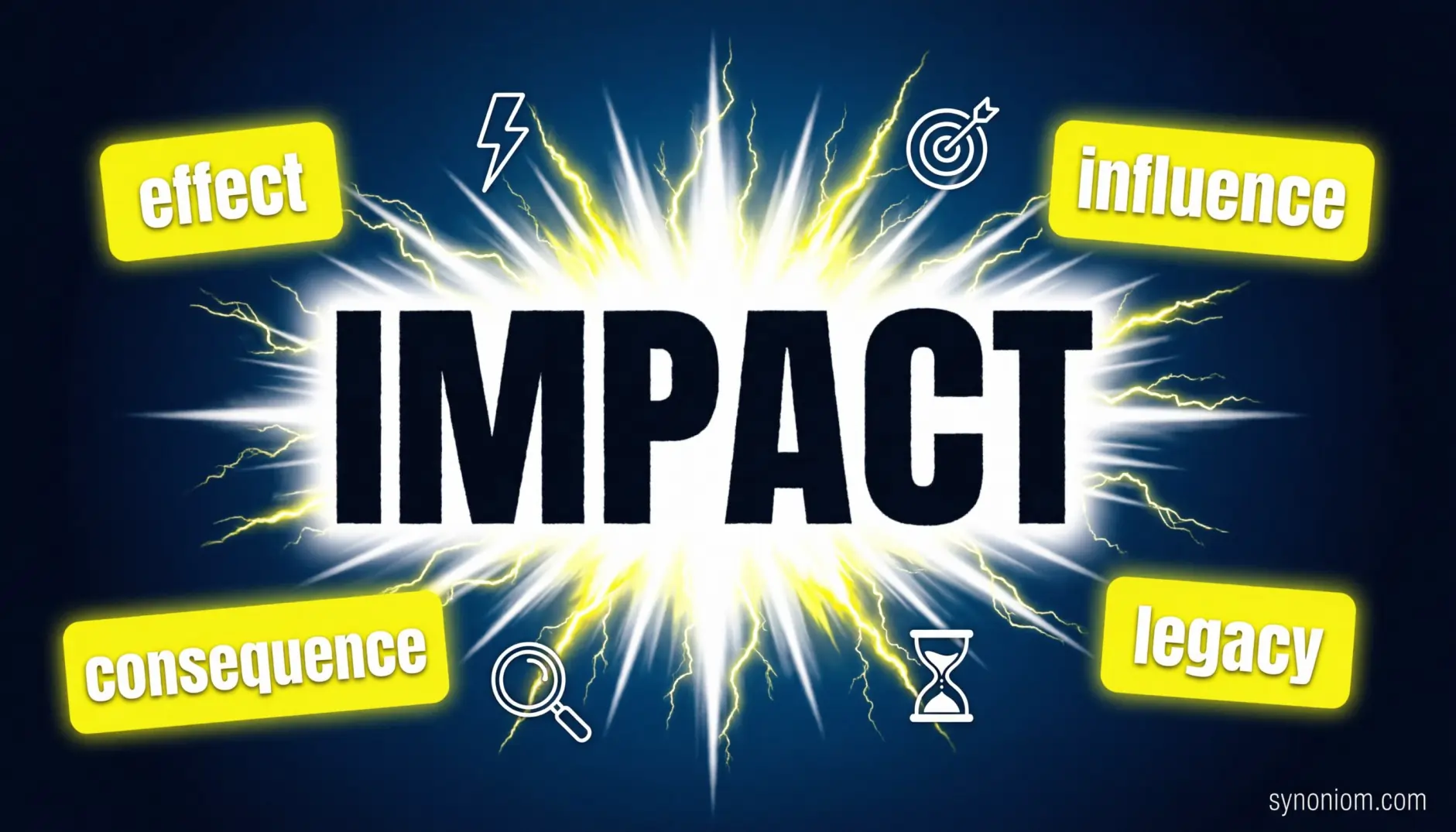
50 Synonyms for Impact
| Synonym | Simple Meaning | Example Sentence |
|---|---|---|
| Effect | A result or outcome caused by something | The effect of the new law was felt immediately. |
| Influence | The power to shape or change something gradually | Her mentor had a lasting influence on her career. |
| Consequence | A result, often negative or serious | The consequences of that decision were severe. |
| Outcome | The final result of a process or action | The outcome of the negotiations was positive. |
| Result | Something that happens because of something else | Hard work produces the result you want. |
| Impression | The feeling or image something leaves behind | The speech made a strong impression on the audience. |
| Mark | A lasting sign or trace left by something | She left her mark on the industry. |
| Footprint | The lasting trace or presence something leaves | The company reduced its environmental footprint. |
| Repercussion | An indirect, often negative result | The scandal had serious repercussions for the firm. |
| Ramification | A complex or far-reaching consequence | The ramifications of the policy change are still unfolding. |
| Significance | The importance or meaning of something | The significance of her discovery cannot be overstated. |
| Weight | The seriousness or importance of something | His words carried a lot of weight in the room. |
| Force | Strong power or effect | The force of the argument changed minds. |
| Power | The ability to affect or change things | Music has the power to heal. |
| Bearing | Relevance or effect on something | This evidence has a direct bearing on the case. |
| Reverberation | An effect that spreads outward | The announcement caused reverberations across the industry. |
| Aftermath | The effects following a major event | The aftermath of the storm lasted weeks. |
| Upshot | The final result or conclusion | The upshot of the discussion was a new plan. |
| Fallout | Negative consequences from an event | The political fallout was enormous. |
| Shock | A sudden, forceful effect | The layoffs came as a shock to employees. |
| Transformation | A deep, complete change | The initiative led to a transformation in the company. |
| Revolution | A dramatic, fundamental change | The internet sparked a revolution in communication. |
| Shift | A significant change in direction or attitude | There has been a shift in consumer preferences. |
| Ripple effect | A series of spreading consequences | The closure had a ripple effect across the region. |
| Clout | Influence or power | She has considerable clout in the industry. |
| Leverage | The power to influence a situation | The data gave them leverage in negotiations. |
| Reach | How far an effect or message spreads | The campaign had global reach. |
| Resonance | A deep, lasting emotional effect | The story had strong resonance with readers. |
| Sway | The ability to influence decisions | His opinion held great sway over the committee. |
| Pull | Attractive influence or drawing power | The brand has strong pull among teenagers. |
| Drive | The force pushing change or progress | Innovation is the drive behind growth. |
| Push | A forceful move toward change | The campaign gave sales a push. |
| Boost | A positive improvement or increase | The promotion gave revenue a boost. |
| Jolt | A sudden and surprising effect | The announcement delivered a jolt to the market. |
| Blow | A sudden, negative impact | Losing the contract was a major blow. |
| Strike | A forceful or sudden effect | The tragedy struck the community deeply. |
| Pressure | A steady force pushing for change | Public pressure led to reforms. |
| Catalyst | Something that speeds up change | The report became a catalyst for action. |
| Stimulus | Something that causes activity or growth | The package acted as an economic stimulus. |
| Trigger | Something that starts events | The decision was the trigger for protests. |
| Wake | The trail of effects left behind | Many changes followed in the wake of the merger. |
| Echo | A repeated or lasting effect | The decision still echoes through the company. |
| Legacy | A lasting result left behind | Her leadership left a strong legacy. |
| Trace | A small but lasting sign or effect | Traces of the old policy remain today. |
| Imprint | A deep, lasting effect | The experience left an imprint on his character. |
| Gravity | Seriousness and importance | Everyone understood the gravity of the situation. |
| Change | A visible difference caused by something | The policy created positive change. |
| Disruption | An interruption of normal activity | New technology caused industry disruption. |
| Turnaround | A complete reversal in results | The CEO engineered a remarkable turnaround. |
| Momentum | Growing force that drives progress | The campaign gained momentum after the launch. |
Important Synonym Groups
Formal Synonyms
These work well in academic papers, official reports, and professional documents.
- Ramification
- Repercussion
- Consequence
- Bearing
- Significance
They add precision and intellectual depth. Use them when your reader expects careful, measured language.
Informal and Conversational Synonyms
These feel natural in everyday speech, casual emails, and social media writing.
- Boost
- Jolt
- Pull
- Push
- Blow
They are direct, energetic, and easy to understand at a glance.
Academic Synonyms
These suit research writing, essays, and scholarly discussions.
- Reverberations
- Catalyst
- Stimulus
- Outcome
- Transformation
They help you sound analytical and precise without sounding robotic.
Professional Synonyms
These fit business emails, presentations, and workplace communication well.
- Leverage
- Clout
- Reach
- Disruption
- Turnaround
They signal strategic thinking and awareness of business dynamics.
Emotional Synonyms
Use these when you want to express deep personal or human significance.
- Resonance
- Imprint
- Echo
- Legacy
- Gravity
They carry genuine feeling and stay with readers long after they finish reading.
Conversational Synonyms
These work naturally in spoken English and informal written exchanges.
- Ripple effect
- Wake
- Shift
- Blow
- Jolt
Slang / Very Casual
- Clout (now widely used in casual and social media contexts to mean influence or power)
- Pull (very informal, especially in spoken conversation)
Antonyms of “Impact”
| Antonym | Meaning | Example |
|---|---|---|
| Insignificance | Lack of importance or effect | The change passed with complete insignificance. |
| Ineffectiveness | Failure to produce results | The campaign’s ineffectiveness surprised the team. |
| Irrelevance | Having no connection or effect | The report highlighted the policy’s irrelevance. |
| Weakness | Lack of force or influence | The weakness of the argument was obvious to everyone. |
| Neutrality | Having no effect either way | The decision was met with complete neutrality. |
| Indifference | No reaction or emotional effect | His speech was received with total indifference. |
| Powerlessness | Having no ability to change or influence anything | The committee felt a sense of powerlessness. |
| Inefficacy | Lack of effectiveness | The treatment’s inefficacy led to further research. |
| Futility | Pointlessness because nothing changes | They realized the futility of continuing the debate. |
| Inaction | Failure to act or create change | Government inaction frustrated many citizens. |
| Passivity | Lack of active influence or response | Her passivity prevented progress on the issue. |
| Stagnation | Absence of growth or movement | Years of stagnation hurt the local economy. |
| Inconsequence | Lack of meaningful result | The mistake was of little inconsequence overall. |
| Unimportance | Lack of significance | The issue’s unimportance became clear later. |
| Negligibility | Too small to matter | The increase in costs was negligible. |
Comparison:
“Impact” vs. Similar Words
Many writers confuse “impact” with closely related words. Here is how they actually differ.
Impact vs. Effect
“Effect” is the broader, more neutral word. It simply describes what happened as a result of something. “Impact” carries more force and suggests the result was significant or notable. So “the medicine had an effect” is neutral, while “the medicine had a powerful impact on recovery rates” signals something more dramatic. In most formal writing, “effect” is actually the safer and more precise choice.
Impact vs. Influence
“Influence” suggests a gradual, often ongoing process of shaping something. It does not carry the same sense of sudden force that “impact” does. A teacher influences a student over years; a powerful speech impacts an audience in a single moment. Use “influence” for slow, steady change and “impact” for something more immediate or forceful.
Impact vs. Consequence
“Consequence” almost always implies a result that follows from a cause, and it often carries a negative or serious tone. You can have a positive impact, but a “consequence” typically suggests something you must deal with or face. “The consequence of ignoring the warning was a system failure” sounds more serious and cause driven than “the impact of the warning being ignored.”
Impact vs. Outcome
“Outcome” focuses entirely on the end result, without suggesting how strong or forceful the process was. “Impact” emphasizes the force or weight of what happened. So “the outcome of the vote was a new law” is neutral and final; “the impact of the vote reshaped the political landscape” emphasizes the scale and significance of the change.
Common Phrases and Expressions
Make an impact This means to produce a strong, visible effect that others notice. Example: “She wanted to make an impact in her first week on the job.”
High impact Used as an adjective to describe something with strong, significant results. Example: “They focused on high impact strategies to grow the business quickly.”
Feel the impact Means to experience the effects of something directly and personally. Example: “Small businesses were the first to feel the impact of the new regulations.”
Long term impact Refers to effects that last or build over a long period of time. Example: “Researchers studied the long term impact of air pollution on lung health.”
Social impact Describes the effect something has on communities or society as a whole. Example: “The charity measures its social impact through community health data.”
On impact Describes something that happens at the exact moment of collision or contact. Example: “The airbag deploys on impact to protect the driver.”
Common Mistakes to Avoid
Using “impact” as a verb in formal writing Many style guides warn against writing “this will impact your results.” Instead, write “this will affect your results” or “this will have an impact on your results.” As a verb, “impact” often sounds vague and corporate.
Confusing “impact” with “effect” and “affect” “Effect” is usually a noun. “Affect” is usually a verb. “Impact” works as both, but it always signals something stronger than a simple effect. Mixing these up is one of the most common grammar mistakes in English writing.
Using emotional synonyms in formal contexts Words like “echo” and “imprint” carry deep feeling. They work beautifully in personal essays or storytelling, but they can feel out of place in a technical report or business document.
Overusing “impact” in one piece of writing If your essay contains “impact” seven times, replace at least five of them. Use the synonym table above to find precise replacements that match your specific meaning each time.
Using “consequence” when you mean a positive result “Consequence” sounds serious and often negative. Do not write “the positive consequences of the new program” if you want to sound natural. Use “outcomes,” “results,” or “effects” instead.
FAQs
What is the best synonym for “impact” in an academic essay?
“Consequence,” “outcome,” and “ramification” are all strong academic choices. If you want to describe something that triggered change, “catalyst” and “stimulus” also work well. Choose based on If you mean a result, a process, or a trigger.
Can I use “effect” and “impact” interchangeably?
Not always. “Effect” is broader and more neutral. “Impact” implies something stronger or more significant. In formal and academic writing, “effect” is often the safer, more precise choice.
Is it wrong to use “impact” as a verb?
Many professional and academic style guides discourage it. Instead of “this decision impacted profits,” write “this decision affected profits” or “this decision had an impact on profits.” Both sound cleaner and more precise.
What synonym for “impact” works best in a business presentation?
“Leverage,” “reach,” “disruption,” and “turnaround” all sound sharp in business contexts. “Ripple effect” also works well when you want to describe how one change spread across an organization.
How do I avoid repeating “impact” in a short paragraph?
Identify exactly what kind of impact you mean each time. Is it a result? Use “outcome.” A lasting mark? Use “legacy” or “imprint.” A sudden negative event? Use “blow” or “jolt.” Matching the synonym to the specific meaning solves the repetition problem instantly.
Conclusion
Knowing fifty synonyms for “impact” does not mean you memorize a list and dump words randomly into your writing. It means you start asking a better question every time: what kind of effect am I actually describing here? Is it sudden or gradual?
Positive or negative? Deep and lasting or brief and surface level? Each time you answer that question honestly, you will pick a stronger, more precise word. And precise words build trust with your reader. Start small. Pick one synonym from this list and use it in your next email, essay, or message.
Then try another one the following day. Gradually, your writing will gain depth, variety, and confidence, and “impact” will become just one of many powerful tools in your vocabulary.

Hi, I’m J.D. Salinger—a language lover who enjoys uncovering the nuances of words. I write about synonyms, meanings, and vocabulary tips to help readers express themselves more clearly and confidently. My goal is to make learning new words fun, simple, and practical. synonympilot.com