Quick Answer
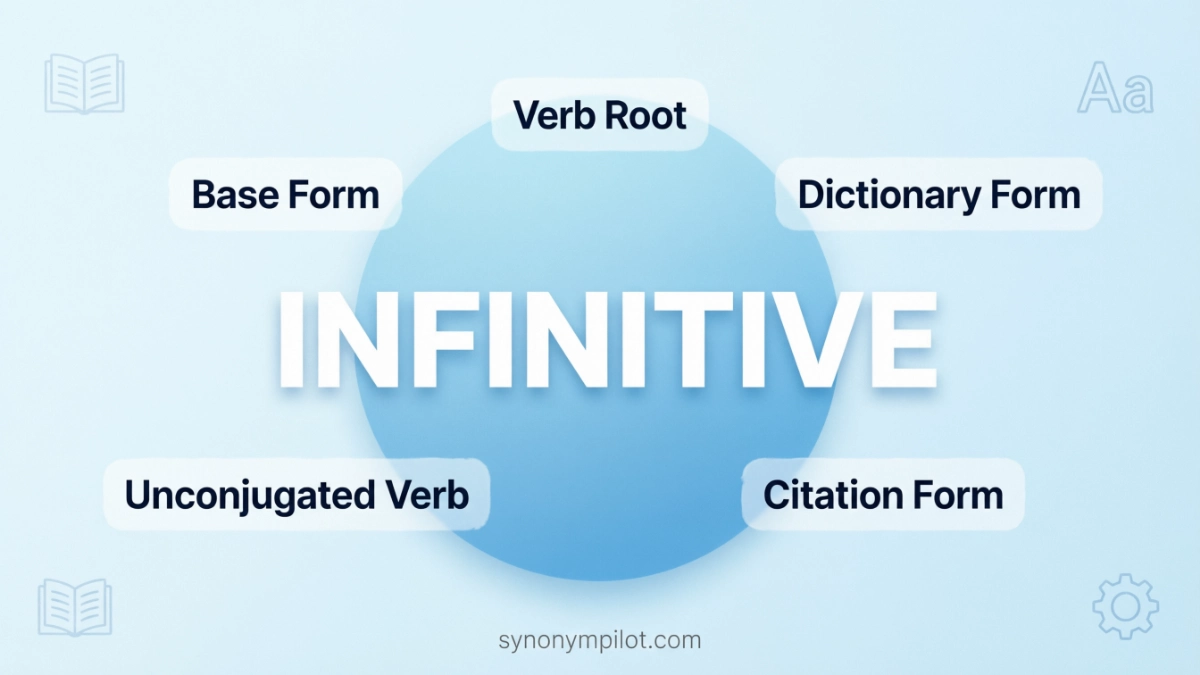
An infinitive is the basic form of a verb, usually preceded by “to” in English, such as to eat, to learn, or to write. Unlike ordinary vocabulary words, infinitive is a grammar term, so it has very few true synonyms. The most accurate alternatives include base form of a verb, verb root, dictionary form, and unconjugated verb form.
If you’ve ever studied English grammar, you’ve probably seen sentences like “I want to learn English” or “She hopes to travel abroad.” In both examples, to learn and to travel are infinitives.
Many learners search for synonyms of infinitive because they encounter different grammar books, teaching styles, or linguistic terms.
However, unlike everyday words such as happy or beautiful, infinitive is a technical grammar term. Therefore, finding accurate alternatives requires understanding exactly what the term means and how grammar experts use it.
This guide explains the meaning of infinitive, its closest alternatives, common confusions, practical examples, and the best term to use in different contexts.
Meaning, Tone & Context
Core Meaning
An infinitive is the basic form of a verb that is not marked for tense, person, or number.
Examples:
- to run
- to study
- to speak
- to improve
Tone
The word infinitive is:
- Academic
- Educational
- Formal grammar terminology
- Common in language teaching
Where It Sounds Most Natural
You will usually hear or read this term in:
- Grammar lessons
- English textbooks
- Linguistics discussions
- Language learning materials
- Academic writing about language
For everyday conversation, people rarely use the word unless they are discussing grammar.
When & How to Use “Infinitive”
Use infinitive when referring to a verb’s basic form rather than an action itself.
Correct:
- The verb eat appears in the infinitive form as to eat.
- Students often learn the infinitive before studying verb tenses.
- An infinitive can function as a noun, adjective, or adverb.
Not Correct:
- I bought an infinitive yesterday.
- She is very infinitive.
The word refers only to grammar.
Real Life Teaching Example
Teacher: What is the infinitive of “went”?
Student: The infinitive is “to go.”
This is a natural and correct use of the term.
Another Word for Infinitive
The closest alternatives include:
- Base form of a verb
- Verb root
- Dictionary form
- Unconjugated verb
- Citation form
- Basic verb form
Among these, base form of a verb is usually the clearest alternative for beginners.
When Not to Use This Word
Avoid using infinitive when:
- Talking about ordinary actions
- Describing people
- Discussing emotions
- Referring to complete verb tenses
For example:
❌ She used an infinitive to the store.
✅ She went to the store.
The term belongs specifically to grammar discussions.
Words Commonly Confused With Infinitive
| Word | Meaning |
|---|---|
| Infinitive | The basic form of a verb, often preceded by to (e.g., to run, to write). |
| Gerund | A verb ending in -ing that functions as a noun (e.g., Swimming is fun). |
| Participle | A verb form used as an adjective or in verb phrases (e.g., a broken window, has finished). |
| Predicate | The part of a sentence that contains the verb and tells something about the subject. |
| Verb | A word that expresses an action, occurrence, or state of being. |
| Clause | A group of words containing a subject and a verb. |
| Phrase | A group of related words that does not express a complete thought. |
| Root | The most basic element of a word from which other forms develop. |
| Stem | The core form of a word before grammatical endings are added. |
| Conjugation | The process of changing a verb’s form to show tense, person, number, or mood. |
Best Alternative by Context
| Context | Best Alternative | Why It Fits |
|---|---|---|
| Beginner Grammar Lesson | Base Form of a Verb | Simple and easy for learners to understand. |
| Academic Linguistics | Citation Form | Common technical term used in linguistic analysis. |
| Dictionary Discussion | Dictionary Form | Refers to the form under which a verb is listed. |
| Verb Structure Analysis | Unconjugated Verb | Emphasizes that the verb has not been changed for tense or person. |
| Language Teaching | Basic Verb Form | Clear and learner-friendly terminology. |
| Morphology | Verb Stem | Focuses on the structural form of the verb. |
| Comparative Linguistics | Root Form | Useful when comparing languages and word origins. |
| Grammar Textbook | Verb Root | Traditional grammar term for the core verb form. |
Which Synonym Should You Choose?
Choose base form of a verb if you are teaching beginners.
Choose dictionary form when discussing how verbs appear in dictionaries.
Choose unconjugated verb when emphasizing that the verb has not changed for tense or subject.
Choose citation form in linguistic or academic contexts.
Choose verb root when discussing word structure.
Real Life Examples of “Infinitive” in Sentences
School
- Our teacher explained the infinitive before teaching verb tenses.
- Students identified the infinitive in each sentence.
- The worksheet focused on infinitive phrases.
Workplace
- The language trainer introduced infinitive structures.
- Editors checked the grammar guide’s explanation of infinitives.
- The instructor compared infinitives and gerunds.
Writing
- An infinitive can act as the subject of a sentence.
- Writers often use infinitive phrases to express purpose.
- The grammar handbook defined the infinitive clearly.
Conversation
- What is the infinitive of drove?
- Can you find the infinitive in this sentence?
- We learned infinitives in English class today.
Synonyms for Infinitive (Verb Form)
| Synonym | Simple Meaning | Example Sentence |
|---|---|---|
| Base form | Original verb form | “Go” is the base form of the verb. |
| Basic verb form | Simplest version of a verb | Teachers start with the basic verb form. |
| Verb root | Core verb form | The verb root remains unchanged. |
| Root form | Original grammatical form | Students identified the root form. |
| Dictionary form | Form shown in dictionaries | Dictionaries list verbs in their dictionary form. |
| Citation form | Standard reference form | Linguists use the citation form. |
| Unconjugated verb | Verb without grammatical changes | The example uses an unconjugated verb. |
| Bare infinitive | Infinitive without “to” | “Go” is a bare infinitive here. |
| Full infinitive | Infinitive with “to” | “To learn” is a full infinitive. |
| To-infinitive | Infinitive beginning with “to” | The sentence contains a to-infinitive. |
| Verb stem | Main part of a verb | The verb stem stays consistent. |
| Lexical form | Dictionary-style form | Researchers examined the lexical form. |
| Canonical form | Standard version | Grammarians use the canonical form. |
| Underlying form | Basic structural form | The underlying form is analyzed. |
| Original verb form | Earliest grammatical form | Start with the original verb form. |
| Standard verb form | Normal reference form | The standard verb form appears first. |
| rudimentary form | Early historical form | Older grammar books use this term. |
| Reference form | Form used for reference | The reference form helps classification. |
| Headword form | Dictionary entry form | The headword form appears in dictionaries. |
| Entry form | Listed form in dictionaries | Verbs appear under their entry form. |
| Non-finite verb form | Verb form without tense | An infinitive is a non-finite verb form. |
| Verb base | Fundamental structure of verb | The verb base remains stable. |
| Fundamental verb form | Most basic version | Begin with the fundamental verb form. |
| Core verb form | Essential form | The core verb form is easy to identify. |
| Plain form | Simple uninflected form | English often uses the plain form. |
| Uninflected form | Form without changes | This is an uninflected form. |
| Non-conjugated form | Before conjugation | The worksheet uses a non-conjugated form. |
| Verbal base | Basic verb structure | Linguists examined the verbal base. |
| Verb citation form | Standard referenced form | The verb citation form is standardized. |
| Principal form | Main grammatical form | Some grammar traditions use principal form. |
| Lexeme form | Abstract dictionary unit | The lexeme form represents the verb. |
| Verb lexeme | Dictionary-level verb unit | The verb lexeme includes all forms. |
| Primary verb form | Main form of verb | Start with the primary verb form. |
| Grammatical base form | Foundational grammar form | This grammatical base form is important. |
| Standard lexical form | Common reference form | Researchers use the standard lexical form. |
| Core grammatical form | Basic grammatical version | The core grammatical form is essential. |
| Prototype verb form | Typical reference form | Linguists discuss the prototype verb form. |
Synonym Groups & Usage Differences
Academic Terms
- Citation form
- Canonical form
- Lexeme form
- Verbal base
These appear mainly in linguistics and academic discussions.
Beginner Friendly Terms
- Base form
- Basic verb form
- Dictionary form
- Root form
Teachers commonly use these with language learners.
Grammar Focused Terms
- Non finite verb form
- Unconjugated verb
- Uninflected form
- Non conjugated form
These emphasize grammatical structure.
Most Common vs Least Common
Most common:
- Base form
- Dictionary form
- Verb root
Less common:
- Canonical form
- Lexeme form
- Prototype verb form
Modern vs Old Fashioned
Modern:
- Base form
- Dictionary form
- Citation form
Older:
- Rudimentary form
- Principal form
Antonyms of Infinitive
| Antonym | Meaning | Example Sentence |
|---|---|---|
| Conjugated verb | Verb changed for tense or subject | “Went” is a conjugated verb. |
| Finite verb | Verb marked for tense and subject | The sentence contains a finite verb. |
| Inflected form | Verb form modified grammatically | The inflected form shows tense. |
| Tensed verb | Verb expressing time (past, present, future) | The tensed verb indicates the past. |
| Personal verb form | Verb form linked to subject agreement | The personal verb form changes with the subject. |
| Declined form | Grammatically altered form (less common for verbs) | The declined form differs from the base. |
| Modified verb form | Verb changed in structure | The modified verb form shows agreement. |
| Conjugated form | Verb adjusted for grammar rules | The conjugated form varies by tense. |
Comparison Section
Infinitive vs Base Form
An infinitive usually includes to.
- to run = infinitive
- run = base form
Infinitive vs Gerund
A gerund ends in ing and acts as a noun.
- To swim is healthy. (infinitive)
- Swimming is healthy. (gerund)
Infinitive vs Participle
Participles function as adjectives or in verb phrases.
- To write a book (infinitive)
- Written by an expert (participle)
Infinitive vs Finite Verb
Finite verbs show tense.
- To go (infinitive)
- Went (finite verb)
Infinitive vs Verb Root
A verb root is the core form, while an infinitive often includes to.
- Root: go
- Infinitive: to go
Common Phrases & Expressions
Split Infinitive
Meaning: A word appears between to and the verb.
Example: She decided to carefully explain the rule.
Bare Infinitive
Meaning: Infinitive without to.
Example: Let him go.
Full Infinitive
Meaning: Infinitive with to.
Example: I want to learn.
Infinitive Phrase
Meaning: An infinitive plus related words.
Example: To finish the project on time.
Perfect Infinitive
Meaning: Refers to an earlier action.
Example: She seems to have forgotten.
Common Mistakes to Avoid
- Confusing infinitives with gerunds.
- Thinking every verb is an infinitive.
- Using infinitive as a general word outside grammar.
- Forgetting that bare infinitives do not use to.
- Assuming root form and infinitive always mean exactly the same thing.
FAQs
What is the simplest synonym for infinitive?
Base form of a verb is usually the easiest synonym for beginners.
Is an infinitive always preceded by “to”?
No. English also has bare infinitives such as go in Let him go.
Is a verb root the same as an infinitive?
Not always. A root is the core form, while an infinitive often includes to.
What is the opposite of an infinitive?
A finite or conjugated verb is usually considered the opposite.
Why do grammar books use different terms?
Different teaching methods and linguistic traditions prefer terms such as base form, citation form, or verb root.
Conclusion
Understanding the term infinitive helps you build a stronger foundation in English grammar. Although this grammar term has only a few true equivalents, alternatives such as base form, dictionary form, verb root, and unconjugated verb can be useful in different learning situations.
The best choice depends on your audience and context. For most learners, base form of a verb is the clearest and easiest alternative. As you continue studying English, pay attention to how infinitives appear in real sentences, especially after common verbs like want, need, hope, and decide.
The more examples you read and use, the more natural these grammar concepts will become. Keep practicing, and your understanding of English sentence structure will continue to improve.

Hi, I’m George Philip—an English language enthusiast who enjoys uncovering the nuances of words. I write about synonyms, vocabulary, and everyday language tips so readers can improve their communication and express themselves effectively. Learning new words should be fun, practical, and inspiring! synonympilot.com