You’re writing a story, and your dialogue looks like this: “I’m leaving,” she said. “Wait,” he said. “Why?” she said. Every line ends the same way, and the conversation starts to feel flat, even if the words themselves are interesting.
Or maybe you’re writing an essay and you keep writing “the author said” over and over until your teacher’s feedback simply reads: “vary your verbs.”
This is one of the most common writing struggles there is. Said is short, simple, and almost invisible which is exactly why writers love it. But when it repeats too often, your writing loses energy and emotion.
The good news is that English offers dozens of natural alternatives, each one adding a different tone, volume, or feeling to your dialogue. Let’s explore them.
Quick Answer
Said is the past tense of “say,” used to report what someone spoke aloud. It simply tells the reader that words were spoken, without adding emotion or tone. It’s the most neutral and widely used word for reporting speech in English.
Meaning, Tone, and Context
Core meaning:
Said reports that someone spoke certain words. It’s a neutral, factual verb it doesn’t tell you how something was said, just that it was said.
Tone: Completely neutral. Said carries no emotional weight, volume, or attitude on its own. That’s actually its biggest strength it stays out of the way and lets the dialogue speak for itself.
Where it sounds most natural:
- Fiction and storytelling (“I’m here,” she said.)
- Journalism and news reporting (“The mayor said the policy would change.”)
- Everyday conversation (“She said she’d be late.”)
- Academic writing when reporting someone’s words or findings (“The researcher said the results were inconclusive.”)
Because said is so neutral, writers and journalists actually prefer it most of the time it doesn’t distract from the dialogue. But when you want to show how something was said angrily, quietly, nervously a more specific synonym becomes genuinely useful.
When and How to Use “Said”
Use said as your default choice when reporting speech, especially in fiction and journalism, because it’s invisible to readers and keeps focus on the actual words spoken.
In dialogue:
“I don’t think that’s a good idea,” she said.
In reported or indirect speech:
He said he would call later that evening.
In journalism:
The spokesperson said the company had no further comment.
In academic or formal writing:
The author said the findings were limited by sample size.
The key skill isn’t avoiding said completely professional writers use it constantly. The skill is knowing when to swap it out for a word that reveals tone, volume, or emotion the moment calls for.
Another Word for Said
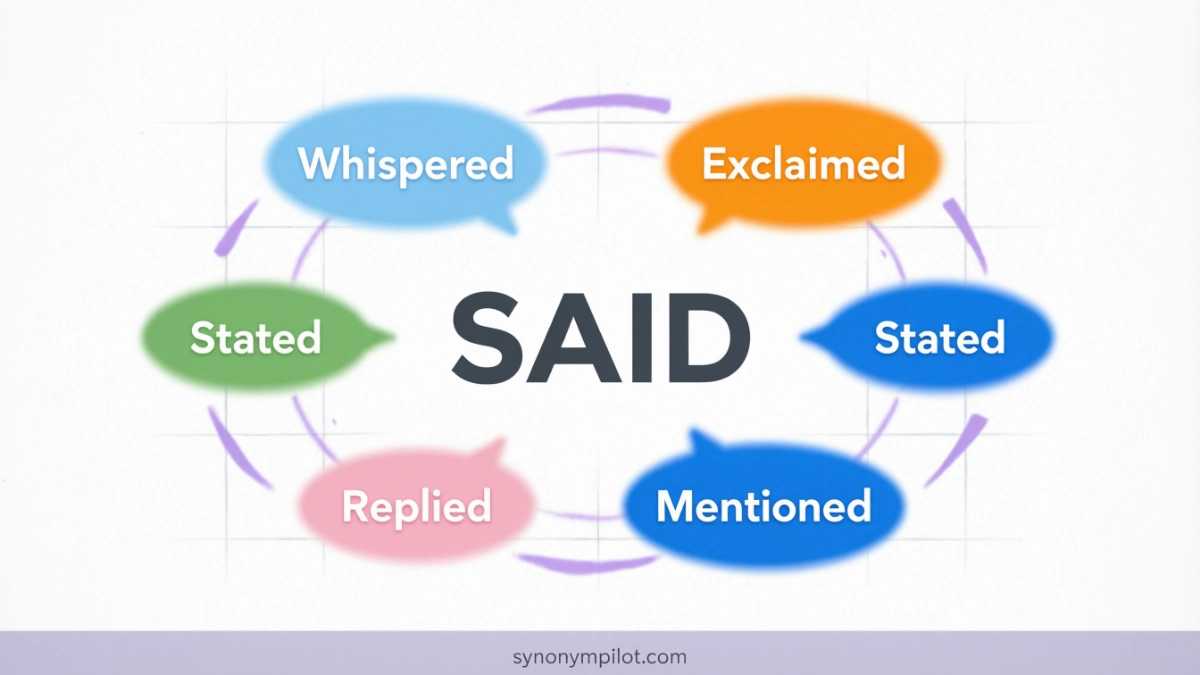
Here are some of the most natural, commonly used alternatives:
- Stated formal, often used in writing or official contexts
- Mentioned casual, implies something said briefly or in passing
- Remarked implies a casual or pointed observation
- Replied used specifically as a response to something
- Explained used when clarifying or giving reasons
- Whispered said very quietly
- Exclaimed said with strong emotion or surprise
- Announced said publicly or formally
- Murmured said softly, often unclearly
- Argued said while disagreeing or debating a point
When Not to Use This Word
Avoid said when:
- You want to show a strong emotion shouted, exclaimed, or sobbed are far more vivid
- You’re describing volume or tone whispered, mumbled, or yelled paint a clearer picture
- The speech is a direct response replied or answered shows the conversational flow better
- You’re writing formally and reporting an official statement stated or announced fits better
- You’ve used said multiple times in the same short passage rotate with a synonym to avoid repetition
Words Commonly Confused With “Said”
| Word | How It Differs from Said |
|---|---|
| Told | Usually requires an object (told her, told him, told us), while said does not. |
| Spoke | Refers to the act of speaking in general, not specific reported words. |
| Stated | More formal and official; suggests a clear and deliberate statement. |
| Asked | Used specifically for questions rather than statements. |
| Replied | Indicates a response to something previously said. |
| Talked | Refers to conversation in general, not a single quoted statement. |
Best Synonym by Context
| Context | Best Synonym | Why It Fits |
|---|---|---|
| Fiction Dialogue (Neutral) | Said, Replied | Keeps the focus on the spoken words rather than the dialogue tag. |
| Showing Strong Emotion | Exclaimed, Shouted, Cried | Adds intensity, emotion, and energy. |
| Quiet or Secretive Speech | Whispered, Murmured | Indicates low volume and a specific mood. |
| Formal or Official Statements | Stated, Announced, Declared | Sounds professional, authoritative, and precise. |
| Explaining or Clarifying | Explained, Clarified | Emphasizes the purpose behind the words. |
| Disagreement or Debate | Argued, Insisted, Protested | Shows conflict, conviction, or resistance. |
| Casual Conversation | Mentioned, Remarked, Noted | Natural alternatives that sound relaxed and conversational. |
Which Synonym Should You Choose?
Ask yourself: What does the moment actually need volume, emotion, formality, or function?
- If it’s just dialogue moving along normally → stick with said or replied
- If the character is upset, scared, or excited → use exclaimed, cried, or gasped
- If the character is being quiet or secretive → use whispered or murmured
- If you’re reporting an official or public statement → use stated, announced, or declared
- If someone is disagreeing or pushing back → use argued, insisted, or protested
- If you’re writing something formal or journalistic → use stated or noted
A simple rule professional writers follow: use “said” as your default, and reach for a stronger synonym only when the emotion or volume genuinely needs it. Overloading dialogue with dramatic verbs actually weakens writing more than repeating “said” does.
Real Life Examples of “Said” in Sentences
School
“The teacher explained that the test would cover three chapters.”
“She mentioned the deadline during yesterday’s class.”
Workplace
“The manager stated that the new policy takes effect Monday.”
“He replied to the email within minutes.”
Writing
“I can’t believe you’re leaving,” she whispered, her voice breaking.
“Get out!” he shouted, slamming the door behind her.
Conversation
“She mentioned she might be late tonight.”
“He just said he needed some time to think.”
Antonyms of Said
| Antonym | Meaning | Example Sentence |
|---|---|---|
| Silenced | Caused someone to stop speaking | The teacher silenced the class before the presentation. |
| Withheld | Chose not to say or reveal something | She withheld her opinion during the discussion. |
| Concealed | Kept information hidden | He concealed the truth from his colleagues. |
| Suppressed | Prevented something from being expressed | The government suppressed reports of the incident. |
| Ignored | Chose not to respond or speak about something | She ignored the question completely. |
| Unspoken | Not expressed in words | There was an unspoken understanding between them. |
| Silent | Not speaking; making no sound | He remained silent throughout the meeting. |
| Muted | Quiet or restrained in expression | Her reaction was muted despite the exciting news. |
Synonym Groups and Usage Differences
Formal and Professional Synonyms
Stated, declared, announced, affirmed, confirmed, acknowledged
These belong in journalism, official reports, business communication, and formal writing. They sound precise and credible, ideal for reporting facts or public statements.
Conversational and Informal Synonyms
Mentioned, remarked, reckoned, joked, teased
These feel natural in everyday speech and casual writing. Reckoned especially carries an informal, conversational tone, often used to express a personal guess or opinion.
Emotional and Vivid Synonyms
Exclaimed, cried, shouted, gasped, sobbed, snapped, sighed
These bring dialogue to life by showing emotion, volume, and physical reaction. They work especially well in fiction, where showing feeling matters more than simply reporting words.
Neutral and Functional Synonyms
Said, replied, answered, added, continued, noted
These keep the focus on the content of speech rather than tone or emotion. Professional writers use these the most because they stay invisible and let dialogue carry the story.
Strongest vs. More General
Strongest (high emotional intensity): shouted, exclaimed, cried, gasped, sobbed
More general (lower intensity, everyday use): said, mentioned, replied, noted
Use the stronger options sparingly overusing dramatic dialogue tags can feel exaggerated and pull readers out of the story.
Modern vs. Old Fashioned
Modern and common: mentioned, noted, pointed out, reckoned
Slightly old fashioned or literary: murmured, declared, affirmed, babbled
Antonyms of Said
| Antonym | Meaning | Example Sentence |
|---|---|---|
| Listened | Paid attention to spoken words instead of speaking | She listened carefully without saying a word. |
| Silenced | Made someone stop speaking | He silenced the room with a single look. |
| Withheld | Deliberately chose not to say something | She withheld her opinion during the meeting. |
| Stayed Silent | Chose not to speak | He stayed silent through the entire argument. |
| Kept Quiet | Did not say anything | She kept quiet, afraid of saying the wrong thing. |
Comparison Section
Said vs. Stated
Said is neutral and works in almost any context. Stated is more formal and implies a deliberate, official statement. Journalists often use stated for quotes from officials, while said fits everyday dialogue.
- “I’ll be there,” she said. (casual, natural)
- The director stated that the merger was finalized. (formal, official)
Said vs. Replied
Said simply reports speech. Replied specifically shows that the speech is a response to something said earlier. Using replied clarifies the back and forth of a conversation.
- “What time is it?” he said. (works, but slightly vague)
- “It’s nearly five,” she replied. (clearly a response)
Said vs. Whispered
Both report speech, but whispered adds volume and mood it tells the reader the words were spoken very quietly, often suggesting secrecy or intimacy. Said gives no information about volume at all.
- “I love you,” he said. (neutral)
- “I love you,” he whispered. (intimate, quiet, emotional)
Said vs. Exclaimed
Exclaimed adds strong emotional intensity surprise, excitement, or shock. Said remains neutral. Overusing exclaimed can feel dramatic, so save it for moments that genuinely call for that energy.
- “We won!” she said. (flat, doesn’t match the excitement)
- “We won!” she exclaimed. (matches the emotional moment)
Common Phrases and Expressions
“Easier said than done”
Meaning: Something sounds simple to talk about but is actually difficult to do.
“Quitting sugar sounds easy, but it’s easier said than done.”
“So to speak”
Meaning: Used to describe something in a non literal or figurative way.
“He’s the backbone of the team, so to speak.”
“Needless to say”
Meaning: Something so obvious it barely needs mentioning.
“Needless to say, she was thrilled about the promotion.”
“It goes without saying”
Meaning: Something is so clearly true that it doesn’t need to be stated.
“It goes without saying that honesty matters in any relationship.”
“When all is said and done”
Meaning: After everything has happened or been considered.
“When all is said and done, we did our best.”
“Said and done”
Meaning: Once something is completed or finalized.
“No sooner said than done the task was finished in minutes.”
“You can say that again”
Meaning: A way to strongly agree with someone (informal).
“That movie was incredible.” “You can say that again!”
Common Mistakes to Avoid
Overusing dramatic synonyms in every line of dialogue
Replacing said with exclaimed or shouted in every sentence makes writing feel exaggerated. Use said as your default and switch only when the moment truly needs more intensity.
Confusing “said” and “told” in grammar
Told always requires an object “He told her” while said does not need one “He said.” Writing “He said her” is incorrect.
Using “stated” in casual conversation
Stated sounds stiff and overly formal outside of news writing or official contexts. In everyday speech or casual writing, said or mentioned feels far more natural.
Mixing up “replied” with “said” in non response situations
Replied should only follow something that was actually asked or said first. Using it to start a conversation creates confusion.
Choosing emotionally strong words for neutral statements
Don’t use cried or gasped for ordinary dialogue. Match the emotional weight of the synonym to what’s actually happening in the scene.
FAQs
What is the best synonym for “said” in formal writing?
Stated and announced work best in formal and journalistic writing. They sound precise and professional, especially when reporting official statements or public announcements.
What’s a stronger word than “said” for emotional dialogue?
Depending on the emotion, try exclaimed for excitement, shouted for anger or urgency, whispered for intimacy, or gasped for shock. Each one adds a different emotional layer that “said” alone can’t provide.
Should I avoid using “said” too much in writing?
Not entirely professional fiction writers actually use said frequently because it’s neutral and doesn’t distract readers. The goal isn’t to eliminate it, but to vary it when the dialogue truly needs more emotion or volume.
What’s the difference between “said” and “told” in grammar?
Said does not require a direct object “She said hello.” Told always needs one “She told him hello.” Mixing these up is one of the most common grammar mistakes English learners make.
What’s a casual way to say “said”?
Mentioned and reckoned are great casual alternatives. They sound relaxed and natural in everyday conversation, unlike more formal options like stated or declared.
Conclusion
The word said is small but mighty it’s the quiet backbone of dialogue and reported speech in English. As you’ve seen, there’s nothing wrong with using it often. But once you understand alternatives like whispered, exclaimed, argued, and stated, you gain the power to show emotion, volume, and tone exactly when your writing needs it.
Start practicing by rewriting a few lines of dialogue you’ve written before. Notice how murmured changes the mood compared to said, or how insisted shows determination that said simply can’t capture. That kind of small, intentional practice builds real vocabulary instinct over time.
Keep experimenting with these words in your stories, emails, and everyday conversations. The more you practice choosing the right word for the right moment, the more natural and expressive your communication will become.

Hi, I’m Camron White, a word lover who enjoys exploring the beauty of the English language. I write about synonyms, meanings, and everyday vocabulary to help readers express themselves more clearly and confidently. My goal is to make learning new words simple, fun, and useful in real-life conversations. synonympilot.com