Quick Answer
“They” is a third person plural pronoun used to refer to a group of people, animals, or things. It can also refer to a single person when their gender is unknown or when they prefer gender neutral language. Common alternatives include “those people,” “the group,” “them,” and context specific phrases depending on formality and situation.
Imagine you’re writing a report and you’ve already used the word “they” five times in three sentences. Or maybe you’re giving a presentation and you want to sound more professional than just saying “they decided to cancel the meeting.” In both cases, knowing another word for “they” can genuinely improve how you write and speak.
This guide covers the most useful alternatives to “they,” explains when and how to use each one, and helps you choose the right option for school, work, writing, and everyday conversation.
Meaning, Tone, and Context
“They” is one of the most commonly used pronouns in English. Its core function is to point to a group of people or things without naming them directly. It is neutral in tone, works in both formal and informal settings, and feels completely natural in everyday speech.
Beyond referring to groups, “they” has become widely accepted as a singular gender neutral pronoun. When you don’t know someone’s gender, or when a person identifies as non binary, “they” is the respectful and grammatically accepted choice in modern English.
In tone, “they” is neither emotional nor formal. It is simply practical. It works in academic writing, casual texting, professional emails, and everything in between.
When and How to Use “They”
You use “they” when referring to more than one person or thing that was already mentioned. For example: “The students finished their exam early. They looked relieved.”
You also use “they” as a singular pronoun when gender is unknown or irrelevant. For example: “Someone left their bag at the door. They should come back for it.”
In professional writing, “they” keeps things clean and unbiased. In conversation, it flows naturally without drawing attention to itself. However, if you have repeated the word too often in your writing, or if you want more precision, you’ll want to know the alternatives covered in this article.
Another Word for They
There is no single perfect replacement for “they” because its best substitute depends entirely on context. Some alternatives work better in formal writing, others in casual speech, and some only make sense when referring to people versus things.
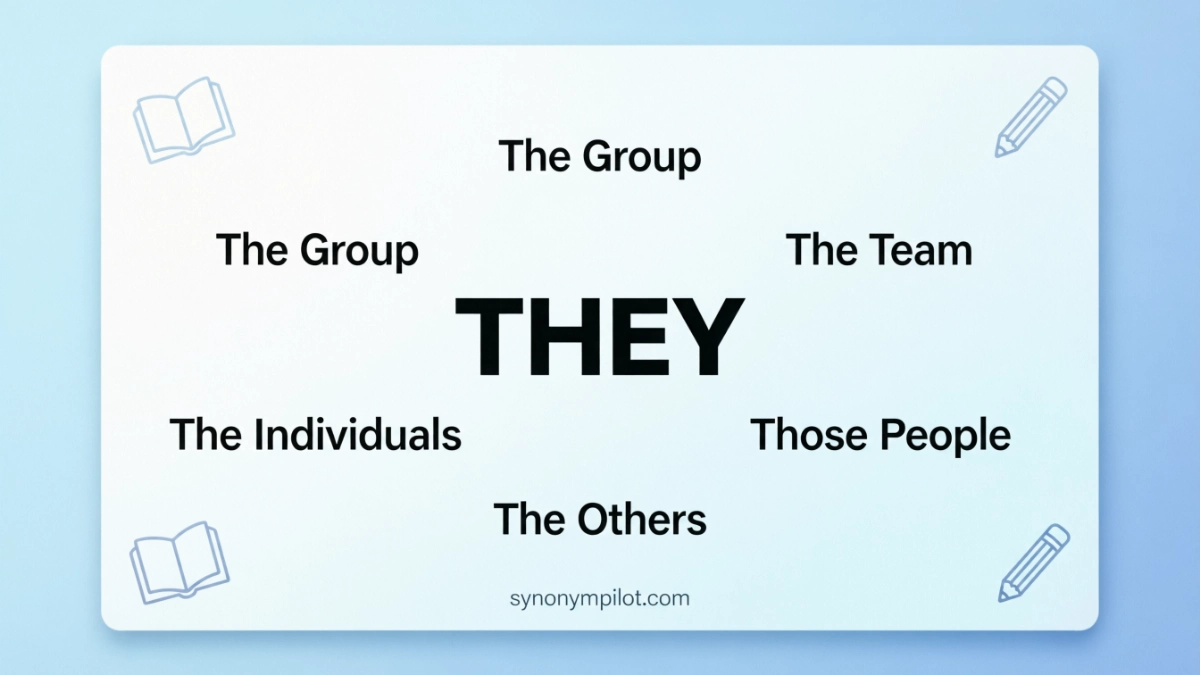
Here are the most useful options: those people, the group, the team, the individuals, them, these people, the others, the parties involved, the aforementioned, one, and context specific noun phrases like “the committee” or “the employees.”
When Not to Use “They”
Avoid replacing “they” with gendered pronouns like “he” or “she” when referring to a person of unknown gender. This is both grammatically risky and socially insensitive in many professional and academic environments today.
Do not use “they” when you are addressing someone directly. Instead of “They should know better,” say “You should know better” if you’re speaking to that person.
In very formal legal or academic writing, overly casual replacements like “those folks” or “these guys” can feel out of place. Stick to precise noun phrases in those contexts.
Words Commonly Confused With They
“They” versus “them” is the most common source of confusion. “They” is used as the subject of a sentence: “They went to the store.” “Them” is used as the object: “I saw them at the store.” Both are third person plural pronouns, but their positions in a sentence are different.
“Their” is the possessive form: “Their car is parked outside.” “There” refers to a place: “The car is over there.” These three words sound similar but carry completely different meanings, and mixing them up is one of the most frequent grammar mistakes in English writing.
Best Synonym by Context
| Context | Best Alternative | Why It Works |
|---|---|---|
| Formal writing | The individuals | Precise, professional, and neutral |
| Academic writing | The aforementioned parties | Clear reference to previously mentioned subjects |
| Workplace | The team / the group | Natural in professional environments |
| Legal documents | The parties concerned | Standard legal phrasing |
| Casual conversation | Those people / those guys | Relaxed and natural |
| Referring to a company | The organization / the firm | Correct for non-human entities |
| Gender-neutral singular | They (singular) | Widely accepted modern usage |
| Narration / storytelling | The characters / the figures | Clear and literary style |
Which Synonym Should You Choose?
The right choice depends on who you’re writing for and what level of formality the situation calls for.
If you’re writing a business email, “the team” or “the group” sounds clean and professional. If you’re working on an academic paper, “the individuals” or “the aforementioned” adds precision. If you’re chatting with a friend, “those people” or “those guys” works fine. If you’re writing a story, replacing “they” with the group’s actual name or role, such as “the soldiers” or “the council,” adds clarity and style.
The key rule is this: use the most specific noun phrase available when clarity matters, and fall back on “they” when the reference is already clear and natural.
Real Life Examples of “They” in Sentences
School: The students didn’t study for the test. They all failed the first section.
Alternative: The students didn’t study for the test. The group failed the first section entirely.
Workplace: The managers held a meeting. They decided to extend the project deadline.
Alternative: The managers held a meeting. The team decided to extend the project deadline.
Writing: The characters entered the abandoned house. They had no idea what was waiting inside.
Alternative: The characters entered the abandoned house. The group had no idea what was waiting inside.
Conversation: Did you hear about the new neighbors? They seem really friendly.
Alternative: Did you hear about the new neighbors? Those people seem really friendly.
50 Synonyms for “They”
| Synonym | Simple Meaning | Example Sentence |
|---|---|---|
| Them | Object form of “they” | I spoke to them yesterday. |
| Those people | A specific group | Those people always arrive late. |
| The group | A collection of individuals | The group made the final decision. |
| The team | People working together | The team completed the project on time. |
| The individuals | Specific people in a group | The individuals were asked to leave. |
| The others | Remaining people | The others stayed behind to help. |
| The party | Formal group/person in agreements | The party agreed to the terms. |
| The parties | Multiple groups (formal) | The parties reached an agreement. |
| The members | People belonging to a group | The members voted unanimously. |
| The crowd | Large group of people | The crowd cheered loudly. |
| The committee | Decision-making group | The committee reviewed the proposal. |
| The council | Governing group | The council approved the budget. |
| The board | Leadership group | The board rejected the merger. |
| The staff | Employees of an organization | The staff were informed this morning. |
| The employees | Workers in a company | The employees requested better hours. |
| The officials | People in authority | The officials denied the allegations. |
| The authorities | Legal or government power holders | The authorities launched an investigation. |
| The administration | Managing body | The administration released a statement. |
| The organization | Formal institution or group | The organization changed its policy. |
| The firm | Business entity | The firm expanded to three cities. |
| The company | Business organization | The company issued a public apology. |
| The agency | Government or business body | The agency updated its guidelines. |
| The institution | Formal establishment | The institution revised its rules. |
| The department | Division within a company | The department submitted its report. |
| The unit | Subgroup | The unit moved to a new location. |
| The squad | Informal team | The squad trained every morning. |
| The crew | Work group | The crew wrapped filming last week. |
| The gang | Informal group of people | The gang met up after work. |
| The bunch | Informal group | That bunch always causes trouble. |
| The lot | Whole group (informal British English) | The whole lot of them disagreed. |
| The pair | Two people | The pair left without saying goodbye. |
| The duo | Two people working together | The duo released a new album. |
| The trio | Three people | The trio won first place. |
| The panel | Group of experts | The panel discussed the policy. |
| The jury | Legal decision group | The jury reached a verdict. |
| The delegates | Representatives at events | The delegates voted on the motion. |
| The representatives | People speaking for others | The representatives attended the summit. |
| The participants | People involved in an activity | The participants completed the survey. |
| The attendees | People at an event | The attendees enjoyed the keynote. |
| The voters | People casting votes | The voters chose a new leader. |
| The citizens | Members of a country or community | The citizens demanded change. |
| The residents | People living in an area | The residents protested the law. |
| The constituents | People represented politically | The constituents contacted their senator. |
| The public | Society in general | The public deserves to know the truth. |
| The masses | Large general population | The masses rallied in the streets. |
| The opposition | Competing group or side | The opposition rejected the proposal. |
| The faction | Subgroup within a larger group | The faction broke away from the party. |
| The alliance | United group | The alliance signed a treaty. |
| One | Impersonal or general subject | One should always respect the rules. |
| The aforementioned | Previously mentioned people | The aforementioned parties must comply. |
Synonym Groups and Usage Differences
Formal alternatives:
“The individuals,” “the parties,” “the aforementioned,” and “the committee” belong in academic papers, legal documents, and formal reports. These phrases signal precision and professionalism. Use them when vague pronouns might create confusion or when you need to sound authoritative.
Informal and conversational alternatives:
“Those people,” “those guys,” “the bunch,” “the gang,” and “the crew” work well in casual speech and informal writing. They feel natural in texts, social media posts, and everyday conversations. However, they would sound too relaxed in a professional email or a research paper.
Professional and workplace alternatives:
“The team,” “the staff,” “the employees,” “the board,” and “the department” are clean, neutral, and widely used in workplace communication. They replace “they” without losing professionalism or clarity.
Academic alternatives:
“The participants,” “the subjects,” “the individuals,” and “the aforementioned” are commonly found in research writing. Academic writing values precision, so these noun based replacements are strongly preferred over pronouns.
Gender neutral usage:
When referring to a single person of unknown or non binary gender, singular “they” remains the most natural and widely accepted choice. Alternatives like “the individual” or “that person” also work in writing.
Antonyms of “They”
| Antonym | Meaning | Example |
|---|---|---|
| I | First-person singular | I made the decision myself. |
| We | First-person plural | We finished the project together. |
| You | Second-person singular or plural | You need to handle this. |
| He | Third-person masculine singular | He called this morning. |
| She | Third-person feminine singular | She approved the report. |
| It | Third-person singular for non-persons | It arrived in the mail today. |
| One | Impersonal singular subject | One must follow the rules. |
Comparison Section
They vs. Them:
“They” acts as the subject; “them” acts as the object. “They called me” is correct. “Them called me” is not. This is a common grammar mistake even among intermediate English speakers.
They vs. One:
“One” is more formal and impersonal. It is common in British English and academic writing. “One should always verify sources” sounds more detached than “They should always verify sources.”
They vs. Those people:
“Those people” is slightly more emphatic and can sometimes carry a distant or even dismissive tone depending on context. Use it carefully in sensitive conversations.
They vs. The group:
“The group” is more specific and clearer, especially when “they” has been used multiple times. It also helps readers who might have lost track of who “they” refers to.
Common Phrases and Expressions
They say:
Used to reference popular opinion or common belief. “They say that practice makes perfect.”
They’re all in:
Means everyone in the group is fully committed. “The team reviewed the plan and they’re all in.”
They call the shots:
Means the group holds the decision making power. “In this organization, the board calls the shots.”
They came, they saw, they conquered:
A classic expression based on Julius Caesar’s famous phrase, now used to describe decisive success.
They mean business:
Means the group is serious and not to be taken lightly. “The inspectors arrived early. They mean business.”
Common Mistakes to Avoid
Do not confuse “they,” “their,” and “there.” These three sound alike but mean completely different things. Always double check which form you need based on your sentence structure.
Avoid using “they” when the reference is unclear. If you’ve introduced multiple groups in a paragraph, “they” becomes confusing. Swap it with the group’s specific name or role.
Do not replace singular “they” with “he or she” in every sentence. While “he or she” is technically correct, repeating it becomes awkward. Singular “they” is the cleaner, widely accepted modern alternative.
Avoid “those people” in sensitive or potentially charged conversations. Depending on tone and context, it can sound cold or dismissive.
FAQs
What is another word for “they” in formal writing?
In formal writing, the best alternatives are “the individuals,” “the parties,” “the group,” or a specific noun phrase like “the committee” or “the employees.” These options sound precise and professional.
Can I use “they” for a single person?
Yes, singular “they” is grammatically correct and widely accepted today. Use it when someone’s gender is unknown or when a person uses gender neutral pronouns.
What is the difference between “they” and “them”?
“They” is the subject pronoun: “They completed the task.” “Them” is the object pronoun: “I thanked them for the help.” They both refer to the same people but play different roles in a sentence.
Is it rude to say “those people”?
Not always, but context matters. In some situations, “those people” can sound dismissive or othering. In neutral contexts it is fine, but be mindful of tone when referring to specific social or cultural groups.
How do I avoid repeating “they” too often in my writing?
Replace “they” with the actual noun it refers to every few sentences. For example, instead of writing “they” four times, use “the team,” “the staff,” “the group,” or the people’s specific role or name to keep the writing varied and clear.
Conclusion
Expanding your vocabulary beyond “they” is a small change that makes a noticeable difference in how clearly and professionally you communicate. Whether you’re writing an academic paper, drafting a work email, or simply trying to avoid repetition in your daily writing, having a range of alternatives ready genuinely helps.
Start by noticing how often you use “they” in a single paragraph. Then try swapping it for a more specific noun phrase. You don’t need to replace every instance, but varying your word choice makes your writing stronger, clearer, and more interesting to read.
Practice this in your everyday writing, and you’ll start to see the difference almost immediately. Vocabulary grows one word at a time, and this is a great place to start.

Hi, I’m J.D. Salinger—a language lover who enjoys uncovering the nuances of words. I write about synonyms, meanings, and vocabulary tips to help readers express themselves more clearly and confidently. My goal is to make learning new words fun, simple, and practical. synonympilot.com