Quick Answer
“It” is a third person singular pronoun used to refer to a thing, animal, idea, situation, or concept that has already been mentioned. It replaces a noun to avoid repetition and keeps sentences flowing naturally.
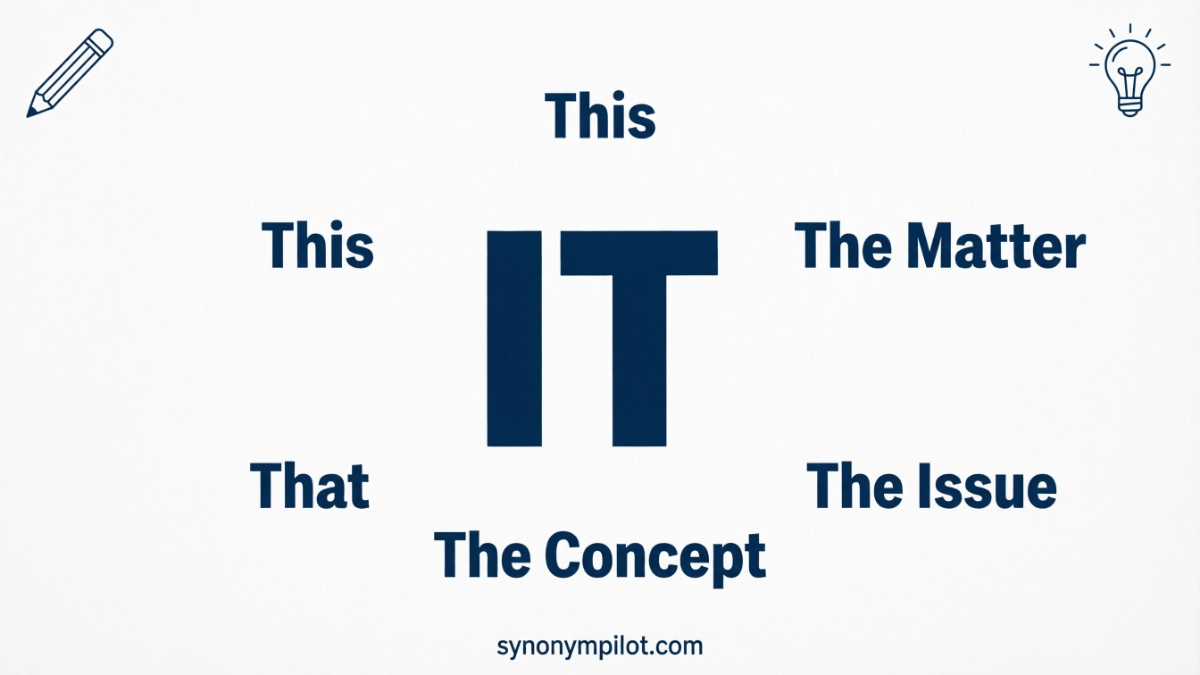
Common alternatives include “this,” “that,” “the thing,” “the matter,” and specific noun phrases depending on context.
You’re writing an email to your manager: “I reviewed the report. It had several errors. It also missed the deadline section. It needs to be revised before Monday.” By the third sentence, “it” starts to feel lazy and unclear. Your reader might even lose track of what “it” refers to.
That’s exactly when knowing another word for “it” becomes genuinely useful. If you’re writing an essay, drafting a professional message, or just trying to sound less repetitive in conversation, having strong alternatives ready makes a real difference.
Meaning, Tone, and Context
At its core, “it” is a neutral, impersonal pronoun. It refers back to something already mentioned, whether that’s a physical object, an abstract idea, a situation, or even an animal whose gender isn’t specified. For example: “The meeting ran long. It felt exhausting.”
In terms of tone, “it” is completely neutral. It works in formal essays, casual texts, academic writing, and professional emails without sounding out of place. However, that very neutrality is also its weakness. When used too often, “it” can make writing feel vague, lazy, or confusing, especially when multiple nouns appear in the same paragraph.
“It” sounds most natural when the reference is crystal clear and only one thing could logically be meant. The moment any ambiguity creeps in, a more specific alternative instantly improves clarity.
When and How to Use “It”
Use “it” when you’ve clearly introduced a subject and want to refer back to it without repeating the full noun. For example: “She opened the package. It contained a handwritten letter.”
You also use “it” in fixed expressions and weather or time references where no specific noun is implied. “It is raining.” “It is three o’clock.” “It seems like a good idea.” In these cases, “it” functions as a dummy subject, meaning it holds the grammatical position of a subject without referring to anything specific.
In storytelling and descriptive writing, “it” can build suspense. “Something moved in the shadows. It was watching them.” Here, the vagueness of “it” actually serves a purpose.
Another Word for It
The best alternative to “it” depends on what “it” is referring to in the first place. For objects, “this,” “that,” or “the item” work well. For situations, “the matter,” “the issue,” or “the case” add precision. For ideas, “the concept,” “the notion,” or “the point” sound more specific and thoughtful.
When “it” refers to something abstract, replacing it with the actual noun or idea almost always improves the sentence. Instead of “It was a mistake,” try “The decision was a mistake.” Instead of “It doesn’t matter,” try “The issue doesn’t matter” or “This doesn’t matter.”
When Not to Use “It”
Avoid “it” when the reference is ambiguous. If your paragraph mentions a plan, a meeting, and a deadline, writing “it was postponed” leaves your reader guessing which one you mean.
Do not use “it” to refer to a person, even informally. Referring to a person as “it” sounds dehumanizing and rude. Use “he,” “she,” or “they” instead depending on the person’s pronouns.
Also avoid starting too many consecutive sentences with “it.” This pattern weakens your writing style quickly and signals a lack of vocabulary range, especially in academic and professional contexts.
Words Commonly Confused With It
“It” versus “this”: “This” points to something close, specific, or just introduced. “It” refers back to something already established. “This is a great idea” introduces the idea. “It makes sense for our team” continues discussing it.
“It” versus “that”: “That” often refers to something more distant, either physically or in time. “That was a difficult week” feels more removed than “It was a difficult week.” Both work, but “that” carries a slightly stronger sense of looking back.
“It” versus “its”: “Its” is the possessive form. “The company released its report” means the report belongs to the company. “It” simply replaces the noun without showing ownership.
Best Synonym by Context
| Context | Best Alternative | Why It Works |
|---|---|---|
| Formal writing | The matter / the issue | Precise and professional |
| Academic writing | The concept / the subject | Clearer and more scholarly |
| Business emails | The item / the point / this | Clean and direct |
| Storytelling | The thing / the object | Maintains narrative flow |
| Casual conversation | This / that | Natural and easy |
| Referring to a situation | The case / the circumstance | Adds specificity |
| Referring to an idea | The notion / the idea itself | Removes ambiguity |
| Legal or technical writing | The aforementioned / the said item | Formal and precise |
| Describing a task | The task / the assignment | More informative |
| Referring to a problem | The problem / the issue | Stronger and clearer |
Which Synonym Should You Choose?
First, identify exactly what “it” refers to in your sentence. Then ask yourself whether a specific noun phrase would be clearer. If yes, use it.
For professional writing, lean toward “the matter,” “the issue,” or “the point.” For academic papers, “the concept,” “the subject,” or “the aforementioned” add scholarly weight. For everyday conversation, “this” and “that” are your most natural choices. For creative writing, sometimes keeping “it” vague serves the story, but replacing it with a vivid noun often makes the scene stronger.
The core principle is simple: the more specific your replacement, the clearer and more confident your writing sounds.
Real Life Examples of “It” in Sentences
School: The teacher explained the formula. It confused most of the class.
Alternative: The teacher explained the formula. The concept confused most of the class.
Workplace: We received the client’s feedback. It was mostly positive.
Alternative: We received the client’s feedback. The response was mostly positive.
Writing: The old house stood at the end of the road. It had been empty for decades.
Alternative: The old house stood at the end of the road. The building had been empty for decades.
Conversation: Did you watch the game last night? It was incredible.
Alternative: Did you watch the game last night? That match was incredible.
50 Synonyms for “It”
| Synonym | Simple Meaning | Example Sentence |
|---|---|---|
| This | Refers to something nearby or just introduced | This needs your attention right away. |
| That | Refers to something more distant or already past | That was a poor decision in hindsight. |
| The thing | Informal reference to an object or matter | The thing broke before I even used it. |
| The matter | A situation or issue being discussed | Let’s not delay the matter any further. |
| The issue | A problem or topic at hand | The issue was resolved by morning. |
| The subject | The topic being discussed | The subject deserves more attention. |
| The object | A physical item being referred to | Place the object on the table carefully. |
| The item | A specific thing or entry | The item was removed from the agenda. |
| The point | The key idea or argument | The point was made very clearly. |
| The concept | An abstract idea | The concept took a while to understand. |
| The notion | A belief or abstract idea | The notion was rejected by the team. |
| The idea | A thought or suggestion | The idea sounds promising to everyone. |
| The case | A situation or set of facts | The case was presented to the board. |
| The situation | A set of circumstances | The situation changed overnight. |
| The circumstance | The specific conditions around something | The circumstance was difficult to navigate. |
| The detail | A specific piece of information | The detail was overlooked in the draft. |
| The fact | A true piece of information | The fact speaks for itself. |
| The reality | What is actually true | The reality is harder to accept. |
| The truth | What is genuine or accurate | The truth came out eventually. |
| The problem | Something causing difficulty | The problem was identified too late. |
| The challenge | A difficult task or situation | The challenge required creative thinking. |
| The task | A piece of work to be done | The task was completed ahead of schedule. |
| The assignment | A specific job or duty | The assignment was submitted on time. |
| The project | A planned piece of work | The project ran over budget. |
| The plan | An intended course of action | The plan was approved last week. |
| The proposal | A formal suggestion | The proposal was sent to the client. |
| The report | A formal written account | The report needs one more revision. |
| The document | A written or digital record | The document was shared via email. |
| The file | A collection of related information | The file was corrupted during transfer. |
| The data | Facts and statistics | The data supports our original theory. |
| The result | An outcome or consequence | The result surprised everyone on the team. |
| The outcome | The final result of something | The outcome was better than expected. |
| The decision | A choice that has been made | The decision stands as of this morning. |
| The choice | A selection between options | The choice turned out to be the right one. |
| The answer | A response or solution | The answer was simpler than we thought. |
| The solution | A way to fix a problem | The solution worked on the first try. |
| The response | A reply or reaction | The response arrived later than expected. |
| The reaction | How something responded | The reaction from the audience was positive. |
| The effect | The result of a cause | The effect was felt across the entire team. |
| The impact | A strong or notable effect | The impact of the change was immediate. |
| The development | A new event or progress | The development changed our strategy. |
| The event | Something that happened | The event drew a large crowd. |
| The occurrence | Something that took place | The occurrence was logged in the records. |
| The incident | A specific happening, often problematic | The incident was reported to management. |
| The experience | Something lived through | The experience was unforgettable. |
| The process | A series of steps | The process takes about three business days. |
| The procedure | An established method | The procedure must be followed exactly. |
| The mechanism | The system or process behind something | The mechanism failed under pressure. |
| The phenomenon | A remarkable or observable event | The phenomenon was studied by scientists. |
| The aforementioned | Something already referred to formally | The aforementioned clause applies here. |
Synonym Groups and Usage Differences
Formal alternatives:
“The matter,” “the issue,” “the circumstance,” “the aforementioned,” and “the said item” work best in legal documents, formal reports, and academic writing. These options signal professionalism and remove any ambiguity that a simple “it” might create.
Informal and conversational alternatives:
“This,” “that,” “the thing,” and “the deal” are natural in everyday speech and casual writing. These feel relaxed and human without losing clarity. You’d use them comfortably in a text message or a friendly conversation.
Academic alternatives:
“The concept,” “the notion,” “the subject,” “the phenomenon,” and “the data” are strong choices in research papers and academic essays. Academic writing values specificity, so replacing “it” with these terms instantly strengthens your argument.
Professional and workplace alternatives:
“The item,” “the point,” “the proposal,” “the report,” and “the outcome” are clean and direct. Business communication rewards clarity, and these replacements make your emails and presentations sound more confident and organized.
Narrative and creative writing alternatives:
In storytelling, you often want to keep “it” for deliberate suspense or mystery. However, swapping “it” for “the object,” “the figure,” “the sound,” or the actual noun creates stronger imagery and more vivid scenes.
Antonyms of “It”
Since “it” is a pronoun rather than a descriptive word, true antonyms do not exist in the traditional sense. However, the following contrasting pronouns provide the clearest opposites based on grammatical person and reference.
| Antonym | Meaning | Example |
|---|---|---|
| I | First-person singular | I made the final call on this. |
| You | Second-person singular or plural | You need to handle this directly. |
| We | First-person plural | We decided to move forward together. |
| They | Third-person plural | They reviewed the plan last night. |
| He | Third-person masculine singular | He submitted the report early. |
| She | Third-person feminine singular | She responded within the hour. |
| Nothing | Absence of the thing referred to | Nothing came of the discussion. |
| Everything | All things collectively | Everything was handled before noon. |
Comparison Section
It vs. This
“This” introduces or highlights something with more emphasis. “It” simply continues a reference already made. “This is the problem we need to fix” draws attention to the problem. “It is the problem we need to fix” assumes the reader already knows what you’re talking about. Use “this” when you want to point something out clearly or start a new thought.
It vs. That
“That” creates a sense of distance, whether physical, emotional, or in time. “It was a good meeting” is neutral. “That was a good meeting” suggests the meeting is over and you’re looking back at it. “That” also works to dismiss or emphasize in a way “it” cannot. “That’s exactly the issue” sounds stronger than “It’s exactly the issue.”
It vs. The Thing
“The thing” is casual and often signals that the speaker is searching for a more precise word. It works in conversation but sounds vague in writing. Use it sparingly and only when speaking or writing in a clearly informal tone.
It vs. The Matter
“The matter” adds formality and seriousness. “Let’s discuss it” is casual. “Let’s discuss the matter” implies a serious, professional conversation. Swap “it” for “the matter” whenever you want to elevate the register of your writing.
It vs. The Issue
“The issue” implies something requires attention or resolution. “It” is neutral and doesn’t carry that weight. “It was discussed briefly” feels lighter than “The issue was discussed briefly,” which signals something more urgent or important.
Common Phrases and Expressions
It goes without saying
Means something is so obvious it barely needs stating. “It goes without saying that honesty matters in every relationship.”
It’s up in the air
Means something is uncertain and not yet decided. “The project timeline is still up in the air.”
It’s a long shot
Means something is possible but unlikely. “Winning the contract is a long shot, but we’ll try.”
It’s the last straw
Means the final problem in a series that finally causes a reaction. “Forgetting the meeting for the third time was the last straw.”
It’s on the table
Means an option or proposal is being considered. “A full restructuring is on the table right now.”
It comes with the territory
Means something is an expected part of a situation or job. “Dealing with difficult clients comes with the territory.”
Common Mistakes to Avoid
The biggest mistake writers make with “it” is using it when the reference is unclear. Always ask yourself: could a reader reasonably wonder what “it” refers to? If the answer is yes, replace it with the specific noun.
Do not confuse “it’s” and “its.” “It’s” is a contraction of “it is.” “Its” shows possession. “It’s raining” means “it is raining.” “The dog licked its paw” shows the paw belongs to the dog. Mixing these two up is one of the most common grammar errors in English.
Avoid using “it” as a filler at the start of too many sentences. “It is important to note that…” and “It should be mentioned that…” often just delay the real point. Cut straight to what you mean instead.
Finally, do not use vague replacements like “the thing” or “the stuff” in formal or professional writing. These sound unpolished and undermine your credibility.
FAQs
What is another word for “it” in formal writing?
In formal writing, your best options are “the matter,” “the issue,” “the subject,” “the aforementioned,” or the specific noun the pronoun refers to. These choices add clarity and professionalism that a plain “it” often lacks.
Can I use “this” instead of “it”?
Yes, and often “this” is the stronger choice. “This” adds a sense of immediacy and draws the reader’s attention. However, use it to introduce or highlight something, not just as a direct swap for every “it” in your writing.
Why does “it” sometimes feel vague in writing?
Because “it” doesn’t carry any meaning on its own. It only works when the reference is completely clear from earlier in the text. When multiple nouns appear in a paragraph, “it” can point to any of them, which creates confusion.
What is the difference between “it’s” and “its”?
“It’s” always means “it is” or “it has.” “Its” shows that something belongs to the subject. A quick test: if you can replace the word with “it is” and the sentence still makes sense, use “it’s.” If not, use “its.”
How do I stop overusing “it” in my essays?
Read your paragraph out loud and note every time “it” appears. Then identify what each “it” refers to and replace at least every other instance with the actual noun or a specific phrase like “the concept,” “the result,” or “the decision.” Your writing will immediately feel more precise and confident.
Conclusion
Replacing “it” with a more specific word is one of the simplest upgrades you can make to your writing. You don’t need to eliminate “it” completely. In fact, “it” is perfectly fine when the reference is obvious.
However, when your writing feels repetitive or vague, reaching for a more precise alternative like “the matter,” “the concept,” “this,” or “the outcome” instantly adds clarity and confidence.
Start small. Take one paragraph you’ve written recently and look for every “it.” Ask yourself whether a specific noun phrase would communicate the same idea more clearly. More often than not, it will.
Practice this habit consistently, and your writing will become noticeably sharper, cleaner, and more professional over time. Every strong writer starts exactly where you are now.

Hi, I’m Theo John, a passionate word explorer who loves diving into the beauty of the English language. I write about synonyms, word meanings, and practical vocabulary tips to help readers communicate with confidence. synonympilot.com