Quick Answer
“Best” means the highest quality, most suitable, or most excellent option among all others. It describes something that surpasses everything else in a specific situation or category. Depending on context, it can refer to performance, quality, skill, or personal preference.
Your manager just sent you an email asking for your “best work” on the upcoming project. You know what to write but suddenly “best” feels too plain, too repeated, too weak for the impression you want to make. Sound familiar?
If you are writing a professional email, crafting an essay, or even posting on social media, using the same word repeatedly makes your language feel flat. Replacing “best” with the right synonym can completely change how your message lands more confident, more precise, or more fitting for the moment.
This guide gives you over 50 powerful synonyms for “best,” explains exactly when and how to use each one, and helps you choose the right word every time.
Meaning, Tone, and Context
At its core, “best” is a superlative adjective the top form of “good.” But the word carries different tones depending on how you use it.
In casual conversation, “best” feels warm and natural: “She is my best friend.” In professional writing, it can sound too simple or generic: “We provide the best services” is vague and overused in business language. In academic writing, it often needs to be replaced with something more precise like “optimal,” “superior,” or “most effective.”
“Best” is neutral in emotional tone, widely understood, and suitable for most audiences. However, because it is so common, it frequently loses impact. Synonyms help you restore that impact by being more specific about what kind of “best” you mean the most efficient, the most fitting, the most admired, or the most powerful.
When and How to Use “Best”
Use “best” when you want to make a clear, simple comparison between options. It works well in everyday speech, informal writing, product descriptions, and friendly recommendations.
- “This is the best coffee shop in the city.”
- “You gave your best effort today that is what matters.”
- “We chose the best candidate for the position.”
However, in formal reports, academic essays, or professional proposals, stronger or more precise synonyms almost always serve you better. Instead of writing “the best solution,” try “the most effective solution” or “the optimal approach.”
Another Word for Best
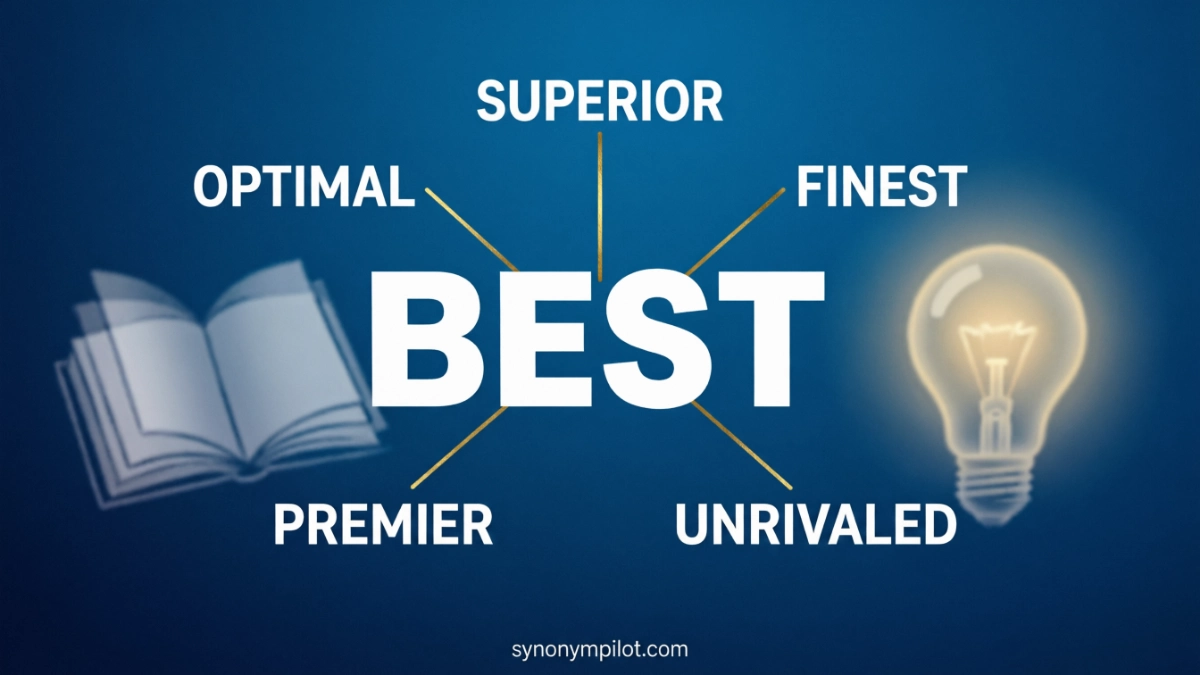
Looking for another word for “best”? The most commonly used alternatives include superior, optimal, finest, top tier, premier, ideal, and outstanding. Each of these shifts the meaning slightly “optimal” leans technical, “finest” sounds refined, and “premier” carries prestige. The right choice depends on your tone, audience, and purpose.
When Not to Use This Word
Avoid “best” when precision matters. In medical, legal, or technical writing, vague superlatives can undermine your credibility. “The best treatment” tells a reader very little “the most clinically proven treatment” is far more authoritative.
Also avoid “best” in formal cover letters when listing skills: “I am the best candidate” sounds boastful rather than confident. Instead, try: “I am exceptionally well suited for this role.”
In marketing copy, “best” is so overused that most readers mentally tune it out. Choose something specific that actually describes what makes your product stand out.
Words Commonly Confused With “Best”
Many people confuse “best,” “better,” “optimal,” “ideal,” and “perfect.” Here is the key difference:
“Better” is comparative it compares two things. “Best” is superlative it compares three or more. “Optimal” means the most favorable under specific conditions, often used in science and business. “Ideal” suggests the perfect standard in theory, not necessarily reality. “Perfect” means without any flaws a stronger and more absolute claim than “best.”
Using “perfect” when you mean “best” can come across as exaggerated, while using “better” instead of “best” may confuse your reader about how many options you are comparing.
Best Synonym by Context
| Context | Best Synonym to Use | Why It Fits |
|---|---|---|
| Academic writing | Optimal, superior, most effective | Formal, precise, and analytical tone |
| Business / professional | Premier, leading, top tier | Sounds authoritative and credible |
| Creative writing | Finest, matchless, transcendent | Expressive and emotionally powerful |
| Everyday conversation | Great, top, awesome | Natural, simple, and commonly used |
| Technical / scientific | Optimal, most efficient, peak | Focuses on precision and performance |
| Emotional / personal | Dearest, most cherished, greatest | Warm, intimate, and heartfelt |
| Marketing copy | Unrivaled, unmatched, industry-leading | Strong persuasive and promotional tone |
| Formal recommendation | Most suitable, most qualified, foremost | Objective, respectful, and professional |
Which Synonym Should You Choose?
The right synonym depends on three things: your audience, your purpose, and the level of formality required.
For professional writing, choose “optimal,” “superior,” or “foremost.” For academic papers, “most effective” or “highest performing” signals analytical thinking. For creative writing, words like “unparalleled” or “transcendent” add emotional depth. For casual speech, “top,” “awesome,” or “greatest” sound natural and approachable.
One simple rule: if “best” feels too plain in your sentence, ask yourself am I describing quality, suitability, performance, or rank? That answer points you to the right synonym.
Real Life Examples of “Best” in Sentences
School: “She submitted the most outstanding project in the class and earned extra credit.”
Workplace: “The team developed an optimal strategy that reduced costs by thirty percent.”
Writing: “Among all the candidates, his credentials were the most impressive and most relevant to the role.”
Conversation: “Honestly, this is the greatest pizza I have ever had no competition.”
50 Synonyms for “Best”
| Synonym | Simple Meaning | Example Sentence |
|---|---|---|
| Superior | Higher in quality than others | This material is superior to anything else on the market. |
| Optimal | Most favorable under given conditions | We found the optimal time to launch the product. |
| Finest | Of the highest standard or quality | She wore her finest dress to the ceremony. |
| Premier | First in rank or importance | He trained at a premier medical institution. |
| Foremost | Most important or leading | She is one of the foremost scientists in her field. |
| Ideal | Perfectly suited or best possible | This location is ideal for a coffee shop. |
| Top | Highest in rank or performance | He finished in the top position in his class. |
| Outstanding | Exceptionally good | Her performance was truly outstanding. |
| Excellent | Extremely good | The team delivered excellent results this quarter. |
| Exceptional | Beyond normal standards | His dedication to the project was exceptional. |
| Unrivaled | Having no equal | Their service is unrivaled in the industry. |
| Unmatched | Without competition | The chef’s skill is unmatched. |
| Unparalleled | Having no comparison | The view was unparalleled. |
| Supreme | Highest in quality or authority | She showed supreme patience. |
| Ultimate | The very best or most extreme | This is the ultimate luxury car. |
| Greatest | Most distinguished or highest level | He is the greatest of all time. |
| Matchless | Without equal | Her dedication was matchless. |
| Peerless | Having no peers | The performance was peerless. |
| Preeminent | Standing above all others | She is preeminent in law. |
| Leading | Most advanced or important | They are a leading tech company. |
| Top-tier | Highest level or rank | He studied at a top-tier university. |
| First-rate | Of the highest quality | The service was first-rate. |
| First-class | Top standard available | The hotel offers first-class comfort. |
| Prime | Highest quality or importance | This is prime real estate. |
| Cream of the crop | The very best in a group | Only the cream of the crop is selected. |
| Gold standard | The best benchmark | This method is the gold standard. |
| Top-notch | Extremely good | Their support team is top-notch. |
| A-grade | Highest rating level | She gave an A-grade performance. |
| Ace | Expert-level skill | He is an ace negotiator. |
| Stellar | Exceptionally good | She gave a stellar performance. |
| Magnificent | Impressively excellent | The building is magnificent. |
| Superb | Of the highest quality | The meal was superb. |
| Exemplary | Serving as the best model | Her behavior is exemplary. |
| Most effective | Producing best results | This is the most effective method. |
| Most suitable | Best fitting for purpose | She is the most suitable candidate. |
| Most qualified | Best credentials | He is the most qualified applicant. |
| Dominant | Most powerful or influential | They are the dominant company. |
| Crowning | Highest achievement | That was his crowning moment. |
| Benchmark | Standard for comparison | It became the industry benchmark. |
| Transcendent | Beyond ordinary limits | A transcendent performance. |
| Consummate | Highly skilled and complete | She is a consummate professional. |
| Quintessential | Perfect example | He is the quintessential leader. |
| Head and shoulders above | Clearly better than others | Her work was head and shoulders above the rest. |
| Definitive | Most authoritative | This is the definitive guide. |
| Flawless | Without mistakes | Her execution was flawless. |
| Incomparable | Beyond comparison | The experience was incomparable. |
| Top-performing | Achieving highest results | He is a top-performing employee. |
| World-class | Among the best globally | She trained at a world-class facility. |
| Peak | Highest point of ability | He is at peak performance. |
| Unsurpassed | Never exceeded | Her skill remains unsurpassed. |
Synonym Groups and Usage Differences
Formal and Academic
Words like “optimal,” “superior,” “foremost,” “preeminent,” and “most effective” belong to formal and academic registers. They suggest careful, evidence based thinking and work best in research papers, official reports, and professional proposals. These words signal precision rather than enthusiasm.
Professional and Business
“Premier,” “leading,” “top tier,” “world class,” and “benchmark” are favorites in business writing, marketing materials, and professional profiles. They carry prestige without sounding overly emotional. Use them when addressing clients, executives, or industry audiences.
Conversational and Informal
“Top notch,” “stellar,” “ace,” “A grade,” and “top” suit everyday speech, casual emails, and informal writing. They feel energetic and relatable without being too stiff or too slang heavy.
Emotional and Personal
“Greatest,” “matchless,” “incomparable,” and “transcendent” carry genuine feeling and admiration. These work beautifully in personal letters, wedding speeches, tributes, and creative writing where you want to convey deep appreciation or awe.
Strongest vs. Weaker Options
“Unparalleled,” “peerless,” “consummate,” and “unsurpassed” are the strongest synonyms they make an absolute claim. “Good,” “top,” or “excellent” are softer and safer. Use the strongest options only when the claim is genuinely defensible.
Phrases and Idioms
“Cream of the crop,” “head and shoulders above,” and “gold standard” are idiomatic expressions that feel natural in speech and informal writing. They add color and personality but are too casual for formal academic use.
Best Synonym by Context
| Context | Best Antonym to Use | Why It Fits |
|---|---|---|
| Quality comparison | Worst | Direct opposite of best in everyday use |
| Formal evaluation | Inferior | Neutral, professional comparison |
| Performance ranking | Poorest | Clear lowest performance level |
| Academic or analysis | Substandard | Indicates below required standard |
| Casual conversation | Bad / Not good | Natural, simple everyday language |
| Technical / process | Least effective | Focuses on efficiency and results |
| Competitive results | Last place | Clear ranking opposite of “best” |
| Moderate criticism | Mediocre | Shows average or unimpressive quality |
Comparison Section
Best vs. Optimal
“Best” is general and emotional; “optimal” is technical and condition specific. You would say “the best birthday gift” but “the optimal dosage” in a medical context. Mixing these up makes writing feel either too casual or too cold for the situation.
Best vs. Ideal
“Ideal” describes a perfect theoretical standard, while “best” refers to the top actual option available. “The ideal candidate would have ten years of experience” means perfection in theory. “She is the best candidate we interviewed” means the top real world choice.
Best vs. Perfect
“Perfect” is stronger and more absolute; it implies zero flaws. “Best” simply means highest among available options. Calling something “perfect” sets a higher standard than “best,” and using it carelessly can sound exaggerated.
Best vs. Superior
“Superior” always implies a direct comparison: something is better than something else. “Best” stands alone as the top of all options. “This model is superior to last year’s version” here you need “superior,” not “best,” because you are comparing two specific things.
Common Phrases and Expressions
“The gold standard”
Used to describe the best recognized example in a field. Example: “Their onboarding program has become the gold standard in the tech industry.”
“Cream of the crop”
Refers to the very best individuals from a group. Example: “Only the cream of the crop gets selected for this scholarship.”
“At its best”
Describes something performing at its highest level. Example: “This is the team at its best focused, creative, and unstoppable.”
“Best of the best”
The absolute top tier. Example: “The academy trains the best of the best in emergency response.”
“Head and shoulders above”
Clearly superior to all others. Example: “Her proposal was head and shoulders above every other submission.”
“Second to none”
Absolutely the best; no one or nothing is better. Example: “His commitment to quality is second to none.”
Common Mistakes to Avoid
Many writers overuse “best” to the point where it loses all meaning, especially in cover letters, marketing copy, and product descriptions. Phrases like “the best quality,” “the best service,” and “the best results” appear so frequently that readers simply ignore them.
Another common mistake is using “best” when “better” is correct. Remember: “better” compares two things, while “best” compares three or more. “She is better than her sister at math” not “the best.”
Avoid using very strong synonyms like “unparalleled” or “transcendent” for minor things. Saying your team’s Monday meeting was “transcendent” sounds unnatural and weakens your credibility. Save the strongest words for genuinely extraordinary situations.
Finally, do not confuse “optimal” with “best” in emotional or personal contexts. “The optimal birthday gift” sounds clinical and strange. “The best birthday gift” is natural and warm.
FAQs
What is the most formal synonym for “best”?
“Optimal,” “foremost,” and “preeminent” are among the most formal alternatives. They suit academic papers, official reports, and professional documents where precision and credibility matter.
Can I use “greatest” instead of “best” in all situations?
Not always. “Greatest” carries more emotional weight and is often used for people, achievements, or experiences “the greatest athlete,” “the greatest moment of my life.” For technical or professional writing, “optimal” or “most effective” fits better.
What is the difference between “best” and “finest”?
“Finest” suggests refinement, elegance, and craftsmanship. You would use it for luxury products, high end dining, or skilled artistry. “Best” is more neutral and general. “Finest” often implies a sensory or aesthetic quality that “best” does not carry.
Is “top notch” appropriate in formal writing?
No “top notch” is informal and conversational. It works well in casual emails, team communications, and everyday speech, but you should replace it with “excellent,” “superior,” or “outstanding” in formal or academic writing.
How do I avoid overusing “best” in my writing?
Before writing “best,” ask yourself: what specifically makes it the best? Is it the most effective, the most suitable, the most skilled, or the most admired? That answer gives you a more precise and powerful synonym. Reading widely and keeping a personal vocabulary list also helps you build the habit naturally over time.
Conclusion
Expanding your vocabulary beyond “best” is one of the most practical things you can do for your writing and communication. If you are sending a professional email, writing an academic paper, or just trying to express yourself more clearly, having the right word ready makes a real difference.
You do not need to memorize all 50 synonyms at once. Start with five or six that match your most common writing situations, perhaps “optimal” for work reports, “outstanding” for feedback, and “finest” for creative writing. Use them in real sentences, notice how they feel, and build from there.
Language improves through practice, not perfection. Every time you reach for a more precise word instead of a default one, your communication becomes a little sharper, a little more confident, and a little more memorable. Keep writing, keep experimenting, and enjoy the process.

Hi, I’m George Philip—an English language enthusiast who enjoys uncovering the nuances of words. I write about synonyms, vocabulary, and everyday language tips so readers can improve their communication and express themselves effectively. Learning new words should be fun, practical, and inspiring! synonympilot.com