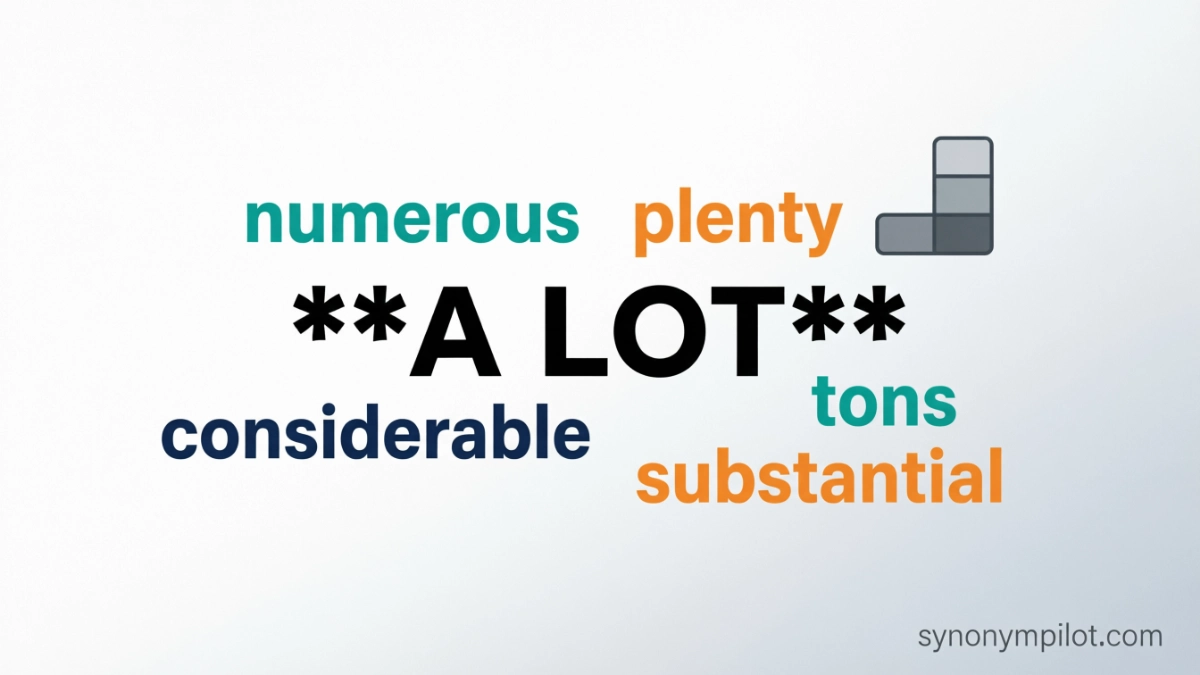
Quick Answer: “A lot” means a large amount, number, or degree of something. It is informal and extremely common in everyday speech and writing. In formal writing, words like “significantly,” “considerably,” or “numerous” can replace “a lot,” while “tons” and “loads” sound more casual.
You text a friend: “I have a lot of work this week.” It is simple, clear, and perfectly natural. But when writing a cover letter, you wouldn’t say “I have a lot of experience in marketing.” Instead, you’d write “I have considerable experience in marketing” or “extensive experience in marketing.”
Same idea, completely different tone and that tone shift can make a real difference in how professional your writing sounds.
What Does “A Lot” Mean?
“A lot” means a large quantity, number, or degree of something. It can describe countable things (“a lot of books”) or uncountable things (“a lot of time”), and it can also describe the intensity of an action (“I miss you a lot”). It is one of the most common informal expressions in English, used constantly in speech and casual writing.
Meaning, Tone, and Context
At its core, “a lot” simply means “much” or “many” a large amount. The tone is informal and conversational. It works perfectly in everyday speech, texting, casual emails, and personal writing.
“A lot” sounds completely natural in conversation: “Thanks a lot for your help,” “There’s a lot of traffic today,” “She talks a lot about her travels.” However, in formal writing academic essays, business reports, or professional documents “a lot” can feel too casual. Words like “considerably,” “significantly,” “substantially,” or “numerous” sound more polished and precise in those contexts.
One important note: “a lot” is always written as two separate words. “Alot” is a common misspelling and is not considered correct in standard English, despite how often people write it that way in casual texting.
When and How to Use “A Lot”
Use “a lot” when you want a simple, friendly, and universally understood way to express a large amount, especially in spoken English and casual writing.
Here are natural examples across different situations:
- “I have a lot of homework tonight.” (casual, conversational)
- “Thanks a lot for helping me move.” (casual, expressing gratitude)
- “There’s a lot of competition in this market.” (semi professional, though “considerable” sounds more formal)
- “She’s improved a lot since last semester.” (descriptive, personal)
When you want your writing to sound more formal, more precise, or simply less repetitive, a synonym such as “considerably,” “significantly,” or “numerous” often communicates the same idea with a more polished tone.
Another Word for A Lot
If you need one quick, reliable alternative depending on context:
- For formal writing → considerably or significantly
- For academic writing → substantially or numerous
- For describing quantity → plenty of or a great deal of
- For emphasis in speech → so much or tons of
- For describing money or resources → a great deal of or a substantial amount of
There is no single “best” replacement for “a lot” the right word depends on whether you are describing quantity, degree, frequency, or intensity, and how formal your writing needs to be.
When Not to Use This Word
Avoid “a lot” in formal essays, reports, or academic writing. “The study found a lot of evidence” sounds casual for academic work. “The study found substantial evidence” or “the study found considerable evidence” reads more appropriately for that context.
Avoid using “a lot” when you need to be specific about numbers or amounts. “We sold a lot of tickets” is vague. “We sold over 500 tickets” gives the reader actual information, which is often more useful in business or reporting contexts.
Avoid writing “alot” as one word this is a very common spelling mistake. “A lot” is always two words. If you want one word with a similar meaning, “many,” “much,” or “plenty” work as single word alternatives depending on the sentence.
Words Commonly Confused With A Lot
A lot vs. Alot:
“Alot” is not a real word it is simply a common misspelling of “a lot.” Always write it as two separate words: “a lot of people,” not “alot of people.”
A lot vs. Allot:
“Allot” is a completely different word meaning “to give or assign a portion of something.” “The teacher allotted ten minutes for the quiz” means she assigned that time. “A lot of students finished early” describes quantity. These two words sound similar but mean very different things.
A lot vs. Lots:
“Lots” works the same way as “a lot” and is equally informal. “Lots of people came to the event” and “a lot of people came to the event” mean the same thing. “Lots” can sometimes feel slightly more casual or enthusiastic in tone.
A lot vs. A few:
“A lot” means a large amount. “A few” means a small number, usually more than two but not many. “I have a lot of friends here” and “I have a few friends here” describe very different situations one suggests abundance, the other suggests a small, often close knit group.
Best Synonym for “A Lot” by Context
| Context | Best Synonym | Why It Fits |
|---|---|---|
| Academic essays | Substantially, considerably, numerous | Formal, precise, and analytical tone |
| Business reports | Significant, a substantial amount | Data-focused and professional language |
| Describing money | A great deal of, a substantial sum | Clearly fits financial context |
| Describing people / things | Numerous, plenty of, countless | Works naturally with countable nouns |
| Describing feelings / degree | Tremendously, immensely, greatly | Expresses intensity and emotion |
| Casual conversation | Tons of, loads of, so much | Natural, informal everyday speech |
| Expressing gratitude | Very much, so much, immensely | Common polite expressions |
Which Synonym Should You Choose?
Ask yourself these quick questions before picking a replacement for “a lot”:
1. How formal is the writing?
“A lot,” “tons of,” and “loads of” suit casual writing. “Considerably,” “substantially,” and “numerous” suit formal or academic writing.
2. Are you describing a countable or uncountable noun?
“Numerous” and “countless” work for countable nouns (numerous people, countless mistakes). “A great deal of” and “substantial” work better for uncountable nouns (a great deal of effort, substantial progress).
3. Are you describing quantity or intensity?
“Plenty of” and “numerous” describe quantity. “Immensely,” “greatly,” and “tremendously” describe the intensity or degree of something, often paired with verbs or adjectives.
4. Is this written or spoken English?
“So much,” “tons,” and “loads” sound natural in speech. “Considerably” and “substantially” work better in writing, especially formal writing.
Real Life Examples of “A Lot” in Sentences
School:
“I learned a lot from that history project.”
“She studies a lot before every exam, which really shows in her grades.”
Workplace:
“The new software has saved us a lot of time on data entry.”
“There’s a lot of pressure to finish the project before the deadline.”
Writing:
“The article includes a lot of useful tips for beginners.”
“He has changed a lot since the last time we saw him in the story.”
Conversation:
“Thanks a lot for picking me up I really appreciate it.”
“I’ve been thinking about this a lot lately.”
50 Synonyms for “A Lot”
| Synonym | Simple Meaning | Example Sentence |
|---|---|---|
| Many | Large number of things | Many students joined the workshop. |
| Much | Large amount (uncountable) | There isn’t much time left. |
| Plenty of | More than enough | We have plenty of food for everyone. |
| Numerous | Very many | Numerous studies support this idea. |
| Countless | Too many to count | She has read countless books. |
| A great deal of | Large amount (formal) | The project requires a great deal of effort. |
| A large amount of | Big quantity | He spent a large amount of money. |
| A substantial amount of | Significant quantity | They invested a substantial amount of time. |
| Considerably | To a large degree | Sales increased considerably. |
| Significantly | Noticeably large amount | Performance improved significantly. |
| Substantially | To a great extent | Costs rose substantially this year. |
| Greatly | Very much | The update greatly improved performance. |
| Immensely | Extremely | She enjoyed the event immensely. |
| Tremendously | Very greatly | His confidence grew tremendously. |
| Enormously | Very large amount | The city changed enormously. |
| Vastly | Extremely | Their approaches differ vastly. |
| Heaps of | Informal large amount | We’ve got heaps of work. |
| Loads of | Informal | She has loads of experience. |
| Tons of | Informal | There are tons of options online. |
| Stacks of | Informal piles/amount | He has stacks of emails. |
| Piles of | Large messy amount | There are piles of papers. |
| Oodles of | Very large informal amount | They have oodles of charm. |
| A ton of | Informal | I have a ton of questions. |
| Bags of | British informal | He has bags of energy. |
| A great many | Large number (formal) | A great many people attended. |
| A multitude of | Very large number | A multitude of problems arose. |
| An abundance of | Plenty, often positive | The region has an abundance of resources. |
| Ample | More than enough | There is ample time left. |
| Copious | Large amount (formal) | She took copious notes. |
| Profuse | Very abundant | He gave profuse apologies. |
| Quite a few | More than expected | Quite a few people came. |
| A good number of | Fairly large number | A good number of applicants qualified. |
| A wide range of | Many types | The store offers a wide range of products. |
| A host of | Many different things | The job has a host of challenges. |
| Galore | In large numbers | There were prizes galore. |
| Considerable | Fairly large amount | The project needs considerable funding. |
| A fair amount of | Reasonable amount | We have a fair amount of time. |
| Quite a bit of | Noticeable amount | I’ve saved quite a bit of money. |
| No end of | Very large amount | It caused no end of trouble. |
| Sizeable | Fairly large | They received a sizeable donation. |
| Extensive | Very broad/large scope | He has extensive experience. |
| Massive | Extremely large | The crowd was massive. |
| Vast | Extremely large | The library has vast collections. |
| To a great extent | Largely | Success depends to a great extent on effort. |
| Heavily | Strong degree | The team relies heavily on data. |
| Profoundly | Deeply | The event changed her profoundly. |
| Extremely | Very high degree | The task is extremely difficult. |
| Highly | Very much (adjectives) | She is highly skilled. |
| Way more than | Informal | We got way more than expected. |
Synonym Groups & Usage Differences
Formal
Considerably, significantly, substantially, a great deal of, a multitude of, copious, extensive suit academic essays, professional reports, and formal correspondence. These words sound precise and avoid the casual feel of “a lot.”
Informal
Tons of, loads of, heaps of, stacks of, oodles of, a ton of, galore, no end of sound natural in everyday conversation and casual writing among friends and family.
Academic
Substantially, considerably, numerous, a multitude of, ample, copious appear frequently in research writing, especially when discussing data, evidence, or scope.
Professional
Significantly, considerable, extensive, a substantial amount of, sizeable sound polished and appropriate for business reports, proposals, and workplace communication.
Conversational
A lot, tons of, loads of, way more than, quite a bit of, plenty of are the most natural choices in spoken English and informal writing.
Strongest vs. Weaker
“Massive,” “vast,” and “enormous” suggest something extremely large stronger than “a lot.” “Quite a few” and “a fair amount of” suggest a noticeable but more moderate quantity weaker than “a lot” in some contexts.
Modern vs. Old Fashioned / Regional
“Heaps of” and “bags of” are common in British English but sound less natural in American English, where “tons of” or “loads of” are more universal. “Oodles of” feels playful and slightly old fashioned but still appears in casual, lighthearted writing.
Antonyms of “A Lot”
| Antonym | Simple Meaning | Example Sentence |
|---|---|---|
| A little | A small amount | I only have a little time before my next meeting. |
| A few | A small number of countable things | She invited a few close friends to the dinner. |
| Hardly any | Almost none | There’s hardly any food left in the fridge. |
| Barely any | Almost none; very little | We had barely any time to prepare before the presentation. |
| Scarcely any | Very little; almost none | There was scarcely any interest in the proposal. |
| Minimal | The smallest possible amount | The changes required minimal effort from the team. |
| Limited | Restricted in amount or availability | We have limited resources for this project. |
| Insufficient | Not enough | The funding was insufficient to complete the renovation. |
Comparison:
A Lot vs. Related Words
These words often replace “a lot,” but each carries a distinct emphasis depending on formality, countability, and context.
A Lot vs. Many
“Many” works specifically with countable nouns things you can count individually. “A lot of” works with both countable and uncountable nouns. “Many books” is correct. “A lot of books” and “a lot of time” are both correct, but “many time” is not.
A Lot vs. Much
“Much” works specifically with uncountable nouns and is often used in questions and negative sentences. “How much time do we have?” and “There isn’t much water left” sound natural. “A lot” works in positive statements more naturally: “We have a lot of time” rather than “We have much time,” which can sound stiff.
A Lot vs. Plenty Of
“Plenty of” often implies “more than enough” a sense of sufficiency or abundance. “A lot of” is more neutral and simply describes a large quantity without necessarily implying it’s enough. “We have a lot of supplies” is neutral. “We have plenty of supplies” reassures that there’s no shortage.
A Lot vs. Considerably
“Considerably” is used with verbs and adjectives to show degree, not with nouns directly. “Considerably more expensive” works. “Considerably of money” does not. “A lot” is more flexible “a lot of money” and “the price increased a lot” both work naturally.
A Lot vs. Numerous
“Numerous” sounds more formal and works only with countable nouns. “Numerous people attended” sounds appropriate for a report. “A lot of people attended” sounds more casual but equally correct. “Numerous water” or “numerous time” would be incorrect “numerous” cannot describe uncountable nouns.
Common Phrases and Expressions
“Thanks a lot” a common way to express gratitude, though it can sometimes sound sarcastic depending on tone.
Example: “Thanks a lot for helping me move this weekend I owe you one.”
“A lot on someone’s plate” means someone has many tasks or responsibilities to handle.
Example: “I know you have a lot on your plate right now, so let me take care of this.”
“Mean a lot” used to express that something is emotionally significant.
Example: “Your support means a lot to me, especially during this difficult time.”
“A lot to ask” used when a request is significant or potentially inconvenient.
Example: “I know it’s a lot to ask, but could you cover my shift tomorrow?”
“Take a lot out of someone” means something is physically or emotionally exhausting.
Example: “Running the marathon really took a lot out of her.”
“A whole lot” an emphatic, informal way to say “a lot,” often used for emphasis.
Example: “That explanation helped a whole lot thank you!”
Common Mistakes to Avoid
Writing “alot” as one word:
This is one of the most common spelling mistakes in English. “A lot” is always two separate words. If unsure, try replacing it with “many” or “much” to check whether your sentence still makes sense.
Using “many” with uncountable nouns:
“Many water” or “many information” are incorrect. “Many” only works with countable nouns (many books, many people). For uncountable nouns, use “much,” “a lot of,” or “a great deal of.”
Using “a lot” in highly formal writing:
While not grammatically incorrect, “a lot” can feel too casual in academic essays, legal documents, or professional reports. “Considerably,” “substantially,” or “significantly” often sound more appropriate in those contexts.
Confusing “a lot” with “allot”:
“Allot” means to assign or give a portion of something a completely different word with a different meaning. “The teacher allotted time for questions” is correct. “The teacher a lotted time for questions” is incorrect and meaningless.
Overusing intensifiers like “a lot” in academic writing:
Repeating “a lot of” throughout an essay can sound repetitive and informal. Rotating with “numerous,” “considerable,” “substantial,” and “a wide range of” adds variety and a more polished tone.
FAQs
Is “a lot” formal or informal?
A: “A lot” is informal. It works perfectly in everyday speech, casual writing, and personal communication. In formal writing academic papers, business reports, or official documents “considerably,” “substantially,” or “numerous” sound more appropriate.
Is “alot” a real word?
A: No. “Alot” is a common misspelling of “a lot,” which should always be written as two separate words. There is no single word “alot” in standard English.
What is the difference between “a lot” and “lots”?
A: They mean the same thing and are both informal. “A lot of people” and “lots of people” are interchangeable. “Lots” can sometimes feel slightly more enthusiastic or casual in tone, but the meaning is identical.
What is a more formal word for “a lot of money”?
A: “A substantial amount of money,” “a considerable sum,” or “a significant amount” all sound more formal and appropriate for professional or financial writing.
Can “a lot” be used with both countable and uncountable nouns?
A: Yes. “A lot” works with both. “A lot of books” (countable) and “a lot of time” (uncountable) are both correct. This makes “a lot” more flexible than words like “many” (countable only) or “much” (uncountable only).
Conclusion
“A lot” is one of the most useful and flexible phrases in English, perfect for everyday conversation, texting, and casual writing. But once you start writing more formally for school, work, or professional communication having alternatives like “considerably,” “numerous,” “a great deal of,” or “substantial” gives your writing more precision and polish.
This week, try noticing how often you use “a lot” in your writing. In casual messages, it’s perfectly fine to keep using it. But in essays, emails, or reports, experiment with swapping it for a more formal alternative from this article. Paying attention to countable versus uncountable nouns will also help you choose the right word every time. With a little practice, these alternatives will become second nature.

Hi, I’m J.D. Salinger—a language lover who enjoys uncovering the nuances of words. I write about synonyms, meanings, and vocabulary tips to help readers express themselves more clearly and confidently. My goal is to make learning new words fun, simple, and practical. synonympilot.com