You just watched a live performance that left you genuinely speechless. Your friend texts you afterward asking how it was. You type back: “It was amazing.” Sent. But did that word actually capture what you felt the goosebumps, the disbelief, the sheer quality of what you witnessed? Probably not entirely.
Amazing is one of the most overworked words in English right now. People use it for a good cup of coffee and for a once in a lifetime sunset.
It appears in emails, reviews, social media captions, and casual conversation so constantly that it has started to lose its edges. When everything is amazing, nothing feels truly amazing anymore.That is exactly why having the right alternatives matters.
If you want to sound more professional, more expressive, more precise, or simply more interesting, this article gives you 50 accurate, natural, and well explained synonyms for amazing along with clear guidance on when and how to use each one.
What Does “Amazing” Mean?
Amazing means causing great surprise, wonder, or admiration something so impressive that it stops you and makes you take notice. It describes people, experiences, achievements, places, and things that go clearly beyond ordinary expectations. Words like extraordinary, astonishing, and breathtaking are strong synonyms for amazing, but each carries a different tone, intensity, and best fit context.
The Core Meaning, Tone, and Context of “Amazing”
At its core, amazing comes from the idea of being amazed struck with wonder or disbelief. Originally, it carried a strong sense of surprise alongside admiration. Today in everyday English, however, it has softened into a general purpose positive adjective that can mean anything from “very good” to “genuinely awe inspiring.”
In terms of tone, amazing is casual to neutral. It works naturally in conversation, social media, informal writing, and enthusiastic professional contexts like marketing. However, because it is so widely and loosely used, it rarely carries weight in formal academic writing, literary criticism, or serious professional communication. In those contexts, more precise words carry far more credibility.
Where “Amazing” Sounds Most Natural
Amazing feels most at home in spoken English and informal written communication. Between friends, in product reviews, in travel writing aimed at general audiences, and in encouraging feedback, amazing lands naturally and warmly. In formal essays, research papers, or high level business communication, though, extraordinary, remarkable, or exceptional will always serve you better.
When and How to Use “Amazing” in Real Life
Use amazing when you want to express genuine enthusiasm and the context is informal or semi formal. It communicates strong positive feeling quickly and clearly, which makes it useful when speed and warmth matter more than precision.
In school: “The student gave an amazing presentation that held the entire class’s attention from start to finish.” At work: “The team pulled off something amazing by delivering the full project two weeks ahead of schedule.” In writing: “The author creates an amazing world that feels completely real despite its fantastical elements.” In conversation: “You have to try this restaurant the food is absolutely amazing.”
Amazing also pairs effectively with intensifiers: truly amazing, absolutely amazing, simply amazing. These combinations appear widely in enthusiastic communication and feel natural when the praise is genuine.
Another Word for Amazing
These are the strongest and most natural alternatives, each with a clear and distinct personality.
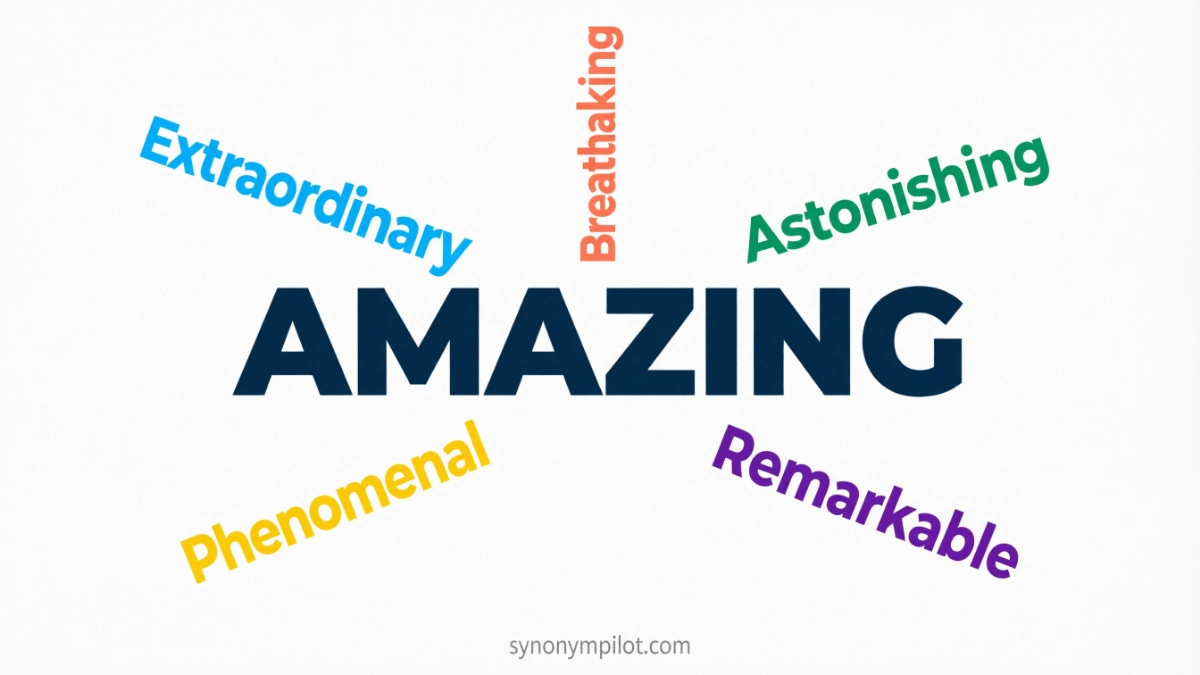
Extraordinary means going well beyond what is ordinary or expected, with a strong sense of rarity and quality. Astonishing means causing genuine surprise and disbelief almost too impressive to believe. Breathtaking describes something so visually or emotionally powerful it seems to steal your breath. Remarkable means noticeably impressive and worth talking about. Phenomenal means far beyond what is normally seen or experienced. Stunning means striking such a strong visual or emotional impact that it momentarily overwhelms. Incredible means so impressive it is almost hard to believe. Outstanding means rising clearly above everything else around it. Spectacular means visually grand and dramatic in an immediately striking way. Awe inspiring means producing a deep sense of wonder and reverence.
When Not to Use “Amazing”
Avoid amazing in formal academic writing, legal or scientific documents, and professional reports where precise, restrained language builds credibility. Calling a research finding “amazing” in an academic paper reads as vague and unscholarly. Remarkable, extraordinary, or significant are far more appropriate.
Also avoid amazing when your praise needs to be specific. If you want to highlight the quality of someone’s thinking, call it insightful or astute. If you want to praise skilled execution, call it masterful or polished. Amazing tells people you liked something but rarely tells them why, which limits its usefulness in any context where specificity matters.
Additionally, overusing amazing in professional or creative writing weakens your voice quickly. When every good thing you encounter is amazing, the word stops functioning as genuine praise and starts reading as filler.
Words Commonly Confused With “Amazing”
Amazing vs. Astonishing
Astonishing carries a stronger element of genuine surprise and disbelief than amazing does today. Something astonishing is so unexpected that it almost shocks you. Amazing has softened over time and often simply means “very good.” Therefore, when you want to convey that something genuinely caught you off guard with its quality or scale, astonishing is the more powerful and precise choice. “The speed of her recovery was astonishing” communicates real disbelief. “The speed of her recovery was amazing” sounds enthusiastic but less specific.
Amazing vs. Extraordinary
Extraordinary specifically means outside the range of what is ordinary rare, exceptional, and qualitatively above the norm. It is more formal and measured than amazing, and it suits professional, academic, and literary contexts far better. “She has an extraordinary talent for languages” reads as considered and credible. “She has an amazing talent for languages” reads as enthusiastic but less authoritative.
Amazing vs. Breathtaking
Breathtaking is strongly visual and emotional. It suits landscapes, performances, moments, and experiences that create an almost physical sensation of awe. Amazing is broader and less tied to a specific type of response. “The view from the summit was breathtaking” paints a vivid picture. “The view was amazing” communicates approval without the same visual impact.
Amazing vs. Spectacular
Spectacular emphasizes dramatic visual grandeur. It suits events, shows, scenery, and physical displays of skill or scale. Amazing is more versatile but less vivid. “The fireworks display was spectacular” creates an immediate image. “The fireworks were amazing” expresses approval without that same cinematic quality.
Best Synonym by Context
| Context | Best Synonym | Why It Works |
|---|---|---|
| Academic or formal writing | Extraordinary / Remarkable | Precise, objective, and credible tone |
| Business or professional praise | Outstanding / Exceptional | Clear, structured professional approval |
| Visual experiences (scenery, art) | Breathtaking / Stunning | Strong sensory and emotional impact |
| Performances (music, sport, theater) | Phenomenal / Spectacular | Emphasizes energy, scale, and impact |
| Intellectual achievement | Astounding / Remarkable | Highlights surprise and high-level thinking |
| Creative or literary writing | Awe-inspiring / Magnificent | Rich, expressive, and stylistically strong |
| Casual conversation / social media | Incredible / Unbelievable | Natural, energetic, and informal |
| Encouraging feedback | Wonderful / Brilliant | Warm, friendly, and positive tone |
Which Synonym Should You Choose?
Three simple questions help you find the right word.
First, what type of experience are you describing?
Visual use breathtaking, stunning, or spectacular. Intellectual use astounding, remarkable, or extraordinary. Emotional use moving, profound, or awe inspiring. Physical performance use phenomenal, outstanding, or incredible.
Second, what is your tone?
Formal use extraordinary, remarkable, or exceptional. Casual use incredible, unbelievable, or brilliant. Enthusiastic and emotional use breathtaking, phenomenal, or stunning.
Third, how rare or surprising is the thing you are praising?
Genuinely rare and shocking astonishing or astounding. Very high quality but not necessarily surprising outstanding or exceptional. Visually overwhelming breathtaking or magnificent.
Real Life Examples of “Amazing” and Its Synonyms in Sentences
School
The student produced a remarkable piece of research that her supervisor described as the strongest undergraduate thesis she had read in years. His ability to connect complex historical events showed an extraordinary depth of understanding for someone at his level.
Workplace
The sales team delivered an outstanding quarter, exceeding every target the company had set for the period. Her phenomenal attention to detail during the audit saved the company from a potentially serious compliance issue.
Writing
The film’s final sequence was breathtaking a wordless ten minutes that said more than any dialogue could have managed. Critics described the debut novel as extraordinary, praising its precision, emotional intelligence, and complete originality.
Conversation
“You have to see this documentary it is genuinely mind blowing. I’ve been thinking about it all week.” “She’s an incredible teacher. The way she explains things makes even the hardest concepts feel approachable.”
Best Synonym by Context
| Context | Best Synonym | Why It Works |
|---|---|---|
| Formal writing or reports | Remarkable / Extraordinary | Clear, precise, and professional tone |
| Academic writing | Phenomenal / Astounding | Strong but still analytical |
| Business / professional praise | Outstanding / Exceptional | Standard evaluative language in workplaces |
| Visual experiences (scenery, art) | Breathtaking / Stunning | Strong sensory and emotional impact |
| Performances (music, sport, theater) | Spectacular / Electrifying | Emphasizes energy, scale, and impact |
| Intellectual achievement | Remarkable / Astounding | Highlights surprise and mental impact |
| Creative or literary writing | Sublime / Enchanting / Majestic | Rich, expressive, and artistic tone |
| Casual conversation or social media | Incredible / Amazing / Unbelievable | Natural, energetic, informal language |
| Encouraging feedback | Wonderful / Brilliant / Fantastic | Warm, positive, and supportive tone |
| Strong emotional reaction | Jaw-dropping / Mind-blowing / Staggering | Expresses shock and intensity |
Synonym Groups and Usage Differences
Formal and Academic Synonyms
Extraordinary, remarkable, exceptional, unprecedented, and unparalleled carry genuine weight in formal writing, research papers, literary essays, and professional evaluations. These words signal considered, measured praise rather than enthusiastic reaction. Consequently, academics, critics, and senior professionals reach for them when they want their admiration to sound credible and authoritative rather than excited and casual.
Professional and Business Synonyms
Outstanding, exceptional, impressive, first rate, and formidable work powerfully in performance reviews, business proposals, professional recommendations, and client communications. They communicate real, substantive quality in a tone that fits corporate and organizational environments without sounding over the top.
Conversational and Informal Synonyms
Incredible, fantastic, brilliant, terrific, and mind blowing feel natural and energetic in everyday speech, casual emails, text messages, and social media. They carry genuine enthusiasm without any stiffness. As a result, they connect warmly with a general audience in relaxed settings and feel far more natural than formal alternatives in those contexts.
Slang and Very Casual Expressions
Mind blowing, jaw dropping, and mind boggling sit at the informal end of the scale with a light slang quality. They are vivid and expressive in conversation and informal writing but can undermine credibility immediately in professional documents or academic work.
Strongest vs. Weaker Synonyms
Transcendent, sublime, and awe inspiring sit at the very top of the emotional intensity scale. Reserve these for experiences that genuinely produce profound wonder or near spiritual responses. Wonderful, terrific, and impressive sit at the gentler end solid, positive, and appropriate for everyday praise without overselling the experience. Matching intensity to reality keeps your language honest.
Emotional vs. Neutral Synonyms
Breathtaking, spellbinding, electrifying, and enchanting carry strong emotional and sensory energy. They make the reader feel something. Outstanding, exceptional, and impressive stay more factual and neutral. Choose emotional synonyms in creative writing, personal storytelling, and enthusiastic speech. Stick with neutral ones in reports, evaluations, and professional assessments.
Antonyms of Amazing
| Antonym | Simple Meaning | Example Sentence |
|---|---|---|
| Ordinary | Not special or unusual | The meal was perfectly ordinary and left no lasting impression. |
| Mediocre | Average or below average quality | The film had a mediocre script that wasted a strong cast. |
| Disappointing | Fails to meet expectations | The sequel was deeply disappointing after so much hype. |
| Dull | Not interesting or exciting | The presentation was so dull that people left early. |
| Unremarkable | Not worth special attention | The building was clean but completely unremarkable. |
| Terrible | Very bad quality | The service was so terrible we decided not to return. |
| Dreadful | Extremely unpleasant or bad | The weather was dreadful and ruined the trip. |
| Poor | Below expected standard | The poor execution ruined an otherwise good idea. |
| Forgettable | Easily forgotten, no impact | The movie was forgettable despite its big budget. |
| Underwhelming | Less impressive than expected | The launch event was underwhelming after all the hype. |
Common Phrases and Expressions With “Amazing”
Truly amazing means something is remarkable in a way that feels completely genuine rather than exaggerated. “What she accomplished under those conditions was truly amazing nobody expected it to succeed.”
Amazing grace refers most famously to the well known hymn, but in general use it describes something beautiful, dignified, and admirable that moves people deeply. “She handled the situation with a kind of amazing grace that everyone in the room recognized and respected.”
An amazing feat describes an achievement that is impressively difficult and noticeably remarkable. “Completing the marathon with no prior training was an amazing feat of sheer willpower.”
Look amazing means to appear visually striking and impressive in one’s appearance. “You look absolutely amazing tonight that color suits you perfectly.”
Simply amazing means so impressive it barely needs any qualification or further explanation. “The speed at which the team rebuilt everything after the fire was simply amazing.”
Nothing short of amazing means so impressive that no word short of amazing would be adequate to describe it. “Her recovery from the injury in just eight weeks was nothing short of amazing.”
Common Mistakes to Avoid
The single biggest mistake with amazing is overusing it until it becomes meaningless. When you call the weather amazing, your dinner amazing, your friend’s haircut amazing, and a major life achievement amazing all in the same day, the word stops functioning as genuine praise. Rotate in alternatives deliberately to keep your language fresh and your praise credible.
Many learners also treat incredible and unbelievable as exact synonyms for amazing, but both carry a stronger element of disbelief. Something incredible or unbelievable is almost too good to process or accept. Using them for ordinary positive experiences can make your language sound unintentionally dramatic or insincere.
Another common mistake is using sublime or transcendent too casually. These are genuinely elevated words that suit profound artistic, spiritual, or philosophical experiences. Calling a sandwich sublime is technically creative but will make most readers smile skeptically rather than nod in agreement.
Furthermore, avoid mixing amazing with other intensifiers that do the same job twice. “Completely and utterly amazing” or “so incredibly amazing” piles emphasis without adding meaning. One well chosen intensifier “truly extraordinary” or “simply breathtaking” always lands with more power and clarity.
Finally, in formal writing, avoid amazing entirely and replace it with remarkable, exceptional, or extraordinary. The formality mismatch will undermine even the most carefully constructed argument.
FAQs
What is a more powerful word than amazing?
Extraordinary, astonishing, and breathtaking are all stronger and more specific than amazing, with extraordinary working best in formal contexts, astonishing when genuine surprise is the point, and breathtaking for powerful visual or emotional experiences.
What is the difference between amazing and astonishing?
Amazing today often simply means “very good,” while astonishing specifically conveys genuine surprise and near disbelief something astonishing is so impressive or unexpected that it almost shocks you, making it the stronger and more precise word when real surprise is part of the feeling.
Is amazing informal or formal?
Amazing sits in the casual to neutral range and works well in conversation and informal writing, but in formal academic writing, business reports, and literary criticism, more precise and measured alternatives like remarkable, exceptional, or extraordinary are always the better choice.
Can I use amazing to describe a person?
Absolutely “she is an amazing teacher” or “he is an amazing friend” both sound natural and warm, though pairing it with a specific quality like “an amazing communicator” or “an amazing problem solver” makes the praise more meaningful and memorable.
What is a good synonym for amazing in a professional email?
Outstanding and exceptional are the safest professional choices because they communicate genuine high level praise in a tone that fits formal business communication without sounding overly casual or emotionally exaggerated.
Conclusion
Amazing is a genuine, useful, and perfectly good word the problem is simply that it shows up everywhere, for everything, all the time. Once you start consciously choosing between breathtaking, extraordinary, astonishing, phenomenal, and remarkable based on what you actually mean, your language immediately becomes more vivid, more credible, and more interesting to everyone who reads or hears it.
Try this today: the next time you feel the urge to type “amazing,” pause for just five seconds and ask if breathtaking, outstanding, or remarkable fits better. You do not need to avoid amazing entirely sometimes it is genuinely the right word.
But building the habit of choosing more deliberately is what separates a wide, confident vocabulary from a limited one. Your words carry your thinking. Make them count, one precise and well chosen word at a time.

Hi, I’m George Philip—an English language enthusiast who enjoys uncovering the nuances of words. I write about synonyms, vocabulary, and everyday language tips so readers can improve their communication and express themselves effectively. Learning new words should be fun, practical, and inspiring! synonympilot.com