You’re writing a business proposal and your third paragraph starts with “Additionally” just like your second one did.
Or you’re reviewing a student essay and you notice “Additionally” appears at the beginning of five consecutive paragraphs. It’s a solid word, but when it shows up too often, readers start noticing the pattern instead of the content.”Additionally” is a perfectly good connector.
It’s clear, professional, and easy to understand. But strong writing varies its transitions, and knowing a range of alternatives from formal to casual means you can always find the right word for the right moment.
What Does “Additionally” Mean?
“Additionally” is an adverb used to introduce an extra point or piece of information that builds on what was just said. It signals: there is more to add, and it goes in the same direction as the previous point. It’s used to link related ideas without creating contrast or changing direction.
Meaning, Tone, and Context
At its core, “additionally” means “in addition to what was just said.” It’s a forward moving word it adds without contrasting, qualifies without limiting, and builds without redirecting. Every time you use it, you’re essentially saying: here is one more thing that supports or extends this point.
In terms of tone, “additionally” sits firmly in the formal to neutral range. It’s most at home in professional writing, academic essays, business reports, and formal correspondence. In casual speech or informal writing, it can sound unnecessarily stiff people naturally reach for “also,” “plus,” or “on top of that” in everyday conversation.
It sounds most natural at the start of a sentence in formal writing: “Additionally, the report outlines three key recommendations.” It works less naturally mid sentence in casual contexts. Knowing this distinction helps you choose the right additive word depending on whether you’re writing a research paper, a team email, a personal blog, or a friendly message.
If you’re also learning words like “furthermore,” “moreover,” and “nevertheless,” understanding how additive words differ from contrast words is a useful related vocabulary topic worth exploring.
When and How to Use “Additionally”
Use “additionally” when you want to introduce a new supporting point in formal or semi formal writing without changing direction.
“The package includes flights and accommodation. Additionally, breakfast is provided each morning.” “The software reduces processing time. Additionally, it integrates with existing systems at no extra cost.” “She has a degree in economics. Additionally, she holds a professional certification in project management.”
Avoid using it in casual conversation it sounds too formal for everyday chat. And avoid repeating it in consecutive sentences vary your connectors to maintain natural rhythm and flow.
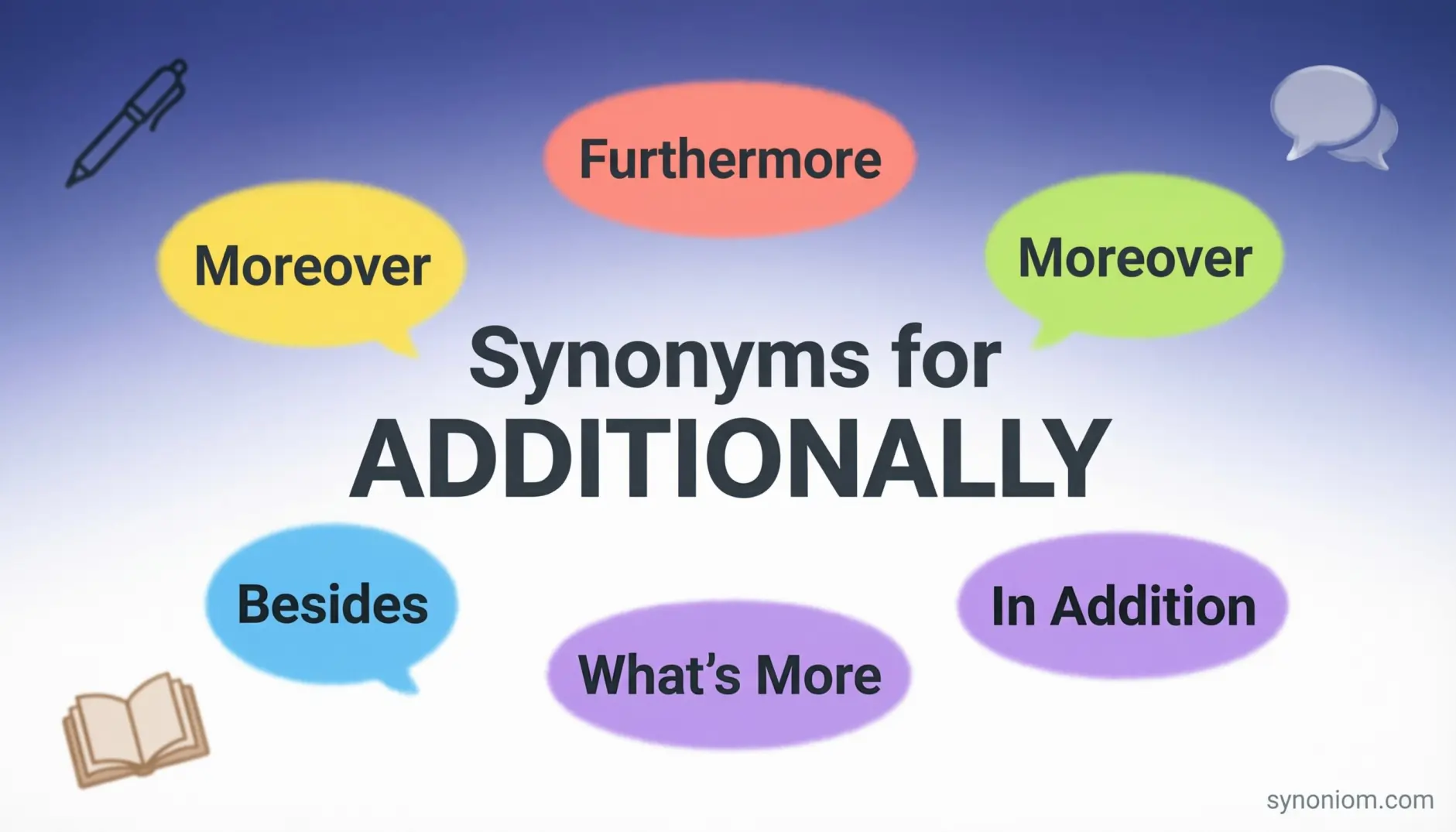
50 Synonyms for Additionally
| Synonym | Simple Meaning | Example Sentence |
|---|---|---|
| Furthermore | Adding a stronger point | The data is clear. Furthermore, the trend is accelerating. |
| Moreover | Adding something even more important | She is qualified. Moreover, she has direct field experience. |
| Also | Simple addition | The report was late. It was also incomplete. |
| Too | In addition | She speaks Spanish, and French too. |
| As well | Also | Please bring your ID, and a passport photo as well. |
| Besides | On top of that | Besides the delay, there were quality concerns. |
| In addition | Adding to what was said | In addition to the delay, costs have risen sharply. |
| What’s more | Emphasizing an added point | It’s affordable. What’s more, it’s available immediately. |
| On top of that | Adding extra | It was cold. On top of that, the heat wasn’t working. |
| Plus | Casual addition | It’s close to the station. Plus, the price is right. |
| Not only that | Stressing a further point | Not only that, the team finished early. |
| And | Simplest connector | She’s reliable, honest, and punctual. |
| To add to this | Adding a related idea | To add to this, a second report confirmed the finding. |
| Added to that | Further addition | Added to that, the timeline has been extended. |
| Beyond that | Further in scope | The app is fast. Beyond that, it’s beautifully designed. |
| On a related note | Adding something connected | On a related note, the survey results are now available. |
| Equally | Same level of importance | Quality matters. Equally, consistency is essential. |
| Likewise | In the same way | She signed the form. Likewise, her co-applicant did too. |
| Similarly | In a comparable manner | The first model failed. Similarly, the second had problems. |
| In the same vein | In a related direction | In the same vein, the second study found similar patterns. |
| Correspondingly | In a related way | Demand increased. Correspondingly, prices rose. |
| Concurrently | At the same time | Both projects ran concurrently throughout the year. |
| Simultaneously | Happening at the same time | The two campaigns launched simultaneously across platforms. |
| In parallel | Running at the same time | Both teams worked in parallel toward the same goal. |
| Along with | Together with | Along with the contract, please submit your invoice. |
| Together with | Combined with | Together with the main findings, a summary was included. |
| As well as | Together with | The role requires writing skills as well as data analysis. |
| Alongside | Next to or together with | Alongside her research, she teaches two courses. |
| Coupled with | Combined with | Coupled with the new data, this changes our projections. |
| Combined with | Joined together | Combined with the training, the new tools improved output. |
| In conjunction with | Working together with | In conjunction with the audit, a review was conducted. |
| Not to mention | Highlighting an extra point | The design is clean, not to mention the loading speed. |
| To boot | As a bonus | He’s talented and generous to boot. |
| Over and above | Beyond what’s expected | Over and above her duties, she mentored the new team. |
| Further | Taking a step further | I would further suggest reviewing the financial projections. |
| Further to | Building on something stated | Further to my last email, please find the updated draft. |
| In tandem | Together, at the same pace | The two departments worked in tandem on the merger. |
| By the same token | For the same reason | By the same token, this principle applies to all members. |
| At the same time | Adding a parallel point | The cost is high. At the same time, the quality justifies it. |
| For that matter | Adding a related fact | He never replied; for that matter, he rarely responds. |
| Incidentally | Adding a related secondary point | Incidentally, the study also covered rural regions. |
| Relatedly | In a connected way | Relatedly, a second investigation was launched that week. |
| Supplementary to | Adding extra support | Supplementary to the report, an appendix was included. |
| In this regard | On the same topic | In this regard, two further recommendations were made. |
| To that end | Supporting the same aim | To that end, additional resources were allocated. |
| Into the bargain | Extra benefit | The flat came furnished, with parking thrown in into the bargain. |
| And then | Adding the next point | First, submit the form. And then, await confirmation. |
| To further this | Extending the same point | To further this, three case studies were commissioned. |
| On the same note | On the same topic | On the same note, the policy was revised last month. |
| In like manner | In the same way (formal) | In like manner, all departments followed the new procedure. |
Important Synonym Groups
Formal Synonyms
Best for academic essays, official reports, legal documents, and formal correspondence.
- Furthermore The methodology was sound. Furthermore, the sample size was sufficient.
- Moreover The candidate is experienced. Moreover, she has an exceptional track record.
- In addition In addition to the financial report, an operational review was submitted.
- Over and above Over and above the contractual requirements, the team delivered a full audit.
- Supplementary to Supplementary to the main findings, a glossary of terms was appended.
Informal Synonyms
Natural in casual messages, social media posts, and relaxed conversations.
- Plus Plus, it’s completely free to use.
- On top of that On top of that, they gave us a full refund.
- To boot Friendly staff and great prices to boot.
- Not only that Not only that, she actually stayed late to help.
- And Simple, clean, and always correct.
Academic Synonyms
Precise and measured ideal for research papers, thesis writing, and scholarly essays.
- Furthermore
- Moreover
- Correspondingly
- In like manner
- Relatedly
Professional Synonyms
Polished and appropriate for business emails, proposals, and workplace reports.
- Additionally Additionally, the revised timeline has been attached.
- In addition In addition to the main deliverables, a risk assessment is included.
- Further to Further to our discussion, please find the updated proposal.
- Alongside Alongside the financial data, a strategic overview has been provided.
- In conjunction with In conjunction with the HR department, a new policy has been drafted.
Emotional / Expressive Synonyms
For personal writing, storytelling, and heartfelt messages.
- What’s more What’s more, he did it entirely without being asked.
- Not to mention Not to mention the hours she put in behind the scenes.
- On top of all that On top of all that, she still found time to check in on everyone.
- To boot Kind, patient, and incredibly generous to boot.
- Not only that Not only that, she remembered every single detail.
Conversational Synonyms
Used naturally in spoken English and casual written communication.
- Also Also, don’t forget to bring your charger.
- Plus Plus, it saves us at least an hour.
- On top of that On top of that, we’re getting a bonus this month.
- Too I’m coming too, if you don’t mind.
- As well Can you bring the files, and the receipts as well?
Slang / Very Casual
For texts, social media captions, and informal chats.
- And then some She delivered everything asked, and then some.
- On top of it all On top of it all, the Wi Fi was down the whole time.
- Plus plus Great location, great food, plus plus the staff were amazing.
Antonyms of “Additionally”
| Antonym | Meaning | Example |
|---|---|---|
| However | Introducing contrast | The plan is solid. However, the budget is a concern. |
| Nevertheless | Despite that | It was challenging. Nevertheless, they succeeded. |
| Instead | In place of something | Instead of adding more, we need to simplify. |
| But | Simple contrast | The idea is good, but the timing is off. |
| Except | Leaving something out | Everyone attended except the project lead. |
| On the contrary | Denying what was said | It wasn’t dull. On the contrary, it was riveting. |
| Conversely | Going in the opposite direction | Costs fell. Conversely, quality improved. |
| Rather | Preferring something else | Rather than adding more, we should cut back. |
| Excluding | Leaving out of the count | Excluding tax, the total is $320. |
| Without | In absence of | She completed the project without any extra resources. |
Comparison: “Additionally” vs. Closely Related Words
Additionally vs. Furthermore
Both add information, but “furthermore” carries slightly more emphasis it implies the next point strengthens or builds on the previous one more meaningfully. “Additionally” is more neutral and additive. In academic writing, “furthermore” often signals that you’re reinforcing an argument; “additionally” simply adds another supporting point.
“The product is affordable. Additionally, it is durable.” (neutral addition) “The product is affordable. Furthermore, independent tests confirm its reliability.” (adding a stronger, more compelling point)
Additionally vs. Moreover
“Moreover” is the strongest of the three. It introduces a point that is not just added but more significant than what came before it escalates. Use “moreover” when your next point genuinely matters more. Using it for minor additions weakens its effect.
“The location is convenient. Additionally, parking is available.” (simple extra fact) “The location is convenient. Moreover, it is the only facility within a 20 mile radius.” (the new point significantly strengthens the case)
Additionally vs. Also
“Also” is simpler and less formal. It works mid sentence or in casual writing. “Additionally” is more formal and typically goes at the start of a sentence. In academic and professional writing, “additionally” sounds more considered; in everyday writing, “also” is warmer and more natural.
“She also submitted a personal statement.” (casual, mid sentence) “Additionally, a personal statement was submitted.” (formal, sentence opening)
Additionally vs. Besides
“Besides” carries a slightly conversational or even slightly dismissive tone it can suggest the new point is being thrown in casually. “Additionally” is more balanced and neutral. In formal writing, “additionally” is almost always the better choice.
“Besides, the deadline has already passed.” (casual, slightly dismissive) “Additionally, the deadline has now passed.” (formal, measured)
Additionally vs. In addition
These are very close in meaning and formality. “In addition” tends to introduce a more substantial point or new category of information. “Additionally” is often used for a supporting detail. “In addition” frequently works better when starting a new paragraph or introducing a separate area of discussion.
“Additionally, the team submitted their expense reports.” (adding a detail) “In addition to the main deliverables, a full risk assessment was included.” (adding a new category of information)
Common Phrases and Expressions
“In addition to the above”
Meaning: Adding to everything that has already been mentioned. “In addition to the above, the committee requests a revised timeline by Friday.”
“Further to my previous email”
Meaning: Building on what was already communicated. “Further to my previous email, please find the signed contract attached.”
“Not only… but also”
Meaning: Emphasizing two related points, with both carrying equal or escalating weight. “Not only did she meet the deadline, but she also exceeded every quality benchmark.”
“Over and above what was required”
Meaning: Going beyond the expected or obligatory. “She delivered over and above what was required of her in this role.”
“On top of everything else”
Meaning: Adding another point when several things are already being discussed. “On top of everything else, the budget was cut by fifteen percent.”
“What’s more”
Meaning: Introducing an especially noteworthy additional point. “The new system is faster and cheaper. What’s more, it requires no additional training.”
Common Mistakes to Avoid
Starting every paragraph with “Additionally”
This is the most common mistake. When every paragraph begins with the same connector, the writing feels mechanical and repetitive. Rotate between “furthermore,” “in addition,” “what’s more,” and “beyond that” to keep the rhythm natural.
Using “moreover” for minor points
“Moreover” is a strong word it signals that the next point is especially important or convincing. Using it to introduce a trivial detail (“Moreover, the conference room has a coffee machine”) makes the word feel out of place. Save it for genuinely significant additions.
Using “additionally” in casual conversation
In everyday speech, “additionally” sounds stiff. If a friend is telling you about their weekend, responding with “Additionally, did you go to the market?” sounds unnatural. Use “also,” “and,” or “on top of that” in relaxed settings.
Confusing “furthermore” and “moreover” as identical
Both are formal additives, but they carry different weights. “Furthermore” simply adds another point in the same direction. “Moreover” escalates it implies the next point is stronger or more important. Using “moreover” when you mean a neutral addition can make the writing feel overstated.
Using “in addition” and “additionally” in the same paragraph
Because they’re so similar, using both in close proximity feels redundant. Choose one and vary your other transitions around it. Mixing “in addition,” “furthermore,” and “what’s more” gives better variety than “in addition” and “additionally” side by side.
FAQs
What’s the most formal synonym for “additionally” in academic writing?
“Furthermore” and “moreover” are the most commonly accepted formal alternatives in academic writing. “Moreover” carries the most argumentative weight, while “furthermore” is a strong, reliable choice for adding supporting evidence without escalation.
Can I start a sentence with “additionally”?
Yes it’s grammatically correct and very standard in formal writing. Always follow it with a comma: “Additionally, the findings were peer reviewed.” It’s less natural mid sentence and rarely used at the end.
What’s the difference between “additionally” and “in addition”?
They’re very close, but “in addition” often introduces a more substantial or separate point a new category of information. “Additionally” tends to add a supporting detail within the same category. In practice, both are interchangeable in most formal contexts.
Is “plus” a good replacement for “additionally”?
In casual writing and conversation, absolutely. “Plus, it’s free” is natural and clear. In formal or academic writing, however, “plus” as a sentence connector is considered too informal. Stick to “furthermore,” “moreover,” or “in addition” in those contexts.
What’s a good alternative to “additionally” in a cover letter?
“Furthermore,” “in addition,” and “beyond this” all work well in cover letters. “What’s more” is slightly warmer and can feel more natural in a personally written letter. Avoid starting too many sentences with the same word regardless of which you choose.
Conclusion
“Additionally” is a reliable, professional connector but it works best when it’s one of many tools in your writing kit, not the only one. Once you start rotating between “furthermore,” “moreover,” “what’s more,” “in addition,” and “beyond that,” your writing develops a more natural rhythm and your arguments feel more carefully constructed.
Think of additive words as gears in a sentence. “Also” and “plus” are casual and light. “Additionally” is steady and formal. “Furthermore” builds momentum. “Moreover” escalates. Choosing the right gear at the right moment is what separates writing that flows from writing that simply lists.
Try replacing “additionally” with two or three alternatives in your next document and notice how the writing breathes differently. That awareness, practiced consistently, is exactly what strong writing is made of.

Hi, I’m Theo John, a passionate word explorer who loves diving into the beauty of the English language. I write about synonyms, word meanings, and practical vocabulary tips to help readers communicate with confidence. synonympilot.com