You’re at a dinner party and someone keeps dropping obscure references no one asked for, correcting everyone’s pronunciation, and talking about their Ivy League education every five minutes. You want to describe them later to a friend, but “pretentious” feels overused. What other word fits?
Or maybe you’re writing a character in a story someone who acts superior, speaks in an unnecessarily complicated way, and looks down on anything they consider “common.” Getting the right word makes all the difference.
That’s exactly what this article is for. If you’re writing, speaking, or just venting about someone insufferable, having a strong range of synonyms for “pretentious” will make your language far more expressive and precise.
What Does “Pretentious” Mean? (Featured Snippet Definition)
“Pretentious” describes a person or behavior that tries to appear more important, intelligent, cultured, or sophisticated than is actually the case. It carries a critical, disapproving tone and is usually used to call out affectation or false superiority. When someone is pretentious, they’re putting on a show trying to impress others in a way that feels exaggerated or insincere.
Meaning, Tone, and Context
At its core, “pretentious” is about performance. A pretentious person isn’t just confident or accomplished they want you to know how accomplished they are, and they often overdo it. The key element is the gap between how they present themselves and who they actually are.
In terms of tone, “pretentious” is clearly negative and somewhat judgmental. It’s not a neutral observation using this word signals disapproval. It works equally well in casual conversation, literary criticism, social commentary, and written character analysis.
You’ll hear it most often in:
- Social or cultural commentary (“The film felt pretentious rather than profound”)
- Describing personalities (“He’s charming, but a little pretentious”)
- Literary or academic criticism (“Her writing style is often criticized as pretentious”)
- Everyday conversation when someone is acting superior (“Don’t be so pretentious about wine”)
It’s a versatile word not overly formal, not slang which is why it appears in everything from book reviews to WhatsApp messages.
When and How to Use “Pretentious”
“Pretentious” works best when you want to describe:
- A person who performs intelligence or sophistication without substance behind it (“He uses complicated words just to sound pretentious”)
- Art, writing, or film that tries too hard to seem deep or meaningful (“The movie was visually interesting but ultimately pretentious”)
- Behavior that signals social superiority in an irritating way (“She was pretentious about her taste in restaurants”)
- Language or style that is unnecessarily ornate or show offy (“The essay’s pretentious tone made it hard to read”)
One useful distinction: “pretentious” is about trying too hard to impress, not simply about being sophisticated or cultured. A genuinely knowledgeable person isn’t pretentious. Pretentiousness is the performance without the depth.
50 Synonyms for “Pretentious”
| Synonym | Simple Meaning | Example Sentence |
|---|---|---|
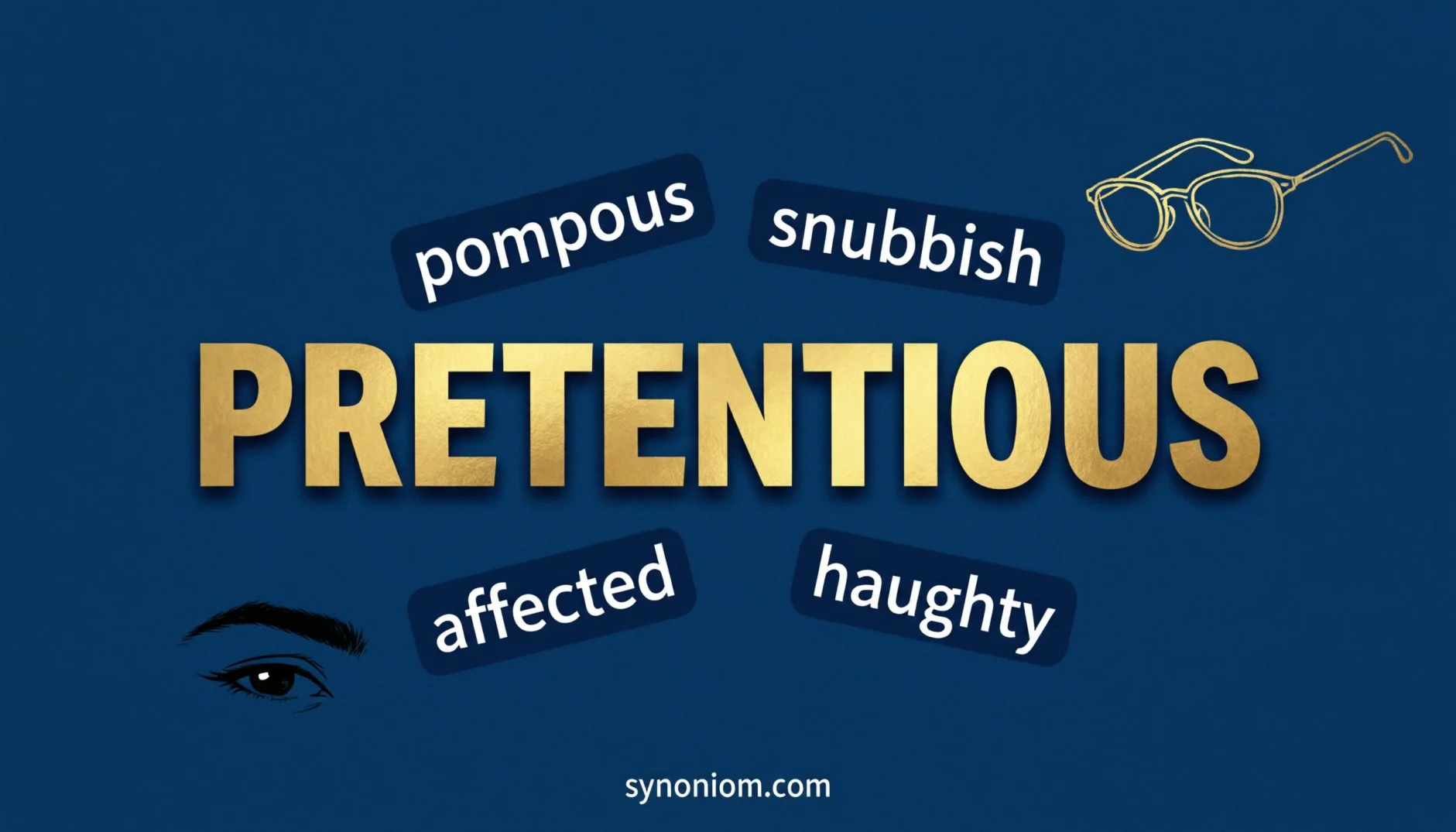
| Pompous | overly self-important | He gave a pompous speech. |
| Arrogant | believing oneself superior | Her arrogant attitude annoyed coworkers. |
| Snobbish | looking down on others | He was snobbish about food. |
| Haughty | cold and superior | She gave a haughty glance. |
| Affected | artificial to impress | His affected accent sounded fake. |
| Conceited | overly proud of oneself | She was too conceited to listen. |
| Ostentatious | showy to impress | The ostentatious décor felt excessive. |
| Self-important | taking oneself too seriously | He spoke in a self-important tone. |
| Grandiose | unrealistically impressive | Her grandiose plans lacked practicality. |
| Highfalutin | pompous and elaborate | The highfalutin language was unnecessary. |
| Uppity | acting above one’s status | Some found him uppity. |
| Supercilious | showing superiority | He wore a supercilious expression. |
| Condescending | treating others as inferior | Her explanations sounded condescending. |
| Patronizing | kindly but superior | His patronizing tone was obvious. |
| Vainglorious | boastfully proud | His vainglorious speeches annoyed people. |
| Imperious | arrogantly commanding | She gave imperious instructions. |
| Egotistical | focused excessively on self | His egotistical behavior hurt teamwork. |
| Narcissistic | self-admiring | The narcissistic influencer loved attention. |
| Boastful | talking proudly | He was boastful about achievements. |
| Showy | attracting attention | Her showy style lacked substance. |
| Theatrical | exaggeratedly dramatic | His theatrical reactions became jokes. |
| Flamboyant | flashy and dramatic | His flamboyant stories entertained everyone. |
| Pedantic | showing off knowledge | She made a pedantic correction. |
| Elitist | believing in superiority | His elitist attitude felt tiresome. |
| Snooty | informally snobbish | Don’t be so snooty. |
| High and mighty | acting superior | He got high and mighty after promotion. |
| Puffed up | swollen with pride | She became puffed up after praise. |
| Stuck up | thinking oneself better | The student seemed stuck up. |
| Full of oneself | overly self-centered | He became full of himself. |
| Overblown | exaggerated | The article’s praise felt overblown. |
| Inflated | overly enlarged ego | His inflated ego hurt teamwork. |
| Lordly | acting superior in rank | The manager had a lordly manner. |
| Disdainful | showing contempt | She was disdainful of pop culture. |
| Vain | obsessed with status | He was too vain to accept criticism. |
| Assuming | taking superiority for granted | Her assuming tone annoyed people. |
| Self-aggrandizing | making oneself seem greater | The memoir felt self-aggrandizing. |
| Hoity-toity | snobbish and superior | She became hoity-toity quickly. |
| Show-offy | trying hard to impress | His show-offy words slowed discussion. |
| Holier than thou | morally superior | Nobody liked his holier-than-thou attitude. |
| Lofty | overly grand in tone | His lofty tone felt too formal. |
| Superior | acting better than others | She adopted a superior manner. |
| Ego-driven | motivated by ego | The ego-driven speech lacked teamwork. |
| Swaggering | self-important behavior | The swaggering newcomer annoyed people. |
| Name-dropping | mentioning famous people to impress | His name-dropping was embarrassing. |
| Overbearing | unpleasantly dominant | Her overbearing personality hurt discussions. |
| Grandstanding | performing for attention | The speech was pure grandstanding. |
| Pseudo-intellectual | pretending deep knowledge | His pseudo-intellectual comments sounded shallow. |
| Overreaching | claiming too much | Her overreaching claims hurt credibility. |
Important Synonym Groups
Formal Synonyms
Best for written analysis, literary criticism, academic essays, or professional writing:
- Pompous, Supercilious, Vainglorious, Imperious, Affected, Grandiose, Ostentatious, Condescending
These carry analytical weight. “His supercilious tone undermined any goodwill he might have built” works well in a character study or essay.
Informal / Conversational Synonyms
Natural in everyday speech, casual writing, or social commentary:
- Stuck up, Snooty, Puffed up, High and mighty, Show offy, Hoity toity, Full of oneself
“She’s been so stuck up since she got that job” is natural in conversation in a way that “she’s been vainglorious” simply isn’t.
Academic Synonyms
Precise and analytical, preferred in scholarly or critical writing:
- Affected, Narcissistic, Egotistical, Pedantic, Elitist, Self aggrandizing, Pseudo intellectual
Professional / Workplace Context
Useful when describing difficult colleagues or toxic behavior at work diplomatically:
- Overbearing, Self important, Patronizing, Condescending, Grandstanding, Ego driven
Emotional Synonyms
When the behavior carries a personal sting when it genuinely hurts or alienates:
- Disdainful, Haughty, Arrogant, Holier than thou, Patronizing
These words capture not just the behavior but the emotional impact it has on those around the person.
Slang / Very Casual
For social media, texting, or venting with friends:
- Stuck up, Hoity toity, Show offy, High and mighty, Full of oneself, Uppity
Antonyms of “Pretentious”
| Antonym | Meaning | Example Sentence |
|---|---|---|
| Humble | modest and not superior | Despite success, she remained humble. |
| Unpretentious | simple and natural | The café had an unpretentious charm. |
| Down to earth | practical and genuine | He is famous but very down to earth. |
| Modest | avoiding exaggeration | She gave a modest response to praise. |
| Genuine | real and sincere | His enthusiasm felt genuine. |
| Authentic | true to oneself | The restaurant had an authentic atmosphere. |
| Unassuming | not seeking attention | The unassuming guest was actually the CEO. |
| Grounded | realistic and stable | Fame never changed her; she stayed grounded. |
| Sincere | honest and heartfelt | The apology sounded sincere. |
| Approachable | easy to talk to | The professor was approachable and kind. |
Comparison: “Pretentious” vs. Similar Words
Pretentious vs. Arrogant
Arrogance is about believing you’re superior and acting on it. Pretentiousness is about performing superiority sometimes without actually feeling it. An arrogant person genuinely thinks they’re better than you. A pretentious person wants you to think they’re better. The emotional feel is different: arrogance can be blunt; pretentiousness is more theatrical.
Pretentious vs. Pompous
These are very close, but “pompous” tends to describe the style of how someone speaks or presents themselves overly ceremonious and grand. “Pretentious” is broader and can apply to beliefs, taste, and overall persona. A pompous speech uses unnecessarily formal language; a pretentious person might also claim superior taste in everything from wine to architecture.
Pretentious vs. Condescending
“Condescending” is specifically about talking down to others it’s relational. “Pretentious” is more about how someone presents themselves overall, not necessarily about how they treat others directly. You can be pretentious without being condescending (a person who fakes sophistication in their Instagram captions) and condescending without being pretentious (a blunt, plain speaking boss who talks down to staff).
Pretentious vs. Affected
“Affected” is more precise it describes deliberate artificiality in manners, speech, or behavior. All affected behavior is pretentious, but not all pretentiousness is affected. An affected accent is calculated and put on; pretentiousness can also include attitudes, values, and taste preferences.
Pretentious vs. Pedantic
“Pedantic” specifically refers to showing off knowledge in an annoying, overly detailed way especially by correcting others unnecessarily. It’s a specific type of pretentious behavior. You can be pedantic without being generally pretentious (a person who just can’t resist grammar corrections) but pedantry is often one component of broader pretentiousness.
Common Phrases and Expressions
“Put on airs”
To behave as if you are more important or sophisticated than you really are. Example: “Ever since she moved to that neighborhood, she’s been putting on airs.”
“Full of hot air”
Talking in a pompous, boastful way with little real substance. Example: “He sounds impressive at first, but he’s mostly full of hot air.”
“Think oneself above something”
To believe a task, person, or place is beneath one’s dignity. Example: “He thinks himself above small talk, which makes him very difficult at parties.”
“Name dropping”
Mentioning well known people you’ve met or know in order to seem important. Example: “Her constant name dropping throughout the interview was not a good sign.”
“Look down one’s nose at”
To regard someone or something with contempt or snobbery. Example: “She looks down her nose at anyone who didn’t go to a top university.”
“Putting on a show”
Performing for effect rather than being genuine. Example: “His enthusiasm during the presentation felt like he was just putting on a show.”
Common Mistakes to Avoid
Confusing “pretentious” with “confident”
Confidence is earned and genuine. Pretentiousness is performed and hollow. Don’t use “pretentious” to describe someone who simply knows their worth the word implies a gap between appearance and reality.
Using “pompous” and “pretentious” as exact interchangeables
They’re close but not identical. “Pompous” is more about speech and presentation style; “pretentious” is about a broader claim to superiority. In many cases they overlap, but the distinction matters in more precise writing.
Overusing “arrogant” when “pretentious” is more accurate
If someone is performing sophistication rather than simply believing they’re superior, “pretentious” is the sharper word. Reserve “arrogant” for direct, unfiltered superiority.
Applying “pedantic” too broadly
“Pedantic” is specifically about showing off knowledge through unnecessary detail or correction. It doesn’t cover general snobbery or social showing off.
Using very casual synonyms in formal writing
Words like “stuck up,” “hoity toity,” and “show offy” are fine in conversation but feel out of place in an essay, review, or professional context. Match your synonym to your audience.
FAQs
What’s the single best one word synonym for “pretentious” in formal writing?
“Pompous” or “affected” are both strong choices. “Pompous” is widely understood and carries clear disapproval. “Affected” is more precise and works well in literary or critical writing where you want to describe deliberate artificiality.
Is “pretentious” always used negatively?
Yes it’s inherently a criticism. There’s no neutral or positive use of “pretentious.” If you want to describe someone who is genuinely cultured or intellectually curious, you’d use words like “sophisticated,” “refined,” or “knowledgeable” instead.
How is “pretentious” different from “snobby”?
“Snobby” (or snobbish) is specifically about looking down on people based on class, taste, or background. “Pretentious” is about performing superiority it’s more about the self presentation. A snob judges others; a pretentious person performs for others. The two often overlap but aren’t identical.
Can a piece of art or writing be pretentious, not just a person?
Absolutely. In fact, this is one of the most common uses of the word in English. A film, novel, speech, or artwork can be called pretentious when it tries too hard to appear deep, meaningful, or sophisticated without delivering on that promise.
What’s a good synonym for “pretentious” that isn’t too harsh?
If you want something milder, try “affected,” “self conscious,” or “overly formal.” These describe the same quality without the full sting of “pretentious.” They’re useful in professional or diplomatic contexts where you want to flag a tone issue without being cutting.
Conclusion
“Pretentious” is a powerful word but having a range of synonyms around it makes you a far more expressive communicator. Whether you’re describing a character in fiction, writing a film review, calling out annoying behavior, or just expanding your vocabulary, knowing the difference between “pompous,” “affected,” “supercilious,” and “condescending” gives you precision and nuance.
The goal isn’t to have more ways to insult people it’s to describe human behavior accurately. A good vocabulary doesn’t just help you sound smart; it helps you think more clearly about what you’re actually observing. Try using one or two of these words in your writing this week and notice how much more vivid and specific your descriptions become. That’s the real reward of building your vocabulary one word at a time.

Hi, I’m J.D. Salinger—a language lover who enjoys uncovering the nuances of words. I write about synonyms, meanings, and vocabulary tips to help readers express themselves more clearly and confidently. My goal is to make learning new words fun, simple, and practical. synonympilot.com