You’re writing an essay and you notice something embarrassing almost every sentence starts with “and” or contains it at least twice. “I woke up and made coffee and checked my phone and got ready for work.”
It reads like a list a child wrote in primary school. You know the writing needs more variety, but you’re not sure what to replace “and” with.
This is one of the most common writing problems at every level beginner, intermediate, and even advanced. “And” is the most frequently used conjunction in English, so naturally it shows up everywhere.
The solution isn’t to avoid it completely, but to know when a different connecting word serves your sentence better.
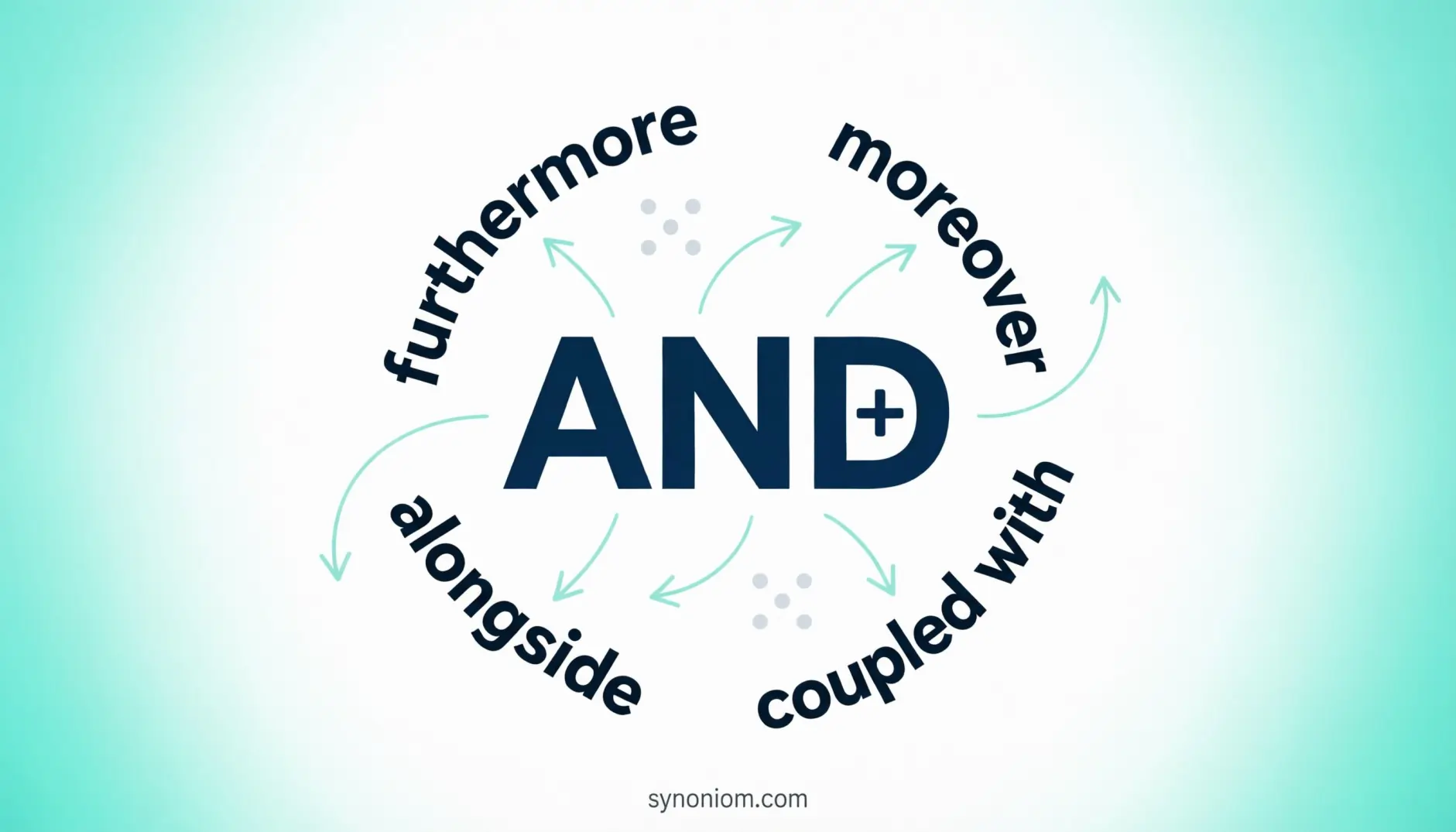
This guide gives you 50 real alternatives to “and,” explains exactly when each one works, and helps you understand the meaningful differences between them.
Featured Snippet Definition
What Does “And” Mean?
“And” is a coordinating conjunction used to connect words, phrases, clauses, or sentences that are related in some way. It signals addition that one thing joins, combines, or continues alongside another. It is the most neutral and versatile connector in English, carrying no extra meaning beyond simple addition.
Meaning, Tone, and Context
At its core, “and” expresses addition and connection. It links two or more equal elements nouns, verbs, adjectives, clauses without specifying any particular relationship between them beyond “these things belong together.”
Because “and” is so neutral, it works across every register formal, informal, academic, emotional, and professional. That universality is precisely why writers overuse it. When every connection is “and,” you lose the ability to show whether things are happening at the same time, in sequence, as a result, or in contrast.
Knowing your alternatives allows you to:
- Show the logical relationship between ideas more clearly
- Vary your sentence rhythm and structure
- Signal contrast, sequence, emphasis, or addition precisely
- Write with more sophistication and less repetition
When and How to Use “And”
“And” is perfectly correct in many situations, so the goal is not to replace it everywhere just to use it deliberately. Use “and” when:
- You want the simplest, most neutral connection (“bread and butter”)
- You’re listing items of equal importance (“She is kind, patient, and reliable”)
- You need a natural, conversational join (“Come in and sit down”)
- You’re writing dialogue that sounds realistic
Replace “and” when you want to show a specific relationship consequence, sequence, contrast, addition with emphasis, or elaboration. That’s where the 50 alternatives below become useful.
50 Synonyms for “And”
| Synonym | Simple Meaning | Example Sentence |
|---|---|---|
| As well as | In addition to, with equal weight | She speaks French as well as Spanish. |
| Along with | Together with, in the same group | The report, along with all attachments, was submitted on time. |
| Together with | Combined with, united | The CEO, together with the board, approved the budget. |
| In addition to | Besides, on top of what was said | In addition to the salary, the role offers full benefits. |
| Plus | Added to, informal addition | The package includes accommodation plus meals. |
| Furthermore | Adding a stronger or more important point | The data is incomplete. Furthermore, the methodology is flawed. |
| Moreover | Adding something even more significant | The plan is expensive. Moreover, it lacks a clear timeline. |
| Besides | On top of that, additionally | Besides being qualified, she brings real-world experience. |
| Also | Adding another element in the same category | He is also responsible for client communications. |
| Too | Adding an element at the end of a thought | She speaks Italian too. |
| Additionally | Adding further information, formal | The contract was signed. Additionally, both parties agreed to mediation. |
| Not only… but also | Emphasizing two connected elements | Not only did she finish first, but she also set a new record. |
| Coupled with | Combined with, often strengthening an idea | His talent, coupled with his work ethic, made him unstoppable. |
| Together | At the same time or in combination | We worked together to solve the problem quickly. |
| As well | In addition, at the end of a sentence | I’ll need the original documents as well. |
| Likewise | In the same way, additionally | She donated to the fund; her partner likewise contributed. |
| What’s more | Adding a particularly noteworthy point | The food was excellent. What’s more, the price was reasonable. |
| On top of that | Adding something extra | The deadline moved up. On top of that, two team members were out sick. |
| Beyond that | Adding something further or more significant | The results were strong. Beyond that, they exceeded all projections. |
| Then | Showing sequence or next step | Finish the introduction, then move on to the body paragraphs. |
| Next | Indicating what follows in sequence | Next, add the chopped onions to the pan. |
| Subsequently | After that, formal | The patient was treated. Subsequently, a follow-up was scheduled. |
| Afterward | Following that in time | She completed the test; afterward, she felt surprisingly calm. |
| Following this | After this point, formal | Following this agreement, both teams began the integration process. |
| Meanwhile | At the same time as something else | She handled the client calls; meanwhile, her team prepared the reports. |
| Simultaneously | At exactly the same time | The two announcements were made simultaneously. |
| At the same time | Happening together | He was nervous; at the same time, he was excited. |
| While | During the same period or alongside | While she edited the draft, he prepared the visuals. |
| Both… and | Connecting two equal elements | Both the timing and the location need to be confirmed. |
| Either… or | Presenting two options | You can either call or send an email. |
| Neither… nor | Excluding two elements together | Neither the report nor the appendix was submitted on time. |
| Including | Specifying what is part of a group | All documents, including the original, must be filed. |
| As well as this | Adding a further related point | She leads the team; as well as this, she mentors new hires. |
| Combined with | Added together | The heat, combined with the humidity, made it unbearable. |
| Paired with | Matched with or put together with | The white wine pairs well with the seafood. |
| Accompanied by | Together with, going alongside | The report was accompanied by a detailed financial summary. |
| With | Simply joined to or involved with | The manager, with her team, completed the audit. |
| And also | More emphatic version of “and” | The plan saves time and also reduces cost significantly. |
| Supplemented by | Added to, filling a gap | The lecture was supplemented by a practical workshop. |
| Complemented by | Added to in a way that improves | The design was complemented by thoughtful typography. |
| Reinforced by | Strengthened by the addition of something | Her argument was reinforced by strong statistical evidence. |
| Including but not limited to | Signaling a non-exhaustive list | Expenses, including but not limited to travel and accommodation, are covered. |
| Alongside | Next to, working in parallel | The new initiative ran alongside the existing program. |
| In conjunction with | Together with, formally coordinated | The department worked in conjunction with external consultants. |
| In tandem with | Working together at the same time | The marketing team worked in tandem with the sales division. |
| Hand in hand with | Closely connected | Economic growth goes hand in hand with investment in education. |
| Side by side with | Together, in parallel | The two systems operated side by side with no conflict. |
| In combination with | Used together, producing a result | Exercise, in combination with a balanced diet, improves health. |
| As a complement to | Adding something that enhances the whole | The workshop serves as a complement to the online course. |
| Jointly with | Together formally or officially | The report was produced jointly with three partner organizations. |
Important Synonym Groups
Formal Synonyms
Best for academic papers, legal documents, official reports, and professional writing:
- Furthermore, Moreover, Additionally, Subsequently, In conjunction with, In tandem with, Supplemented by, Including but not limited to
These signal a carefully constructed argument or document. “Furthermore, the evidence suggests a systemic failure” carries more analytical weight than “and the evidence suggests.”
Informal / Conversational Synonyms
Natural in everyday speech, casual emails, or friendly writing:
- Plus, Too, As well, What’s more, On top of that, Also, And also
“The hotel was gorgeous. Plus, it was way cheaper than we expected” sounds like real speech. Use these in blogs, casual writing, and everyday conversation.
Academic Synonyms
Preferred in research writing, essays, and scholarly argumentation:
- Furthermore, Moreover, Additionally, Not only… but also, Coupled with, Reinforced by, In combination with, Both… and
These allow academic writers to build layered arguments and show how ideas relate logically, not just additively.
Professional / Business Writing Synonyms
Common in reports, presentations, proposals, and workplace communications:
- Along with, Together with, In addition to, Accompanied by, Alongside, Jointly with, In conjunction with
“The proposal, along with supporting data, was reviewed by the committee” is clean, professional, and specific.
Sequencing Synonyms (time and order)
When “and” is being used to show what happens next:
- Then, Next, Subsequently, Afterward, Following this, Meanwhile, Simultaneously, At the same time, While
These are especially useful in instructions, narratives, and process writing where order matters.
Emphasis Synonyms
When you want the addition to feel stronger or more noteworthy:
- Not only… but also, What’s more, Beyond that, Coupled with, Combined with
“Not only did the project come in under budget, but it also finished ahead of schedule” is far more emphatic than simply using “and.”
Antonyms of “And”
| Antonym | Meaning | Example |
|---|---|---|
| But | Shows contrast or exception | She studied hard, but she didn’t pass the exam. |
| However | Shows contrast, more formal | The plan is solid. However, the timeline is unrealistic. |
| Yet | Shows contrast, especially unexpected | He was tired, yet he kept working through the night. |
| Although | Shows contrast within one clause | Although the price was high, the quality was worth it. |
| Despite | Introduces contrast without a clause | Despite the rain, the event was a success. |
| Instead | Shows replacement or alternative | She didn’t call; instead, she sent a message. |
| Rather than | Choosing one over another | He chose to walk rather than take a taxi. |
| On the contrary | Directly opposing the previous point | I’m not upset. On the contrary, I’m relieved. |
| Whereas | Showing a direct contrast between two things | He prefers structure, whereas she thrives in flexibility. |
| Nevertheless | Despite what was just said | The results were mixed. Nevertheless, the team made real progress. |
Comparison: “And” vs. Similar Connecting Words
And vs. Furthermore
“And” simply adds. “Furthermore” adds with emphasis it signals that the next point is strengthening or building on what came before. “She is qualified and experienced” is neutral. “She is qualified. Furthermore, she brings ten years of direct industry experience” makes the second point feel more significant.
And vs. Also
Both add information, but “also” is slightly more emphatic and often used to highlight a point worth noticing. “He speaks French also” draws slight attention to that detail. “He speaks French and Spanish” treats both languages as equal and neutral. “Also” often works better mid sentence or at the start; “and” connects most naturally mid clause.
And vs. Moreover
“Moreover” signals that what follows is not just additional but actually more important or convincing than what came before. It’s a formal escalation word. Use it in essays and reports when you want to build toward a stronger point. “And” has no such escalating effect.
And vs. As well as
“As well as” works like “and” but gives slightly more weight to the first element. “She speaks French and Spanish” treats both equally. “She speaks French as well as Spanish” subtly emphasizes the French. In formal writing, “as well as” also often joins noun phrases more elegantly than a plain “and.”
And vs. While (for simultaneous events)
When two things happen at the same time, “while” shows that simultaneity clearly. “She answered emails and her colleague prepared the slides” is slightly ambiguous about timing. “While she answered emails, her colleague prepared the slides” makes it clear these happened at the same time.
Common Phrases and Expressions
1. “Not only… but also”
A construction that emphasizes two related points, with the second being at least as important as the first. Example: “Not only did the campaign increase awareness, but it also drove a 40% rise in sign ups.”
2. “In addition to the above”
A formal phrase used in reports and official documents to introduce further information. Example: “In addition to the above, the committee recommended a six month review period.”
3. “On top of that”
A conversational way of adding something extra, often something surprising or noteworthy. Example: “The flight was delayed by three hours. On top of that, our luggage didn’t arrive.”
4. “What’s more”
An informal but effective way to add a particularly striking or persuasive additional point. Example: “The product is easy to use. What’s more, it costs half the price of the leading alternative.”
5. “Hand in hand with” Describing two things that naturally go together or reinforce each other. Example: “Good leadership goes hand in hand with clear communication.”
6. “Coupled with” Combining two things in a way that makes them stronger or more significant together. Example: “His technical knowledge, coupled with his ability to explain things simply, made him an exceptional teacher.”
Common Mistakes to Avoid
Starting too many sentences with “And”
Starting a sentence with “And” is grammatically acceptable in modern English, but doing it repeatedly makes writing feel immature or rushed. Vary your connectors “Furthermore,” “Moreover,” or simply restructuring the sentence often works better.
Using “furthermore” and “moreover” interchangeably without intention
Both add information, but “moreover” signals that what follows is more significant. Use “furthermore” to add a supporting point and “moreover” to escalate toward your strongest point.
Replacing “and” with “plus” in formal writing
“Plus” is conversational and informal. “The package includes flights plus accommodation” works in casual copy or speech. In a formal report or academic paper, use “in addition to” or “as well as” instead.
Confusing “while” with “although”
“While” can show simultaneous time or contrast depending on context, which creates ambiguity. “While I understand your concern, I disagree” uses “while” as contrast but in formal writing, “although” is cleaner and unambiguous. Save “while” for genuine time based simultaneity when precision matters.
Overusing “also” at the start of sentences
“Also” at the start of every additional sentence becomes as repetitive as “and.” Alternate with “additionally,” “what’s more,” or restructure the sentence to embed the addition mid clause.
FAQs
Is it grammatically wrong to start a sentence with “and”?
No it’s perfectly acceptable in modern English. Style guides used to advise against it, but most contemporary grammar authorities allow it. That said, doing it repeatedly is a style problem, not a grammar one. When you find yourself starting multiple sentences with “and,” that’s a signal to vary your connectors.
What’s the best formal alternative to “and” in academic writing?
“Furthermore” and “moreover” are the most widely used formal alternatives in academic writing. “Additionally” is also strong and very common in research papers. The right choice depends on whether you’re simply adding information (furthermore) or escalating toward a stronger point (moreover).
Can I use “plus” instead of “and” in professional emails?
In informal or friendly professional emails, yes “plus” can sound natural and warm. In formal business writing, reports, or official communications, stick to “in addition to,” “along with,” or “as well as.” Context and audience always determine the right register.
Q4: What’s the difference between “also” and “too”?
Both mean the same thing they add another element. The main difference is position: “also” typically appears mid sentence or at the beginning (“She also attended the meeting”), while “too” usually appears at the end (“She attended the meeting too”). In questions, “too” sounds warmer; “either” is used in negatives (“I didn’t go either”).
Q5: How do I avoid overusing “and” in a list?
For three or more items, use commas to separate the items and reserve “and” only before the last one this is called the Oxford comma style: “We need pens, paper, and ink.” If you want a more formal or sophisticated feel for long or complex lists, consider restructuring with “in addition to” or “along with” to break the list into logical groups.
Conclusion
“And” is one of the most useful words in English but like any tool used too often in the same way, it starts to lose its effect. Knowing when to reach for “furthermore,” “coupled with,” “alongside,” or “not only… but also” gives your writing more precision, rhythm, and sophistication.
The goal isn’t to avoid “and” it’s to use every connector deliberately. When you choose “moreover” instead of “and,” you’re signaling to your reader that the next point is especially important.
When you choose “while,” you’re showing two things happening at once. That kind of intentional word choice is what separates clear writing from truly effective writing.
Start small: next time you draft a paragraph, highlight every “and” and ask whether a more specific connector would work better. You’ll be surprised how quickly that habit improves your writing.

Hi, I’m George Philip—an English language enthusiast who enjoys uncovering the nuances of words. I write about synonyms, vocabulary, and everyday language tips so readers can improve their communication and express themselves effectively. Learning new words should be fun, practical, and inspiring! synonympilot.com