Have you ever noticed how often the word “also” appears in your writing and conversations? It’s a simple and useful word that helps add information, but using it repeatedly can make your English sound repetitive and less engaging.
If you are writing an essay, sending a professional email, creating content, or simply chatting with friends, knowing different ways to say “also” can make your communication smoother and more natural.
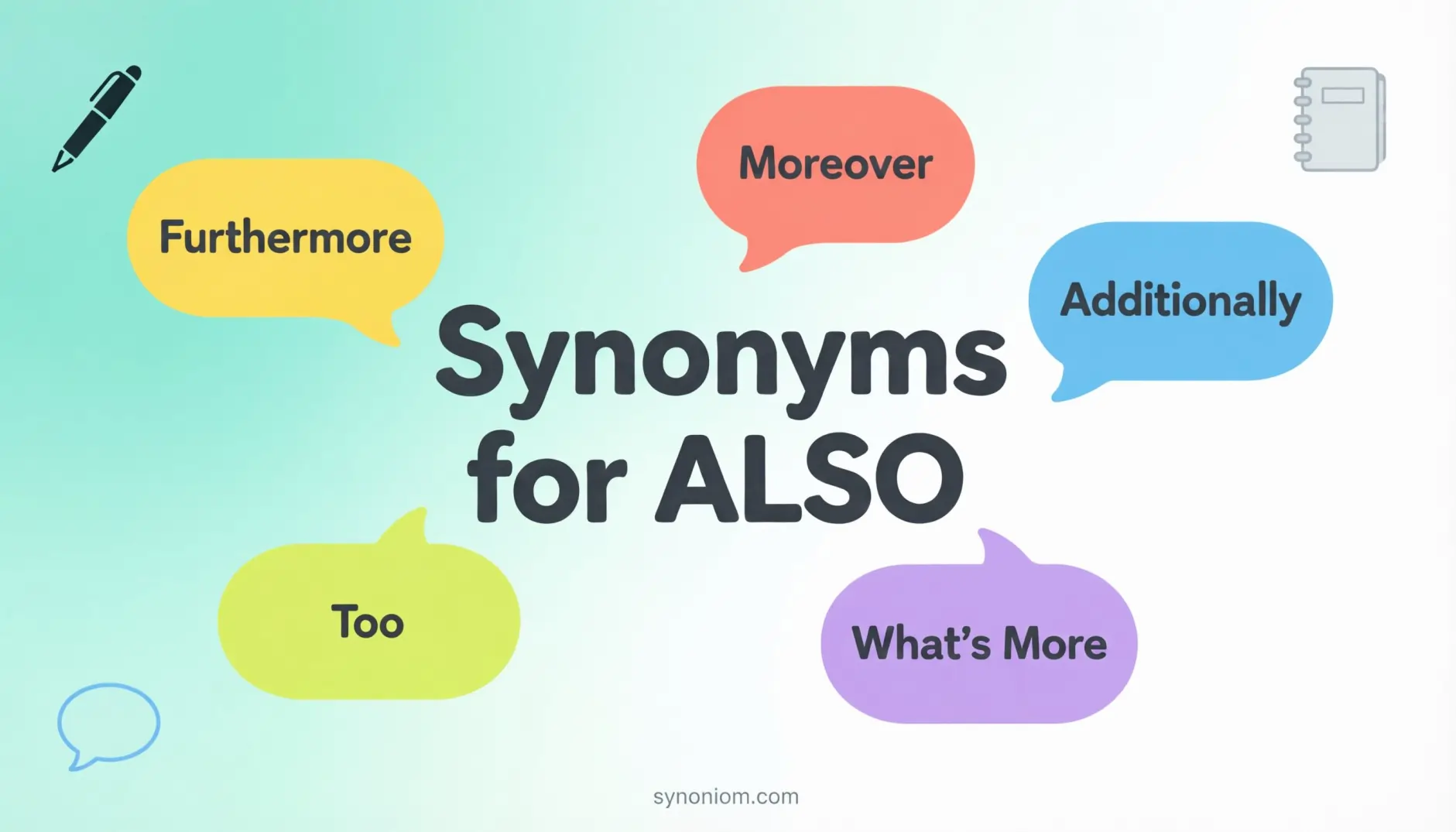
In this guide, you’ll discover 50 powerful synonyms for “also”, along with their meanings, examples, and best usage situations.
From formal alternatives like “furthermore” and “moreover” to casual options such as “too” and “plus,” these words will help you express ideas more effectively and improve both your spoken and written English with greater variety and confidence.
What Does “Also” Mean?
“Also” is an adverb used to add more information to something already stated it means “in addition” or “as well.”
It connects a new point to what came before it without creating contrast. It simply signals: there is more to say, and it points in the same direction.
Meaning, Tone, and Context
At its core, “also” is an additive word. It tells the reader or listener that something extra is being added another fact, another quality, another reason. It doesn’t contrast, it doesn’t emphasize strongly, and it doesn’t introduce exceptions. It simply adds.
In terms of tone, “also” is completely neutral. It works in formal essays, casual conversation, business writing, academic papers, and everyday speech without sounding strange in any of them. That flexibility is exactly what makes it so easy to overuse.
It sounds most natural mid sentence or at the start of a sentence when listing ideas. In formal writing, “furthermore,” “moreover,” and “in addition” are often more appropriate. In academic writing, “additionally” and “moreover” carry more weight. In casual speech, “too,” “as well,” and “on top of that” feel more natural and warm.
Knowing which additive word fits the moment based on formality, emphasis, and position in a sentence is what separates competent English from genuinely polished English.
When and How to Use “Also”
Use “also” when you want to add a related point without creating contrast or introducing a new argument.
“She speaks French. She also speaks Arabic.” “The hotel was comfortable. The food was also excellent.” “I’d like to also mention the contribution of the support team.”
For stronger additions, use “moreover” or “furthermore.” For casual additions, “too” or “as well” at the end of a sentence often feel more natural. For listing in professional writing, “additionally” or “in addition” tend to read more clearly.
50 Synonyms for “Also”
| Synonym | Simple Meaning | Example Sentence |
|---|---|---|
| Too | As well (end of sentence) | She’s a great writer and a good speaker too. |
| As well | In addition (end of sentence) | He submitted the report and sent the summary as well. |
| Additionally | Adding another point | The fee covers tuition. Additionally, meals are included. |
| Furthermore | Adding something stronger | The data is clear. Furthermore, the trend is accelerating. |
| Moreover | Even more importantly | She is skilled. Moreover, she is deeply committed. |
| Besides | On top of that | Besides the salary, the benefits package is excellent. |
| In addition | Adding to what was said | In addition to the delay, there were quality issues. |
| What’s more | Emphasizing extra info | The food was great. What’s more, it was affordable. |
| On top of that | Adding extra (casual) | It was late. On top of that, it was raining heavily. |
| Not only that | Stressing a further point | Not only that, he finished the project ahead of schedule. |
| Plus | Adding casually | It’s close to home. Plus, the rent is very reasonable. |
| Equally | At the same level | The design matters. Equally, usability is key. |
| Likewise | In the same way | He voted yes. Likewise, his colleague agreed. |
| Similarly | In a comparable way | The first model failed. Similarly, the second had flaws. |
| Along with | Together with | Along with the report, she submitted her recommendations. |
| Alongside | Next to or together | Alongside his teaching, he continues to write. |
| Together with | Combined with | Together with the team, she delivered the project on time. |
| In the same way | Just like something else | In the same way, the second experiment confirmed the result. |
| By the same token | For the same reason | By the same token, rules apply to everyone equally. |
| At the same time | Simultaneously or equally | It is important. At the same time, it must be affordable. |
| Including | Making part of the whole | The package includes flights, including airport transfers. |
| As well as | Together with | She handles HR as well as payroll. |
| Not to mention | Highlighting an extra point | The view was stunning, not to mention the service. |
| To boot | As an added bonus (casual) | He’s talented, and funny to boot. |
| Into the bargain | As an extra benefit (British) | The apartment came furnished, with parking included into the bargain. |
| Over and above | Beyond what is expected | Over and above his duties, he mentored three junior staff. |
| Beyond that | Further addition | The app is fast. Beyond that, it’s beautifully designed. |
| Added to that | As a further point | The traffic was bad. Added to that, the meeting ran late. |
| Coupled with | Combined with | Coupled with her ambition, her skills made her stand out. |
| Combined with | Joined together | Combined with the new strategy, results improved quickly. |
| In conjunction with | Working together with | In conjunction with the finance team, the plan was revised. |
| Accordingly | As a connected result | The rules changed. Accordingly, the process was updated. |
| Correspondingly | In a related manner | Demand rose. Correspondingly, prices increased. |
| Simultaneously | At the same time | She managed two projects simultaneously. |
| In parallel | At the same time and level | Both teams worked in parallel to meet the deadline. |
| Concurrently | Happening at the same time | The two investigations ran concurrently. |
| Incidentally | Adding a related but secondary point | Incidentally, the study also covered urban areas. |
| For that matter | Adding a related fact | He never replied; for that matter, he rarely does. |
| On a related note | Adding something connected | On a related note, the second report was delayed too. |
| In like manner | In the same way (formal) | In like manner, all participants followed the protocol. |
| To that end | Supporting the same goal | To that end, extra resources were allocated. |
| In this regard | On this same topic | In this regard, the committee made two recommendations. |
| Relatedly | In a related way | Relatedly, the second study found similar patterns. |
| Supplementary to | Adding extra support | Supplementary to the main findings, the annex includes raw data. |
| In tandem | Together at the same pace | The two departments worked in tandem on the launch. |
| Hand in hand | Together closely | Confidence and preparation go hand in hand. |
| Further | Taking it a step ahead | I would further suggest reviewing the third section. |
| Further to | Building on what was said | Further to my earlier email, please find the attachment. |
| To add to this | Adding another related idea | To add to this, new evidence was submitted late. |
| And | Simplest connector | She’s fast and reliable and thorough. |
Important Synonym Groups
Formal Synonyms
Best for academic papers, official reports, and formal correspondence.
- Furthermore The study was thorough. Furthermore, its methodology was sound.
- Moreover She met the criteria. Moreover, she exceeded expectations.
- Additionally The deadline was missed. Additionally, communication was poor.
- In addition In addition to the fine, the license was suspended.
- Over and above Over and above the brief, she delivered a full audit.
Informal Synonyms
Natural in casual conversation, texts, and relaxed writing.
- Too I’m coming too, if that’s okay.
- Plus It’s nearby. Plus, it’s open on weekends.
- On top of that He was late. On top of that, he forgot the files.
- To boot She’s kind, smart, and funny to boot.
- And Short, simple, and always right.
Academic Synonyms
Precise and analytical for research and scholarly writing.
- Furthermore
- Moreover
- Correspondingly
- Concurrently
- In like manner
Professional Synonyms
Clear and clean for business emails, reports, and presentations.
- Additionally Additionally, the proposal includes a risk assessment.
- In addition In addition to the core deliverables, we have included a timeline.
- Further to Further to our conversation, please see the revised draft.
- Alongside Alongside the main project, the team handled two support tasks.
- In conjunction with In conjunction with HR, a new policy was drafted.
Emotional / Expressive Synonyms
For personal writing, storytelling, and warmth.
- Not only that Not only that, she stayed long after the event ended.
- What’s more What’s more, he did it without being asked.
- And to top it all And to top it all, they gave us a complimentary upgrade.
- Hand in hand Kindness and strength go hand in hand.
- Not to mention Not to mention the effort she put into every detail.
Conversational Synonyms
Natural in spoken English and casual writing.
- As well Are you coming as well?
- Too Can I have one too?
- Plus Plus, it’s free.
- On top of that On top of that, they gave us a discount.
- For that matter He never calls for that matter, he barely texts.
Slang / Very Casual
For informal chats, social posts, and relaxed writing.
- And then some She did everything asked and then some.
- On top of it all On top of it all, the Wi Fi was broken.
- To boot Great location and cheap to boot.
Antonyms of “Also”
“Also” is used to add information. Its antonyms are words and phrases that show contrast, exclusion, limitation, or an alternative idea.
| Antonym | Meaning | Example |
|---|---|---|
| However | Introducing a contrast | The plan is good. However, the budget is tight. |
| But | Simple contrast | I like it, but it’s too expensive. |
| Instead | In place of something | Instead of expanding, they reduced the team. |
| Nevertheless | Despite that | It was hard. Nevertheless, they succeeded. |
| Except | Leaving something out | Everyone attended except the manager. |
| On the contrary | Denying what was said | It wasn’t boring. On the contrary, it was thrilling. |
| Rather | Preferring something else | He chose to listen rather than speak. |
| Excluding | Leaving out | Excluding VAT, the total is $450. |
| Without | In absence of | She managed the project without any extra help. |
| Conversely | In the opposite direction | Sales rose. Conversely, demand fell. |
Comparison: “Also” vs. Closely Related Words
Also vs. Too
Both mean the same thing, but their position differs. “Also” usually goes mid sentence or at the start. “Too” usually goes at the end of a sentence. In formal writing, “also” is preferred. In casual speech, “too” sounds warmer and more natural.
“She also attended the meeting.” (mid sentence, neutral) “She attended the meeting too.” (end of sentence, conversational)
Also vs. Furthermore
“Furthermore” is stronger. It doesn’t just add it builds on something already said, often adding something more significant. In academic or formal writing, “furthermore” signals that the next point carries extra weight.
“The product is affordable. Also, it is durable.” (simple addition) “The product is affordable. Furthermore, independent testing confirmed its durability.” (adds emphasis and builds the argument)
Also vs. Moreover
“Moreover” is even stronger than “furthermore” it adds something more compelling or more important than what came before. It’s essentially saying “and even more impressively…” Use it when the addition genuinely strengthens your point.
“The report was late. Also, it was incomplete.” (neutral addition) “The report was late. Moreover, key data had been deliberately omitted.” (escalating significance)
Also vs. Besides
“Besides” can mean “in addition to” or “apart from.” When used to mean “in addition,” it often carries a slight informal tone or emotional flavor a sense of “and there’s more.” It’s a bit more expressive than “also.”
“Besides being late, he also forgot the files.” (adds an extra point with slight frustration) “He was also late.” (plain, neutral addition)
Also vs. In addition
“In addition” is more formal and often used to introduce a new, separate point rather than continuing a flowing sentence. It works best at the start of a sentence in professional or academic writing.
“In addition, the committee reviewed the financial statements.” (new, formal point) “The committee also reviewed the financial statements.” (smooth, flowing sentence)
Common Phrases and Expressions
“Not only… but also”
Meaning: Used to emphasize two related points, with the second being equally or more important. “She is not only talented but also incredibly hardworking.”
“As well as”
Meaning: Used to add something of equal importance. “The course covers grammar as well as pronunciation.”
“What’s more”
Meaning: Emphasizing that the next point is particularly noteworthy. “The new system is faster. What’s more, it costs half as much.”
“On top of that”
Meaning: Adding something extra often used when the additions are piling up. “The event was poorly organized. On top of that, the venue was too small.”
“Not to mention”
Meaning: Highlighting an additional point that makes things even more notable. “The hike was challenging, not to mention the altitude.”
“Over and above”
Meaning: Beyond what is expected or required. “Over and above her official duties, she trained the new recruits.”
Common Mistakes to Avoid
Starting too many sentences with “Also”
“Also” at the start of every sentence creates a choppy, list like rhythm that feels lazy in writing. Vary with “In addition,” “Furthermore,” or “What’s more” to maintain flow and show progression.
Using “moreover” and “furthermore” interchangeably without thought
Both are formal additives, but “moreover” carries more weight it adds something more significant. “Furthermore” simply adds another supporting point. Using “moreover” for a minor detail makes the word feel out of place.
Putting “also” at the end of a sentence
“Also” at the end of a sentence sounds unnatural in English. “I’d like to come also” is technically understood but awkward. Use “too” or “as well” at the end: “I’d like to come too” or “I’d like to come as well.”
Confusing “likewise” with “similarly”
“Likewise” often means “the same is true of me/this” it mirrors something. “Similarly” means “in a comparable way” and is used for comparisons between separate things. In formal writing, they’re not always interchangeable.
Overusing “plus” in formal writing
“Plus” as an additive connector (“Plus, the team is experienced”) is perfectly fine in casual and conversational writing. In a business report or academic essay, it reads as too informal. Use “additionally” or “furthermore” instead.
FAQs
What’s a more formal word for “also” in an essay?
“Furthermore,” “moreover,” and “additionally” are the most natural formal replacements. They not only add information but also show the reader that your argument is building. “In addition” works well at the start of a new sentence or paragraph.
Can I use “too” and “also” in the same way?
Mostly yes, but position matters. “Too” sounds best at the end of a sentence in casual speech. “Also” sits more comfortably in the middle or at the start. In formal writing, “also” is generally preferred over “too.”
Is it wrong to start a sentence with “Also”?
Not at all it’s grammatically correct. The issue is doing it repeatedly, which makes writing feel choppy. Mix it with other additive words and vary where they appear in your sentences for smoother writing.
What’s the difference between “furthermore” and “in addition”?
“In addition” simply introduces another point. “Furthermore” does the same but suggests the new point reinforces or strengthens the previous one. “Furthermore” is slightly stronger and more argumentative.
What’s a casual way to say “also” in conversation?
“Too” and “as well” are the most natural in speech. “Plus” works well in relaxed settings. “On top of that” is great when you want to add emphasis or suggest the additions are stacking up.
Conclusion
“Also” is one of those reliable, invisible words that does its job quietly sometimes too quietly. Swapping it occasionally for “furthermore,” “what’s more,” “not to mention,” or “as well” doesn’t just reduce repetition. It adds texture, rhythm, and clarity to your writing.
The best approach is to think about what kind of addition you’re making. Is it a simple add? Use “too” or “additionally.” Is it a stronger, more important point? Reach for “moreover” or “furthermore.” Is it casual and expressive? “On top of that” or “plus” will feel right.
Try replacing “also” in your next piece of writing with just two or three alternatives from this list. You’ll be surprised how much more natural and confident your English sounds. Small choices, made consistently, build into genuinely strong writing.

Hi, I’m J.D. Salinger—a language lover who enjoys uncovering the nuances of words. I write about synonyms, meanings, and vocabulary tips to help readers express themselves more clearly and confidently. My goal is to make learning new words fun, simple, and practical. synonympilot.com