You’re writing an email to your manager. You want to say: “The project is going well. However, we need more time.” It sounds fine but what if you’ve already used “however” three times in the same email? That’s when knowing good alternatives really saves you.
“However” is one of the most useful contrast words in English. But using it too often makes your writing feel repetitive.
If you’re writing an essay, a professional email, or just chatting with someone, having a strong list of synonyms for “however” makes your English sound much more natural and varied.
What Does “However” Mean?
“However” is a linking word used to show contrast or a change in direction between two ideas. It signals that what comes next is different from, or opposite to, what was just said. It works in both spoken and written English and can appear at the beginning of a sentence, in the middle, or after a semicolon.
Meaning, Tone, and Context
At its core, “however” means “but” or “on the other hand.” It introduces a contrasting idea without dismissing the first one.
In terms of tone, “however” sits comfortably in the middle it’s not too casual and not overly formal. You can use it in academic essays, business writing, everyday conversations, and even informal emails. That versatility is exactly why it gets overused.
It sounds most natural when you need a smooth, professional contrast. In very casual speech, people tend to use “but” or “though” instead. In academic writing, “nevertheless” or “nonetheless” may feel more precise. Understanding this range helps you choose the right word for the right moment.
When and How to Use “However”
Use “however” when you want to introduce a contrasting idea while keeping a balanced, measured tone.
“The weather was perfect. However, we decided to stay indoors.”
“She studied hard. However, the exam results were disappointing.”
It works especially well at the start of a new sentence or after a semicolon:
“The plan sounds great; however, the budget is too tight.”
Avoid starting every sentence with it. Mix it with other contrast words to keep your writing fresh.
50 Synonyms for “However”
| Synonym | Simple Meaning | Example Sentence |
|---|---|---|
| But | simple contrast | I wanted to go, but it was too late. |
| Yet | surprising contrast | She was tired, yet she kept working. |
| Still | despite that | It was cold; still, they went outside. |
| Though | even so | I liked it, though it was expensive. |
| Although | even if | Although he tried, he couldn’t finish. |
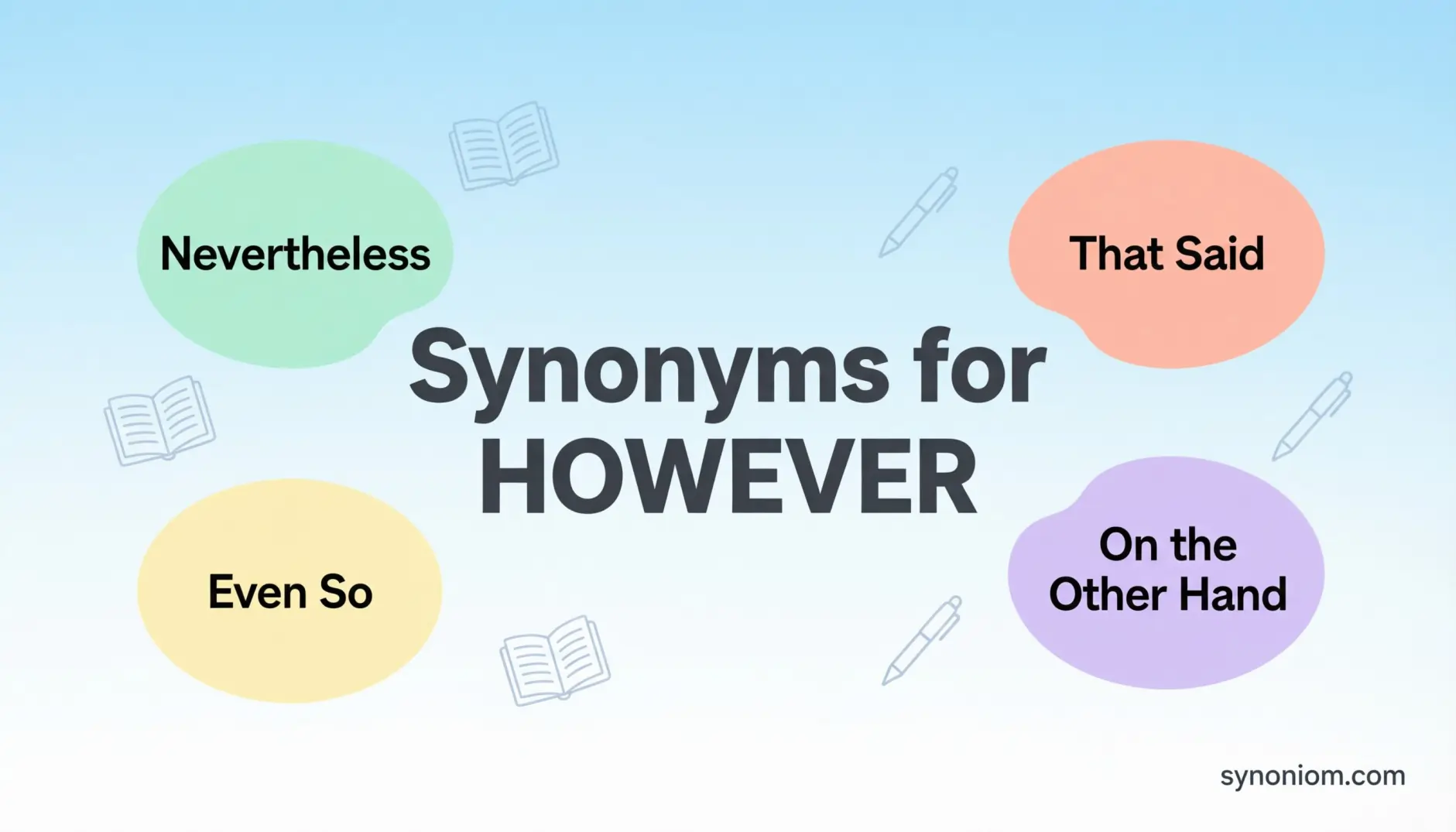
| Even so | despite this | It rained. Even so, we had fun. |
| That said | balancing point | It’s a good book. That said, it’s long. |
| On the other hand | opposite view | It’s fast. On the other hand, it’s costly. |
| Nevertheless | despite that | She failed. Nevertheless, she tried again. |
| Nonetheless | even still | It was hard. Nonetheless, they finished. |
| In contrast | showing difference | He loves spicy food. In contrast, she doesn’t. |
| By contrast | comparison | Sales rose in May. By contrast, June was slow. |
| Conversely | opposite direction | Prices rose. Conversely, demand dropped. |
| On the contrary | denying a point | It wasn’t boring. On the contrary, it was exciting. |
| Alternatively | another option | You can email. Alternatively, call us directly. |
| Instead | in place of | Don’t shout. Instead, speak calmly. |
| Rather | preferred choice | I’d rather walk than drive. |
| Regardless | without effect | It was difficult. Regardless, she finished. |
| Notwithstanding | despite (formal) | Notwithstanding delays, the project succeeded. |
| Despite that | although | It was risky. Despite that, they moved forward. |
| All the same | still true | It’s expensive. All the same, it’s worth it. |
| Just the same | no difference | He was upset. Just the same, he stayed polite. |
| In spite of this | despite everything | Costs rose. In spite of this, profits held. |
| Be that as it may | even so (formal) | Be that as it may, we must continue. |
| Having said that | balancing point | It’s risky. Having said that, it could work. |
| At the same time | simultaneous contrast | I like him. At the same time, he frustrates me. |
| Even then | under those conditions | I studied hard. Even then, I barely passed. |
| For all that | despite everything | He was nervous. For all that, he spoke well. |
| With that said | moving to contrast | Great work. With that said, improvements are needed. |
| Then again | rethinking | It’s pricey. Then again, quality costs. |
| Admittedly | acknowledging a point | Admittedly, I was wrong. |
| Granted | accepting a point | Granted, it takes time, but results are good. |
| That being said | acknowledging then contrasting | She’s skilled. That being said, she needs training. |
| Even though | despite the fact | Even though he’s tired, he keeps going. |
| Whilst | at the same time (British) | Whilst it’s useful, it has limits. |
| Whereas | showing a difference | She is outgoing, whereas he is quiet. |
| While | contrasting two things | While I like coffee, I prefer tea. |
| In any case | no matter what | In any case, we should be prepared. |
| Anyway | moving past contrast | It was strange. Anyway, let’s continue. |
| Besides | additionally contrasting | I’m busy. Besides, it’s not my responsibility. |
| Beyond that | further contrast | The price is high. Beyond that, delivery is slow. |
| Yet still | emphasizing despite | It was raining. Yet still, they played on. |
| Contrary to this | opposite to | Contrary to this, the results were positive. |
| Different from this | showing a change | Different from this case, others went smoothly. |
| In reality | what’s actually true | He seemed confident. In reality, he was afraid. |
| In actuality | true situation | It looks easy. In actuality, it’s complex. |
| In truth | being honest | In truth, the situation is complicated. |
| In practice | what actually happens | In theory it works. In practice, it’s difficult. |
| Ironically | unexpected reversal | Ironically, the safety expert got injured. |
| Paradoxically | seemingly contradictory | Paradoxically, the busier he got, the calmer he seemed. |
Important Synonym Groups
Formal Synonyms
These are best for reports, academic essays, official letters, and professional writing.
- Nevertheless She lacked experience. Nevertheless, she handled it well.
- Nonetheless The budget was cut. Nonetheless, the team delivered.
- Notwithstanding Notwithstanding the challenges, they succeeded.
- Be that as it may Be that as it may, a decision must be made.
- Conversely Sales rose. Conversely, customer satisfaction dropped.
Informal Synonyms
These feel natural in everyday conversations and casual messages.
- But I like it, but it’s too expensive.
- Though It was fun, though a bit tiring.
- Still I know it’s hard. Still, you should try.
- Then again It’s risky. Then again, it could really pay off.
- Anyway It didn’t work out. Anyway, we learned something.
Academic Synonyms
Ideal for research papers, thesis writing, and scholarly articles.
- Nevertheless
- Nonetheless
- Conversely
- Whereas
- In contrast
Professional Synonyms
Used in business writing, emails, reports, and presentations.
- That said
- Having said that
- With that said
- On the other hand
- In any case
Emotional / Conversational Synonyms
These carry a more personal or feeling driven tone.
- Even so Even so, I can’t stay angry at him.
- All the same All the same, I appreciate what you did.
- Granted Granted, you were trying to help.
- Admittedly Admittedly, I could have handled that better.
- In truth In truth, I was scared.
Slang / Very Casual
Only for very informal chats, texts, or social media.
- But hey I messed up. But hey, it happens.
- Eh, still It wasn’t perfect. Eh, still better than before.
Antonyms of “However”
“However” is used to introduce a contrast or exception. Its antonyms are transition words that show addition, agreement, continuation, or cause-and-effect.
| Antonym | Meaning | Example |
|---|---|---|
| Furthermore | Adding a similar point | The food was great. Furthermore, the service was excellent. |
| Moreover | Adding something stronger | She’s talented. Moreover, she works incredibly hard. |
| Additionally | Adding more information | It’s affordable. Additionally, it comes with a warranty. |
| Similarly | In a similar way | He works hard. Similarly, his brother does too. |
| Likewise | In the same way | I enjoyed the trip. Likewise, my family loved it. |
| In addition | Adding to what was said | The location is perfect. In addition, the price is right. |
| Therefore | Showing a result | She trained well. Therefore, she won the race. |
| Consequently | As a result | He didn’t sleep. Consequently, he felt exhausted. |
| Thus | So; as a result | The data was clear. Thus, the decision was easy. |
| Hence | For this reason | She was late. Hence, she missed the introduction. |
Comparison: “However” vs. Closely Related Words
However vs. But
“But” is simpler and more direct. It’s perfect for casual speech. “However” is slightly more formal and works better in writing. Both show contrast, but “however” has more weight.
“I like coffee but I’m cutting back.” (casual) “I like coffee. However, I’m cutting back for health reasons.” (slightly formal)
However vs. Nevertheless
“Nevertheless” is stronger. It suggests the contrast is more significant or the effort was harder. Use it when you want to emphasize persistence or determination.
“It rained. However, we went out.” (neutral contrast) “It rained heavily. Nevertheless, they completed the mission.” (stronger emphasis)
However vs. Although
“Although” introduces a contrast within a single sentence, while “however” connects two separate sentences or clauses. They’re not always interchangeable.
“Although she was tired, she kept working.” (one sentence) “She was tired. However, she kept working.” (two sentences)
However vs. On the other hand
“On the other hand” is used to introduce a completely different perspective, often one with equal weight. “However” is more general.
“The plan is fast. On the other hand, it carries risk.” (two balanced views) “The plan is fast. However, it needs more review.” (adding a limiting point)
However vs. That said
“That said” is slightly warmer and more conversational. It’s a softer way of introducing a contrast, often used after giving a compliment or positive point.
“That said” feels natural in spoken English and professional settings alike.
Common Phrases and Expressions with “However”
“However you look at it”
Meaning: No matter how you consider it, the result is the same. “However you look at it, we need a better strategy.”
“However much”
Meaning: No matter how much or how little. “However much she tries, she can’t seem to relax.”
“However, it should be noted”
Used in formal writing to add a cautionary or contrasting observation. “The results are promising. However, it should be noted that the sample size was small.”
“However, this does not mean”
Common in academic and professional writing to prevent misinterpretation. “Prices dropped. However, this does not mean the product is lower quality.”
“However difficult it may be”
Used to acknowledge a challenge while pushing forward. “However difficult it may be, we must finish this project on time.”
Common Mistakes to Avoid
Using “however” with a comma incorrectly
A very common mistake is writing: “I wanted to help, however I couldn’t.” This needs either a semicolon before “however” or a period. The correct forms are: “I wanted to help; however, I couldn’t.” or “I wanted to help. However, I couldn’t.”
Confusing “although” and “however”
“Although” connects two parts of one sentence. “However” connects two separate sentences. Switching them creates grammatically incorrect writing.
Using “nevertheless” in casual speech
It sounds unnatural in everyday conversation. Save it for written English or formal presentations.
Overusing “that said” or “having said that”
These are great contrast phrases, but using them in every paragraph makes your writing feel repetitive and formulaic.
Using “on the contrary” to mean “on the other hand”
“On the contrary” is used to deny something just stated. “On the other hand” presents a different but equally valid view. They are not always interchangeable.
FAQs
Can I start a sentence with “however”?
Yes, absolutely. Starting a sentence with “however” is grammatically correct and very common in both formal and informal writing. Just make sure to follow it with a comma: “However, the results were unexpected.”
What’s a more casual way to say “however” in everyday conversation?
In daily speech, “but,” “though,” “still,” and “then again” all sound more natural. “However” works fine in speech but tends to appear more often in writing.
Is “nevertheless” the same as “however”?
They’re close in meaning but “nevertheless” carries more weight. It’s used when the contrast is stronger or when someone is pushing forward despite difficulty. In many sentences they’re interchangeable, but “nevertheless” feels more emphatic.
What’s the difference between “whereas” and “however”?
“Whereas” is used to show a direct comparison or difference between two things, usually within a single sentence. “However” is more flexible and can connect separate sentences or ideas without a strict comparison structure.
Can I use “notwithstanding” instead of “however”?
Yes, but it’s a very formal word. You’ll mostly see it in legal documents, official reports, or academic writing. In everyday writing, it would sound too stiff. Stick to “however,” “nevertheless,” or “that said” for most purposes.
Conclusion
Learning synonyms for “however” is one of those small vocabulary upgrades that makes a big difference. Once you start using words like “nevertheless,” “that said,” “even so,” or “on the other hand,” your writing instantly feels more polished and less repetitive.
The key is to match the word to the tone of what you’re writing casual, professional, or academic.Start small. Pick two or three synonyms from this list and try using them in your next email, essay, or message.
The more you practice, the more naturally these words will come to you. Good vocabulary isn’t about sounding impressive it’s about expressing yourself clearly and confidently in every situation. Keep practicing, and you’ll notice the difference sooner than you think.

Hi, I’m George Philip—an English language enthusiast who enjoys uncovering the nuances of words. I write about synonyms, vocabulary, and everyday language tips so readers can improve their communication and express themselves effectively. Learning new words should be fun, practical, and inspiring! synonympilot.com