You’ve just finished a performance review and written: “This quarter was better than last quarter, the results were better, and the team performed better overall.” It’s accurate but reading it back, it feels thin.
Or you’re giving feedback to a student and “this draft is better” doesn’t quite capture what improved or by how much.
“Better” is one of English’s workhorses. It gets the job done in almost any situation, which is exactly why it gets overused.
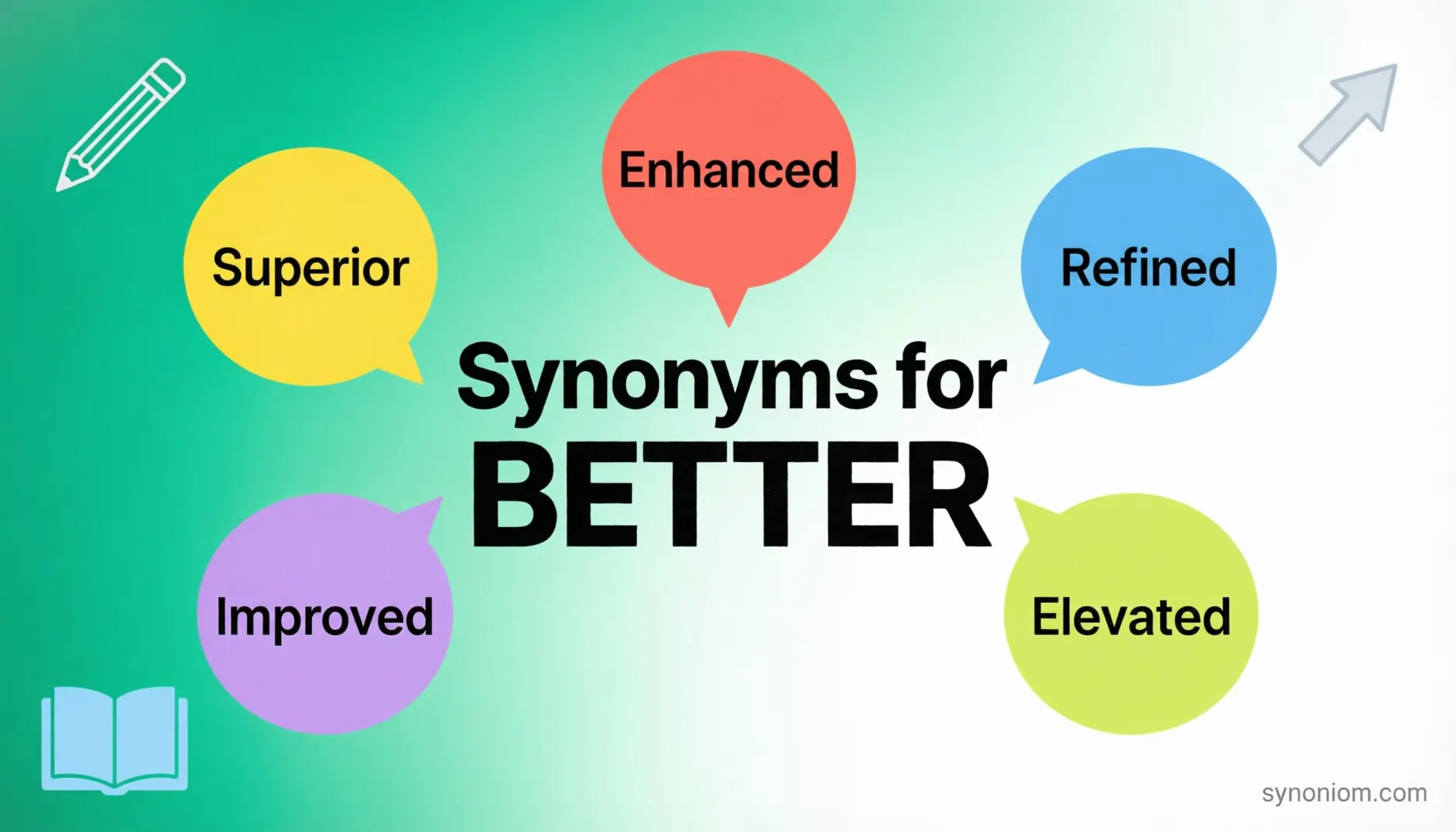
A more precise word “improved,” “superior,” “refined,” “enhanced” tells your reader not just that something changed, but how and in what direction.
What Does “Better” Mean?
“Better” is a comparative adjective and adverb meaning of higher quality, more suitable, or more desirable than something else. It describes improvement over a previous state or superiority compared to another option. It can refer to quality, performance, health, skill, behavior, or almost any area where one thing surpasses another.
Meaning, Tone, and Context
“Better” is fundamentally a comparative word it always implies that something is being measured against something else, whether stated or implied. “This is better” means better than something specific or better than before.
In terms of tone, “better” is neutral and universal. It works in casual conversation, academic writing, professional reports, emotional discussions, and formal documents. It carries no strong emotional charge and no particular formality level, which makes it flexible but also somewhat flat.
It sounds most natural in everyday speech and general writing. In academic and professional contexts, more specific words tend to communicate more precisely “superior” suggests a clear ranking, “enhanced” describes deliberate improvement, “refined” implies careful development over time. In emotional contexts, words like “healthier,” “stronger,” or “more fulfilling” often connect more deeply.
The word is also used in health contexts (“feeling better”), moral contexts (“being a better person”), and skill contexts (“getting better at something”) each with its own set of more vivid alternatives.
When and How to Use “Better”
Use “better” when you want to describe improvement or superiority in a simple, broadly understood way.
“The new version is better than the original.” “She’s feeling much better after the rest.” “His second essay was significantly better.” “We need a better approach to this problem.”
When you want to specify the nature of the improvement whether it’s quality, performance, health, morality, refinement, or superiority a more targeted synonym will always communicate more clearly and make your writing stand out.
50 Synonyms for “Better”
| Synonym | Simple Meaning | Example Sentence |
|---|---|---|
| Superior | Higher in quality or rank | This model is clearly superior to the previous one. |
| Improved | Made better than before | The improved version launched with fewer bugs. |
| Enhanced | Made stronger or more effective | The enhanced formula absorbs more quickly. |
| Upgraded | Moved to a higher standard | The system has been fully upgraded. |
| Advanced | Further developed or ahead | This is a more advanced technique than most beginners use. |
| Refined | Polished and improved through care | Her writing style has become notably refined over time. |
| Elevated | Raised to a higher level | The chef elevated a simple dish into something remarkable. |
| Surpassing | Going beyond in quality | The results were surpassing all earlier expectations. |
| Exceeding | Going further than expected | The team’s performance was exceeding the original targets. |
| Outstanding | Remarkably above average | Her presentation was truly outstanding. |
| Excellent | Very high quality | The customer service here is excellent. |
| Exceptional | Unusually good, beyond the norm | His dedication to the project was exceptional. |
| Preferable | More suitable or desirable | Walking is often preferable to driving in the city center. |
| Preferred | More wanted or chosen | The preferred candidate had more relevant experience. |
| Worthier | More deserving | This version is worthier of the audience’s attention. |
| Sounder | More logical or reliable | Her argument is sounder than the previous draft. |
| Stronger | More powerful or effective | The revised proposal is far stronger. |
| More effective | Producing better results | This approach is more effective for long-term retention. |
| More efficient | Doing more with less waste | The new process is more efficient by a significant margin. |
| More capable | Better able to perform | She’s far more capable than she gives herself credit for. |
| More suitable | More fitting for the purpose | A quieter venue would be more suitable for the event. |
| More appropriate | More fitting in context | A formal tone would be more appropriate here. |
| More qualified | Having stronger credentials | The second applicant was clearly more qualified. |
| More polished | Smoother and more professional | The final draft was far more polished than the first. |
| More accomplished | Skilled and experienced | He’s become a more accomplished writer this year. |
| More skilled | Better at a specific task | She’s now more skilled in negotiation than anyone on the team. |
| Healthier | In better physical or mental condition | She’s eating well and feeling much healthier. |
| Recovered | Back to a good state after illness | He’s fully recovered and back at work. |
| Restored | Returned to a good condition | The building has been beautifully restored. |
| Revamped | Redesigned for improvement | The revamped website is far more user-friendly. |
| Overhauled | Completely improved after review | The curriculum was overhauled after poor student feedback. |
| Optimized | Made as effective as possible | The route has been optimized to save time and fuel. |
| Perfected | Brought to the highest standard | She perfected her technique over many years. |
| Sharpened | Made more precise or focused | His arguments are much sharper since the last revision. |
| Polished | Smoothed and made more professional | The final product felt genuinely polished. |
| Fine-tuned | Carefully adjusted for best results | The engine was fine-tuned for peak performance. |
| Streamlined | Made simpler and more efficient | The process was streamlined to remove unnecessary steps. |
| Corrected | Made accurate after mistakes | The corrected version addresses all earlier errors. |
| Rectified | Put right after something was wrong | The error in the report has been fully rectified. |
| Amended | Changed to improve or correct | The policy was amended to reflect current guidelines. |
| Outperforming | Doing more than expected | The new recruit is outperforming several senior staff. |
| Head and shoulders above | Clearly superior to others | She’s head and shoulders above the other applicants. |
| A cut above | Slightly but noticeably superior | This restaurant is a cut above the usual options nearby. |
| Above par | Better than the standard | Her work this term has been well above par. |
| Up to scratch | Meeting the required standard | The revised report is finally up to scratch. |
| More desirable | More wanted or appealing | A flexible working policy is more desirable to many candidates. |
| More rewarding | Giving more satisfaction | Teaching is far more rewarding than she expected. |
| More promising | Showing greater potential | The second candidate seemed far more promising. |
| More constructive | More helpful toward progress | That feedback was much more constructive than last time. |
| More favorable | More positive or advantageous | The updated terms are more favorable to the buyer. |
Important Synonym Groups
Formal Synonyms
Best for official documents, academic writing, and professional correspondence.
- Superior The revised methodology is clearly superior to the original approach.
- Preferable A peer reviewed source is preferable to an anonymous blog.
- Enhanced The enhanced safety protocols reduced incidents significantly.
- Optimized The delivery system was optimized for speed and accuracy.
- Rectified All discrepancies identified in the audit have been rectified.
Informal Synonyms
Natural in everyday conversation, casual messages, and relaxed writing.
- A cut above This place is a cut above the usual.
- Head and shoulders above He’s head and shoulders above the rest of the class.
- Up to scratch Finally, that report is up to scratch.
- More promising The second option seems way more promising.
- Sharper This draft is much sharper than the last one.
Academic Synonyms
Precise and analytical for essays, research, and scholarly writing.
- Superior The experimental group demonstrated superior results.
- Enhanced Enhanced cognitive engagement was observed in test participants.
- More effective The intervention proved more effective than the control method.
- Refined The model was refined based on preliminary data.
- Optimized The algorithm was optimized to reduce computational load.
Professional Synonyms
Clear and credible for business writing, reports, and workplace communication.
- Improved Q3 figures show an improved margin across all product lines.
- Enhanced The enhanced onboarding process reduced early turnover.
- Upgraded The infrastructure has been upgraded to meet current demand.
- Streamlined Our reporting process has been streamlined for efficiency.
- More effective The new training format has proven more effective for retention.
Emotional Synonyms
Warm and expressive for personal writing, conversations, and motivation.
- Healthier You seem so much healthier and happier these days.
- Stronger She came out of that period stronger than before.
- More fulfilling He finally found work that was far more fulfilling.
- More rewarding Volunteering has been more rewarding than I ever expected.
- Recovered She’s recovered and feeling like herself again.
Conversational Synonyms
Used naturally in spoken English and relaxed writing.
- Stronger Your argument is much stronger this time.
- More polished That pitch felt so much more polished.
- More suitable A different venue would be more suitable honestly.
- More promising The second idea sounds way more promising.
- Sharper Her writing has got so much sharper this year.
Slang / Very Casual
For texts, social media, and informal chats.
- On another level That performance was honestly on another level.
- Way better This one’s just way better, no question.
- Miles ahead The second draft is miles ahead of the first.
- Next level The new menu is seriously next level.
- Leagues above She’s leagues above the competition.
Antonyms of “Better”
| Antonym | Meaning | Example |
|---|---|---|
| Worse | Lower in quality or condition | The second draft was actually worse than the first. |
| Inferior | Lower in standard or rank | The cheaper product was noticeably inferior. |
| Weaker | Less strong or effective | His second argument was considerably weaker. |
| Poorer | Lower in quality | The lighting in the second room was much poorer. |
| Substandard | Below the required level | Several items were substandard and had to be rejected. |
| Diminished | Reduced in quality or strength | The sound quality was diminished after the edit. |
| Deteriorated | Got worse over time | The situation deteriorated rapidly after the announcement. |
| Declining | Getting progressively worse | His performance has been noticeably declining this semester. |
| Inadequate | Not good enough for the purpose | The current system is simply inadequate for modern needs. |
| Lacking | Missing something needed | The plan is lacking in detail and structure. |
Comparison: “Better” vs. Closely Related Words
Better vs. Superior
“Superior” is stronger and more formal. It implies a clear, often measurable difference in rank or quality. “Better” is more neutral and conversational. In professional or academic writing, “superior” carries more weight. In casual speech, it can sound slightly arrogant.
“This draft is better than the last one.” (neutral, everyday) “This method is demonstrably superior to previous approaches.” (formal, measured)
Better vs. Improved
“Improved” specifically means something was worked on and changed it implies intentional effort. “Better” is comparative without explaining why the change happened. Use “improved” when the effort behind the change is part of the point.
“Sales are better this quarter.” (comparison, neutral) “Sales have improved following the new strategy.” (deliberate change with reason)
Better vs. Enhanced
“Enhanced” suggests deliberate strengthening or enriching it implies something was already good and has been made more powerful or more effective. You wouldn’t say someone “enhanced” after recovering from an illness; you’d say they “improved” or “recovered.”
“The enhanced version includes new security features.” (deliberately made stronger) “The updated version is better overall.” (general improvement, no specific direction)
Better vs. Preferable
“Preferable” means more suitable or desirable for a specific purpose or in a specific situation. It’s about fit rather than absolute quality. Something can be preferable without being objectively better.
“Walking is preferable when the distance is short.” (more suitable for the situation) “Electric vehicles are better for the environment.” (comparative quality claim)
Better vs. Refined
“Refined” implies gradual polishing through care and attention often used for skills, writing, techniques, or style. It carries an aesthetic quality that “better” doesn’t. Something refined has been worked on deliberately, over time.
“His writing has become more refined with practice.” (carefully developed) “His writing has gotten better.” (general improvement)
Common Phrases and Expressions
“Better than ever”
Meaning: In the best state something has ever been in. “After the redesign, the app works better than ever.”
“From bad to better”
Meaning: A positive shift from a difficult situation toward improvement. “The company moved from bad to better once the new management arrived.”
“A step up”
Meaning: A noticeable improvement or move to a higher level. “This job is a real step up from where she was two years ago.”
“A cut above”
Meaning: Slightly but noticeably superior to comparable things. “Her attention to detail is a cut above most candidates we’ve interviewed.”
“Head and shoulders above”
Meaning: Clearly and significantly better than everyone or everything else. “That candidate was head and shoulders above the rest of the shortlist.”
“Go one better”
Meaning: To do something slightly better than someone else or than a previous effort. “He went one better this season and broke the club record.”
Common Mistakes to Avoid
Saying “more better” or “most best”
“Better” is already a comparative form it means more good. “More better” is grammatically incorrect in standard English. Similarly, “best” is already superlative “most best” is wrong. Use “even better,” “far better,” or “much better” to emphasize degree.
Using “superior” in casual conversation
“Superior” sounds natural in professional or academic writing but can come across as stiff or condescending in casual speech. Saying “my coffee is superior to yours” in a friendly chat sounds oddly formal. Stick to “better” in relaxed conversations.
Confusing “enhanced” and “improved”
“Enhanced” means made stronger or more powerful it implies the original was already functional. “Improved” means corrected or developed. You improve something that had issues; you enhance something that was already working well.
Using “preferable” as a straight synonym for “better”
“Preferable” is about suitability and context it means more appropriate for a specific situation. It doesn’t make a general quality claim. “Coffee is preferable to tea in the morning” means you prefer it in that context, not that coffee is objectively better as a drink.
Overusing “enhanced” in professional writing
“Enhanced” has become something of a buzzword in business writing. When everything is “enhanced,” the word loses its meaning. Use it specifically when something has genuinely been strengthened or enriched, not as a general substitute for “improved” or “updated.”
FAQs
What’s a more formal word for “better” in a report or essay?
“Superior,” “more effective,” “enhanced,” and “refined” all work well depending on what you mean. For comparing quality, “superior” is strong. For describing results, “more effective” is precise. For describing careful development, “refined” or “polished” fit well.
Can I use “improved” and “better” interchangeably?
Often yes, but “improved” specifically implies that effort was made to make something better. “Better” is purely comparative. “The service is better” describes a change; “the service has improved” suggests something was done to bring that change about.
What’s a casual way to say something is much better?
“Way better,” “miles ahead,” “on another level,” and “leagues above” all work naturally in informal speech and texts. “Head and shoulders above” is casual but has more weight and works in professional conversation too.
Is “superior” too strong a word to use casually?
In most casual conversations, yes it can sound a bit formal or even arrogant. In professional writing, academic papers, or formal comparisons, it’s perfectly natural. For everyday use, “better,” “stronger,” or “a cut above” tend to feel more appropriate.
What’s an emotional way to say someone is getting better?
“Recovering,” “healing,” “growing stronger,” “coming into their own,” and “finding their footing” all work beautifully in personal, emotional contexts. They suggest progress with warmth, which “better” doesn’t always convey on its own.
Conclusion
Once you move beyond “better” and start reaching for “refined,” “enhanced,” “superior,” “more effective,” or “a cut above,” your writing becomes more precise, more expressive, and more confident. These aren’t just fancier words they communicate what kind of improvement happened, how significant it was, and what it means in context.
The next time you write “better,” pause and ask: better in what way? More efficient? More polished? More suitable? Stronger? That question leads you straight to the right word.
Pick three or four favorites from this list and try using them this week in a work email, a piece of writing, or even a conversation. Small vocabulary shifts like these become habits over time, and those habits make a real difference in how clearly and confidently you express yourself every day.

Hi, I’m Camron White, a word lover who enjoys exploring the beauty of the English language. I write about synonyms, meanings, and everyday vocabulary to help readers express themselves more clearly and confidently. My goal is to make learning new words simple, fun, and useful in real-life conversations. synonympilot.com