Quick Answer: “Bad” means of poor quality, unpleasant, harmful, or morally wrong. It covers a wide range of negative situations from a bad meal to a bad decision to a bad person.
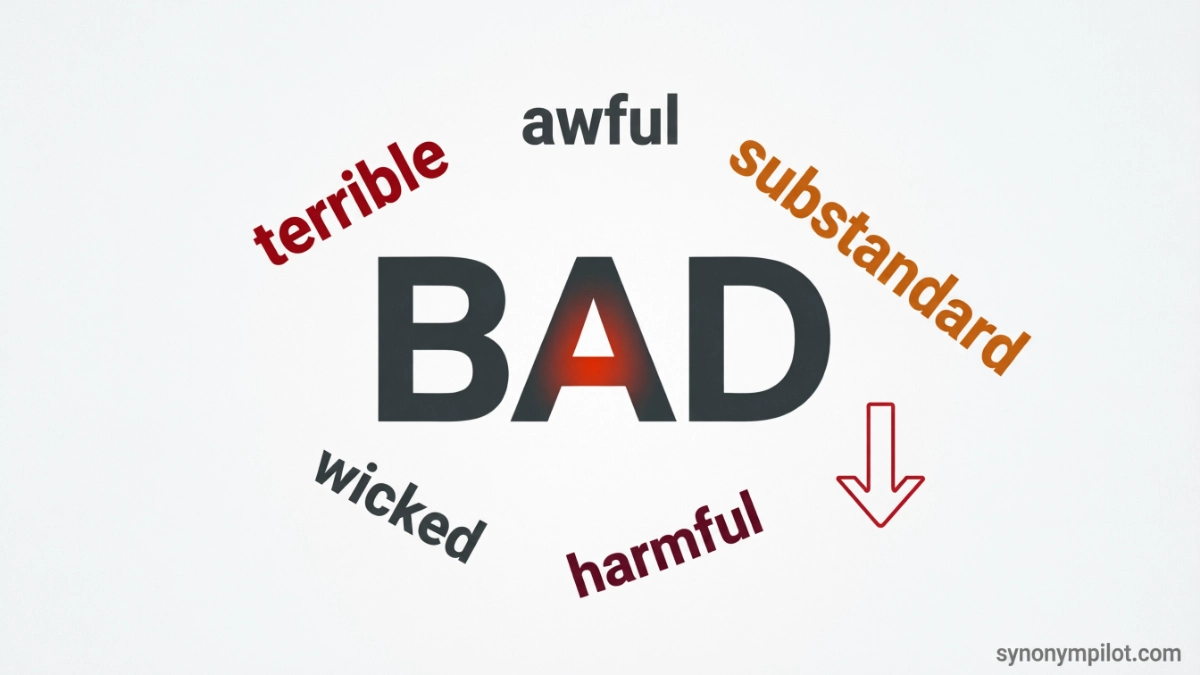
Words like “terrible,” “poor,” “harmful,” or “wicked” can replace “bad” depending on the type of negativity and how strong the feeling is.
You’re reviewing a restaurant online and you type “the food was bad.” It’s honest, but it tells the reader almost nothing. Was it tasteless? Undercooked? Actually unpleasant to eat? So you revise:
“The food was bland, poorly seasoned, and served cold.” Or maybe you’re writing a formal complaint and “bad” feels too vague so you write “the quality was substandard and unacceptable.”
Suddenly, your words carry real weight.That’s what the right synonym does it doesn’t just describe, it communicates.
What Does “Bad” Mean?
“Bad” describes something of low quality, harmful nature, unpleasant character, or morally wrong behavior. It is one of the most flexible negative adjectives in English, covering everything from a bad smell to a bad habit to a bad decision. Because it covers so much, it often needs more specific alternatives to communicate exactly what is wrong.
Meaning, Tone, and Context
At its core, “bad” signals that something falls below an acceptable standard whether in quality, behavior, outcome, or character. The tone is neutral and informal. It works in everyday conversation (“that was a bad idea”), casual writing (“the film was bad”), and even professional speech when used deliberately for effect.
However, “bad” rarely fits formal or academic writing well. In those contexts, words like “substandard,” “inadequate,” “harmful,” or “detrimental” communicate more precisely and professionally. Similarly, in creative writing, “bad” is often too weak to carry emotional impact “appalling,” “wretched,” or “atrocious” paint a far more vivid picture.
“Bad” is also highly context dependent. A “bad” person implies moral wrongdoing. A “bad” essay implies low quality. A “bad” smell implies unpleasantness. The exact meaning shifts completely based on what noun follows it which is why choosing a more specific synonym almost always strengthens your writing.
When and How to Use “Bad”
Use “bad” when you want a quick, universally understood word to express that something is negative, harmful, or of poor quality especially in casual, spoken, or informal contexts.
Here are natural examples:
- “I had a really bad day.” (casual, emotional)
- “That was a bad call.” (informal, judgmental)
- “She’s in a bad mood this morning.” (descriptive, conversational)
- “The signal in this area is bad.” (practical, everyday)
When you want your writing to be more precise, more formal, or more emotionally vivid, choosing a more specific synonym from the list below will always strengthen your communication.
Another Word for Bad
If you need one quick, reliable alternative depending on context:
- For poor quality → substandard or inferior
- For harmful or damaging → detrimental or harmful
- For morally wrong → wicked or immoral
- For very extreme negative → terrible or appalling
- For casual conversation → awful or lousy
There is no single “best” replacement for “bad” the right word depends on whether you mean poor quality, harm, moral failure, or general unpleasantness.
When Not to Use This Word
Avoid “bad” in formal academic or professional writing where more precise vocabulary is expected. “The results were bad” tells a reader almost nothing useful. “The results were significantly below expectations” or “the outcomes were detrimental to long term performance” communicates specificity and authority.
Avoid “bad” in creative writing when you want strong emotional impact. “It was a bad experience” is weak. “It was a harrowing, deeply unsettling experience” pulls the reader into the feeling. Specific synonyms always create stronger imagery.
Avoid using “bad” to describe people in professional or sensitive contexts. “He’s a bad employee” sounds blunt and imprecise. “His performance has been consistently below the required standard” communicates the same message professionally and respectfully.
Words Commonly Confused With Bad
Bad vs. Poor:
“Poor” often describes quality specifically a poor performance, poor results, poor quality without always implying harm or moral failure. “Bad” covers all these categories and more. “Poor” sounds slightly more formal and measured. “Poor lighting in the office affected focus” sounds more professional than “the office lighting was bad.”
Bad vs. Terrible:
“Terrible” is significantly stronger than “bad.” It implies something is extremely negative, often to a disturbing or shocking degree. “The weather was bad” describes an ordinary unpleasant day. “The weather was terrible” suggests conditions were severe and unpleasant beyond normal expectations.
Bad vs. Harmful:
“Harmful” specifically describes something that causes damage or injury physical, emotional, or environmental. “Bad” is broader and doesn’t always imply actual damage. “Harmful chemicals” describes a real danger. “Bad chemicals” sounds vague and doesn’t communicate the risk as clearly.
Bad vs. Wicked:
“Wicked” describes moral badness evil, deliberately wrong, or deeply immoral. “Bad” can describe moral failure too, but far more mildly. “A wicked person” suggests serious evil. “A bad person” suggests someone who behaves badly, but without the same weight of intentional wrongdoing.
Best Synonym for Bad by Context
| Context | Best Synonym | Why It Fits |
|---|---|---|
| Academic/formal writing | Substandard, Inadequate, Detrimental | Precise and professionally appropriate |
| Creative/literary writing | Wretched, Appalling, Dreadful | Vivid and emotionally strong |
| Business writing | Subpar, Unsatisfactory, Inferior | Professional without being dramatic |
| Health and safety contexts | Harmful, Hazardous, Damaging | Specific to risk and danger |
| Moral/ethical contexts | Immoral, Wicked, Corrupt | Describes wrongdoing with precision |
| Casual conversation | Awful, Lousy, Dreadful | Natural and expressive |
| Describing behavior | Unacceptable, Inappropriate, Improper | Professional without being harsh |
Which Synonym Should You Choose?
Ask yourself these quick questions before picking a replacement for “bad”:
1. What type of “bad” is this? Poor quality, harmful, morally wrong, or unpleasant? Each type has its own best synonyms.
2. How extreme is it? “Lousy” and “poor” describe mild negativity. “Appalling,” “atrocious,” and “abysmal” describe extreme cases. “Terrible” and “dreadful” sit in between.
3. How formal is the context? “Awful” and “lousy” suit casual speech. “Substandard,” “inadequate,” and “detrimental” suit formal writing.
4. Are you describing something or criticizing someone? When describing a thing, “inferior” or “substandard” works. When describing behavior, “inappropriate” or “unacceptable” is more tactful in professional writing.
Real Life Examples of “Bad” in Sentences
School
“The essay received a low grade due to its poor structure and lack of supporting evidence.”
“His behavior in class was disruptive and unacceptable throughout the term.”
Workplace
“The report was substandard and needed to be substantially revised before submission.”
“The client was unhappy with the inferior quality of the delivered work.”
Writing
“The villain in the novel was not merely wicked, but calculating and entirely without remorse.”
“Critics described the film as appalling a complete waste of its talented cast.”
Conversation
“That meeting was a total waste of time absolutely awful from start to finish.”
“The traffic today was horrendous; I sat in the same spot for forty minutes.”
50 Synonyms for Bad
| Synonym | Simple Meaning | Example Sentence |
|---|---|---|
| Terrible | Extremely unpleasant or poor quality | The food at the hotel was terrible. |
| Awful | Very unpleasant or low quality | I had an awful headache all day. |
| Dreadful | Extremely unpleasant or shocking | The storm caused dreadful damage. |
| Appalling | Shockingly bad or unpleasant | The living conditions were appalling. |
| Atrocious | Extremely bad or wicked | The customer service was atrocious. |
| Abysmal | Extremely poor in quality | The exam results were abysmal. |
| Horrendous | Extremely unpleasant | The traffic was horrendous this morning. |
| Lousy | Informal term for very bad | The Wi-Fi connection is lousy. |
| Inferior | Lower in quality than another | The cheaper model proved inferior. |
| Substandard | Below the required quality level | The work was substandard. |
| Poor | Low quality or performance | Her performance was poor. |
| Inadequate | Not sufficient or good enough | The budget was inadequate. |
| Unsatisfactory | Not meeting expectations | The report was unsatisfactory. |
| Deficient | Missing something necessary | The building was deficient in safety features. |
| Unacceptable | Below minimum standards | His behavior was unacceptable. |
| Subpar | Below average quality | The restaurant’s service was subpar. |
| Mediocre | Only average, not impressive | The movie was mediocre. |
| Wretched | Extremely bad or miserable | They lived in wretched conditions. |
| Deplorable | Deserving strong criticism | The housing conditions were deplorable. |
| Lamentable | Regrettably bad | The roads are in a lamentable state. |
| Detrimental | Harmful or damaging | Lack of sleep is detrimental to health. |
| Harmful | Causing damage | Smoking is harmful to the lungs. |
| Damaging | Producing negative effects | The scandal was damaging to the company. |
| Hazardous | Dangerous or risky | The chemicals are hazardous. |
| Dangerous | Likely to cause harm | The road becomes dangerous in winter. |
| Wicked | Morally wrong or evil | The wicked plot fooled many people. |
| Immoral | Against moral principles | Fraud is immoral. |
| Corrupt | Dishonest for personal gain | The corrupt official was arrested. |
| Villainous | Having qualities of a villain | The villainous character drove the story. |
| Sinful | Against moral or religious values | Many considered the act sinful. |
| Reprehensible | Deserving strong condemnation | His actions were reprehensible. |
| Vile | Extremely unpleasant or disgusting | The smell was vile. |
| Foul | Offensive or unpleasant | A foul odor filled the room. |
| Rotten | Very poor quality or morally bad | It was a rotten experience. |
| Dire | Extremely serious or urgent | The company faced dire financial problems. |
| Grave | Serious and concerning | The patient’s condition remained grave. |
| Severe | Very serious or extreme | The storm caused severe damage. |
| Harsh | Unpleasantly severe | The criticism was harsh. |
| Negative | Unfavorable or harmful | The publicity had a negative impact. |
| Objectionable | Likely to cause disapproval | His comments were objectionable. |
| Offensive | Causing anger or discomfort | The joke was offensive. |
| Distasteful | Unpleasant or morally offensive | The remarks were distasteful. |
| Inappropriate | Not suitable for the situation | The comment was inappropriate. |
| Wrong | Incorrect or morally unacceptable | It was wrong to lie. |
| Inexcusable | Impossible to justify | The delay was inexcusable. |
| Shocking | Causing strong negative surprise | The findings were shocking. |
| Disgraceful | Bringing shame or disapproval | The behavior was disgraceful. |
| Ghastly | Extremely unpleasant or horrifying | The accident scene was ghastly. |
| Shoddy | Poorly made or done | The shoddy workmanship was obvious. |
| Pitiful | So poor it inspires pity | The presentation was pitiful. |
Synonym Groups and Usage Differences
Formal
Substandard, inadequate, detrimental, deficient, inferior, reprehensible, deplorable suit academic essays, formal reports, official complaints, and professional correspondence. They communicate negativity with precision and authority.
Informal
Lousy, awful, rotten, dreadful, ghastly sound natural in casual conversation, social media, and relaxed writing. They’re expressive and immediately understood.
Academic
Detrimental, harmful, inadequate, deficient, negative, severe appear frequently in research papers, health writing, policy analysis, and scholarly discussion, especially when describing outcomes, conditions, or effects.
Professional
Substandard, unsatisfactory, subpar, unacceptable, inappropriate, inferior suit business emails, performance reviews, formal complaints, and workplace communication. They describe problems clearly without sounding overly emotional.
Moral/Ethical
Wicked, immoral, corrupt, reprehensible, sinful, villainous describe moral failure and intentional wrongdoing. These carry ethical judgment and suit literary, religious, legal, or philosophical contexts.
Strongest vs. Weaker
“Abysmal,” “appalling,” “atrocious,” and “deplorable” describe extreme negativity far stronger than “bad.” “Mediocre,” “poor,” and “subpar” describe mild or moderate failures weaker and more measured.
Slang / Very Informal
“Lousy,” “rotten,” and “ghastly” sit at the casual end of the scale. In youth slang, “bad” itself has been reclaimed in some contexts to mean impressively good “that performance was bad” can be a compliment in certain informal registers, particularly in music and pop culture.
Antonyms of Bad
| Antonym | Meaning | Example |
|---|---|---|
| Good | Of high quality or morally right | The feedback from the client was genuinely good. |
| Excellent | Very high in quality | The presentation received an excellent response from the audience. |
| Superior | Of higher quality compared to others | The premium version proved clearly superior in every test. |
| Beneficial | Producing good or positive results | Regular exercise is highly beneficial for mental health. |
| Virtuous | Having high moral standards | She is known as an honest and virtuous professional. |
| Satisfactory | Meeting the expected or required standard | The work was satisfactory, though there’s room for improvement. |
| Admirable | Deserving respect and praise | His dedication to the project was truly admirable. |
| Acceptable | Meeting the minimum required standard | The final version of the report was acceptable and ready to submit. |
| Outstanding | Exceptionally good | Her outstanding performance earned a promotion. |
| Exceptional | Unusually excellent | The team delivered exceptional results this quarter. |
| Superb | Of extremely high quality | The restaurant served a superb meal. |
| Wonderful | Extremely pleasing or impressive | We had a wonderful time during the trip. |
| Positive | Favorable or beneficial | The campaign had a positive impact on sales. |
| Favorable | Showing approval or producing good results | The company received favorable reviews. |
| Commendable | Worthy of praise | Her commitment to the project was commendable. |
| Honorable | Guided by integrity and fairness | He made the honorable choice despite pressure. |
| Ethical | Following accepted moral principles | The organization maintains ethical business practices. |
| Noble | Having high moral qualities | It was a noble effort to help those in need. |
| Helpful | Providing assistance or support | The guide was very helpful for beginners. |
| Constructive | Intended to improve rather than criticize | The manager offered constructive feedback. |
Comparison: Bad vs. Related Words
Bad vs. Poor
“Poor” describes quality specifically and sounds more measured and formal than “bad.” “Poor performance” suits a professional review. “Bad performance” sounds informal and slightly vague. In academic writing, “poor” nearly always sounds more appropriate than “bad.”
Bad vs. Terrible
“Terrible” is significantly more intense than “bad.” A bad day is unpleasant. A terrible day is genuinely awful. When something is extremely negative, “terrible” communicates greater severity. Using “terrible” for mild situations sounds exaggerated; use it only when the negativity is genuinely strong.
Bad vs. Harmful
“Harmful” specifically describes damage caused physical, emotional, or environmental. “Bad” is broader and doesn’t always imply actual damage. “That habit is harmful” communicates real danger. “That habit is bad” is true but vaguer. In health and safety contexts, “harmful” is always the stronger, more precise choice.
Bad vs. Awful
“Awful” and “bad” are very close in everyday speech, but “awful” usually sounds slightly stronger and more emotionally expressive. “The experience was bad” is flat. “The experience was awful” communicates real unpleasantness with more feeling. Both are informal; neither suits formal academic writing.
Bad vs. Wicked
“Wicked” is specifically about moral evil deliberate wrongdoing, often involving cruelty or malice. “Bad” can describe moral failure too, but more mildly. “A bad person” might simply be someone who behaves poorly. “A wicked person” suggests intentional evil. In creative writing and moral discussions, “wicked” carries far more dramatic weight.
Common Phrases and Expressions
“Go from bad to worse”
When a situation keeps getting more negative rather than improving.
Example: “The project started behind schedule, and then it went from bad to worse when the budget was cut.”
“In bad shape”
Describing something or someone in poor condition.
Example: “The old building was in really bad shape it hadn’t been maintained in years.”
“A bad apple”
One person whose negative behavior affects those around them.
Example: “One bad apple can genuinely affect the morale of an entire team.”
“No good, very bad”
An emphatic informal phrase for something completely and thoroughly negative.
Example: “Yesterday was a no good, very bad day from start to finish.”
“A bad taste in the mouth”
A lingering sense of unpleasantness after a bad experience.
Example: “The way the meeting ended left everyone with a bad taste in the mouth.”
“Through the bad times”
A phrase recognizing support or endurance during difficult periods.
Example: “True friends stick with you through the bad times, not just the good.”
Common Mistakes to Avoid
Using “bad” in academic or professional writing:
“The experiment produced bad results” sounds too casual for a report. “The experiment produced substandard results” or “the outcomes were significantly below expected thresholds” communicates the same idea with appropriate precision.
Confusing “terrible” and “bad” for mild situations:
“Terrible” implies extreme negativity. Using it for minor inconveniences “the wait was terrible” can sound dramatic. “The wait was frustrating” or “longer than expected” is more proportionate.
Using “harmful” and “bad” interchangeably in health writing:
“Bad food” is vague. “Harmful food additives” or “foods that are damaging to digestive health” communicates specific risk. Always specify what kind of harm in health and safety contexts.
Describing people as “bad” in professional feedback:
“She’s a bad employee” is both vague and unprofessional. “Her performance has consistently fallen below the required standard” communicates the same concern while remaining specific and constructive.
Overusing informal synonyms like “awful” or “lousy” in writing:
These words suit conversation but weaken formal written communication. In professional emails, reports, or essays, replacing “awful” with “severely substandard” or “lousy” with “considerably below expectations” immediately elevates the tone.
FAQs
What is a more formal word for “bad” in academic writing?
A: “Substandard,” “inadequate,” “detrimental,” and “deficient” are all strong formal alternatives. The best choice depends on whether you’re describing quality (“substandard results”), harm (“detrimental effects”), or insufficiency (“inadequate funding”).
What is the difference between “bad” and “terrible”?
A: “Terrible” is significantly stronger than “bad” it implies extreme negativity, often shocking or overwhelming. “Bad” covers everything from mildly negative to quite negative. Reserve “terrible” for genuinely extreme situations to avoid sounding exaggerated.
What is a good synonym for “bad” when describing behavior?
A: “Unacceptable,” “inappropriate,” “objectionable,” and “reprehensible” are all precise alternatives for describing negative behavior in professional or formal contexts. “Inappropriate” works best for situational issues; “reprehensible” carries stronger moral judgment.
Can “bad” ever mean something positive?
A: In informal, especially youth slang, “bad” can be used as a compliment meaning impressively good “that routine was bad” can mean it was excellent. This usage is common in music and pop culture. However, standard English always treats “bad” as negative, so context is everything.
What is the strongest synonym for “bad” to describe something of terrible quality?
A: “Abysmal,” “atrocious,” and “appalling” are the strongest options for describing extremely poor quality. “Deplorable” and “wretched” also work well when the negativity causes a strong emotional reaction.
Conclusion
“Bad” is one of those words you use every day but it rarely says as much as it could. If you’re writing a formal complaint, crafting a creative story, or simply describing a frustrating experience, the right synonym communicates not just that something was negative, but exactly how negative it was and why.
This week, try noticing every time you use “bad” in writing or speech. Ask yourself: do I mean poor quality, harmful, morally wrong, or just unpleasant?
Then reach for the word that captures that specific type of negativity. With practice, these distinctions become natural and your writing becomes noticeably clearer, more vivid, and more precise.

Hi, I’m J.D. Salinger—a language lover who enjoys uncovering the nuances of words. I write about synonyms, meanings, and vocabulary tips to help readers express themselves more clearly and confidently. My goal is to make learning new words fun, simple, and practical. synonympilot.com