Quick Answer: Nuanced means showing small, careful differences in meaning, tone, or detail rather than being simple or one sided. A nuanced opinion, explanation, or piece of writing considers multiple sides of an issue instead of treating it as black and white. The word is common in academic, professional, and thoughtful conversational writing.
Picture this: your professor hands back an essay with a comment that says, “Your argument is good, but it needs to be more nuanced.” Or maybe a coworker describes a tricky client situation by saying, “It’s nuanced there’s no simple right answer here.”
You nod, but a small part of you wonders: what exactly does nuanced mean, and how do I sound nuanced myself without using the same word over and over?
That’s exactly what this guide is for. If you’re writing an essay, preparing for a job interview, or just trying to sound more precise when you talk about complicated topics, you’ll find clear explanations, real examples, and a full list of alternatives so you never have to repeat “nuanced” five times in one paragraph again.
Meaning, Tone & Context
At its core, nuanced describes something that has subtle distinctions small but meaningful differences that change how something should be understood. A nuanced view doesn’t say “this is simply good” or “this is simply bad.” It says, “this depends on context, and here’s why.”
Tone: Nuanced sits firmly in formal and academic territory, though it also shows up often in thoughtful professional and conversational English when people are discussing complex topics like politics, relationships, ethics, or culture. It rarely appears in casual small talk about everyday things like weather or food, because it signals depth and careful thinking.
Where it sounds most natural:
- Academic essays and research papers
- Workplace discussions about strategy, policy, or difficult decisions
- Journalism and opinion writing
- Conversations about emotionally or morally complex topics
- Reviews of books, films, or art that have layered meaning
You generally won’t hear someone describe a simple yes or no fact as nuanced. The word is reserved for situations with genuine complexity.
When & How to Use “Nuanced”
Use nuanced when you want to show that something resists a simple, single sentence explanation. Here are realistic ways it shows up:
In writing feedback: “Your thesis statement is clear, but the body paragraphs could use a more nuanced discussion of the counterarguments.”
In workplace conversations: “The feedback from the team was nuanced some loved the redesign, others had specific concerns about usability.”
In everyday discussion: “Her take on the documentary was pretty nuanced. She liked the storytelling but questioned some of the historical claims.”
In personal reflection: “I used to think it was a simple issue, but the more I learned, the more nuanced my understanding became.”
Notice the pattern: nuanced almost always pairs with ideas like “more than one side,” “depends on the situation,” or “not black and white.”
Another Word for Nuanced
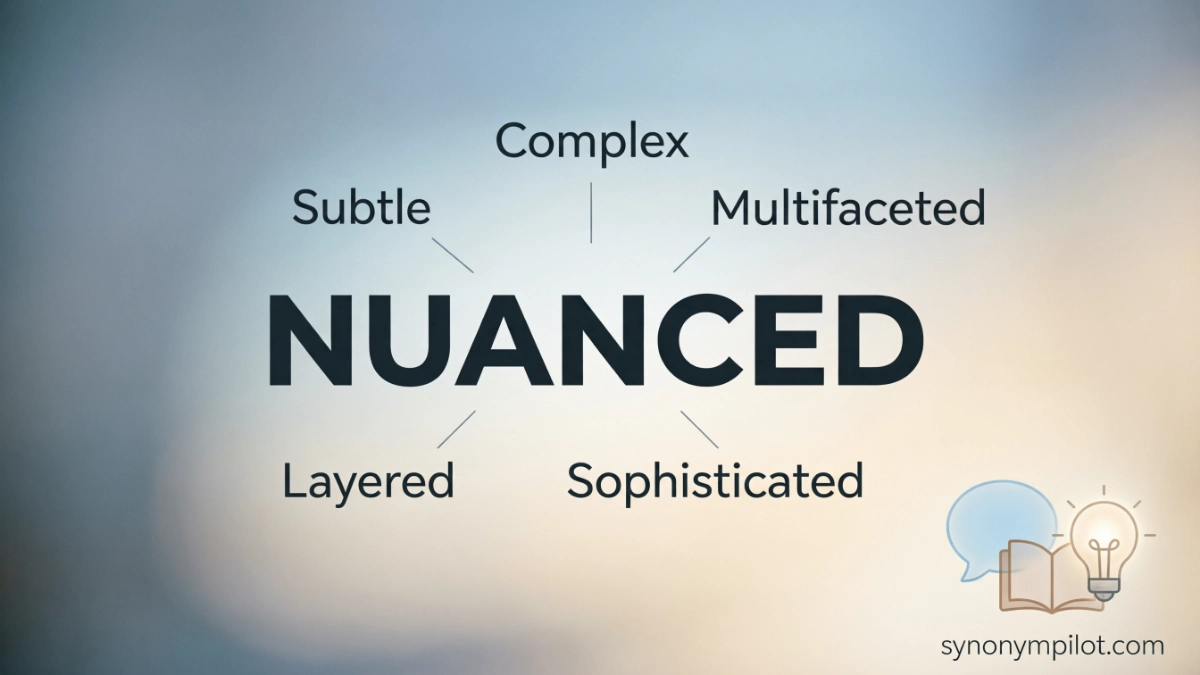
If you need a single quick substitute, the closest everyday alternatives are subtle, complex, or multifaceted, depending on what you’re emphasizing:
- Use subtle when the differences are small and easy to miss.
- Use complex when there are many interconnected parts.
- Use multifaceted when something has several distinct angles or perspectives.
When Not to Use This Word
Avoid “nuanced” in situations where something genuinely is simple or clear cut. Calling a basic fact “nuanced” can sound evasive, as if you’re avoiding a direct answer. For example, saying “Whether the store is open today is nuanced” sounds odd store hours are simply a fact, not a matter of perspective.
It also tends to feel out of place in very casual texting or informal chat among friends, where simpler words like “complicated” or “tricky” flow more naturally.
Words Commonly Confused With Nuanced
- Nuanced vs. Vague Nuanced means precise but layered; vague means unclear and lacking detail. These are almost opposites, even though people sometimes mix them up.
- Nuanced vs. Complicated Complicated often has a slightly negative, frustrating tone (hard to deal with), while nuanced is neutral or positive, suggesting thoughtful depth.
- Nuanced vs. Biased A nuanced view considers multiple angles fairly; a biased view leans heavily toward one side. They’re often confused because both involve “having a perspective,” but their honesty levels differ completely.
Best Synonym for Nuance by Context
| Context | Best Synonym | Why It Works |
|---|---|---|
| Academic writing | Multifaceted | Signals scholarly depth and multiple angles |
| Casual conversation | Complicated | Easier and more natural sounding in everyday talk |
| Describing emotions | Layered | Captures emotional depth without sounding clinical |
| Workplace discussion | Complex | Professional and neutral in tone |
| Art or film review | Subtle | Highlights fine artistic detail |
| Political commentary | Balanced | Implies fairness across multiple viewpoints |
| Personal opinions | Mixed | Simple way to show more than one feeling |
Which Synonym Should You Choose?
Think about three things before picking a word: formality, emphasis, and audience.
If you’re writing a formal report, lean toward words like multifaceted, intricate, or sophisticated. If you’re chatting with a friend about a messy situation, complicated or tricky will sound far more natural than multifaceted. And if you specifically want to highlight that something requires careful, sensitive judgment like a delicate conversation delicate or sensitive may fit better than nuanced itself.
A simple rule: the more academic or professional your audience, the more comfortable you can be reaching for sophisticated alternatives. The more casual the setting, the simpler your word choice should stay.
Real Life Examples of “Nuanced” in Sentences
School:
“The teacher praised her essay for offering a nuanced analysis of the novel’s two main characters.”
Workplace:
“We need a more nuanced approach to performance reviews instead of just pass or fail ratings.”
Writing:
“The article presented a nuanced look at remote work, weighing both its benefits and its hidden costs.”
Conversation:
“Honestly, my feelings about moving cities are nuanced excited about the opportunity, but sad to leave my friends.”
Best Synonyms for Nuance by Context
| Context | Best Synonym | Why It Fits |
|---|---|---|
| Academic writing | Complexity, Sophisticated analysis | Emphasizes intellectual depth and multiple factors |
| Literary analysis | Layered, Subtextual | Highlights hidden meanings and interpretation |
| Professional communication | Measured, Balanced | Suggests careful consideration and precision |
| Data and research | Granular, Fine-grained | Focuses on small but important distinctions |
| Psychology and emotions | Mixed, Multidimensional | Captures complex feelings and perspectives |
| Critical thinking | Insightful, Perceptive | Reflects deep understanding of subtle differences |
| Everyday conversation | Subtle, Complicated | Natural and commonly understood alternatives |
| Politics and policy | Many-sided, Multifaceted | Recognizes multiple legitimate viewpoints |
| Art and culture | Textured, Variegated | Suggests richness and diversity of meaning |
| Decision-making | Carefully weighted, Considered | Indicates thoughtful evaluation of factors |
Synonym Groups & Usage Differences
Formal:
Words like multifaceted, intricate, and sophisticated belong in essays, reports, and academic writing. They sound polished but can feel stiff in casual speech.
Conversational:
Complicated, mixed, and tricky are what people naturally say out loud when discussing something layered. They’re friendly, accessible, and easy to understand.
Academic:
Discerning, qualified, equivocal, and granular show up frequently in research, philosophy, and critical writing where precision matters most.
Professional:
Balanced, measured, and calibrated work well in workplace settings, especially around feedback, negotiation, or strategy.
Strongest vs. weaker:
Intricate and multidimensional suggest deeper complexity than subtle, which implies something smaller and easier to overlook.
Emotional vs. neutral:
Layered and textured often carry emotional warmth, especially in storytelling, while precise and fine grained stay neutral and analytical.
Antonyms of Nuance
| Antonym | Meaning | Example |
|---|---|---|
| Simple | Easy to understand, with no hidden complexity | His explanation was refreshingly simple. |
| Black and white | Seeing only two extreme options | She has a black-and-white view of right and wrong. |
| Obvious | Clear and easy to notice immediately | The mistake was obvious to everyone in the room. |
| Crude | Lacking detail or refinement | It was a crude summary that missed key details. |
| One-dimensional | Showing only a single perspective | The character felt one-dimensional and predictable. |
| Vague | Lacking clear or specific detail | His vague answer didn’t really explain anything. |
| Blunt | Direct, without subtlety or softness | She gave a blunt, no-nuance opinion. |
| Straightforward | Simple and easy to follow | The instructions were straightforward and quick to read. |
Comparison Section
Nuanced vs. Complex
Both words involve multiple parts, but complex focuses on structure how many pieces are involved and how they connect. Nuanced focuses on meaning the subtle differences in interpretation. A complex system can have simple, clear meaning; a nuanced statement can be short but still carry layered implications.
Example: “The tax code is complex” (many rules) vs. “Her opinion on taxes is nuanced” (multiple fair perspectives).
Nuanced vs. Subtle
Subtle emphasizes something small and easy to miss. Nuanced emphasizes a fuller picture made of many small distinctions. Subtlety is often just one ingredient within something nuanced.
Example: “There was a subtle change in her voice” vs. “Her overall reaction was nuanced, mixing relief with disappointment.”
Nuanced vs. Vague
These are often confused but mean nearly opposite things. Nuanced means precise and detailed, just not simple. Vague means unclear and lacking detail altogether. A nuanced answer can still be specific; a vague one rarely is.
Example: “His nuanced critique pointed out exactly what worked and what didn’t” vs. “His vague critique never explained what he actually meant.”
Common Phrases & Expressions
“A nuanced take”
Refers to an opinion that considers multiple sides fairly. Example: “I appreciated her nuanced take on the controversial policy.”
“Nuanced understanding”
Describes deep, well rounded knowledge of a topic. Example: “Years of fieldwork gave him a nuanced understanding of local customs.”
“Lose the nuance”
Means oversimplifying something complex. Example: “Headlines often lose the nuance of the original research.”
“Add nuance to the conversation”
Means contributing a more detailed or balanced perspective. Example: “Her question really added nuance to the conversation.”
“Pick up on the nuance”
Means noticing subtle, important details others might miss. Example: “Good editors pick up on the nuance in a writer’s tone.”
Common Mistakes to Avoid
A common mistake is using “nuanced” to describe something that’s actually just confusing or poorly explained those are different problems. Another mix up is treating “nuanced” and “biased” as similar, when nuance actually implies fairness, not favoritism. People also sometimes overuse the word in casual speech, where simpler alternatives like “complicated” or “mixed” sound more natural and less forced.
FAQs
Is “nuanced” formal or informal?
It leans formal and academic, though it appears comfortably in professional and thoughtful everyday conversations about complex topics.
What’s a simpler way to say “nuanced”?
“Complicated,” “mixed,” or “layered” are simpler, more conversational alternatives that most people use naturally in daily speech.
Can a person be described as nuanced?
Yes it usually means the person has thoughtful, well rounded views rather than extreme or oversimplified opinions.
Is “nuanced” the same as “complex”?
Not exactly. Complex describes structure and many connected parts, while nuanced describes subtle differences in meaning or interpretation.
Why do people use “nuanced” so often in essays?
Because it signals critical thinking showing you’ve considered multiple perspectives instead of settling for an oversimplified argument.
Conclusion
Learning a word like “nuanced” and its many alternatives gives you more precision when describing complicated ideas, feelings, or opinions.
Instead of repeating the same word in every essay or conversation, you now have a full toolkit: subtle, layered, multifaceted, complex, and many more, each suited to a slightly different shade of meaning.
The best way to make these words stick is simple: start noticing when you’re tempted to call something “nuanced,” then pause and ask whether a more specific alternative fits better.
Try using one new synonym this week in a conversation, email, or piece of writing. Small, consistent practice like this naturally builds richer, more confident vocabulary over time.

Hi, I’m George Philip—an English language enthusiast who enjoys uncovering the nuances of words. I write about synonyms, vocabulary, and everyday language tips so readers can improve their communication and express themselves effectively. Learning new words should be fun, practical, and inspiring! synonympilot.com