You’re writing a thank you message to a friend who helped you through a hard month, and you type: “Thank you for your support.” It’s true and heartfelt but it also feels like the same phrase everyone writes on every card and message.
Or maybe you’re updating your resume and you’ve written “supported the marketing team” three times across different jobs. It starts to feel repetitive, even though each role involved very different kinds of work.
Support is one of those words that fits almost everywhere emotional, financial, physical, professional which is exactly why it gets used so often.
Learning its sharper, more specific alternatives helps you say exactly what kind of support you mean, if that’s comfort, money, encouragement, or hands on help.
Quick Answer
Support means to help, encourage, or hold up someone or something. It can refer to emotional comfort, physical strength, financial help, or backing an idea or person. The right synonym depends on what kind of support you’re actually describing.
Meaning, Tone, and Context
Core meaning:
Support means providing help, strength, encouragement, or backing to someone or something, so they can function, stand, succeed, or feel better.
Tone: Neutral to warm. Support works in formal, professional, academic, and emotional contexts equally well. It carries a generally positive, caring connotation.
Where it sounds most natural:
- Emotional contexts (“She supported me through a difficult time.”)
- Professional and workplace settings (“He supports the finance team.”)
- Physical contexts (“The beams support the entire roof.”)
- Academic and argumentative writing (“The data supports this theory.”)
Because support covers so many different situations, it’s also one of the easiest words to overuse. Choosing a more specific synonym often makes your meaning clearer and your writing more precise.
When and How to Use “Support”
Use support when you want to describe helping, encouraging, sustaining, or backing someone or something.
Emotional support:
“My family supported me through the divorce.”
Financial support:
“The scholarship supports students from low income families.”
Physical support:
“These columns support the weight of the entire building.”
Supporting an idea or argument:
“The research supports the new treatment approach.”
Professional or technical support:
“Our IT team supports over 500 employees.”
Notice how the meaning shifts slightly in each example that’s exactly why having specific synonyms matters. The word stretches to fit many situations, but a more precise word often communicates faster and clearer.
Another Word for Support
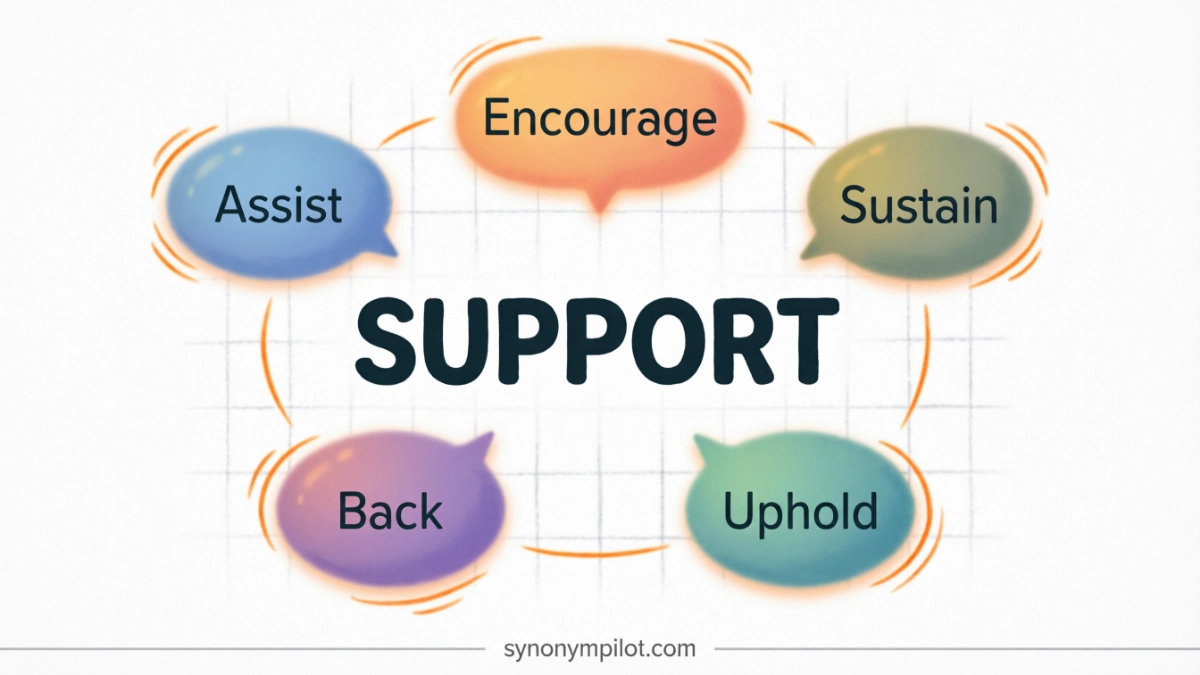
Here are some of the most natural, commonly used alternatives:
- Help the simplest, most common everyday alternative
- Assist slightly more formal, often professional
- Back informal, especially for supporting an idea or person
- Sustain to keep something going or functioning over time
- Uphold to support a principle, value, or decision
- Fund specifically financial support
- Encourage emotional or motivational support
- Reinforce to strengthen something that already exists
- Bolster to strengthen or boost something, often confidence or an argument
- Aid formal or practical help, often in difficult situations
When Not to Use This Word
Avoid support when:
- You mean something purely physical and structural hold up or brace may be clearer
- You’re describing financial help specifically fund or sponsor is more precise
- The tone is very casual back or help out feels more natural in conversation
- You want to emphasize strengthening something already in place reinforce or bolster fits better
- You’ve repeated support multiple times already rotate with a synonym to avoid sounding repetitive
Words Commonly Confused With Support
| Word | How It Differs from Support |
|---|---|
| Help | More general and casual; doesn’t always imply ongoing assistance |
| Sustain | Focuses on maintaining something over time, not just helping once |
| Encourage | Specifically emotional or motivational, not physical or financial |
| Fund | Strictly financial; doesn’t apply to emotional or physical support |
| Endorse | Public approval of an idea, not hands-on assistance |
| Maintain | Keeping something working or in good condition, not necessarily helping a person |
Best Synonym by Context
| Context | Best Synonym | Why It Fits |
|---|---|---|
| Emotional situations | Comfort, Encourage, Stand by | Warm and personally meaningful |
| Workplace or professional | Assist, Back, Facilitate | Clear and appropriately formal |
| Financial contexts | Fund, Sponsor, Subsidize | Specific and accurate |
| Physical/structural | Hold up, Brace, Prop up | Concrete and literal |
| Academic or argumentative | Substantiate, Corroborate | Precise and scholarly |
| Casual conversation | Back, Help out, Root for | Natural and relaxed |
| Advocacy or causes | Champion, Advocate for, Uphold | Strong and purpose-driven |
Which Synonym Should You Choose?
Start by asking: What kind of support am I actually describing?
- Emotional comfort → use comfort, console, or stand by
- Practical, hands on help → use assist or aid
- Financial help → use fund, sponsor, or subsidize
- Physical strength or stability → use hold up, brace, or prop up
- Strengthening an argument → use substantiate or corroborate
- Backing a cause or person publicly → use champion or advocate for
- Everyday casual help → use help out or back
Once you identify the type of support, choosing the right word becomes much simpler and your writing instantly feels more specific and genuine.
Real Life Examples of “Support” in Sentences
School
“Her teacher encouraged her to keep trying, even after she failed the first attempt.”
“The tutoring program assists students who are struggling with math.”
Workplace
“The HR department backs employees through every step of the hiring process.”
“Our new software facilitates communication across remote teams.”
Writing
“The evidence substantiates the author’s main argument.”
“Strong family bonds sustained her through years of hardship.”
Conversation
“I’ve got your back, no matter what happens.”
“She really stood by me when things got tough.”
Best Synonym by Context
| Context | Best Synonym | Why It Fits |
|---|---|---|
| Academic writing | Advocate for, Uphold, Corroborate | Precise and formal, suitable for scholarly discussion |
| Business communication | Assist, Facilitate, Endorse | Professional and workplace-friendly |
| Financial support | Fund, Finance, Subsidize | Specifically refers to monetary assistance |
| Emotional support | Comfort, Console, Encourage | Focuses on feelings and personal well-being |
| Teamwork and collaboration | Help, Assist, Pitch in | Natural and commonly used in group settings |
| Legal or evidence-based contexts | Substantiate, Corroborate, Validate | Emphasizes proof and verification |
| Leadership and advocacy | Champion, Advocate for, Promote | Indicates active support for a cause or idea |
| Casual conversation | Help, Back, Lend a hand | Natural and easy to understand |
| Loyalty and relationships | Stand by, Stick by, Stand behind | Highlights commitment and reliability |
| Education and development | Foster, Nurture, Empower | Focuses on growth and improvement |
Synonym Groups and Usage Differences
Formal and Professional Synonyms
Assist, facilitate, sustain, uphold, substantiate, underwrite
These fit naturally in workplace communication, academic writing, and official reports. Underwrite especially appears in financial and legal contexts.
Emotional and Personal Synonyms
Comfort, console, stand by, stick by, nurture, care for
These carry warmth and emotional connection, ideal for personal relationships, emotional writing, and heartfelt conversations.
Financial Synonyms
Fund, sponsor, subsidize, finance, underwrite, patronize
These specifically relate to monetary support and work well in business, charity, and economic contexts. They shouldn’t be used for emotional or physical support.
Physical and Structural Synonyms
Hold up, prop up, brace
These describe literal, physical support holding weight or stability. They don’t apply to emotional or financial situations.
Argument and Evidence Based Synonyms
Substantiate, corroborate, validate, back up
These belong in academic writing, research, and debate, where you’re supporting a claim or theory with evidence rather than supporting a person.
Conversational and Informal Synonyms
Back, root for, cheer on, pitch in, lend a hand
These feel natural and warm in everyday speech. They’re less appropriate for formal essays or professional reports.
Strongest vs. More General
Strongest: champion, advocate for, empower, defend
More general: help, assist, back
Stronger words show deeper commitment and active involvement, while general words simply state that help occurred.
Antonyms of Support
| Antonym | Meaning | Example |
|---|---|---|
| Oppose | To actively resist or disagree with something | Several council members opposed the new policy. |
| Undermine | To weaken something gradually, often secretly | His comments undermined her confidence. |
| Abandon | To leave someone without help or support | He abandoned the project halfway through. |
| Hinder | To get in the way of progress or help | Poor communication hindered the team’s success. |
| Discourage | To reduce someone’s confidence or motivation | Constant criticism discouraged the young writer. |
| Neglect | To fail to give needed care or attention | The company neglected its smaller clients. |
| Sabotage | To deliberately damage or obstruct something | A rival employee sabotaged the presentation. |
| Obstruct | To block or prevent progress | Road construction obstructed traffic for hours. |
| Impede | To slow down or interfere with progress | Lack of funding impeded the research effort. |
| Resist | To refuse to accept or assist | Many employees resisted the proposed changes. |
| Prevent | To stop something from happening | New regulations prevented the merger. |
| Block | To stop movement or progress | A fallen tree blocked the road. |
| Thwart | To prevent someone from succeeding | Security measures thwarted the attack. |
| Inhibit | To restrain or hold back | Fear of failure inhibited his creativity. |
| Deter | To discourage someone from acting | High costs may deter potential buyers. |
| Counteract | To act against and reduce an effect | The medication counteracts the symptoms. |
| Challenge | To question or oppose | Several experts challenged the findings. |
| Criticize | To express disapproval | The proposal was heavily criticized. |
| Reject | To refuse to accept or approve | The committee rejected the application. |
| Withhold | To refuse to give help or support | They withheld financial assistance. |
Comparison Section
Support vs. Help
Help is simple, general, and casual. Support often implies a deeper, more sustained kind of assistance emotional, financial, or structural. “He helped me move boxes” describes a single task. “He supported me through college” implies ongoing commitment.
Support vs. Encourage
Encourage is specifically about motivation and confidence. Support is broader and can include physical, financial, or emotional help. You can support someone financially without encouraging them emotionally, and vice versa.
Support vs. Sustain
Sustain emphasizes keeping something going over time, often something fragile or ongoing. Support is broader and can apply to a single moment or action. “The donations sustained the charity for years” shows continuity that simple support doesn’t always imply.
Support vs. Fund
Fund is strictly financial. Support can include money, but also emotional, physical, or moral backing. Using fund incorrectly for emotional support “She funded me through my depression” sounds wrong and confusing.
Support vs. Endorse
Endorse means publicly approving of something, often without necessarily doing hands on work. Support often implies active involvement. A celebrity can endorse a product without actually supporting the company in any deeper sense.
Common Phrases and Expressions
“Lend support”
Meaning: To offer help or backing to someone or something.
“Local businesses lent support to the community fundraiser.”
“In support of”
Meaning: Showing approval or backing for something.
“She spoke in support of the new education policy.”
“Pillar of support”
Meaning: Someone who provides strong, dependable help.
“Her mother has always been her pillar of support.”
“Moral support”
Meaning: Emotional encouragement, without necessarily doing physical tasks.
“I couldn’t fix the problem, but I gave him moral support.”
“Show support”
Meaning: To demonstrate that you care about or back someone/something.
“Hundreds of fans showed support outside the stadium.”
“Support system”
Meaning: A network of people who provide emotional or practical help.
“Having a strong support system made recovery much easier.”
“Stand in support of”
Meaning: To publicly back a cause, decision, or person.
“Employees stood in support of the new workplace policies.”
Common Mistakes to Avoid
Using “support” when you mean something purely financial
Saying “She supported the charity” is vague. If you mean money specifically, funded or sponsored communicates it more clearly.
Confusing “support” and “encourage”
Encourage focuses on motivation and confidence. Support is broader. Don’t use them interchangeably when the context calls for emotional motivation specifically.
Overusing “support” in resumes and professional writing
Repeating “supported the team” across multiple job descriptions feels generic. Use facilitated, assisted, strengthened, or contributed to for more specific, impressive language.
Using casual synonyms in formal writing
Words like root for or pitch in feel out of place in business reports or academic essays. Save them for conversational or informal writing.
Choosing physical synonyms for emotional contexts
Brace and prop up are literal, physical words. Using them for emotional situations “He propped her up emotionally” sounds unnatural. Use comfort or console instead.
FAQs
What is the best synonym for “support” in a resume?
Facilitated, assisted, and strengthened work very well on resumes. They sound specific and active, which employers prefer over the more generic “supported.”
What’s the difference between “support” and “help”?
Help is simple and can describe a single small task. Support often implies something deeper or more sustained emotional backing, financial assistance, or ongoing encouragement over time.
What’s a stronger word than “support” for emotional situations?
Comfort, console, and stand by carry more emotional weight than the general word support. They specifically highlight care during difficult times rather than general assistance.
Can “support” be used for both people and ideas?
Yes. You can support a person emotionally (“She supported her friend”) or support an idea or argument (“The data supports this theory”). The meaning shifts slightly depending on what’s being supported.
What’s a casual way to say “support”?
Back, root for, and pitch in are all relaxed, everyday alternatives. They work well in casual conversation but should be avoided in formal or professional writing.
Conclusion
Support is a warm, flexible word but its flexibility is exactly why it benefits from a few sharper alternatives. Whether you’re describing emotional comfort, financial backing, physical stability, or professional assistance, choosing the right synonym helps your reader understand precisely what kind of support you mean.
Try using comfort the next time you write about emotional care, or fund when money is genuinely involved. Notice how champion feels more active and passionate than simply saying support. These small shifts make your communication clearer and more genuine.
Keep practicing these words in your everyday writing and conversations. The more naturally you use them, the more precise and confident your communication will become whether you’re comforting a friend, writing a resume, or backing a cause you believe in.

Hi, I’m Theo John, a passionate word explorer who loves diving into the beauty of the English language. I write about synonyms, word meanings, and practical vocabulary tips to help readers communicate with confidence. synonympilot.com