Your teacher hands back your essay and says: “You used the word ‘different’ five times in three paragraphs.” Sound familiar? It happens to almost everyone learning English. “Different” is such a natural go to word that we rarely stop to think about replacing it even when a more precise word would make our writing so much stronger.
If you’re writing a school essay, a work report, or just trying to sound more natural in conversation, knowing the right alternatives to “different” will genuinely upgrade your English.
What Does “Different” Mean?
“Different” is an adjective used to describe something that is not the same as another thing it stands apart in some way, if in appearance, behavior, opinion, or nature. It can describe a small distinction or a complete contrast depending on the context. It’s one of the most flexible and commonly used words in English.
Meaning, Tone, and Context
At its core, “different” simply means “not the same.” But the word carries almost no emotional weight on its own it’s neutral, plain, and general. That’s useful sometimes, but it also means it rarely adds color or precision to your writing.
In terms of tone, “different” works everywhere: casual conversation, formal essays, academic writing, and professional emails. The problem is exactly that it’s so universal that it becomes forgettable. When you’re describing a truly unique idea, a striking contrast, or a deeply personal distinction, “different” often undersells what you actually mean.
The word sounds most natural in everyday speech: “That’s a different approach.” But in writing, especially formal or academic writing, more specific alternatives communicate your meaning with more precision and impact.
When and How to Use “Different”
Use “different” when you want to show a contrast or distinction between two or more things without specifying the nature of the difference.
“These two products target different markets.” “She has a completely different way of seeing the world.” “The twins have very different personalities.”
When the difference is more specific one thing is unique, unusual, diverse, contrasting, or incompatible a more targeted synonym will always serve you better.
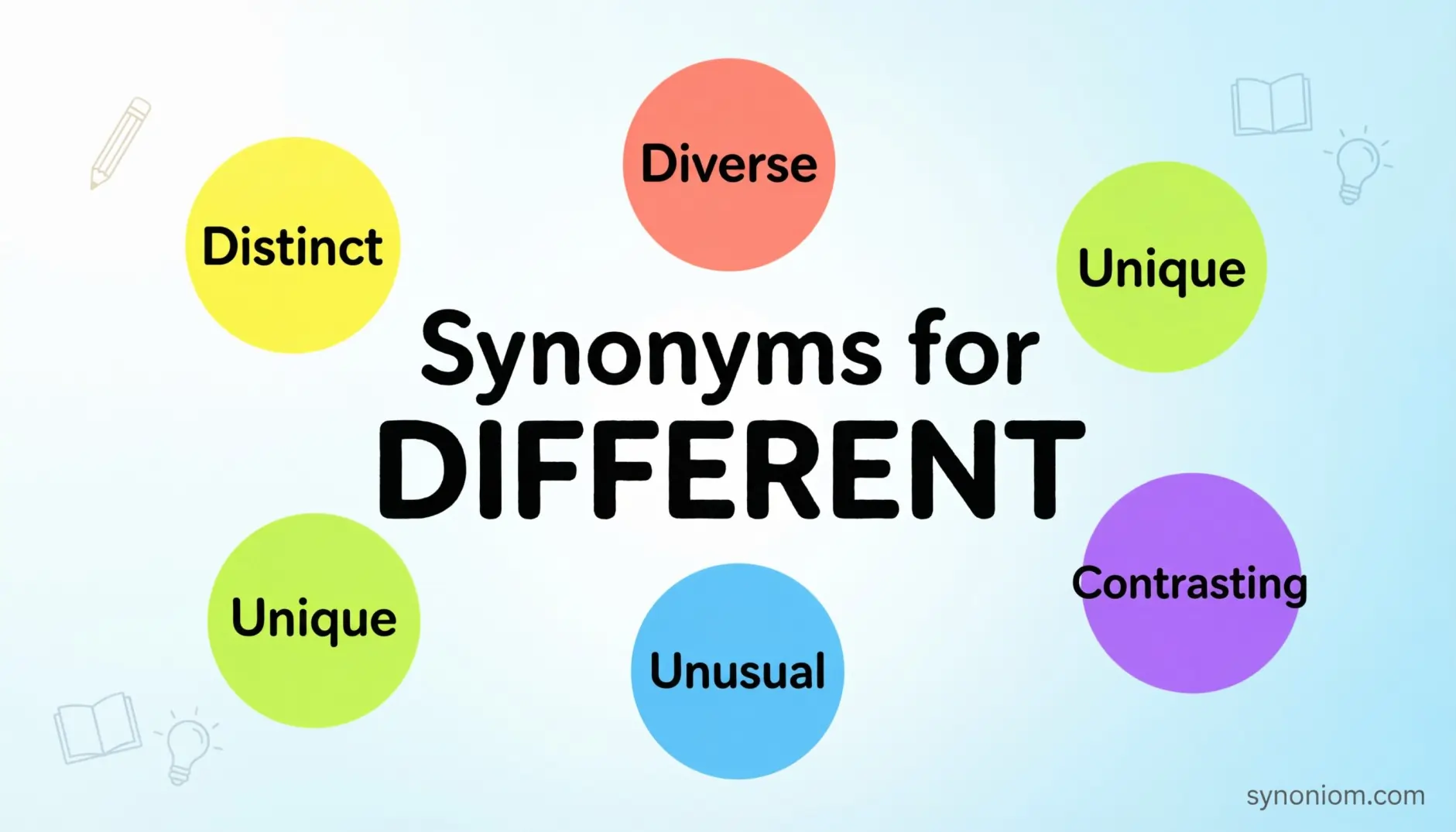
50 Synonyms for “Different”
| Synonym | Simple Meaning | Example Sentence |
|---|---|---|
| Distinct | clearly separate | The two styles are distinct. |
| Unique | one of a kind | Every snowflake is unique. |
| Diverse | varied in type | The team has diverse skills. |
| Varied | having variety | The menu offers varied options. |
| Contrasting | showing clear differences | The report shows contrasting results. |
| Dissimilar | not alike | The plans are dissimilar. |
| Unlike | not the same as | Unlike her brother, she enjoys hiking. |
| Separate | not connected | Keep the files separate. |
| Unusual | not typical | That was an unusual reaction. |
| Uncommon | rare | It’s uncommon to see snow here. |
| Divergent | moving apart | The studies reached divergent conclusions. |
| Contrary | opposite in nature | His actions were contrary to his words. |
| Opposing | directly against | They hold opposing opinions. |
| Contrarian | against the norm | He is known for contrarian views. |
| Alternative | another option | We need an alternative solution. |
| Varying | changing or unequal | Results were varying by region. |
| Mismatched | poorly paired | They wore mismatched socks. |
| Unrelated | having no connection | The events seem unrelated. |
| Disparate | very different in kind | The team had disparate backgrounds. |
| Incompatible | unable to work together | Their schedules are incompatible. |
| Inconsistent | not matching | His behavior is inconsistent. |
| Irregular | not following a pattern | She works irregular hours. |
| Alien | unfamiliar or foreign | The idea felt alien to him. |
| Novel | new and original | The scientist proposed a novel theory. |
| Original | not copied | Her approach was original. |
| Fresh | new and different | We need a fresh perspective. |
| Innovative | creative and new | The product has an innovative design. |
| Unconventional | not following norms | He uses unconventional methods. |
| Atypical | not typical | This was an atypical outcome. |
| Anomalous | outside the norm | The anomalous result needs review. |
| Rare | uncommon | Such talent is rare. |
| Extraordinary | far beyond ordinary | She showed extraordinary skill. |
| Singular | remarkable and unique | He has a singular talent. |
| Peculiar | strange or unusual | There is something peculiar here. |
| Curious | unusual and interesting | The object had a curious shape. |
| Eccentric | unusually individual | He is known for eccentric habits. |
| Odd | strange | It’s odd that nobody noticed. |
| Strange | unfamiliar | The software has strange features. |
| Exotic | unusual and intriguing | The market sold exotic fruits. |
| Remote | far apart in nature | Their ideas are remote from each other. |
| Poles apart | completely opposite | Their opinions are poles apart. |
| At odds | in conflict | Their accounts were at odds. |
| Out of the ordinary | beyond typical | That was out of the ordinary. |
| Another | an alternative one | Let’s try another method. |
| Modified | changed from the original | The modified version worked better. |
| Altered | changed in some way | The altered design looked cleaner. |
| Revised | corrected or updated | Here is the revised document. |
| Transformed | completely changed | The city has transformed rapidly. |
| Unorthodox | against convention | The coach used an unorthodox strategy. |
| Newfangled | unusually new | Some dislike newfangled technology. |
Important Synonym Groups
Formal Synonyms
Best suited for official writing, academic papers, and professional reports.
- Distinct The two categories are distinct in their function.
- Disparate The project brought together disparate teams.
- Divergent The panel reached divergent conclusions.
- Dissimilar The results were dissimilar across all three trials.
- Anomalous The anomalous reading required further analysis.
Informal Synonyms
Natural in everyday speech and casual writing.
- Odd That’s a bit odd, don’t you think?
- Strange Something strange is going on here.
- Another Let’s just try another way.
- Fresh I need a fresh start.
- Out of the ordinary She was definitely out of the ordinary.
Academic Synonyms
Precise and analytical ideal for essays and research.
- Divergent
- Disparate
- Atypical
- Anomalous
- Contrasting
Professional Synonyms
Clean, neutral, and suitable for business communication.
- Alternative We should explore alternative approaches.
- Varied The team brings varied expertise to the table.
- Inconsistent The data has been inconsistent across quarters.
- Revised Please review the revised proposal.
- Modified A modified version of the plan has been submitted.
Emotional Synonyms
Carry a personal or expressive tone.
- Alien His views felt completely alien to her.
- Peculiar There was something peculiar about the way he spoke.
- Extraordinary What she did for others was truly extraordinary.
- Singular He had a singular passion for justice.
- Rare A friendship like that is rare.
Conversational Synonyms
Used naturally in spoken English.
- Poles apart We’re just poles apart on this one.
- At odds They’ve been at odds all week.
- Unlike Unlike last time, today went smoothly.
- Another Can we try another option?
- Different kind of This is a whole different kind of problem.
Slang / Very Casual
For texts, social media, or informal chats.
- Off beat His humor is a little off beat.
- Left field That idea came completely out of left field.
- Not your average She’s not your average student.
Antonyms of “Different”
| Antonym | Meaning | Example Sentence |
|---|---|---|
| Same | exactly alike | These two files are the same. |
| Identical | perfectly matching | The twins wore identical outfits. |
| Similar | nearly alike | The results were similar across both groups. |
| Alike | resembling each other | The two brothers think alike. |
| Uniform | all the same throughout | The students wore uniform clothing. |
| Consistent | staying the same | Her performance has been consistent all year. |
| Matching | going together well | The curtains and cushions are matching. |
| Equivalent | equal in value or meaning | One mile is equivalent to 1.6 kilometers. |
| Comparable | similar enough to compare | The two products are comparable in quality. |
| Related | connected or linked | These issues are closely related. |
Comparison: “Different” vs. Closely Related Words
Different vs. Distinct
“Different” is general it just means “not the same.” “Distinct” is more precise. It means clearly separate, with a clear identity of its own. Use “distinct” when the separation is obvious and intentional.
“The two colors look different.” (general) “The two brands have distinct identities.” (clear and defined)
Different vs. Diverse
“Diverse” suggests a variety of types within a group it’s about richness and range, not just contrast. “Different” compares two things; “diverse” describes a collection.
“We have different opinions.” (two opposing views) “Our team has diverse opinions.” (many varied viewpoints)
Different vs. Unusual
“Unusual” specifically means “not typical” or “not common.” “Different” just means “not the same.” Something can be different from another thing without being unusual at all.
“She has a different approach.” (compared to others, neutral) “She has an unusual approach.” (uncommon, stands out)
Different vs. Unique
“Unique” is stronger. It means one of a kind there’s nothing else quite like it. Overusing “unique” weakens its meaning. Use it only when something is genuinely one of a kind.
“That’s a different design.” (not the same as others) “That’s a unique design.” (nothing else like it in the world)
Different vs. Contrary
“Contrary” is used when two things are directly opposed, especially in opinion, evidence, or direction. It’s more confrontational than “different.”
“Her evidence was contrary to what the report claimed.” (directly opposing) “Her findings were different from the report.” (not the same, neutral)
Common Phrases and Expressions
“A different story altogether”
Meaning: Something completely unlike what was described or expected. “The interview went well, but the salary negotiation was a different story altogether.”
“Poles apart”
Meaning: Completely and entirely different in nature or opinion. “Their approaches to parenting are poles apart.”
“Cut from a different cloth”
Meaning: Having a different character or nature than others around them. “He may come from the same background, but he’s cut from a different cloth.”
“Worlds apart”
Meaning: Separated by a very large difference in lifestyle, views, or quality. “The two versions of the software are worlds apart in terms of speed.”
“A different kettle of fish”
Meaning: A completely different type of situation or problem. “Managing a team is a different kettle of fish compared to working alone.”
“Chalk and cheese”
Meaning: Two things or people that are completely unlike each other. “Those two colleagues are like chalk and cheese hard to believe they work together so well.”
Common Mistakes to Avoid
Overusing “unique” as a synonym for “different”
“Unique” means one of a kind. If something is just different from one other thing, it’s not necessarily unique. Saying “each person has a unique personality” is fine, but “this is a unique alternative” often misuses the word.
Confusing “distinct” and “distinctive”
“Distinct” means clearly separate or different. “Distinctive” means having a strong, recognizable quality. A voice can be distinctive (recognizable) without being distinct from another (clearly separate).
Using “diverse” for two things
“Diverse” describes variety within a group usually three or more things. For comparing just two things, use “different,” “contrasting,” or “dissimilar” instead.
Using “contrary” too casually
“Contrary” implies direct opposition, often used in formal or logical arguments. In casual settings, it can sound argumentative or stiff. Stick to “different” or “unlike” in everyday conversation.
Saying “very unique” or “very different kinds”
“Unique” doesn’t need “very” it’s already absolute. And “different kinds” already implies variety, so “very different kinds” is often redundant. Keep it clean and precise.
FAQs
What’s a more formal word for “different” in an essay?
“Distinct,” “divergent,” “disparate,” and “contrasting” all work well in academic and formal writing. They add precision that “different” doesn’t. For example, instead of “different conclusions,” try “divergent conclusions” or “contrasting findings.”
Can I use “various” instead of “different”?
“Various” works when you mean several kinds or more than two options. It’s not a direct synonym in all cases. “They offer various flavors” works, but “her opinion is various from mine” does not.
Is “unlike” the same as “different”?
They’re similar, but “unlike” is usually used in comparisons: “Unlike last year, this year went smoothly.” “Different” is more flexible and stands alone more naturally.
What’s the best synonym for “different” in a professional email?
“Alternative,” “revised,” “varied,” and “modified” all fit naturally in professional writing, depending on what you mean. Choose based on context are you offering a new option, showing a change, or noting a contrast?
How do I use “disparate” correctly?
“Disparate” means very different in kind so different that the things seem to belong to completely different categories. “The company merged two disparate teams with almost nothing in common.” Don’t use it for minor differences; save it for when the contrast is striking.
Conclusion
Once you start replacing “different” with more targeted words like “distinct,” “diverse,” “contrary,” or “uncommon,” you’ll notice how much sharper your writing becomes. These aren’t fancy words for the sake of it they’re more accurate words that say exactly what you mean.
Pick three or four synonyms from this list that feel natural to you and try working them into your writing this week. Use “distinct” in your next report, try “unlike” in a conversation, or drop “varied” into an email.
Over time, these choices become habit, and your English starts to feel more confident, more expressive, and a lot more interesting. Small vocabulary upgrades, practiced consistently, make a real difference.

Hi, I’m Camron White, a word lover who enjoys exploring the beauty of the English language. I write about synonyms, meanings, and everyday vocabulary to help readers express themselves more clearly and confidently. My goal is to make learning new words simple, fun, and useful in real-life conversations. synonympilot.com