You’re updating your CV and you’ve written “experience” in almost every bullet point. Or you’re telling a story about a trip and you keep saying “it was such an experience” without quite capturing what it actually felt like.
Both situations are more common than you’d think and both have simple fixes once you know the right words.
“Experience” is one of those words that covers so much ground it can feel almost too broad. A job skill, a life event, a memory, a feeling they all get called “experience.”
The more specific word you choose, the more your reader or listener actually understands what you mean.
What Does “Experience” Mean?
“Experience” refers to knowledge, skill, or understanding gained through doing or living through something over time. It can also describe a specific event or situation that someone has been through something that happened and left an impression. As a verb, it means to go through or feel something firsthand.
Meaning, Tone, and Context
“Experience” has two main uses. The first is about accumulated knowledge the kind you build over years of doing something. “She has ten years of experience in finance.” The second is about a specific event or moment something that happened. “The concert was an unforgettable experience.”
In terms of tone, “experience” is neutral and versatile. It fits formal writing, casual conversation, academic papers, and professional CVs without sounding out of place. That neutrality is useful, but it also means the word rarely adds color or emotional depth on its own.
It sounds most natural in professional contexts (“relevant experience”) and personal storytelling (“a life changing experience”). In academic writing, words like “exposure,” “expertise,” or “empirical knowledge” often carry more precision. In emotional or personal contexts, words like “ordeal,” “journey,” or “encounter” feel more vivid and human.
When and How to Use “Experience”
Use “experience” when you want to refer broadly to knowledge built over time or to describe a notable event someone has lived through.
“He has years of experience managing large teams.” “Travelling alone was the best experience of my life.” “She has firsthand experience dealing with difficult clients.”
When you want to be more precise to describe expertise, a specific encounter, a challenging situation, or a deeply personal moment a more targeted synonym will always add clarity and color.
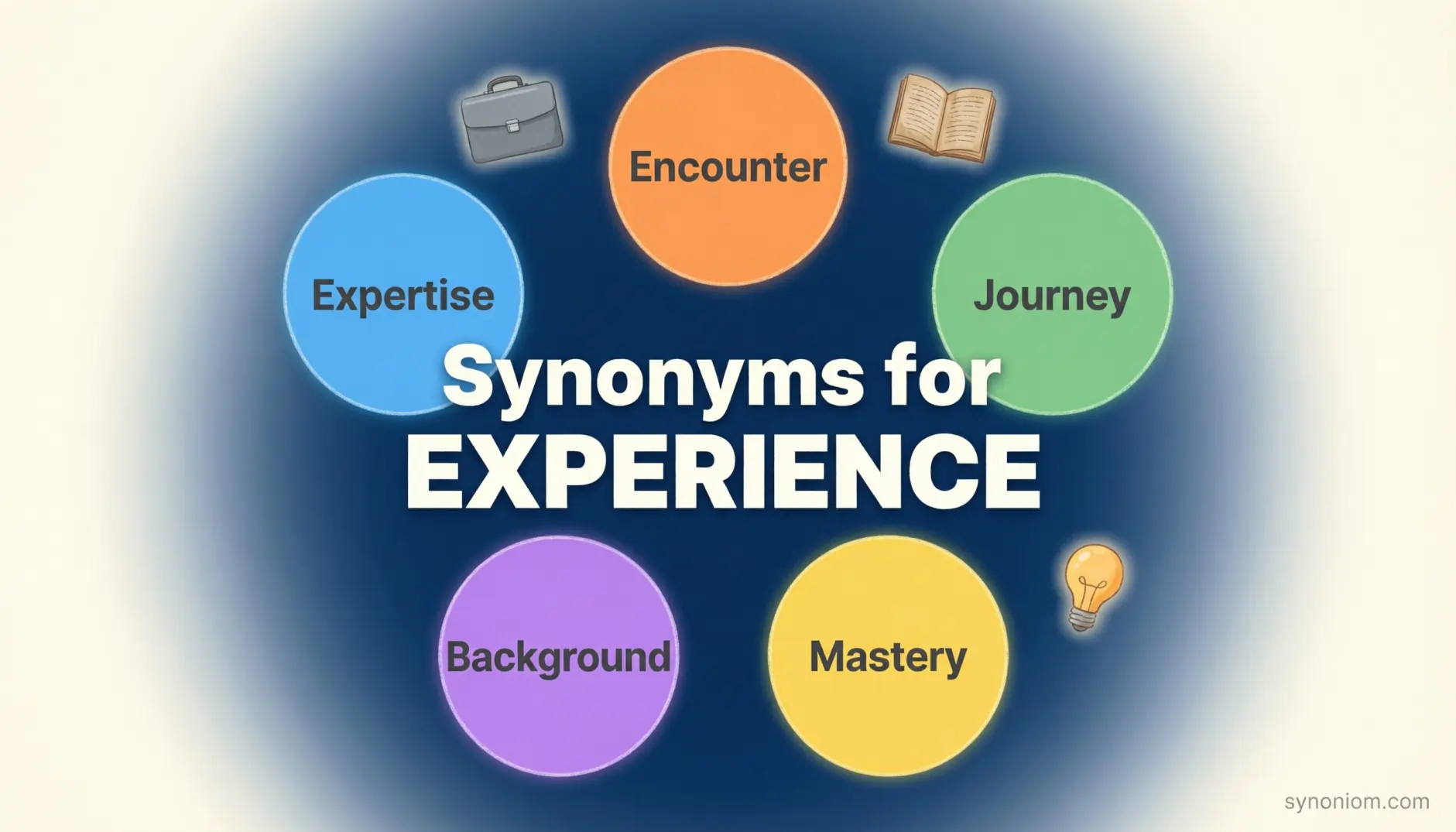
50 Synonyms for “Experience”
| Synonym | Simple Meaning | Example Sentence |
|---|---|---|
| Expertise | deep skill in a field | She has expertise in marketing. |
| Knowledge | information and understanding | His knowledge of history is impressive. |
| Skill | learned ability | The job requires communication skill. |
| Proficiency | high level of ability | She has proficiency in Spanish. |
| Competence | ability to perform well | Technical competence is essential. |
| Mastery | complete command of a subject | He achieved mastery of the piano. |
| Know-how | practical knowledge | She has the know-how to solve it. |
| Background | past education and work | His background is in engineering. |
| Track record | history of results | The company has a strong track record. |
| Exposure | contact with something | Travel gave her cultural exposure. |
| Familiarity | comfortable knowledge | He has familiarity with the system. |
| Understanding | depth of knowledge | Her understanding of science is strong. |
| Insight | deep perception | Experience gave him valuable insight. |
| Wisdom | good judgment from life | Age often brings wisdom. |
| Encounter | a specific meeting or event | The encounter changed his perspective. |
| Event | something that happened | It was an unforgettable event. |
| Incident | a particular occurrence | The incident was reported quickly. |
| Episode | one experience or period | That episode taught him patience. |
| Adventure | exciting experience | Backpacking was an adventure. |
| Ordeal | difficult experience | Recovery was a long ordeal. |
| Trial | challenging test | Starting a business was a trial. |
| Journey | process of growth | Learning became a journey. |
| Affair | situation or event | The affair attracted attention. |
| Happening | event or occurrence | The happening drew a crowd. |
| Occurrence | something that took place | Such occurrences are rare. |
| Sensation | strong feeling | Flying created a unique sensation. |
| Impression | effect left behind | The interview left a good impression. |
| Memory | remembered experience | It remains a treasured memory. |
| Recollection | remembered event | Her recollection was detailed. |
| Background knowledge | foundational understanding | Background knowledge helps learners. |
| Hands-on experience | practical involvement | The internship provided hands-on experience. |
| Fieldwork | practical work in real settings | The project required fieldwork. |
| Practice | repeated activity | Years of practice improved his skills. |
| Training | structured learning | She completed professional training. |
| Apprenticeship | learning from an expert | He entered an apprenticeship. |
| Grounding | solid foundation | A grounding in math is useful. |
| Awareness | conscious understanding | The campaign raised awareness. |
| Intuition | instinctive understanding | Her intuition was correct. |
| Seasoning | maturity gained through experience | The veteran brought seasoning to the team. |
| Cultivation | gradual development | Skill cultivation takes time. |
| Involvement | participation in something | His involvement was significant. |
| Participation | active taking part | Participation was encouraged. |
| Engagement | active connection | Her engagement with the project was strong. |
| Observation | learning through watching | Observation improved his understanding. |
| Exposure to | contact with something | Early exposure to art helps creativity. |
| Immersion | deep involvement | Language immersion speeds learning. |
| Hardship | difficult life experience | Hardship built resilience. |
| Chapter | phase of life | That job was an important chapter. |
| Milestone | significant achievement | Graduation was a major milestone. |
| Lesson | knowledge gained from experience | Failure became a valuable lesson. |
Important Synonym Groups
Formal Synonyms
Best for academic writing, official documents, and professional reports.
- Expertise The panel included experts with considerable expertise in the field.
- Proficiency Proficiency in both languages is required for this position.
- Competence The audit questioned the competence of the management team.
- Mastery Mastery of the subject took over a decade to develop.
- Exposure Prolonged exposure to the legal system shaped her thinking.
Informal Synonyms
Natural in casual conversation and personal writing.
- Know how She has the know how to get this done quickly.
- Chapter That was a tough chapter in my life, but I grew from it.
- Lesson I learned my lesson the hard way.
- Adventure Moving to a new city was quite an adventure.
- Hands on experience Nothing beats real hands on experience.
Academic Synonyms
Precise and analytical right for research, essays, and scholarly writing.
- Exposure
- Observation
- Immersion
- Competence
- Grounding
Professional Synonyms
Clean and credible ideal for CVs, cover letters, and business writing.
- Track record Her track record speaks for itself.
- Background He brings a strong background in supply chain management.
- Expertise We are looking for someone with expertise in digital marketing.
- Training Extensive training in crisis communication is required.
- Proficiency Proficiency in Excel is an advantage.
Emotional Synonyms
Personal and expressive for storytelling, memoirs, and heartfelt writing.
- Ordeal What she went through was a genuine ordeal.
- Journey Recovery was a long and emotional journey.
- Memory Some memories stay with you your whole life.
- Hardship The hardship he survived gave him extraordinary empathy.
- Impression She left a lasting impression on everyone she met.
Conversational Synonyms
Used naturally in everyday speech.
- Know how Do you have the know how to set this up?
- Background What’s your background in this area?
- Encounter That encounter with the taxi driver was hilarious.
- Episode That was a strange episode at work last week.
- Lesson That trip taught me a real lesson about planning.
Slang / Very Casual
For informal chats, social media, or relaxed writing.
- Been there, done that Oh, the office politics? Been there, done that.
- Real world chops She’s got real world chops that most graduates lack.
- Street smarts He didn’t study much, but he’s got street smarts.
Antonyms of “Joyful”
| Antonym | Meaning | Example Sentence |
|---|---|---|
| Sorrowful | deeply sad or grieving | He looked sorrowful at the farewell. |
| Miserable | very unhappy and uncomfortable | The weather made everyone miserable. |
| Dejected | low in spirit after disappointment | She felt dejected after rejection. |
| Gloomy | dark and sad mood | He stayed gloomy all day. |
| Melancholic | gently reflective sadness | The movie left a melancholic feeling. |
| Despondent | hopeless and deeply down | He became despondent after failures. |
| Downcast | visibly sad or discouraged | She looked downcast after the news. |
| Cheerless | without happiness or warmth | The room felt cheerless and empty. |
| Forlorn | lonely and abandoned in sadness | He stood forlorn at the station. |
| Disheartened | losing hope or confidence | She felt disheartened by criticism. |
Comparison: “Experience” vs. Closely Related Words
Experience vs. Expertise
“Experience” is time spent doing something. “Expertise” is the deep, refined skill that comes from doing it exceptionally well. You can have years of experience without true expertise and rare individuals develop expertise quickly.
“He has five years of experience in sales.” (time and exposure) “She is widely regarded as an expert in behavioral economics.” (mastery level skill)
Experience vs. Knowledge
“Knowledge” is what you know facts, concepts, understanding. “Experience” is what you’ve done or been through. You can have knowledge from books without any firsthand experience.
“She has extensive knowledge of tax law.” (learned) “She has direct experience handling tax disputes.” (done it)
Experience vs. Encounter
“Encounter” describes a specific, often brief or unexpected meeting or event. “Experience” can be ongoing and long term. An encounter is usually a single moment; an experience can last years.
“The encounter with the customs officer was stressful.” (specific incident) “Working abroad was a defining experience.” (extended period)
Experience vs. Exposure
“Exposure” suggests introduction or contact often early or limited. “Experience” implies deeper, more sustained involvement. Exposure is the beginning; experience is what builds over time.
“Her early exposure to music shaped her career.” (first contact) “By thirty, she had ten years of experience as a performer.” (built over time)
Experience vs. Background
“Background” refers to a person’s history their combination of education, training, and past roles. “Experience” focuses more on what someone has actually done. On a CV, both matter, but they highlight different things.
“Her background in engineering made her a strong candidate.” (overall history) “She has direct experience leading infrastructure projects.” (specific doing)
Common Phrases and Expressions
“A learning experience”
Meaning: Something difficult or unexpected that taught you something valuable. “Losing my first client was hard, but it was a real learning experience.”
“Firsthand experience”
Meaning: Knowledge gained by doing something yourself, not hearing about it. “She has firsthand experience working in conflict zones.”
“Years of experience”
Meaning: A long period of doing something, suggesting competence and depth. “With thirty years of experience, he was the obvious choice to lead the team.”
“A once in a lifetime experience”
Meaning: Something so rare it’s unlikely to happen again. “Seeing the Northern Lights was a once in a lifetime experience.”
“Lived experience”
Meaning: Personal, direct knowledge from having actually lived through something often used in social and academic contexts. “The policy was shaped by the lived experience of the community it serves.”
“In my experience”
Meaning: Based on what I have personally seen or done. “In my experience, the first year of running a business is always the hardest.”
Common Mistakes to Avoid
Using “expertise” and “experience” interchangeably
They’re related but not the same. “Expertise” suggests mastery a high level of skill. “Experience” just means you’ve done something. Saying “I have expertise in basic data entry” sounds exaggerated; “experience” is the better fit there.
Overusing “journey” in professional contexts
“Journey” works beautifully in personal, emotional, or reflective writing. In a business report or job application, it can sound overly dramatic. Stick to “background,” “track record,” or “experience” in professional settings.
Confusing “encounter” with “experience”
“Encounter” is a single, specific event usually brief or unexpected. Don’t use it to describe a long period or ongoing process. “My encounter with teaching” sounds odd; “my experience in teaching” is correct.
Using “exposure” to mean full competence
“Exposure” signals contact or introduction, not mastery. Saying “I have exposure to Python” on a CV honestly signals you’ve seen or tried it. Saying “I have experience in Python” implies you’ve actually worked with it. Don’t use them as equals.
Overloading a CV with the word “experience”
On a CV or cover letter, vary your language. Use “background,” “track record,” “expertise,” “proficiency,” and “hands on involvement” to describe different aspects of what you’ve done. It reads as more thoughtful and confident.
FAQs
What’s the best synonym for “experience” on a CV?
It depends on what you’re describing. For long term work history, “background” or “track record” sound professional and strong. For specific skills, “expertise” or “proficiency” add more weight. For practical work, “hands on experience” or “direct involvement” are clear and credible.
Is “exposure” the same as “experience”?
Not quite. “Exposure” usually means you’ve been introduced to something or had some contact with it. “Experience” implies you’ve actually done it in a meaningful way. On a job application, saying “I have exposure to project management” signals less confidence than saying “I have experience managing projects.”
Can I use “knowledge” instead of “experience”?
Sometimes, but they mean different things. “Knowledge” focuses on what you know (facts, concepts); “experience” focuses on what you’ve done. For academic topics, “knowledge” works well. For practical skills and work history, “experience” is the better fit.
What’s an emotional word for a difficult experience?
“Ordeal” is strong and honest it conveys something hard that had to be endured. “Hardship” works for sustained difficulty. “Trial” fits a situation that tested you. “Chapter” is gentler and more reflective.
What’s a good word for “experience” in a research paper?
“Exposure,” “observation,” “immersion,” and “empirical engagement” work well in academic contexts. If you’re referring to lived knowledge, “firsthand experience” or “direct involvement” are precise and credible.
Conclusion
“Experience” is a powerful word, but like any word used too often, it starts to lose its impact. If you’re writing a CV, telling a personal story, working on an essay, or just chatting with a colleague, choosing a more specific word “expertise,” “ordeal,” “background,” “encounter,” “mastery” helps the other person actually feel and understand what you mean.
Try this: the next time you write or say the word “experience,” pause for just a second and ask yourself if a more targeted word might say it better.
With practice, these choices become natural. Your writing becomes sharper, your storytelling becomes more vivid, and your professional language sounds more considered and confident. That’s the real value of building vocabulary not sounding impressive, but being understood.

Hi, I’m Theo John, a passionate word explorer who loves diving into the beauty of the English language. I write about synonyms, word meanings, and practical vocabulary tips to help readers communicate with confidence. synonympilot.com