You’re halfway through writing a presentation, and you’ve already used “engaging” three times to describe your content. Or maybe you’re reviewing a book, a speaker, or a class, and “engaging” is the word that keeps coming to mind, but it feels a little flat from overuse.
This happens constantly in writing and conversation. “Engaging” is one of those go to words that fits almost anywhere, which is exactly why it gets repeated so often.
Knowing a few solid alternatives can make your writing sound more precise, more varied, and more genuinely descriptive of what actually held your attention.
QUICK ANSWER
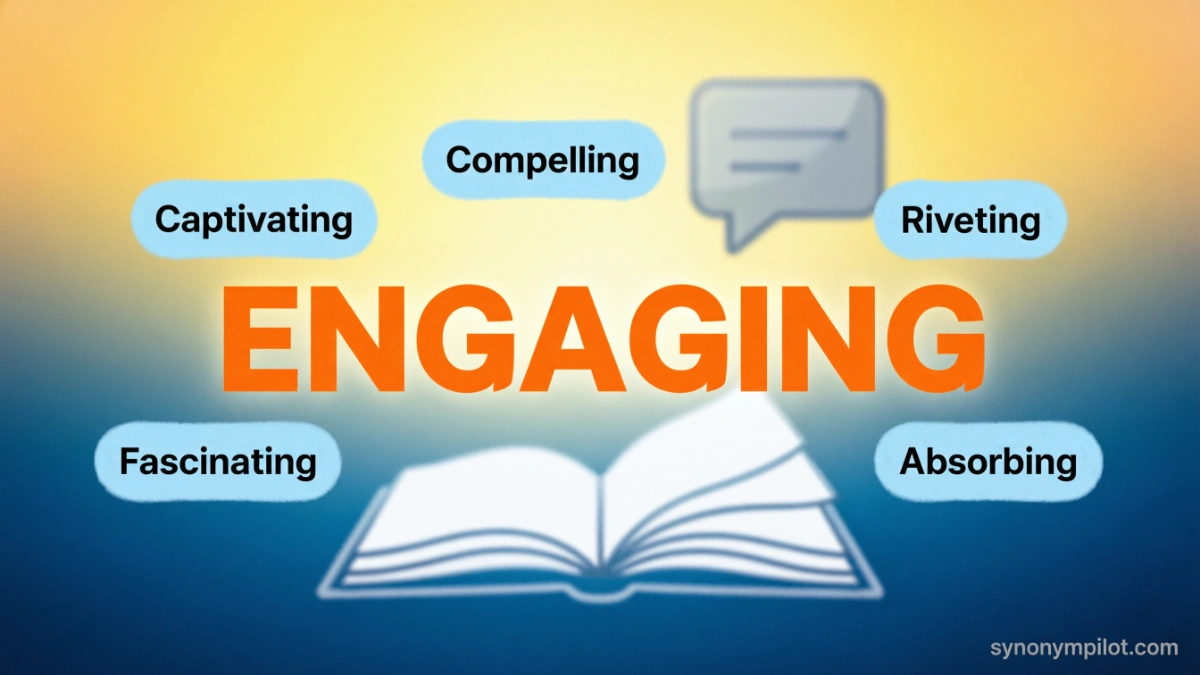
“Engaging” describes something that holds your attention and makes you genuinely interested, if it’s a person, a story, a class, or a conversation. It suggests that something is enjoyable enough to keep you involved rather than distracted. Common synonyms include captivating, compelling, absorbing, interesting, and gripping.
MEANING, TONE & CONTEXT
At its core, “engaging” means something draws your attention and keeps it there, usually in a pleasant or stimulating way. It’s a positive word, used to praise content, people, or experiences that don’t feel boring.
The tone of “engaging” is warm, approachable, and fairly neutral in formality. It works comfortably in professional contexts (describing a speaker or a meeting), academic writing (describing a teaching style or a text), and everyday conversation (describing a movie or a friend’s storytelling).
“Engaging” sounds most natural when describing communication, content, or personality, things like a presentation, a novel, a teacher, or a podcast. It’s less natural for describing physical objects or static things that don’t involve some form of interaction or attention.
WHEN & HOW TO USE “ENGAGING”
Use “engaging” when you want to describe something that successfully holds attention and creates interest, without sounding overly dramatic.
In writing, it works well for describing books, articles, or media: “The documentary was engaging from start to finish, even for viewers unfamiliar with the topic.”
In professional settings, it often describes communication skills or presentations: “Her engaging delivery kept the entire room focused during the quarterly review.”
In casual conversation, people use it to describe people or experiences: “He’s such an engaging storyteller, you forget how long he’s been talking.”
ANOTHER WORD FOR ENGAGING
If you need a simple, everyday alternative, “interesting” is the closest match. It’s slightly more neutral and general, while “engaging” specifically implies that something actively holds your attention rather than just being worth noting.
WHEN NOT TO USE THIS WORD
Avoid “engaging” when describing something purely informative but dry, like a technical manual or a list of statistics, unless it genuinely held attention in an unusual way. Calling something “engaging” when it was actually just clear or useful can confuse your meaning.
It’s also a poor fit for describing physical appearance or static objects. Saying a painting’s colors are “engaging” sounds slightly off; “striking” or “vivid” would communicate that idea more naturally.
WORDS COMMONLY CONFUSED WITH ENGAGING
People often confuse “engaging” with “entertaining.” Entertaining specifically implies enjoyment and amusement, while engaging is broader and can apply to serious, thoughtful, or educational content that holds attention without necessarily being fun.
“Engaging” also gets mixed up with “interactive.” Interactive describes something that requires active participation, like a game or a workshop activity, while engaging simply means something keeps your attention, even passively, like a well written novel.
Finally, “engaging” is sometimes confused with “charming.” Charming describes a pleasant, likable quality in a person, often related to personality or manner, while engaging more specifically refers to the ability to hold attention through communication or content.
Best Synonym by Context for Engaging
| Context | Best Synonym | Why It Fits |
|---|---|---|
| Books / stories | Gripping, Compelling | Strong narrative pull that keeps readers interested |
| Presentations / speakers | Captivating, Dynamic | Holds attention with confident and energetic delivery |
| Conversations / people | Charismatic, Animated | Describes engaging personality and expressive interaction |
| Academic / educational content | Stimulating, Thought-provoking | Encourages thinking and intellectual curiosity |
| Movies / media | Absorbing, Riveting | Creates immersive attention and emotional involvement |
| Workplace meetings | Interactive, Lively | Suggests participation, discussion, and energy |
| Marketing / advertising | Persuasive, Attention-grabbing | Designed to attract and hold audience interest |
| Online content | Hooking, Scroll-stopping | Captures attention quickly in digital environments |
| Lectures / teaching | Engaging, Clear, Accessible | Helps learners stay focused and understand easily |
| Events / experiences | Exciting, Memorable | Creates strong emotional involvement and lasting impact |
WHICH SYNONYM SHOULD YOU CHOOSE?
Start by thinking about what specifically held your attention. If it was a story or plot, words like “gripping” or “compelling” fit better than general terms. If it was someone’s personality or speaking style, “charismatic” or “animated” capture that more accurately.
Next, consider the formality of your context. Academic or professional writing benefits from words like “stimulating” or “compelling,” while casual conversation works fine with simpler choices like “fun” or “interesting.” Matching the word to the setting keeps your language natural rather than forced.
REAL LIFE EXAMPLES OF “ENGAGING” IN SENTENCES
School: “Our history teacher makes even the most engaging topics, like ancient trade routes, feel relevant today.”
Workplace: “The team lead gave an engaging presentation that kept everyone asking follow up questions.”
Writing: “The novel’s engaging plot twists made it impossible to put down before finishing the chapter.”
Conversation: “That podcast episode was so engaging, I missed my bus stop listening to it.”
Best Synonym by Context for Engaging
| Context | Best Synonym | Why It Fits |
|---|---|---|
| Books / stories | Gripping, Compelling, Engrossing | Keeps readers fully focused and emotionally invested |
| Movies / media | Absorbing, Riveting, Immersive | Creates a strong sense of attention and involvement |
| Presentations / speakers | Captivating, Dynamic, Eloquent | Holds attention through confident, expressive delivery |
| Conversations / people | Charismatic, Animated, Charming | Reflects engaging personality and social presence |
| Academic / educational content | Stimulating, Thought-provoking, Involving | Encourages thinking and active mental participation |
| Workplace meetings | Interactive, Lively, Active | Promotes participation and energy in discussion |
| Marketing / content | Persuasive, Eye-catching, Catchy | Attracts attention and influences audience response |
| Entertainment / performance | Mesmerizing, Spellbinding, Entrancing | Holds attention in a powerful, almost hypnotic way |
| Writing / storytelling style | Vivid, Colorful, Dramatic | Makes content lively and easy to visualize |
| General use | Interesting, Appealing, Entertaining | Broad, everyday alternatives for engaging content |
SYNONYM GROUPS & USAGE DIFFERENCES
Formal
Words like “compelling,” “stimulating,” and “eloquent” suit academic writing, formal presentations, and professional reports. They sound polished without becoming overly casual.
Informal
“Catchy,” “fun,” and “entertaining” fit everyday conversation and casual writing, like reviews, texts, or social posts. They sound natural without feeling stiff.
Academic
“Thought provoking,” “stimulating,” and “compelling” work well in essays, lectures, and academic discussions, where the focus is on intellectual engagement rather than entertainment.
Professional
“Dynamic,” “persuasive,” and “compelling” suit workplace settings, especially when describing presentations, pitches, or leadership communication.
Conversational
“Interesting,” “fun,” and “entertaining” feel comfortable in everyday speech, podcasts, and informal writing.
Strongest vs. Weaker
“Riveting,” “enthralling,” and “spellbinding” sit at the strongest end, describing something that completely captures attention. “Interesting” and “appealing” sit at the weaker end, suitable for mild or general interest.
Emotional vs. Neutral
“Stirring,” “inspiring,” and “mesmerizing” carry emotional weight and connect to feeling. “Stimulating” and “thought provoking” stay more neutral, focused on intellectual interest rather than emotion.
Antonyms of Engaging
| Antonym | Meaning | Example Sentence |
|---|---|---|
| Boring | Lacking interest or excitement | The boring lecture made half the class check their phones. |
| Dull | Uninteresting or lacking energy | His dull presentation failed to hold anyone’s attention. |
| Tedious | Long, slow, and uninteresting | The tedious paperwork felt endless by the end of the day. |
| Monotonous | Repetitive and lacking variety | The monotonous tone of the speech put several people to sleep. |
| Uninspiring | Failing to motivate or interest others | The uninspiring pitch didn’t convince a single investor. |
| Flat | Lacking energy or excitement | The comedian’s flat delivery killed the joke’s timing. |
| Lifeless | Without energy or engagement | The lifeless meeting dragged on for nearly two hours. |
| Tiresome | Causing boredom or fatigue over time | The tiresome routine made the workshop feel like a chore. |
| Repetitive | Doing the same thing again and again | The repetitive content made the article hard to finish. |
| Uninteresting | Not holding attention or curiosity | The book was uninteresting from the very first chapter. |
| Drab | Lacking brightness or excitement | The drab classroom felt uninspiring and cold. |
| Pedestrian | Ordinary and unremarkable | The speech was pedestrian and failed to impress the audience. |
COMPARISON SECTION
Engaging vs. Interesting
“Interesting” simply means something is worth attention, while “engaging” implies that something actively holds attention over time. Example: “An interesting fact” might be a single detail, while “an engaging lecture” suggests sustained attention throughout.
Engaging vs. Entertaining
“Entertaining” specifically implies enjoyment or amusement, often through humor or lightness. “Engaging” is broader and can describe serious, educational, or emotional content that holds attention without necessarily being fun. A documentary about war can be engaging without being entertaining.
Engaging vs. Compelling
“Compelling” suggests a stronger, almost irresistible pull toward attention, often tied to argument or narrative force. “Engaging” is slightly gentler and broader, describing general attention holding qualities. A compelling argument convinces; an engaging argument simply keeps you listening.
Engaging vs. Charming
“Charming” describes a pleasant, likable personal quality, often social or interpersonal. “Engaging” focuses more specifically on the ability to hold attention through communication or content, regardless of likability. Someone can be charming in person without necessarily being an engaging speaker.
COMMON PHRASES & EXPRESSIONS
“Engage the audience”
Means actively capturing and holding listeners’ attention during a talk or performance. Example: “The trainer used real examples to engage the audience throughout the workshop.”
“Hard to put down”
Describes a book or story so engaging that the reader doesn’t want to stop. Example: “This mystery novel was hard to put down once the investigation began.”
“Keep someone engaged”
Means maintaining someone’s interest and attention over time. Example: “Interactive activities help keep students engaged during long lessons.”
“Edge of your seat”
Describes content so engaging that it creates suspense or excitement. Example: “The final match had fans on the edge of their seats until the last second.”
“Couldn’t look away”
Describes something so visually or narratively engaging that attention stays fixed on it. Example: “The performance was so intense, the crowd couldn’t look away.”
COMMON MISTAKES TO AVOID
Don’t use “engaging” interchangeably with “entertaining,” since engaging content can be serious or educational without being amusing. Avoid confusing “engaging” with “interactive,” as interactive specifically implies participation, not just attention. Be careful not to overuse stronger synonyms like “riveting” or “spellbinding” for mildly interesting content, since this can sound exaggerated. Finally, remember “engaging” usually describes communication or content, so using it for static objects or unrelated physical descriptions can sound slightly unnatural.
FAQs
What’s a stronger word than engaging?
“Riveting,” “enthralling,” and “spellbinding” all carry more intensity than “engaging,” suggesting something completely captures attention without any effort to look away.
What’s a more casual way to say engaging?
“Fun,” “interesting,” or “entertaining” work well in everyday conversation when you want something simpler and less formal.
Is “engaging” a formal or informal word?
“Engaging” works comfortably in both formal and informal settings, which is part of why it’s used so often in professional, academic, and casual writing alike.
What’s the difference between engaging and interactive?
“Interactive” specifically means something requires participation or response, like a quiz or workshop activity, while “engaging” simply means it holds attention, even passively, like a good book.
Can “engaging” describe a person, not just content?
Yes. “Engaging” often describes someone’s personality or communication style, such as an engaging speaker, teacher, or storyteller, when they naturally hold others’ attention.
CONCLUSION
Building a stronger vocabulary around words like “engaging” makes your writing and speech feel more precise and varied. Each alternative carries its own nuance, from the intellectual pull of “thought provoking” to the emotional intensity of “riveting.”
Paying attention to context, if you’re describing a book, a speaker, or a conversation, helps you choose words that genuinely match the experience.
Try swapping in a few new synonyms the next time you describe something interesting, and notice how much more specific and natural your language becomes. Small changes like these add up to clearer, more confident communication over time.

Hi, I’m Theo John, a passionate word explorer who loves diving into the beauty of the English language. I write about synonyms, word meanings, and practical vocabulary tips to help readers communicate with confidence. synonympilot.com