You’re writing a book review and you’ve used the word “evil” four times in two paragraphs. Or maybe you’re describing a character in a story, a historical event, or even just a really frustrating coworker’s behavior, and “evil” feels either too strong or somehow not strong enough.
This happens to writers and speakers constantly. The word “evil” carries a lot of weight, but English gives you dozens of ways to express the same idea with different shades of meaning, formality, and intensity.
If you’re writing an essay, telling a story, or just trying to describe something morally wrong in conversation, this guide will help you find the exact word you need.
QUICK ANSWER
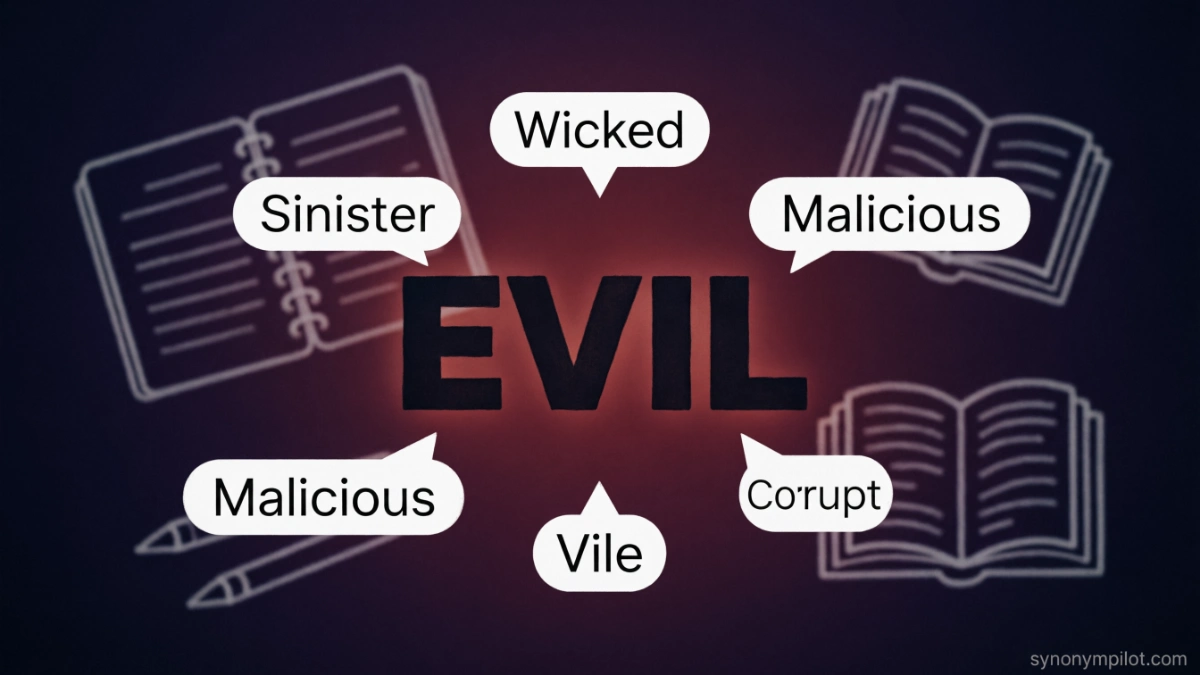
“Evil” means deeply immoral, wicked, or harmful in a serious and often deliberate way. It describes actions, people, or things that cause great harm or suffering. Common synonyms include wicked, malicious, sinister, vile, and corrupt, each carrying a slightly different tone and intensity.
MEANING, TONE & CONTEXT
At its core, “evil” describes something morally wrong on a serious level. It’s not just “bad” in a casual sense (like bad weather or a bad meal) — it implies real harm, cruelty, or moral corruption.
The tone of “evil” is strong and absolute. It’s used in formal writing, literature, religious or philosophical discussion, and everyday conversation when describing serious wrongdoing. It can sound dramatic in casual speech (“that’s so evil!”) or deeply serious in academic and ethical contexts (discussing genocide, cruelty, or moral philosophy).
“Evil” sounds most natural when describing intentional harm, malicious behavior, or moral darkness, if in a person, an action, or an abstract force. It works in storytelling, news reporting, religious texts, and personal conversations alike.
WHEN & HOW TO USE “EVIL”
Use “evil” when you want to describe something as morally wrong in a serious, often intentional way.
In writing, it works well for describing villains, historical atrocities, or corrupt systems: “The dictator’s evil policies caused widespread suffering.”
In conversation, people often use it more loosely, sometimes even humorously: “Don’t be evil, share your fries.”
In academic or philosophical writing, “evil” often appears alongside discussions of ethics, morality, and human nature: “Philosophers have debated the nature of evil for centuries.”
ANOTHER WORD FOR EVIL
If you need a quick, simple alternative, “wicked” is the closest match in everyday English. It carries the same sense of moral wrongness but feels slightly more old fashioned or storybook in tone, which makes it perfect for fairy tales, casual writing, or lighter contexts where “evil” might feel too heavy.
WHEN NOT TO USE THIS WORD
Avoid “evil” when describing minor mistakes, small inconveniences, or everyday annoyances. Calling a delayed flight or a rude comment “evil” sounds exaggerated and can undermine your credibility as a writer or speaker.
It’s also best avoided in neutral, professional feedback. Saying a colleague’s decision was “evil” instead of “unethical” or “poorly judged” can come across as overly dramatic in workplace communication.
WORDS COMMONLY CONFUSED WITH EVIL
People often mix up “evil” with “bad,” but they aren’t equivalent. “Bad” is a general, mild term that can describe anything from weather to quality, while “evil” specifically implies moral wrongdoing and harm.
“Evil” is also confused with “cruel.” Cruelty involves causing pain or suffering, often deliberately, but doesn’t always imply the deeper moral corruption that “evil” suggests. A person can be cruel without being fundamentally evil.
Finally, “evil” and “sinister” get blurred together. Sinister describes something that seems threatening or suggests future harm, while evil describes an established moral quality, not just an impression.
Best Synonym by Context for Evil
| Context | Best Synonym | Why It Fits |
|---|---|---|
| Storytelling / villains | Wicked, Sinister | Classic literary tone that suits villains and dark characters |
| Academic / philosophy | Malevolent, Immoral | Precise and formal register for discussing ethics and morality |
| News / journalism | Corrupt, Malicious | Neutral yet serious terms commonly used in reporting |
| Everyday conversation | Mean, Nasty | Casual, easy-to-understand alternatives with lighter intensity |
| Describing a person’s character | Depraved, Vile | Strong moral judgment about someone’s nature or behavior |
| Describing an action | Heinous, Atrocious | Emphasizes the severity and shocking nature of an act |
| Horror / supernatural | Demonic, Fiendish | Creates a dark, frightening atmosphere |
| Religious contexts | Sinful, Unholy | Relates to violations of spiritual or moral laws |
| Political corruption | Corrupt, Treacherous | Highlights abuse of power and betrayal of trust |
| Extreme cruelty | Ruthless, Merciless | Focuses on the absence of compassion or pity |
| Literary writing | Odious, Loathsome | Rich, expressive vocabulary for strong condemnation |
| Psychological behavior | Perverse, Twisted | Describes distorted or unhealthy moral thinking |
WHICH SYNONYM SHOULD YOU CHOOSE?
Start by asking how intense the harm or wrongdoing really is. For everyday rudeness or minor unkindness, words like “mean” or “nasty” fit better than “evil.” For serious moral corruption or intentional cruelty, words like “wicked,” “malicious,” or “depraved” carry the right weight.
Next, consider your audience and setting. Academic or journalistic writing calls for more precise, neutral sounding words like “malevolent” or “corrupt,” while creative writing and storytelling can lean into vivid, dramatic words like “sinister” or “diabolical.”
REAL LIFE EXAMPLES OF “EVIL” IN SENTENCES
School: “The villain in the novel we’re reading is portrayed as truly evil, with no remorse for his actions.”
Workplace: “The investigation revealed an evil scheme to defraud elderly customers.”
Writing: “Her evil laugh echoed through the abandoned house as the lights flickered out.”
Conversation: “Eating my last slice of pizza? That’s just evil.”
Best Synonym by Context for Evil
| Context | Best Synonym | Why It Fits |
|---|---|---|
| Fairy tales & fantasy | Wicked, Villainous | Common in stories with heroes and villains |
| Horror & supernatural | Sinister, Demonic, Malevolent | Creates a dark and threatening atmosphere |
| Crime & law | Heinous, Atrocious, Depraved | Describes severe wrongdoing or criminal acts |
| Politics & corruption | Corrupt, Iniquitous, Treacherous | Highlights abuse of power and dishonesty |
| Everyday conversation | Mean, Nasty, Bad | Natural and easy to understand |
| Formal writing | Immoral, Unethical, Malevolent | Professional and precise |
| Religious contexts | Sinful, Unholy, Profane | Relates to moral or spiritual wrongdoing |
| Psychological behavior | Sadistic, Twisted, Perverse | Describes harmful or distorted thinking |
| Extreme cruelty | Ruthless, Merciless, Brutal | Emphasizes lack of compassion |
| Literary writing | Odious, Loathsome, Fiendish | Rich, expressive, and descriptive language |
SYNONYM GROUPS & USAGE DIFFERENCES
Formal
Words like “malevolent,” “iniquitous,” and “depraved” suit academic essays, legal writing, and formal analysis. They sound precise and serious without being dramatic.
Informal
“Nasty,” “mean,” and “rotten” work well in everyday conversation. They’re lighter and more flexible, often used even for non serious situations.
Academic
“Immoral,” “unethical,” and “malevolent” appear frequently in philosophy, ethics, and social science writing, where precision matters more than emotional impact.
Strongest vs. Weaker
“Heinous,” “monstrous,” and “atrocious” represent the strongest end of the scale, reserved for extreme wrongdoing. “Mean” and “nasty” sit at the weaker end, suitable for everyday unkindness rather than serious harm.
Emotional vs. Neutral
“Hateful,” “vile,” and “despicable” carry strong emotional charge and judgment. “Corrupt” and “unethical” stay more neutral and fact based, common in journalism and reporting.
Modern vs. Old Fashioned
“Wicked” and “diabolical” carry a slightly old fashioned, storybook feel, often used in fairy tales or fantasy writing. “Toxic behavior” and “harmful” reflect more modern, everyday phrasing for similar ideas, though they’re not exact synonyms.
Antonyms of Evil
| Antonym | Meaning | Example |
|---|---|---|
| Good | Morally right or virtuous | She was known for her good and generous heart. |
| Kind | Caring and considerate toward others | His kind words comforted the grieving family. |
| Virtuous | Having strong moral principles | The virtuous leader earned everyone’s trust. |
| Benevolent | Wishing to do good for others | The benevolent donor funded the entire school. |
| Righteous | Morally correct or justified | They fought for a righteous cause. |
| Honorable | Acting with integrity and honesty | His honorable decision saved the company’s reputation. |
| Compassionate | Showing concern for others’ suffering | The compassionate nurse stayed late to comfort patients. |
| Innocent | Free from moral wrong or guilt | The innocent child knew nothing of the crime. |
| Saintly | Extremely good or pure | Her saintly patience never seemed to run out. |
| Noble | Having high moral character | He made a noble sacrifice for his family. |
| Ethical | Following accepted moral standards | The company is committed to ethical business practices. |
| Moral | Concerned with right and wrong behavior | She always tried to make the moral choice. |
| Upright | Honest and morally respectable | He was known as an upright member of the community. |
| Principled | Guided by strong moral values | She remained principled despite pressure to compromise. |
| Altruistic | Selflessly concerned for others | His altruistic efforts improved many lives. |
| Humane | Showing kindness and compassion | The organization promotes humane treatment of animals. |
| Charitable | Generous in helping others | The charitable foundation supports local families. |
| Just | Fair and morally right | The judge sought a just outcome for everyone involved. |
| Pure | Free from corruption or wrongdoing | Her motives were pure and sincere. |
| Selfless | Putting others before oneself | The firefighter’s selfless actions saved lives. |
COMPARISON SECTION
Evil vs. Wicked
“Evil” feels more absolute and serious, often used in moral or philosophical contexts. “Wicked” carries a slightly lighter, more storybook tone, common in fairy tales and casual speech. Example: “The evil dictator” sounds historically serious, while “the wicked stepmother” sounds like classic fiction.
Evil vs. Cruel
“Cruel” focuses specifically on causing pain or suffering, often through actions or words. “Evil” implies a deeper, more fundamental moral corruption. A person can be cruel in one moment without being evil overall, but “evil” suggests a lasting moral state.
Evil vs. Sinister
“Sinister” describes something that seems threatening or suggests hidden danger, often before anything bad actually happens. “Evil” confirms the wrongdoing has already occurred or is certain. Example: “A sinister smile” hints at hidden intentions, while “an evil act” describes something already done.
Evil vs. Malicious
“Malicious” specifically describes intent to harm, often through smaller actions like gossip, lies, or sabotage. “Evil” is broader and more extreme, often describing a person’s overall character rather than a single action.
COMMON PHRASES & EXPRESSIONS
“The lesser of two evils”
Used when choosing between two bad options, picking the one that causes less harm. Example: “Voting for either candidate felt like choosing the lesser of two evils.”
“Speak no evil”
Means avoiding gossip, harsh criticism, or harmful speech about others. Example: “She believes in speaking no evil, even about people she dislikes.”
“Evil eye”
A superstitious glare believed to bring bad luck, or simply a disapproving look. Example: “My grandmother gave me the evil eye when I came home late.”
“Root of all evil”
Refers to something believed to be the main cause of wrongdoing, often used about money. Example: “Some say greed, not money itself, is the root of all evil.”
“Necessary evil”
Something unpleasant or harmful that must be accepted because it leads to a greater benefit. Example: “Taxes feel like a necessary evil for maintaining public services.”
COMMON MISTAKES TO AVOID
Don’t use “evil” for minor annoyances; it sounds exaggerated and reduces your credibility. Avoid confusing “evil” with “bad,” since “bad” is far more general and less morally charged. Be careful not to overuse intense synonyms like “diabolical” or “monstrous” in professional writing, as they can sound overly dramatic outside of creative contexts. Finally, remember that “sinister” describes an impression of danger, not confirmed wrongdoing, so don’t use it interchangeably with “evil.”
FAQs
What’s a stronger word than evil?
“Heinous,” “monstrous,” and “atrocious” all carry more extreme weight than “evil,” often used for serious crimes or large scale harm.
What’s a softer way to say evil?
“Naughty,” “mean,” or “unkind” work well when you want a lighter, less serious tone, especially in casual conversation.
Is “evil” a formal or informal word?
“Evil” works in both formal and informal contexts. It appears in academic philosophy as easily as it does in casual conversation, which makes it unusually flexible.
What’s the difference between evil and devilish?
“Devilish” often has a playful or mischievous undertone, while “evil” is more serious and absolute. A devilish grin suggests mischief, not necessarily true wrongdoing.
Can “evil” describe things, not just people?
Yes. “Evil” can describe actions, intentions, systems, or even abstract ideas, such as “an evil plan” or “the evils of war.”
CONCLUSION
Learning the right words for “evil” helps you communicate with more precision, if you’re writing fiction, discussing ethics, or just describing someone’s bad behavior.
Each synonym carries its own shade of meaning, from the playful “wicked” to the deeply serious “heinous.” Paying attention to tone and context will help you choose words that fit naturally, instead of repeating “evil” over and over.
Try using a few new synonyms the next time you write or speak about wrongdoing, and notice how much more vivid and accurate your language becomes. Small vocabulary choices like these make a real difference in how clearly and confidently you communicate.

Hi, I’m J.D. Salinger—a language lover who enjoys uncovering the nuances of words. I write about synonyms, meanings, and vocabulary tips to help readers express themselves more clearly and confidently. My goal is to make learning new words fun, simple, and practical. synonympilot.com