You just finished a big project at work. Your boss sends a company wide email saying, “The team achieved great success with this launch.”
That feels good. But then you sit down to write your own reflection, your performance review, or a motivational message to your colleagues, and you type “success” four times in three sentences. Suddenly the word that felt so powerful starts sounding hollow and repetitive.
This happens constantly in professional writing, academic essays, speeches, and even everyday conversations. “Success” carries enormous emotional weight, but it also gets overused so quickly that it stops landing.
The fix is simple: build a strong set of alternatives that express exactly the kind of achievement, victory, or accomplishment you actually mean. Let us work through all of them together.
What Does “Success” Mean?
“Success” means achieving a goal, reaching a desired outcome, or accomplishing something you set out to do. It describes the positive result of effort, planning, or talent. You can use it to describe a personal achievement, a professional result, a project outcome, or even a moment of victory in any area of life.
Meaning, Tone, and Context of “Success”
At its core, “success” describes the gap between where you started and where you wanted to go, and confirms that you crossed it. It is a results focused word. It tells your reader or listener that something worked, something was achieved, or something went the right way.
In terms of tone, “success” is versatile. It works in formal speeches and academic writing, in professional reports and business presentations, and equally well in casual conversation. However, because of this versatility, it tends to get used in situations that actually call for more specific language.
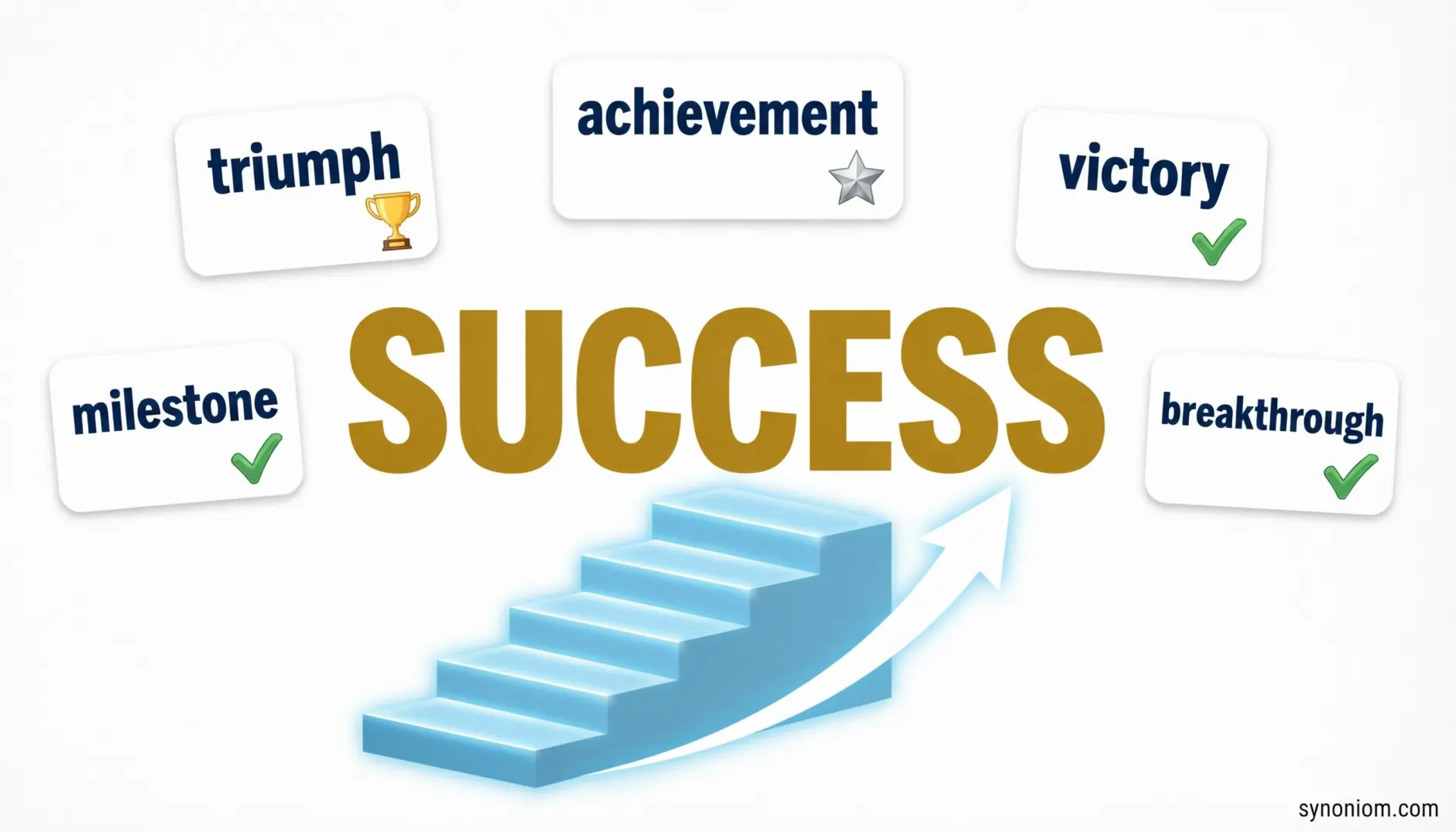
For instance, winning a championship is not just a success; it is a triumph or a victory. Finishing a difficult research project is not just a success; it is an accomplishment or an achievement. A business reaching its revenue targets is not just a success; it is a milestone or a breakthrough. Each of those words tells a richer story than “success” alone.
“Success” also carries an inherently positive and motivating emotional charge. It inspires. It validates effort. Therefore, choosing a synonym that matches both the specific achievement and the emotional context of your message always strengthens your communication.
When and How to Use “Success”
You reach for “success” when you want to describe a positive outcome in a broad, clear, and universally understood way.
In professional writing: “The product launch was a significant success for the entire division.”
In academic writing: “The intervention showed measurable success in reducing dropout rates.”
In everyday conversation: “That dinner party was a real success. Everyone loved it.”
In motivational writing: “Your dedication brought this project to success against all odds.”
Notice that in each case, “success” gives a general stamp of approval on an outcome. However, whenever you want to say something more specific, more emotional, or more precise, one of the fifty synonyms below will serve you far better.
50 Synonyms for Success
| Synonym | Simple Meaning | Example Sentence |
|---|---|---|
| Achievement | Something accomplished through effort | Completing the marathon was her greatest achievement. |
| Accomplishment | Successfully completed task or goal | Learning coding is a major accomplishment. |
| Victory | Winning against challenge or opponent | The team celebrated their victory. |
| Triumph | Powerful or emotional success | Finishing the degree felt like a triumph. |
| Win | Informal success result | Landing the client was a big win. |
| Attainment | Reaching a goal | Her attainment of the top score impressed everyone. |
| Feat | Impressive achievement | Climbing that mountain was a feat. |
| Milestone | Important progress point | Reaching 1M users was a milestone. |
| Breakthrough | Sudden important success | The research was a breakthrough. |
| Mastery | Full control of a skill | His mastery of math was clear. |
| Distinction | Outstanding excellence | She graduated with distinction. |
| Coup | Brilliant successful move | Signing that deal was a coup. |
| Conquest | Overcoming a big challenge | Learning French felt like a conquest. |
| Result | Outcome of effort | Years of work produced great results. |
| Outcome | Final result of effort | The outcome exceeded expectations. |
| Progress | Forward movement | She made steady progress. |
| Gain | Something achieved | The policy brought real gains. |
| Fruition | Effort finally succeeds | Plans came to fruition. |
| Fulfillment | Deep sense of success | Writing the book gave fulfillment. |
| Realization | Making a goal real | The realization of her dream took years. |
| Prosperity | Long-term success | The region saw prosperity. |
| Flourishing | Growing success | The business is flourishing. |
| Advancement | Moving forward in success | His advancement was fast. |
| Rise | Growth in status | Her rise in the company was quick. |
| Elevation | Promotion or higher status | Her elevation was deserved. |
| Laurels | Honors earned | He rested on his laurels. |
| Glory | Great honor | She basked in glory. |
| Honor | Respect earned | Winning was an honor. |
| Recognition | Public acknowledgment | Her work got recognition. |
| Prestige | High status | The school has prestige. |
| Renown | Wide fame | The chef gained renown. |
| Repute | Reputation of success | The company has strong repute. |
| Fame | Being widely known | His fame spread quickly. |
| Arrival | Reaching success point | The award marked her arrival. |
| High point | Best moment | The concert was a high point. |
| Peak | Highest achievement level | She reached her peak. |
| Zenith | Highest success point | The company hit its zenith. |
| Pinnacle | Top level achievement | That was his pinnacle. |
| Apex | Highest point | It was the apex of success. |
| Crest | Top stage of progress | The company rode the crest. |
| Accolade | Award or praise | The film got accolades. |
| Kudos | Praise | She earned kudos. |
| Credit | Recognition for success | The team deserves credit. |
| Reward | Something earned | Hard work brought reward. |
| Score | Informal win | That deal was a score. |
| Jackpot | Big unexpected success | That job felt like a jackpot. |
| Stroke of luck | Lucky success | It was a stroke of luck. |
| Bragging rights | Achievement pride | They got bragging rights. |
| Banger | Very successful result | That project was a banger. |
| Slam dunk | Guaranteed success | Hiring him was a slam dunk. |
Important Synonym Groups
Formal Synonyms
These belong in academic papers, official reports, award speeches, and professional documents.
- Attainment
- Distinction
- Realization
- Fruition
- Elevation
They carry intellectual weight and signal deliberate, measured language. They fit anywhere your audience expects precision and formality.
Informal and Conversational Synonyms
These feel completely natural in everyday speech, casual writing, and friendly messages.
- Win
- Score
- High point
- Kudos
- Arrival
They are energetic, warm, and immediately relatable to any audience.
Academic Synonyms
These suit research writing, analytical essays, and scholarly discussion.
- Attainment
- Advancement
- Outcome
- Progress
- Mastery
They describe achievement in a measured, evidence based way that academic writing demands.
Professional Synonyms
These work well in performance reviews, business presentations, and workplace communication.
- Milestone
- Breakthrough
- Gain
- Advancement
- Recognition
They signal strategic thinking and communicate achievement in a way that resonates in corporate environments.
Emotional Synonyms
Use these when the achievement carries deep personal meaning, pride, or emotional satisfaction.
- Triumph
- Fulfillment
- Glory
- Flourishing
- Conquest
These words go beyond just “something worked.” They capture how it felt, which makes them powerful in speeches, personal essays, and storytelling.
Conversational Synonyms
These fit naturally into spoken English and relaxed written exchanges.
- Win
- Feat
- Coup
- Peak
- Credit
Slang / Very Casual
- Banger (very informal, popular in modern casual speech)
- Slam dunk (American informal expression for a clear success)
- Jackpot (casual, implies unexpected great results)
- Bragging rights (playful, popular in competitive contexts)
Antonyms of Success
| Antonym | Meaning | Example |
|---|---|---|
| Failure | Not achieving the intended goal | The product launch ended in failure due to poor planning. |
| Defeat | Losing against a challenge or opponent | The team suffered defeat in the final match. |
| Setback | A problem that slows progress | The funding cut was a major setback. |
| Downfall | Sudden loss of success or status | Poor decisions led to the company’s downfall. |
| Collapse | Complete breakdown of a system or plan | The project ended in collapse. |
| Disappointment | Not meeting expectations | The results were a disappointment. |
| Ruin | Total destruction of success or plans | Mismanagement caused financial ruin. |
Comparison: “Success” vs. Similar Words
Several words cluster close to “success” but each carries its own distinct flavor. Here is how to use them precisely.
Success vs. Achievement
“Achievement” focuses on the specific thing accomplished, the task, the goal, the result. “Success” focuses on the broader state of having done well. So a person can have many achievements that collectively make up a life of success. Use “achievement” when you point to something specific. Use “success” for the overall picture.
Success vs. Victory
“Victory” implies there was something to overcome, an opponent, an obstacle, a competition, a struggle. It carries an active, fighting quality. “Success” does not require a fight; it simply means reaching a goal. Therefore, winning a championship is a victory; finishing a personal project on time is a success.
Success vs. Triumph
“Triumph” is the emotional, high intensity version of “victory.” It suggests that the journey was especially hard and the feeling of winning is especially powerful. Graduating after years of personal difficulty is a triumph, not just a success. Use “triumph” when the emotional weight of the moment deserves more than a neutral word.
Success vs. Accomplishment
“Accomplishment” feels warmer and more personal than “success.” It describes something you did and feel proud of, often something that required skill, discipline, or perseverance. “Success” is broader and more results focused. Writing a book is an accomplishment; becoming a bestselling author is a success.
Success vs. Breakthrough
“Breakthrough” specifically describes an achievement that happens after a period of difficulty or blockage. It implies that something was previously stuck, and now it has moved forward. “Success” does not carry that meaning. A research team that finally solves a problem after years of failure experiences a breakthrough, not just a success.
Common Phrases and Expressions
Key to success This describes the most important factor or habit that leads to positive results. Example: “Consistency and daily practice are the real keys to success in language learning.”
Measure of success This refers to the standard or tool you use to evaluate If something worked. Example: “Customer retention is the most important measure of success for a subscription business.”
Taste of success This describes a first, brief, or early experience of achieving something positive. Example: “Winning that regional competition gave the young team their first taste of success.”
Recipe for success This describes a combination of elements or habits that reliably produce good results. Example: “Clear goals, strong teamwork, and honest communication form a solid recipe for success.”
Path to success This describes the process, steps, or journey that leads to achieving a goal. Example: “There is no single path to success; different people find their own routes.”
Overnight success This describes someone who appears to achieve success very suddenly, though usually after years of unseen effort. Example: “She looked like an overnight success, but the reality was ten years of hard work behind the scenes.”
Common Mistakes to Avoid
Using “triumph” and “success” interchangeably “Triumph” carries strong emotional intensity and suggests a hard fought battle. Using it casually for minor wins sounds exaggerated. Save it for genuinely significant emotional moments. “Success” works better for general positive results.
Confusing “achievement” and “accomplishment” Both describe something completed successfully, but “accomplishment” tends to feel more personal and skill based, while “achievement” can describe measurable, often formal results. In a resume, both work, but “achievement” fits better with data and results, while “accomplishment” suits qualitative, personal growth.
Using “victory” without a contest or challenge “Victory” needs an opponent or obstacle. Saying “it was a victory to finish the report” sounds odd unless the report was genuinely difficult and you overcame something real. In neutral professional contexts, “success” or “achievement” fits more naturally.
Overusing “milestone” in business writing “Milestone” is powerful because it describes a specific, significant point on a journey. However, calling every small win a milestone weakens its impact quickly. Reserve it for genuinely notable markers of progress.
Using slang like “slam dunk” in formal writing Expressions like “slam dunk” and “banger” belong in casual emails, social media, or friendly conversations. They land badly in academic papers, official reports, or professional presentations. Always match your synonym to your audience and context.
FAQs
What is the most powerful synonym for “success” in a motivational speech?
“Triumph” and “glory” carry the most emotional force in motivational contexts because they speak directly to the feeling of overcoming struggle and achieving something meaningful.
Which synonym for “success” sounds best in a professional performance review? “Achievement,” “advancement,” and “milestone” all fit well in performance reviews because they sound specific, measurable, and results focused without sounding over the top or too emotional.
What is the difference between “success” and “victory”?
“Victory” implies you overcame an opponent, competition, or serious challenge, while “success” simply means reaching a goal. Use “victory” when there was a real struggle involved and “success” for general positive outcomes.
Can I use “triumph” and “victory” interchangeably?
They are close but not identical. “Victory” focuses on the act of winning, while “triumph” focuses on the emotional feeling of having won, especially after a hard journey. “Triumph” is stronger, more personal, and more emotionally intense.
What is a good synonym for “success” in academic writing?
“Attainment,” “achievement,” and “fruition” all work well in academic contexts because they sound precise, formal, and analytically grounded without sounding overly dramatic or casual.
Conclusion
“Success” is a word worth knowing deeply, not just as a single vocabulary item, but as a whole family of related words, each carrying its own emotional weight, formality level, and precise meaning. When you reach for “triumph” instead of “success,” you tell a story of struggle and victory.
When you choose “milestone,” you mark a specific moment in a longer journey. When you use “fulfillment,” you speak directly to what the achievement felt like, not just what it produced. That kind of precision transforms ordinary writing into something that genuinely connects with readers.
So from today, pay attention to how you describe achievements in your writing, your emails, and your conversations. Experiment with two or three new synonyms each week. The more precisely you express achievement, the more powerfully your words land.

Hi, I’m George Philip—an English language enthusiast who enjoys uncovering the nuances of words. I write about synonyms, vocabulary, and everyday language tips so readers can improve their communication and express themselves effectively. Learning new words should be fun, practical, and inspiring! synonympilot.com