Quick Answer:
“Kind” describes a person who shows warmth, generosity, and care toward others. It means being friendly, considerate, and willing to help without expecting anything in return. Because “kind” is so commonly used, replacing it with a more specific synonym makes your writing richer, more precise, and more emotionally resonant.
Have you ever described someone as “kind” and felt that the word didn’t fully capture how caring, generous, or compassionate they really were? While “kind” is one of the most positive and commonly used words in English, relying on it too often can make your writing sound repetitive and less expressive.
The English language offers many powerful alternatives that highlight different shades of kindness, from gentle and thoughtful behavior to deep compassion and selflessness.
In this guide, you’ll discover 50 carefully selected synonyms for “kind,” along with their meanings, usage tips, and real-life examples.
If you’re writing an essay, professional email, creative story, or simply looking to improve your vocabulary, these alternatives will help you communicate warmth, generosity, and care with greater precision and impact.
Meaning, Tone, and Context of “Kind”
Someone left you a thoughtful note after a difficult week. Your first instinct is to describe them as “kind” and you are absolutely right. But was it their gentleness? Their generosity? Their compassion? Each of those words says something slightly different, and each one creates a clearer picture than “kind” alone ever could.
At its core, “kind” means showing goodwill, warmth, and genuine care for others. It covers a wide emotional range from small daily acts of consideration to deep, lasting compassion. The word itself is positive, gentle, and universally understood. However, because it covers so much territory, it can feel vague in writing when a more precise word would serve you far better.
Here is a quick tone guide:
- Casual conversation “kind” feels natural, warm, and completely appropriate
- Formal writing prefer “benevolent,” “charitable,” “gracious,” or “magnanimous”
- Academic writing prefer “altruistic,” “empathetic,” “compassionate,” or “benevolent”
- Workplace and professional prefer “considerate,” “supportive,” “generous,” or “gracious”
- Creative writing try “tender,” “warm hearted,” “gentle,” “selfless,” or “big hearted”
- Emotional or personal writing prefer “compassionate,” “caring,” “loving,” or “nurturing”
When and How to Use “Kind”
“Kind” works as an adjective describing a person, action, gesture, or response. You can describe someone as kind, call their behavior a kind act, or thank them for their kind words. The word fits almost every positive social situation where warmth and care are present.
Consider these contrasts:
“She was kind to him during a hard time.” warm, natural, slightly general
“She showed remarkable compassion during one of the hardest periods of his life.” specific, emotionally powerful, and more memorable
“That was a kind thing to do.” perfectly acceptable in conversation
“That was an extraordinarily generous gesture that he will never forget.” vivid, precise, and far more impactful
Whenever you write “kind,” pause and think about which specific quality you are really describing. Is it warmth? Generosity? Patience? Empathy? Tenderness? Each of these carries its own meaning, and choosing the right one elevates your writing immediately.
Another Word for “Kind”
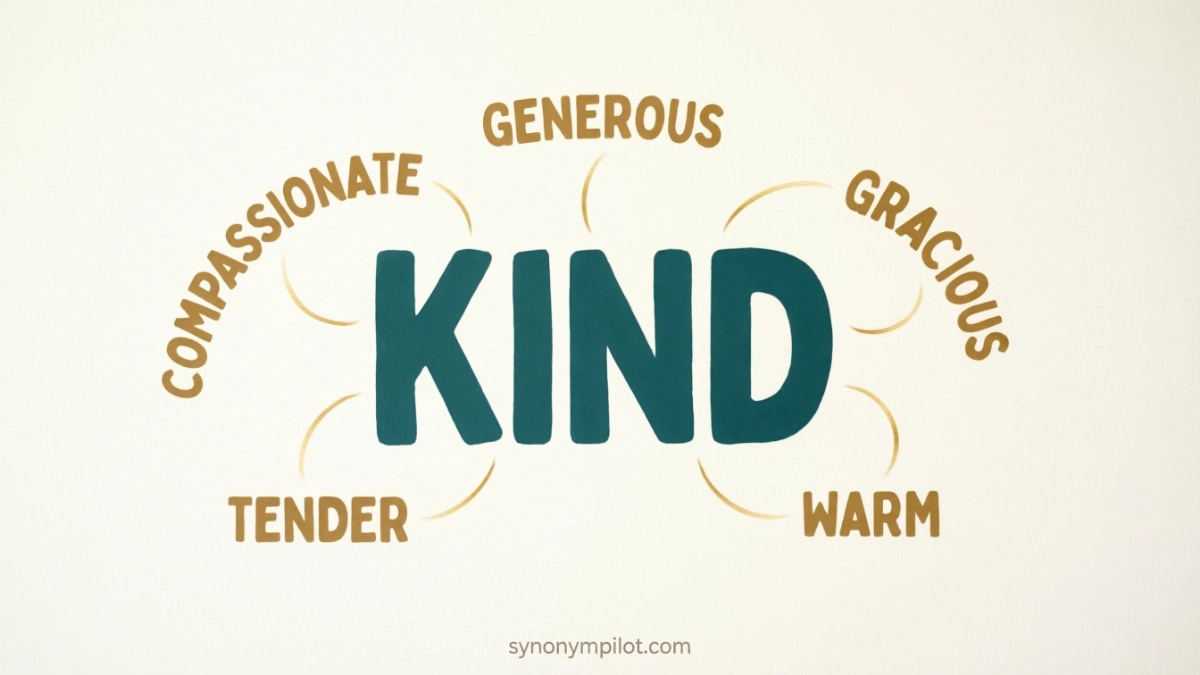
The best general synonyms for “kind” are compassionate, generous, warm, considerate, and caring. These five cover the most common situations where you want to describe someone showing genuine goodness toward others.
Beyond these, your best choice depends on the specific quality you want to highlight:
- For emotional warmth warm hearted, tender, affectionate, loving
- For giving and generosity generous, charitable, giving, bountiful
- For helping and support supportive, helpful, attentive, thoughtful
- For formal or elevated contexts benevolent, gracious, magnanimous, philanthropic
- For patience and understanding patient, tolerant, gentle, forgiving
- For deep empathy compassionate, empathetic, sympathetic, humane
When Not to Use “Kind”
Avoid “kind” in formal academic or professional writing when a more precise and weighty word is available. “The benevolent leadership of the organization” carries more authority than “the kind leadership of the organization” in a formal report or essay.
Also avoid using “kind” when the positive quality you are describing goes significantly deeper than simple everyday niceness. Calling a person who dedicated their life to helping others simply “kind” undersells their character enormously. Words like “selfless,” “compassionate,” “humane,” or “philanthropic” do far more justice to that level of goodness.
In creative writing, “kind” can make vivid, emotional moments feel flat. “She had a kind smile” is forgettable. “She had a smile that made strangers feel instantly at home” is a sentence readers remember.
Words Commonly Confused With “Kind”
Kind vs. Nice
“Nice” is even more general than “kind.” It describes someone who is pleasant, agreeable, or inoffensive. Being nice is largely about social comfort. Being kind requires genuine care and some level of effort or sacrifice. “She was nice about it” means she handled something pleasantly. “She was kind about it” means she showed real warmth and consideration for your feelings.
Kind vs. Generous
“Generous” specifically refers to giving of time, money, resources, or attention without holding back. You can be kind without being generous, and generous without being particularly warm. “He was generous with his time” describes giving. “He was kind to everyone he met” describes overall character.
Kind vs. Compassionate
“Compassionate” is deeper and more emotionally intense than “kind.” Compassion involves truly feeling and understanding another person’s pain and responding from that place. “Kind” can describe a polite gesture. “Compassionate” describes someone who genuinely enters into another person’s suffering. Use “compassionate” when the emotional depth is real and significant.
Kind vs. Gentle
“Gentle” describes softness in manner, movement, or speech a quality of being careful not to cause harm. It focuses on how someone does something rather than why. A kind person wants to help. A gentle person does so with care and softness. Both often go together, but they are not identical.
Kind vs. Thoughtful
“Thoughtful” means taking the time to think about what someone else needs before acting. A thoughtful person anticipates and considers. A kind person responds with warmth. “She left him a thoughtful note” says she paid attention to what he needed. “She left him a kind note” says the note was warm and caring.
Best Synonym by Context
| Context | Best Synonym | Why It Works |
|---|---|---|
| Academic writing | Altruistic / Benevolent / Empathetic | Formal, ethical, and analytical tone |
| Formal writing | Gracious / Magnanimous / Charitable | Polished and elevated vocabulary |
| Professional workplace | Considerate / Supportive / Respectful | Appropriate for communication and teamwork |
| Creative writing | Warm-hearted / Tender / Big-hearted | Emotional and expressive language |
| Personal & emotional writing | Compassionate / Loving / Nurturing | Deep emotional connection and care |
| Describing generosity | Generous / Giving / Charitable | Focuses on acts of kindness |
| Describing patience | Gentle / Patient / Tolerant | Calm and understanding behavior |
| Casual conversation | Warm / Caring / Sweet | Natural and simple everyday tone |
| Deep empathy | Compassionate / Humane / Sympathetic | Strong emotional understanding of others |
Which Synonym Should You Choose?
Think about three things before choosing: the specific quality of kindness you mean, the tone of your writing, and the emotional weight of the situation.
For formal and professional writing, gracious, benevolent, and considerate are your strongest choices. For academic writing, altruistic and empathetic add intellectual precision. For creative and personal writing, tender, warm hearted, and compassionate create genuine emotional resonance. For describing large scale generosity or goodness, magnanimous and philanthropic carry real weight.
When in doubt, “caring” is the most natural and widely understood upgrade from “kind” in most everyday writing contexts because it adds emotional warmth without requiring any formality.
Real Life Examples of “Kind” in Sentences
School
“The teacher’s patient and encouraging approach helped the struggling student regain confidence.”
“Her considerate gesture of sharing notes without being asked meant more to him than she realized.”
Workplace
“He was consistently supportive of junior colleagues, always making time to answer their questions.”
“Her gracious response to the criticism showed real professionalism and emotional maturity.”
Writing
“The old woman had a warm hearted generosity that the whole village had relied on for decades.”
“His compassionate nature made him the first person everyone turned to when something went wrong.”
Conversation
“She is honestly one of the most caring people I have ever met in my entire life.”
“That was so thoughtful of you I genuinely did not expect anyone to notice.”
50 Synonyms for “Kind” Full Reference Table
| Synonym | Simple Meaning | Example Sentence |
|---|---|---|
| Compassionate | Deeply caring about others’ suffering | The compassionate nurse stayed with the patient all night. |
| Generous | Willing to give freely | She was generous with her time and support. |
| Caring | Showing warmth and concern | He is a caring teacher who listens to every student. |
| Warm | Friendly and emotionally open | Her warm smile made everyone feel welcome. |
| Considerate | Thinking about others’ feelings | He is always considerate of people’s needs. |
| Thoughtful | Showing careful attention to others | That was a thoughtful gift she sent. |
| Gentle | Soft, calm, and kind in behavior | His gentle voice helped calm the child. |
| Benevolent | Kind and well-meaning | The benevolent leader supported many charities. |
| Gracious | Polite, kind, and respectful | She was gracious even under pressure. |
| Tender | Soft, loving, and gentle | He spoke in a tender tone to comfort her. |
| Sympathetic | Understanding others’ feelings | She was sympathetic toward his situation. |
| Empathetic | Truly understanding others’ emotions | An empathetic friend can change your life. |
| Warm-hearted | Naturally kind and caring | She is a warm-hearted person who helps everyone. |
| Big-hearted | Extremely kind and generous | His big-hearted nature impressed everyone. |
| Selfless | Putting others before self | Her selfless actions helped the entire community. |
| Altruistic | Acting for the good of others | His altruistic work inspired many volunteers. |
| Charitable | Kind through giving or helping | They made a charitable donation to the hospital. |
| Supportive | Giving help and encouragement | He is always supportive during difficult times. |
| Affectionate | Showing love and warmth | She wrote an affectionate message to her friend. |
| Nurturing | Caring for growth and development | Her nurturing approach helped students succeed. |
| Tolerant | Accepting of differences | He is tolerant of different opinions. |
| Patient | Calm and understanding | She was patient with the new learners. |
| Loving | Showing deep affection | A loving parent supports their child unconditionally. |
| Humane | Kind toward people and animals | The humane treatment of animals is important. |
| Magnanimous | Forgiving and generous in spirit | His magnanimous apology ended the conflict. |
| Philanthropic | Donating for social good | The philanthropic foundation funded schools. |
| Attentive | Paying careful attention | The attentive nurse noticed every detail. |
| Cordial | Warm and polite | The meeting ended on a cordial note. |
| Amiable | Friendly and pleasant | He has an amiable personality. |
| Friendly | Open and welcoming | The friendly staff helped us immediately. |
| Sweet | Gently kind and pleasant | It was sweet of you to help. |
| Obliging | Willing to help | The obliging waiter brought extra chairs. |
| Accommodating | Helpful and flexible | She was accommodating with our schedule. |
| Helpful | Providing assistance | He is always helpful in class. |
| Good-natured | Pleasant and easygoing | His good-natured humor made everyone smile. |
| Soft-hearted | Easily moved by emotions | She is soft-hearted toward animals. |
| Merciful | Forgiving and kind | The merciful judge reduced the sentence. |
| Forgiving | Willing to forgive mistakes | She is forgiving and never holds grudges. |
| Decent | Fair and kind in behavior | He is a decent human being. |
| Gracious (handling situations) | Elegant and kind in action | She handled criticism in a gracious way. |
| Benign | Harmless and gentle | His benign attitude reduced tension. |
| Open-hearted | Emotionally open and kind | They gave us an open-hearted welcome. |
| Reassuring | Providing comfort and calm | Her reassuring words eased his worries. |
| Indulgent | Gently permissive out of kindness | The indulgent teacher gave extra time. |
| Well-meaning | Having good intentions | He was well-meaning but slightly mistaken. |
| Solicitous | Showing caring concern | She was solicitous about his recovery. |
| Protective | Caring by keeping others safe | A protective parent always watches closely. |
| Wholesome | Pure and genuinely good | The movie has a wholesome message. |
| Decent-hearted | Morally good and kind | He is a decent-hearted man. |
Synonym Groups and Usage Differences
Formal Synonyms
Benevolent, magnanimous, gracious, altruistic, humane, and philanthropic belong in formal writing, academic papers, official speeches, and serious written communication. They carry weight and intellectual seriousness. Use these when you want your writing to reflect careful thought rather than casual warmth.
Conversational and Informal Synonyms
Warm, sweet, caring, friendly, good natured, and big hearted feel completely natural in everyday speech and informal writing. They are approachable, genuine, and emotionally direct. Use these in personal writing, social media, casual emails, and everyday conversation without hesitation.
Emotional and Personal Synonyms
Compassionate, tender, loving, soft hearted, open hearted, and nurturing carry the deepest emotional weight in this list. They describe kindness that comes from a place of genuine emotional investment. Use these in personal essays, tributes, eulogies, love letters, and any writing where you want the reader to feel something real.
Professional Synonyms
Considerate, supportive, attentive, accommodating, gracious, and decent work naturally in workplace writing and professional communication. They signal warmth without sacrificing professional tone. These are exactly the words to use in performance reviews, professional references, and formal feedback.
Strongest vs. Gentler Synonyms
The strongest and most emotionally charged synonyms include compassionate, selfless, altruistic, magnanimous, and humane. These describe exceptional, deep, or life changing kindness. Gentler alternatives like nice, friendly, sweet, and pleasant describe surface level pleasantness. Match the strength of your word to the depth of the kindness you are actually describing.
Antonyms of “Kind”
| Antonym | Meaning | Example Sentence |
|---|---|---|
| Cruel | Deliberately causing pain or suffering | His cruel response left her shaken and deeply upset. |
| Unkind | Lacking warmth or care toward others | His unkind dismissal of her idea discouraged the whole team. |
| Harsh | Severe and unforgiving in words or treatment | The harsh feedback gave no encouragement at all. |
| Cold | Emotionally detached and unfriendly | Her cold reception made the new employee feel unwelcome. |
| Callous | Indifferent to the suffering of others | His callous attitude toward the team’s stress shocked everyone. |
| Selfish | Caring only about oneself | His selfish refusal to share information slowed the project. |
| Inconsiderate | Not thinking about the effect on others | His inconsiderate behavior caused daily frustration in the office. |
| Heartless | Showing no compassion or empathy | Her heartless dismissal of the complaint was inappropriate. |
Common Phrases and Expressions
“A kind gesture”
A small but meaningful act of warmth or generosity toward someone.
Example: “Bringing her a coffee without being asked was a simple kind gesture that lifted her entire morning.”
“Kill them with kindness”
Respond to hostility or unkindness with deliberate, persistent warmth.
Example: “She decided to kill them with kindness rather than sink to the same level of pettiness.”
“The kindness of strangers”
Unexpected and moving generosity from people you do not know.
Example: “After losing her wallet, she was genuinely overwhelmed by the kindness of strangers who helped her get home.”
“Random acts of kindness”
Spontaneous, unplanned gestures of generosity and care for others.
Example: “The organization encouraged employees to perform random acts of kindness every Friday.”
“Pay it forward”
Respond to someone’s kindness by doing something good for another person.
Example: “She decided to pay it forward after a stranger helped her during a particularly stressful morning.”
“A gentle soul”
A naturally kind, quiet, and caring person who rarely causes harm.
Example: “Everyone who knew him described him as a gentle soul who had never said a harsh word to anyone.”
Common Mistakes to Avoid
Treating “kind” and “nice” as identical words is the most widespread vocabulary mistake in this category. “Nice” describes pleasantness someone who does not cause discomfort. “Kind” describes active warmth and genuine care. A person can be nice without ever truly being kind. In writing, choosing “kind” when you mean “pleasant” or vice versa creates a meaningful mismatch your reader may notice even if they cannot name it.
Overusing “compassionate” in professional writing is also worth avoiding. “Compassionate” carries strong emotional depth and works best in personal, medical, social, or humanitarian contexts. Using it to describe a colleague who held the door open sounds disproportionate and slightly theatrical.
Using “generous” only in financial contexts limits this word unnecessarily. Generosity applies equally to time, attention, energy, patience, and praise. “She was generous with her encouragement” is just as natural and meaningful as “she was generous with her money.”
Confusing “empathetic” and “sympathetic” is common among English learners. “Sympathetic” means you understand and feel for someone’s situation. “Empathetic” means you truly enter into their emotional experience and feel it alongside them. Empathy is deeper, more personal, and more emotionally demanding than sympathy.
FAQs
What is the most formal synonym for “kind”?
“Benevolent” and “magnanimous” are the most formal and elevated options, making them ideal for academic essays, formal speeches, and official written communication.
What is the difference between “kind” and “compassionate”?
“Kind” describes general warmth and goodwill, while “compassionate” specifically involves deeply feeling and responding to another person’s pain or suffering making compassion the emotionally deeper of the two words.
Which synonym for “kind” works best in a professional email or reference letter?
“Considerate,” “supportive,” and “gracious” work best in professional contexts because they communicate warmth while maintaining an appropriate level of formality and precision.
Is “sweet” a good synonym for “kind”?
“Sweet” works well in casual conversation and informal writing, but it sounds too gentle and informal for professional or academic contexts where “considerate” or “thoughtful” would be far more appropriate.
Can “altruistic” be used as an everyday synonym for “kind”?
Not quite “altruistic” specifically means acting entirely for others with no personal benefit, which is a higher and more specific standard than everyday kindness, so save it for truly selfless behavior rather than ordinary acts of warmth.
Conclusion
“Kind” is one of the most beautiful words in the English language and one of the most overworked. But now you have fifty precise and expressive alternatives to reach for whenever you want your writing to do more than simply say someone was pleasant or nice.
If you are writing a tribute, a professional reference, a personal essay, or a thank you note, the right synonym for “kind” transforms a good sentence into one that genuinely moves people. This week, try replacing one “kind” with a more specific word.
Use “compassionate” when the care went deep. Write “generous” when someone gave without being asked. Choose “tender” when gentleness was the quality that mattered most. Each precise word you practice builds your vocabulary naturally and makes your English more human, more honest, and more powerful. Keep going every word counts.

Hi, I’m George Philip—an English language enthusiast who enjoys uncovering the nuances of words. I write about synonyms, vocabulary, and everyday language tips so readers can improve their communication and express themselves effectively. Learning new words should be fun, practical, and inspiring! synonympilot.com