Quick Answer
“Large” means something is bigger than average in size, amount, or scale. It is a neutral, everyday adjective that works in almost any context from describing a room to summarizing a dataset. You can replace it with words like “enormous,” “vast,” “substantial,” or “considerable” depending on exactly how big something is and how formal your writing needs to be.
The word “large” is one of the most common adjectives in English, used to describe something that is bigger than average in size, amount, importance, or scale.
While it is a useful and versatile word, using it repeatedly can make your writing sound plain and repetitive. Fortunately, English offers many powerful alternatives that can help you express your ideas more clearly and accurately.
If you are writing an essay, preparing a business report, describing a place, or simply improving your everyday vocabulary, choosing the right synonym can make a noticeable difference.
In this guide, you will discover 50+ synonyms for “large”, along with their meanings, examples, and best usage contexts. By learning these alternatives, you can make your writing more precise, engaging, and professional.
What Does “Large” Really Mean?
You are writing a property listing and you type: “The apartment has a large living room and large windows.” It works but it also feels a little flat. Now try: “The apartment has a spacious living room and floor to ceiling windows.” Suddenly the reader can picture it.
That is the power of choosing the right synonym for “large.” The word itself is perfectly correct, but it is also one of the most overused adjectives in English. Whether you are writing an essay, describing a product, filling out a report, or telling a story, a more precise word always communicates more.
“Large” covers physical size, quantity, scale, and importance depending on context. The word family includes “largely” (mostly), “enlarge” (to make bigger), and “at large” (free or in general). Understanding these related forms helps you use the word and its synonyms more confidently across different situations.
Meaning, Tone, and Context of “Large”
At its core, “large” means above average in size or amount. It is a neutral, descriptive adjective with no strong emotional charge in either direction.
The tone is clean and versatile. In formal writing, “large” sounds professional but plain. In casual conversation, it works fine but rarely adds color. In academic writing, more specific words like “substantial,” “considerable,” or “extensive” carry more weight.
“Large” sounds most natural in:
- Everyday conversation “Can I get a large coffee, please?”
- Product descriptions “Available in small, medium, and large.”
- News and reporting “A large crowd gathered outside the venue.”
- General writing “The company made a large investment in infrastructure.”
In more expressive or formal writing, however, a more specific synonym will almost always do a better job.
When and How to Use “Large”
Use “large” when you need a clear, neutral descriptor for size or scale and the context does not require a more precise or emotional word. It pairs naturally with nouns like room, number, amount, group, quantity, portion, city, company, and scale.
Examples:
- “A large number of students applied for the scholarship.”
- “They live in a large house on the edge of town.”
- “The project required a large amount of time and resources.”
When precision matters especially in professional, academic, or creative writing replace “large” with a synonym that captures exactly what you mean. “Vast” is better for open spaces. “Substantial” is better for quantities or importance. “Towering” is better for physical height.
Another Word for Large
Here are the most natural and useful alternatives depending on what you are describing:
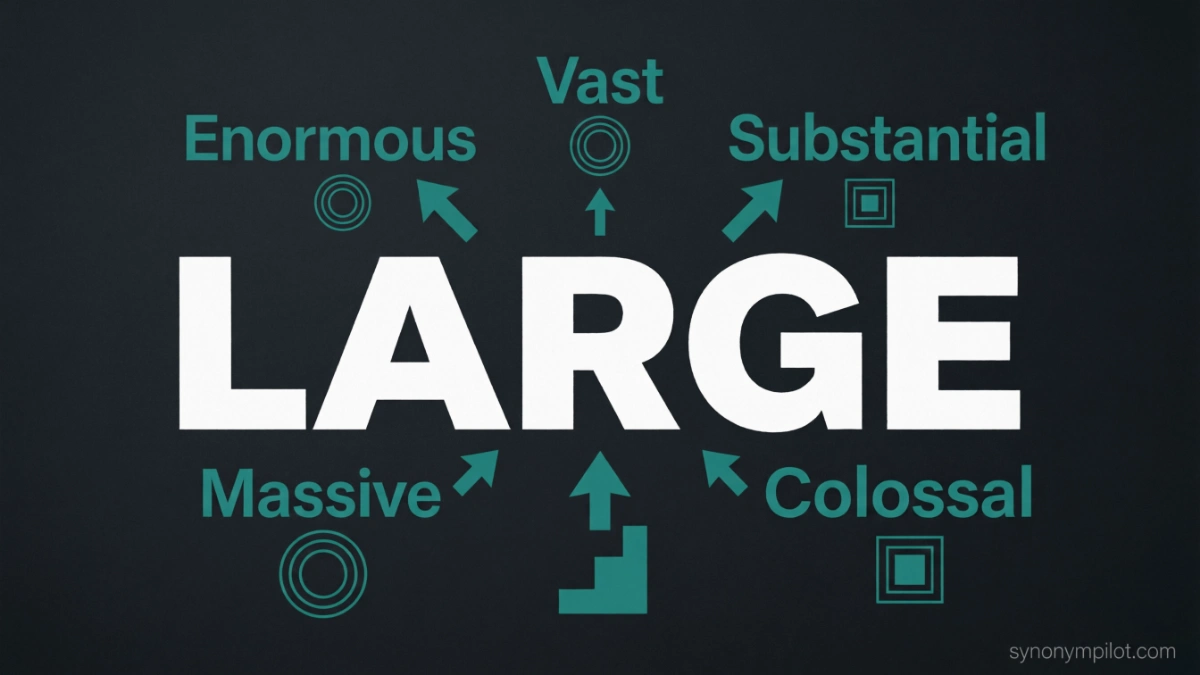
- Enormous much bigger than expected
- Vast wide and seemingly endless in scale
- Substantial large enough to be important or significant
- Considerable large in a way that deserves attention
- Immense impressively huge
- Spacious large in a way that feels open and comfortable
- Extensive large in range or coverage
- Massive very large in physical size or impact
- Sizable fairly large; notably bigger than average
- Colossal shockingly or extraordinarily large
When Not to Use “Large”
Avoid “large” when precision matters. In academic or technical writing, saying “a large improvement” tells your reader very little. Instead, use “substantial,” “significant,” or “considerable” words that imply measurable or meaningful scale.
Also avoid it in descriptive or creative writing when you want to evoke an image. “Large building” is forgettable. “Towering building” or “sprawling complex” creates a picture. Similarly, “large field” tells us nothing vivid “sweeping meadow” or “vast open plain” brings the scene to life.
In professional contexts, “large” can also feel vague in proposals and reports. Replacing it with “extensive,” “substantial,” or “sizeable” instantly sounds more considered and precise.
Words Commonly Confused With “Large”
Large vs. Big
These two words mean nearly the same thing, but “big” is more informal and conversational. “Big” also carries more emotional weight “a big moment,” “a big deal.” “Large” is more neutral and slightly more formal, especially in written contexts.
Large vs. Great
“Great” used to mean large in older English (“a great distance”), and it still does in some fixed phrases. However, today “great” primarily means excellent or impressive. Avoid using “great” to mean physically large in modern writing it causes confusion.
Large vs. Huge
“Huge” is more emphatic and informal than “large.” It signals that something is not just big but surprisingly or strikingly big. “Huge” also carries emotional weight “a huge mistake,” “a huge success” while “large” stays neutral.
Large vs. Extensive
“Extensive” refers to large range or coverage not just physical size. You use it for things that spread across time, territory, or subject matter. A large library has many books; an extensive library suggests wide, comprehensive coverage across many topics.
Best Synonym by Context (for “Large”)
| Context | Best Synonym | Why It Works |
|---|---|---|
| Academic writing | Substantial / Considerable | Formal, precise, and analytical |
| Business and professional writing | Sizeable / Extensive | Measured and credible |
| Describing physical spaces | Spacious / Vast / Sprawling | Vivid and specific |
| Describing quantities or data | Significant / Considerable | Clear and informative |
| Creative or literary writing | Immense / Towering / Colossal | Emotionally vivid and expressive |
| Casual conversation | Big / Huge / Massive | Natural and energetic |
| Describing scope or coverage | Extensive / Wide-ranging / Broad | Accurate for non-physical scale |
Which Synonym Should You Choose?
Start by deciding what kind of “largeness” you are describing. Is it physical size? Use “enormous,” “massive,” or “spacious.” Is it amount or degree? Use “substantial,” “considerable,” or “significant.” Is it range or coverage? Use “extensive,” “wide ranging,” or “broad.” Is it shocking in scale? Use “colossal,” “immense,” or “gigantic.”
Then consider your audience and tone. Formal writing calls for “substantial” and “considerable.” Creative writing benefits from “towering,” “vast,” and “sprawling.” Casual conversation flows better with “huge,” “massive,” and “big.”
One strong, precise word always beats “large” when you want your writing to feel intentional and polished.
Real Life Examples of “Large” and Its Synonyms in Sentences
School
- “The school library holds an extensive collection of reference materials.”
- “A considerable number of students attended the after school science fair.”
Workplace
- “The company secured a substantial contract with a new international client.”
- “They operate a sprawling distribution center just outside the city.”
Writing
- “The vast desert stretched silently in every direction as far as she could see.”
- “The colossal statue dominated the town square and drew visitors from across the country.”
Conversation
- “That pizza was massive I could only finish two slices.”
- “They have a huge backyard, perfect for parties.”
50 Synonyms for “Large” Full Reference Table
| Synonym | Simple Meaning | Example Sentence |
|---|---|---|
| Enormous | Much bigger than normal | The enormous crowd filled the stadium. |
| Vast | Extremely wide or endless | The vast ocean stretched beyond sight. |
| Substantial | Large and important | She made a substantial donation. |
| Considerable | Noticeably large in amount or size | The task required considerable effort. |
| Immense | Extremely large | The immense glacier moved slowly. |
| Massive | Very large and heavy | A massive storm hit the coast. |
| Spacious | Large and open (space) | The office is bright and spacious. |
| Extensive | Covering a large area or scope | The garden needs extensive care. |
| Colossal | Extremely large | The colossal ship dominated the harbor. |
| Sizable | Fairly large | They received a sizable grant. |
| Gigantic | Huge like a giant | A gigantic screen filled the wall. |
| Towering | Very tall and dominant | The towering building impressed visitors. |
| Expansive | Wide and far-reaching | The estate had expansive gardens. |
| Broad | Wide in scope or size | He has broad shoulders. |
| Sweeping | Wide and covering large areas | Sweeping views of the valley appeared. |
| Grand | Large and impressive | The grand hall hosted the event. |
| Whopping | Very large (informal) | She earned a whopping bonus. |
| Bulky | Large and difficult to carry | The bulky package was hard to move. |
| Hulking | Large and heavy | A hulking machine blocked the door. |
| Oversize | Bigger than normal | He wore an oversize jacket. |
| Sprawling | Spread over a large area | A sprawling campus covered the land. |
| Boundless | Without limits | Her energy felt boundless. |
| Magnanimous | Large in generosity (figurative) | His magnanimous act impressed all. |
| Wide | Large from side to side | The wide river separated the towns. |
| Deep | Large in depth | The lake is deep in the center. |
| Generous | Large in portion or amount | She served generous meals. |
| Monumental | Extremely large or significant | A monumental shift occurred. |
| Remarkable | Notably large or impressive | A remarkable amount of progress was made. |
| Prodigious | Extremely large in amount | He wrote a prodigious number of books. |
| Soaring | Rising to great height | Soaring ceilings filled the room. |
| Roomy | Informally large inside | The car is roomy in the back. |
| Capacious | Very spacious | She carried a capacious bag. |
| Ample | More than enough | There is ample parking space. |
| Titanic | Extremely large | A titanic effort was required. |
| Significant | Large enough to matter | There was significant growth. |
| Herculean | Extremely large or difficult | A Herculean task was completed. |
| Limitless | Without boundaries | Their ambition seemed limitless. |
| Wide-ranging | Covering many areas | The report had wide-ranging ideas. |
| Abundant | Large in quantity | The region has abundant resources. |
| Plentiful | Large in supply | Rainfall was plentiful this year. |
| Hefty | Large and heavy (informal) | He got a hefty salary. |
| Thumping | Very large (British informal) | They won by a thumping margin. |
| Astronomical | Extremely large (informal) | Costs were astronomical. |
| Excessive | Too large | The portions were excessive. |
| Outsized | Larger than expected | He had an outsized influence. |
| Staggering | Shockingly large | A staggering number of people applied. |
| King-size | Extra large | They bought a king-size bed. |
| Mighty | Large and powerful | A mighty river flowed nearby. |
| Capacious (alt use) | Very roomy inside | The warehouse was capacious. |
| Whopping (repeat emphasis) | Extremely large | The bill was whopping. |
Synonym Groups and Usage Differences
Formal and Academic Synonyms
Words like substantial, considerable, extensive, significant, and wide ranging belong in essays, reports, research writing, and professional documents. They communicate measured, analytical precision without sounding casual.
Example: “The study revealed a considerable gap between policy and practice.”
Professional and Business Synonyms
Sizable, substantial, extensive, ample, and outsized work well in business writing, proposals, and workplace communication. They sound deliberate and informed.
Example: “The firm made a sizable investment in employee training this year.”
Informal and Conversational Synonyms
Huge, massive, whopping, hefty, and roomy are natural in casual conversation, text messages, and informal writing. They add energy and relatability without any formality.
Example: “That was a massive portion I could not finish it.”
Strongest Synonyms (Maximum Impact)
Colossal, titanic, astronomical, immense, and gigantic describe scale that genuinely shocks or overwhelms. Use these when “large” would massively understate something.
Example: “The astronomical cost of the project forced the team to reconsider.”
Describing Physical Space Specifically
Spacious, expansive, sprawling, capacious, and roomy all describe physical largeness with a focus on how it feels to be inside or around that space. They work especially well in property descriptions, travel writing, and interior design contexts.
Example: “The sprawling estate included seven bedrooms and a private lake.”
Old Fashioned and Literary Synonyms
Prodigious, titanic, boundless, and magnanimous carry a more classical or literary tone. They appear often in older writing and literature, and they add a formal, elevated register when used today.
Example: “He possessed a prodigious appetite for knowledge.”
Antonyms of “Large”
| Antonym | Simple Meaning | Example Sentence |
|---|---|---|
| Small | Below average in size | The kitten was small enough to fit in one hand. |
| Tiny | Extremely small | She found a tiny crack in the wall. |
| Miniature | Much smaller than normal | He collects miniature buildings. |
| Compact | Small but efficient | The compact car is ideal for cities. |
| Narrow | Limited in width | The narrow path fits only one person. |
| Modest | Small and simple | They live in a modest house. |
| Slight | Very small in amount or degree | There is a slight difference between them. |
| Minor | Not large or important | Only minor changes were made. |
| Limited | Restricted in size or amount | The team had limited resources. |
| Petite | Small and delicate (often for people) | She has a petite frame. |
| Diminutive | Very small in size | A diminutive figure stood at the door. |
| Minuscule | Extremely tiny | There was a minuscule amount of dust. |
| Wee | Very small (informal, British) | A wee bit of sugar, please. |
| Lilliputian | Extremely small (literary) | The village was almost lilliputian in scale. |
| Puny | Small and weak | He lifted the puny weights easily. |
| Reduced | Made smaller in size | The store offers reduced packaging. |
| Meager | Small in amount or quantity | They survived on meager supplies. |
| Insignificant | Too small to matter | The error was insignificant. |
| Restricted | Kept small or limited | Access was restricted to a small group. |
| Compact-sized | Small and space-saving | She bought a compact-sized laptop. |
Comparison: Large vs. Closely Related Words
Large vs. Big
“Big” is more casual and emotionally expressive. “Large” is more neutral and precise. Both describe size, but “big” also describes importance informally “a big deal,” “a big moment.” In formal writing, stick with “large” or a more specific synonym.
Large vs. Huge
“Huge” is stronger and more emphatic than “large.” It implies surprising or striking size and carries a conversational energy that “large” lacks. In formal contexts, “large” or “substantial” is the better choice over “huge.”
Large vs. Massive
“Massive” focuses on physical bulk and weight as much as size. Something massive feels heavy and imposing. Use “massive” when you want to emphasize solidity and weight, not just dimensions.
Large vs. Vast
“Vast” is specifically for things that spread over a wide area or seem limitless in scope open spaces, oceans, datasets, ideas. It has a slightly poetic quality and works beautifully in descriptive writing. “Large” simply describes above average size without that sense of open expanse.
Large vs. Substantial
“Substantial” is the formal, analytical choice. It implies that the size or amount is large enough to matter or make a difference. Use it in academic and professional writing wherever “large” feels vague or too plain.
Common Phrases and Expressions
“By and large”
Meaning: on the whole; mostly; in general.
“By and large, the conference was a success despite the technical issues.”
“Large scale”
Meaning: involving a lot of people, resources, or area.
“The government launched a large scale campaign to improve public health.”
“At large”
Meaning: free and not captured, or referring to the general public.
“The suspect remains at large following yesterday’s incident.”
“Larger than life”
Meaning: a person or thing that seems more impressive, dramatic, or vivid than normal.
“She had a larger than life personality that filled every room she entered.”
“In large part”
Meaning: mostly; mainly; to a great degree.
“The success of the event was in large part due to the volunteers.”
“Loom large”
Meaning: to seem very important, threatening, or dominant.
“The deadline was looming large, and the team stayed late to finish.”
Common Mistakes to Avoid
Using “large” when precision is needed is the most common error. In formal or academic writing, “large improvement” and “large amount” both feel vague. Replace them with “significant improvement” and “substantial amount” to sound more credible and precise.
Confusing “large” and “great” trips up many learners. In modern English, “great” almost always means excellent or important not physically big. Saying “a great distance” still works in some fixed phrases, but avoid using “great” to mean physically large in general writing.
Overusing “huge” and “massive” in formal writing is a tone mistake. Both words work well in casual speech, but they sound too informal and emotional for academic essays, business reports, or professional emails.
Mixing up “extensive” and “large” also causes problems. “Extensive” describes range and coverage, not physical size. A large garden is physically big. An extensive garden suggests it covers many areas or contains great variety. Use the right word for the right meaning.
FAQs
What is the most formal synonym for “large”?
“Substantial” and “considerable” are the most widely used formal alternatives. Both work well in academic writing, professional reports, and business communication because they imply meaningful scale rather than just physical size.
What is the difference between “large” and “vast”?
“Large” simply describes above average size. “Vast” specifically describes something that spreads over a wide area or seems limitless in scope. Use “vast” for open landscapes, huge datasets, or ideas that cover enormous ground.
Can I use “massive” in a formal essay?
Generally, it is better to avoid “massive” in formal academic writing because it carries an informal, conversational energy. Use “substantial,” “considerable,” or “significant” instead for a more measured and professional tone.
What is a good synonym for “large amount”?
“Substantial amount,” “considerable amount,” and “significant quantity” all work well in formal writing. In casual speech, “a huge amount” or “a massive amount” are natural and widely understood.
Is “big” the same as “large”?
They are very close in meaning, but “big” is more informal and emotionally expressive. “Large” is slightly more neutral and formal. In professional or academic writing, “large” is the safer choice, though a more specific synonym is almost always even better.
Conclusion
“Large” is a reliable, useful word but with so many stronger alternatives available, there is rarely a reason to settle for it when precision matters. Whether you need the analytical weight of “substantial,” the visual power of “towering,” or the casual energy of “massive,” English gives you exactly the right tool for every situation.
Start building this habit gradually. When you write “large” in a sentence, ask yourself: What kind of large is this? Is it wide? Tall? Heavy? Significant? Surprising? That one question guides you toward a better word every time.
Over days and weeks, you will notice your writing feeling sharper, more vivid, and more confident. Your readers will follow your descriptions more easily, and your arguments will carry more weight. That small vocabulary shift makes a bigger difference than you might expect.

Hi, I’m Camron White, a word lover who enjoys exploring the beauty of the English language. I write about synonyms, meanings, and everyday vocabulary to help readers express themselves more clearly and confidently. My goal is to make learning new words simple, fun, and useful in real-life conversations. synonympilot.com