Quick Answer:
Feel means to experience a physical sensation or an emotion either through your body or your mind. It’s one of the most common verbs in English, used to describe everything from touching something rough to sensing sadness or excitement. Depending on the context, it can refer to physical touch, emotional experience, or personal opinion.
You’re writing a story and you type: “She felt happy. He felt sad. They felt nervous.” Then you read it back and something seems flat. Every sentence starts with “felt” and the whole paragraph loses its energy.
Or maybe you’re in a conversation and you want to say “I feel like this isn’t right” but you’re not sure if that sounds too casual for the email you’re writing to your manager.
That’s the thing about the word feel it’s incredibly useful, but relying on it too heavily makes your writing and speaking less vivid.
If you want stronger emotional words, more precise physical descriptions, or simply a fresher alternative, this guide gives you exactly what you need.
Meaning, Tone, and Context
Feel is a versatile verb with three main uses:
1. Physical sensation experiencing something through touch or the body
“The fabric feels soft against her skin.”
2. Emotional experience experiencing an emotion or inner state
“I feel anxious before every exam.”
3. Opinion or belief expressing a personal view or instinct
“I feel like we’re making the right decision.”
Tone: Feel is neutral, conversational, and universally understood. It works across formal and informal contexts, though in academic writing, more precise words like perceive, sense, or experience often serve better.
Where it sounds most natural: Everyday speech, personal writing, emotional expression, and informal communication. In professional writing, replacing it with a stronger, more specific word almost always improves clarity.
When and How to Use “Feel”
Use feel when you want to describe an internal experience physical, emotional, or instinctive. It’s flexible enough for almost any situation, but the key is knowing when a more specific word would actually serve you better.
Physical context:
- “Can you feel the heat coming from the stove?”
- “Her hands felt numb after the long walk in the cold.”
Emotional context:
- “I feel proud of everything you’ve achieved.”
- “He feels overwhelmed by the number of tasks on his list.”
Opinion or intuition:
- “I feel like we should reconsider our approach.”
- “She feels strongly that the policy needs to change.”
Feel is also commonly used in the phrase “I feel that…” to soften statements and make them sound less aggressive or absolute in professional and personal conversations.
Another Word for Feel
Here are the most natural and commonly used alternatives, depending on what you mean:
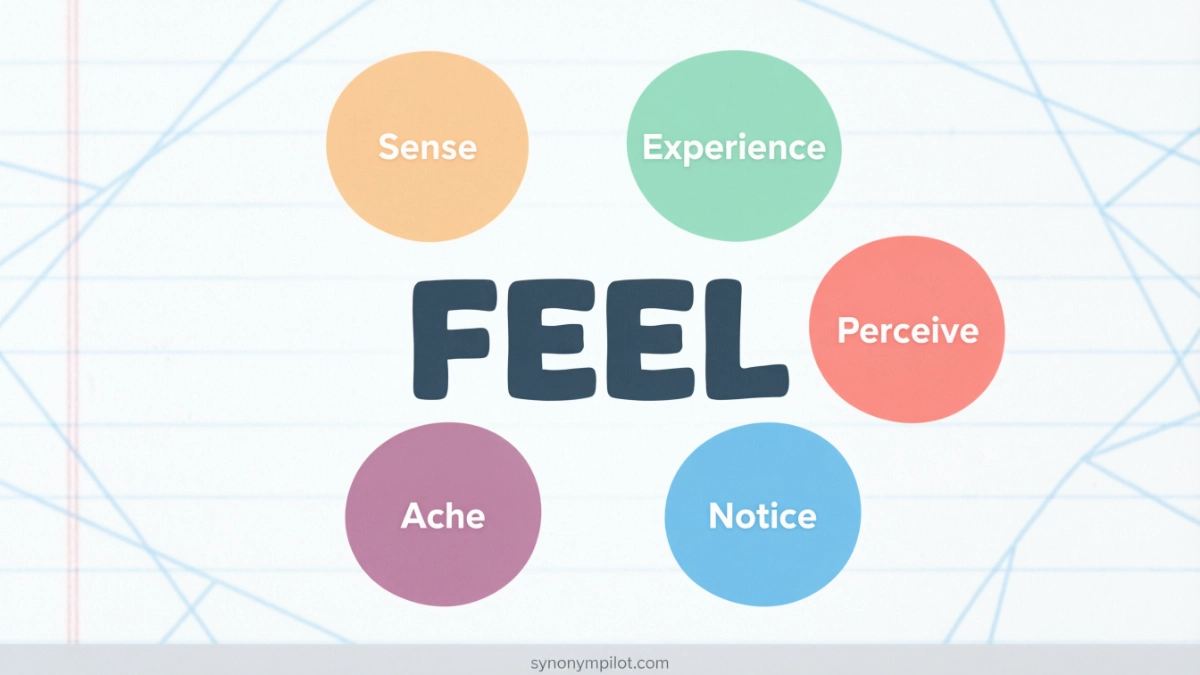
- Sense great for intuition and subtle awareness
- Experience more formal, ideal for writing
- Perceive academic and precise
- Notice for becoming aware of something
- Detect for discovering something subtle
- Undergo for going through an experience or process
- Emotion when referring to the feeling itself as a noun
- Sense for physical or emotional awareness
- Encounter when meeting or facing something
- Touch specifically for physical sensation
When Not to Use “Feel”
Avoid feel when:
- You need more precision in academic or professional writing perceive or experience are stronger
- The sentence sounds repetitive you’ve already used feel two or three times in a paragraph
- You’re describing a strong physical reaction words like ache, sting, throb, or burn are far more vivid
- You want to express a specific emotion instead of “I feel bad,” say “I feel guilty” or “I feel disappointed”
- Your writing needs more energy “She sensed danger” is sharper than “She felt something was wrong”
Words Commonly Confused With “Feel”
| Word | How It Differs from Feel |
|---|---|
| Sense | More subtle; often used for instinct or slight awareness |
| Touch | Only refers to physical contact, not emotions |
| Experience | Broader; covers a whole situation, not just a sensation |
| Think | About reasoning and logic, not emotion or sensation |
| Believe | About conviction and opinion, not sensory or emotional experience |
| Notice | Becoming aware of something external, not internal |
Best Synonym by Context (Feel)
| Context | Best Synonym | Why It Fits |
|---|---|---|
| Physical sensation | Sense, detect, touch | More vivid and precise |
| Emotional experience | Experience, undergo | Stronger and more expressive |
| Intuition or gut reaction | Sense, perceive, intuit | More specific to instinct |
| Academic writing | Perceive, experience, discern | Formal and precise |
| Creative writing | Ache, yearn, tremble | Emotionally vivid |
| Casual conversation | Notice, get, reckon | Natural and relaxed |
| Opinion or belief | Think, believe, reckon | Clearer in meaning |
Which Synonym Should You Choose?
The best synonym depends on what kind of feeling you mean.
- Describing your body? Use sense, detect, ache, or notice.
- Describing an emotion? Use experience, undergo, carry, or a specific emotion word like grieve or rejoice.
- Sharing an opinion? Use think, believe, or reckon.
- Writing a story? Use vivid, specific words tremble, yearn, burn, ache.
- Writing formally? Use perceive, experience, or discern.
The single most powerful upgrade you can make: replace “feel” with the specific emotion. Instead of “she felt bad,” write “she felt ashamed.” That one change carries twice the impact.
Real Life Examples in Sentences
School:
- “I sensed something was wrong as soon as the teacher walked in.”
- “He experienced real anxiety before his presentation.”
Workplace:
- “She perceived a shift in the team’s attitude after the announcement.”
- “I noticed some tension during the meeting.”
Writing:
- “He ached for a life he had never lived.”
- “She trembled as the cold air rushed through the broken window.”
Conversation:
- “I get what you’re saying I just think we need more time.”
- “Honestly, I reckon this is the best option we’ve got.”
50 Synonyms for Feel
| Synonym | Simple Meaning | Example Sentence |
|---|---|---|
| Sense | Become aware of through instinct or sensation | She sensed something was wrong before anyone spoke. |
| Experience | Go through or live through something | He experienced real joy when his daughter was born. |
| Perceive | Become aware of something through senses or mind | She perceived a change in his tone immediately. |
| Notice | Become aware of something | I noticed the room felt colder than usual. |
| Detect | Discover or identify something subtle | The doctor detected a slight irregularity in the scan. |
| Undergo | Go through a process or experience | She underwent enormous stress during the project. |
| Encounter | Meet or come across something | He encountered deep sadness after the loss. |
| Suffer | Experience something painful or difficult | She suffered intense anxiety before each exam. |
| Endure | Put up with something difficult over time | He endured years of disappointment before succeeding. |
| Enjoy | Experience pleasure or satisfaction | She enjoyed a deep sense of calm after meditating. |
| Savor | Appreciate and enjoy something deeply | He savored the warm feeling of being home again. |
| Harbor | Hold a feeling inside over time | She harbored a deep sense of resentment for years. |
| Carry | Hold an emotion or burden | He carried the weight of guilt long after the incident. |
| Ache | Feel a dull, persistent physical or emotional pain | She ached for news from her family. |
| Yearn | Feel a deep longing | He yearned for a simpler life. |
| Crave | Feel a strong desire | She craved human connection after months alone. |
| Tremble | Shake with fear, excitement, or cold | His hands trembled as he opened the letter. |
| Burn | Feel intense heat or strong emotion | She burned with ambition. |
| Thrill | Feel intense excitement | The crowd thrilled at the final goal. |
| Grieve | Feel deep sorrow | He grieved quietly after losing his father. |
| Rejoice | Feel or show great happiness | She rejoiced when she heard the good news. |
| Dread | Fear something with strong anxiety | He dreaded facing his manager after the mistake. |
| Relish | Enjoy something greatly | She relished every quiet moment she got. |
| Agonize | Experience severe mental or physical pain | He agonized over the difficult decision. |
| Cherish | Feel deep affection or warmth | She cherished every memory of her childhood home. |
| Resent | Feel bitterness toward someone or something | He resented being left out of the decision. |
| Regret | Feel sorry about something that happened | She regretted the harsh words she had spoken. |
| Delight | Feel or show great pleasure | He delighted in the small successes of each day. |
| Ache for | Long painfully for something | She ached to hear his voice again. |
| Fear | Feel scared or threatened | He feared the conversation he had been avoiding. |
| Trust | Feel confidence in someone or something | She trusted her instincts completely. |
| Intuit | Know or sense something without logic | He intuited that something important was about to change. |
| Discern | Perceive or understand something clearly | She discerned a difference in his attitude right away. |
| Recognize | Identify or become aware of something familiar | He recognized the feeling of being truly at peace. |
| Register | Become aware of something consciously | She barely registered the cold because of her excitement. |
| Appreciate | Recognize and value something positively | He appreciated the quiet kindness she showed him. |
| Absorb | Take in and process an experience | She absorbed the strange beauty of the moment. |
| Observe | Become aware of something through attention | He observed a growing unease in the room. |
| Grasp | Mentally understand or emotionally connect with | She grasped the full weight of the situation slowly. |
| Reckon | Think or feel informally | I reckon this is the right move. |
| Get | Understand or feel something informally | I totally get why you’re upset. |
| Dig | Enjoy or appreciate something (informal) | She really digs the vibe of this café. |
| Vibe | Sense the atmosphere or energy of a situation (slang) | I’m vibing with this idea more than I expected. |
| Connect | Feel emotionally linked to someone or something | He connected with the story on a personal level. |
| Relate | Feel personal understanding or similarity | She could relate to every word in that song. |
| Lament | Feel or express deep sorrow | He lamented the end of a beautiful chapter. |
| Revel | Take great pleasure or delight in something | She reveled in the freedom of the open road. |
| Wrestle | Struggle with a feeling or decision | He wrestled with guilt for weeks afterward. |
| Brood | Think about something in a troubled way | She brooded over the argument all evening. |
| Wallow | Stay in a feeling, especially sadness | He wallowed in self-pity for too long after the breakup. |
Synonym Groups and Usage Differences
Formal and Academic Synonyms
Perceive, discern, undergo, experience, detect, register
These work well in essays, research writing, and professional reports. They’re precise and objective, which suits academic tone.
Conversational and Informal Synonyms
Get, reckon, notice, relate, connect
These sound natural in everyday speech and casual writing. Use them in texts, friendly emails, or blog posts where a warm, relaxed tone matters.
Emotional and Vivid Synonyms
Ache, yearn, grieve, rejoice, tremble, burn, wallow, wrestle
These bring writing to life. They show rather than tell, making them perfect for stories, personal essays, and poetry. Each one carries its own specific emotional weight.
Slang and Modern Informal
Vibe, dig
These appear in casual, modern speech particularly among younger speakers. Avoid them in formal writing or professional contexts.
Strongest vs. More General
Strongest: agonize, yearn, grieve, burn, tremble
More general: experience, notice, sense, get
Stronger words create more impact. Use them when you want your reader to truly feel the emotion but don’t overuse them or they lose their power.
Neutral vs. Emotional
Neutral: perceive, detect, register, notice, discern
Emotional: ache, cherish, dread, relish, resent, rejoice
Neutral words describe awareness. Emotional words describe how deeply something affects a person.
Antonyms of Feel
| Antonym | Meaning | Example |
|---|---|---|
| Ignore | To pay no attention to | He ignored the growing discomfort. |
| Overlook | To miss or fail to notice something | She overlooked the signs that something was wrong. |
| Dismiss | To disregard a feeling or idea | He dismissed his anxiety instead of addressing it. |
| Suppress | To actively hold back or push down a feeling | She suppressed her anger during the meeting. |
| Deny | To refuse to acknowledge a feeling | He denied feeling nervous, but his hands gave it away. |
| Numb | To lose the ability to feel | The shock left her completely numb. |
| Disregard | To pay no attention to something | He disregarded the warning signs completely. |
Comparison Section
Feel vs. Sense
Both describe inner awareness, but sense leans more toward instinct or subtle perception. “I feel nervous” is direct. “I sensed something was off” implies reading between the lines. Sense often works better for intuitive or atmospheric moments.
Feel vs. Experience
Experience is broader and more formal. It covers entire situations rather than a single sensation. “I felt cold” is immediate; “I experienced harsh winter conditions” covers a whole situation. Use experience in formal writing and when the context is larger.
Feel vs. Think
This is where many learners get confused. Feel relates to emotion or sensation. Think relates to logic and reasoning. “I feel it’s wrong” comes from the gut. “I think it’s wrong” comes from reasoning. In formal writing, think is usually more appropriate for opinions.
Feel vs. Touch
Touch is only physical contact. Feel covers both physical and emotional experience. You touch a surface, but you feel warmth, sadness, or excitement.
Feel vs. Notice
Notice is about external awareness catching something with your attention. Feel is internal. You notice a pattern, but you feel discomfort. Swap them only when awareness shifts from inside to outside.
Common Phrases and Expressions
1. “Feel it in your bones”
To have a strong instinctive sense about something.
“I feel it in my bones today is going to be a great day.”
2. “Feel out of place”
To feel uncomfortable or like you don’t belong somewhere.
“She felt out of place at the formal dinner.”
3. “Feel under the weather”
To feel slightly ill or unwell.
“I’m going to skip the gym today I feel a bit under the weather.”
4. “Feel the pinch”
To experience financial difficulty.
“Many families are feeling the pinch after the price increases.”
5. “Get a feel for something”
To become familiar with a new situation or skill.
“It took her a few weeks to get a feel for the new software.”
6. “Feel strongly about”
To have a firm or passionate opinion.
“He feels strongly about protecting the environment.”
7. “Feel your way through”
To proceed carefully and gradually in an unfamiliar situation.
“She felt her way through her first year of teaching.”
Common Mistakes to Avoid
Using “feel” instead of a specific emotion
I feel bad” tells readers very little. Do you feel guilty, sad, embarrassed, or worried? Choose the word that actually fits the emotion.
Confusing “feel” with “think” in formal writing
In professional or academic contexts, “I feel that…” can sound too emotional or subjective. Use “I believe that…” or “I think that…” when you’re expressing a reasoned opinion.
Overusing “felt” in storytelling
Stacking felt in every sentence drains energy from your writing. Rotate it with sensed, noticed, experienced, or vivid emotion specific verbs.
Using strong emotional synonyms out of context
Words like agonize or yearn are powerful but using them for minor situations sounds dramatic. Save them for genuinely intense moments.
Mixing up “feel like” and “feel as if”
Both are correct, but “feel as if” is more formal and grammatically precise in writing. “Feel like” is natural in conversation.
FAQs
What is the best synonym for “feel” in academic writing?
Perceive and experience are your best options in academic writing. They sound precise and objective without being cold. Discern also works well when you mean to understand something clearly.
What’s a stronger word than “feel” for emotional writing?
Depending on the emotion, try ache, yearn, tremble, grieve, or burn. These verbs show the emotion rather than simply naming it, which creates far more impact in stories and personal essays.
Is “feel” formal or informal?
It’s neutral neither strictly formal nor informal. However, in professional and academic writing, more specific words like experience or perceive often work better.
What is the noun form of “feel”?
The main noun forms are feeling (an emotion or sensation) and feel itself (as in “the feel of the fabric”). Related words include sensation, emotion, perception, and sense.
Can I use “sense” and “feel” interchangeably?
Often, yes but not always. Sense leans toward awareness and intuition, while feel covers both physical sensation and emotion more broadly. “I sensed tension in the room” works better than “I felt tension in the room” when you mean reading the atmosphere rather than personally experiencing an emotion.
Conclusion
The word feel is one of the most natural words in English and that’s exactly why it gets overused. Once you start exploring its synonyms, you discover a whole range of words that express sensation, emotion, and awareness with far more precision and power.
Try using sense the next time you mean instinct. Reach for ache when the emotion runs deep. Use experience in your next formal email. And next time you write “she felt nervous,” challenge yourself to find the exact word that captures that specific kind of nervous “she trembled,” “she dreaded,” or “her stomach tightened.”
That’s what vocabulary growth feels like in practice small, real choices that make your communication genuinely better every day. Keep experimenting, keep noticing, and keep reaching for the word that truly fits the moment.

Hi, I’m J.D. Salinger—a language lover who enjoys uncovering the nuances of words. I write about synonyms, meanings, and vocabulary tips to help readers express themselves more clearly and confidently. My goal is to make learning new words fun, simple, and practical. synonympilot.com