Quick Answer:
“Nice” means pleasant, kind, or enjoyable. It describes people, places, things, or experiences that give a positive feeling. While it works in everyday conversation, replacing it with stronger synonyms makes your writing and speaking more expressive and precise.
You just met someone at a party and you want to describe them to your friend later. What do you say? “She was really nice.” It works, sure but does it really capture who she was? Was she warm? Charming? Thoughtful? Generous? The word “nice” gets the job done, but it rarely tells the full story.
That’s the challenge with “nice.” It’s one of the most overused words in English. Teachers circle it in red pen. Writing coaches call it vague. And honestly, once you learn the alternatives, you’ll see why.
This guide gives you 50+ strong synonyms for “nice,” explains when and how to use them, and helps you pick the exact right word every time.
What Does “Nice” Actually Mean?
At its core, “nice” means pleasant, agreeable, or kind. It’s a positive word but a very general one.
The tone is casual and conversational. You use it comfortably with friends, family, and in relaxed writing. It works in almost any situation, which is exactly why it can feel weak. When a word fits everything, it often says nothing specific.
“Nice” can describe:
- A person’s personality (She’s so nice)
- An experience (We had a nice time)
- An object or place (That’s a nice jacket / It’s a nice neighborhood)
- Weather, food, and more (The weather was nice today)
It’s informal by nature. In academic writing, professional emails, or formal speeches, you’ll almost always want a more precise word.
When and How to Use “Nice”
Use “nice” in casual, everyday conversations where precision isn’t the priority. It’s perfectly natural in text messages, small talk, and relaxed writing.
- “Thanks for dinner everything was nice.”
- “He’s a really nice guy.”
- “We had a nice walk this morning.”
It also works as a quick compliment when the relationship is friendly and informal. However, in job applications, essays, creative writing, or formal emails, lean toward more specific synonyms that carry clearer meaning.
Another Word for Nice
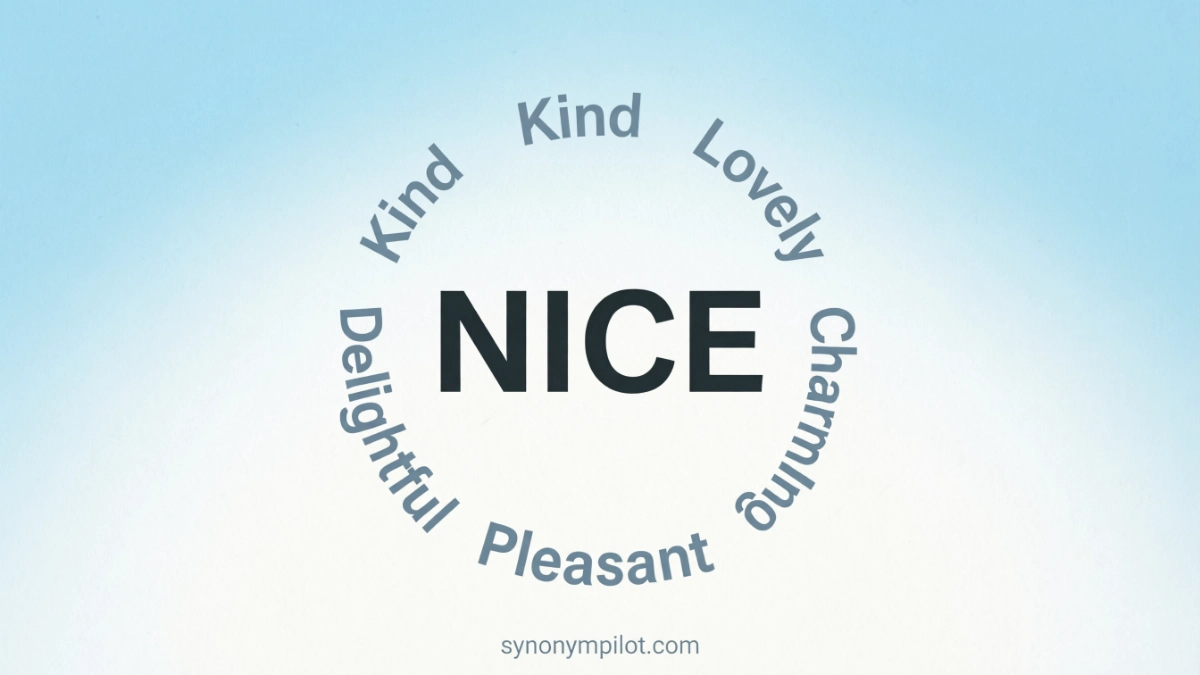
The best single replacement depends on what you mean. For personality, try “kind” or “warm.” For experiences, use “enjoyable” or “pleasant.” For appearance, go with “attractive” or “lovely.” For quality work, choose “impressive” or “excellent.”
When Not to Use “Nice”
Avoid “nice” when:
- You’re writing a formal essay, cover letter, or academic paper
- You want to make a strong impression in professional communication
- You’re giving a detailed compliment that deserves more depth
- You’re writing fiction and need vivid, specific description
- The word feels generic and forgettable in context
In these cases, a more expressive synonym will always serve you better.
Words Commonly Confused With “Nice”
Many learners mix up “nice,” “kind,” and “good.” Here’s the difference:
- Nice = pleasant and agreeable in manner
- Kind = genuinely caring and considerate toward others
- Good = high quality or morally correct
- Pleasant = creating a feeling of comfort or enjoyment
- Lovely = delightful, beautiful, or charming slightly more emotional than “nice”
“He was nice to me” suggests polite, agreeable behavior. “He was kind to me” suggests real emotional warmth and care.
Best Synonym by Context
| Context | Best Synonym | Why It Works |
|---|---|---|
| Describing a person’s character | Kind / Warm / Thoughtful | More specific and meaningful than “nice” |
| Describing an experience | Enjoyable / Delightful / Wonderful | Captures emotional impact clearly |
| Describing appearance | Attractive / Lovely / Elegant | More vivid and descriptive |
| Professional writing | Pleasant / Commendable / Admirable | Formal, neutral, and polished tone |
| Academic writing | Satisfactory / Favorable / Commendable | Objective and structured wording |
| Casual conversation | Great / Lovely / Cool / Awesome | Natural and commonly used |
| Creative writing | Charming / Enchanting / Radiant | Rich, expressive, and imagery-driven |
Which Synonym Should You Choose?
Ask yourself three questions:
- What exactly am I describing? A person, a place, an experience, or an object?
- What’s the tone? Casual chat, formal writing, or professional communication?
- What feeling do I want to create? Warmth, admiration, elegance, or excitement?
If you’re writing to a friend, “lovely” or “wonderful” work naturally. If you’re writing a performance review, try “commendable” or “professional.” In fiction, “enchanting” or “charming” paint a clearer picture than “nice” ever could.
Real Life Examples in Sentences
School
- “The teacher gave a really clear and enjoyable lesson today.”
- “Your essay was well written and thoughtful much stronger than ‘nice’ work.”
Workplace
- “She delivered a commendable presentation to the client.”
- “The team created a welcoming atmosphere for new employees.”
Writing
- “The garden was enchanting, full of color and gentle fragrance.”
- “He had a warm, approachable manner that made everyone feel at ease.”
Conversation
- “That was such a delightful evening we should do it again.”
- “You look lovely today, by the way.”
Best Synonym by Context (Nice)
| Context | Best Synonym | Why It Works |
|---|---|---|
| Describing a person’s character | Kind, Warm, Thoughtful | More precise and emotionally accurate than “nice” |
| Describing an experience | Enjoyable, Delightful, Wonderful | Captures emotional satisfaction clearly |
| Describing appearance or vibe | Attractive, Lovely, Elegant | More vivid and descriptive |
| Professional writing | Pleasant, Commendable, Admirable | Formal, polished tone |
| Academic writing | Satisfactory, Favorable, Commendable | Neutral and objective language |
| Casual conversation | Great, Cool, Lovely, Awesome | Natural and commonly used |
| Creative writing | Charming, Enchanting, Radiant | Rich, expressive, emotional |
| Customer service / tone | Polite, Courteous, Gracious | Professional friendliness |
| Emotional warmth | Sweet, Caring, Affectionate | Strong relational meaning |
| Workplace behavior | Amiable, Easygoing, Supportive | Cooperative and professional tone |
| High praise / quality | Excellent, Superb, Stellar | Strong positive evaluation |
| Formal appreciation | Commendable, Admirable, Praiseworthy | Respectful and structured praise |
| Social personality | Friendly, Sociable, Likable | Everyday interpersonal tone |
| Event / atmosphere | Inviting, Wholesome, Heartwarming | Emotional and immersive description |
Synonym Groups and Usage Differences
Formal Synonyms
Words like commendable, admirable, cordial, gracious, courteous, benevolent, and refined work well in professional emails, academic writing, formal speeches, and business contexts. They carry weight and sound polished.
Informal and Conversational Synonyms
Words like lovely, sweet, wonderful, cheerful, easygoing, and likable sound natural in everyday speech, text messages, and friendly writing. They’re warm without being stiff.
Emotional Synonyms
Words like heartwarming, endearing, compassionate, radiant, and uplifting carry real emotional depth. Use them when you want to connect on a human level in personal messages, speeches, or emotional writing.
Professional Synonyms
In workplace contexts, supportive, engaging, accommodating, genuine, and commendable sound credible and specific without feeling overdone or too casual.
Strong vs. Weaker Synonyms
Stronger: excellent, superb, stellar, brilliant, splendid these make a real impact.
Weaker: satisfactory, agreeable, pleasant these suggest something positive but not remarkable.
Old Fashioned vs. Modern
Amiable, benevolent, and gracious carry a slightly formal, old fashioned tone elegant but not always natural in casual modern conversation. Cool, lovely, and engaging feel far more current.
Antonyms of “Nice”
| Antonym | Meaning | Example Sentence |
|---|---|---|
| Rude | Disrespectful and impolite | He was rude to the staff during the meeting. |
| Unpleasant | Not enjoyable or agreeable | The conversation had an unpleasant tone. |
| Unkind | Lacking kindness or compassion | It was unkind to ignore her request for help. |
| Harsh | Severe, strict, or overly critical | His feedback was harsh but honest. |
| Disagreeable | Difficult to deal with or unpleasant | She had a disagreeable attitude at work. |
| Cold | Emotionally distant or unfriendly | His reply was cold and impersonal. |
| Mean | Cruel or intentionally hurtful | It was mean to exclude him from the group. |
| Awful | Extremely bad or unpleasant | The experience was absolutely awful. |
| Hostile | Aggressive or unfriendly | The audience became hostile during the speech. |
| Nasty | Harsh, unpleasant, or offensive | He made a nasty remark about her work. |
Comparison Section
Nice vs. Kind
“Nice” describes surface behavior how someone acts around others. “Kind” goes deeper it reflects genuine care. A person can be nice without being truly kind. Kindness involves effort and empathy; niceness can just be politeness.
Nice vs. Pleasant
“Pleasant” often describes experiences or environments more than people. “That was a pleasant evening” works well. “She was pleasant” is more neutral and less warm than “she was nice.”
Nice vs. Lovely
“Lovely” carries more emotional warmth and is slightly more enthusiastic than “nice.” British English speakers use “lovely” very naturally in conversation. In American English, it sounds a bit more formal or deliberate.
Nice vs. Wonderful
“Wonderful” is stronger and more expressive. “We had a nice time” is fine. “We had a wonderful time” leaves a much bigger impression and sounds more genuine.
Common Phrases and Expressions
1. Nice to meet you
A polite greeting when meeting someone for the first time.
“It was so nice to meet you at the event yesterday.”
2. Have a nice day
A warm farewell wishing someone well.
Cashiers, teachers, and colleagues use this naturally every day.
3. Nice work
Praising someone’s effort or result.
“Nice work on the presentation the client was impressed.”
4. That’s nice of you
Acknowledging someone’s kind gesture.
“You brought coffee for everyone? That’s so nice of you.”
5. Nice and easy
Describes doing something slowly and carefully.
“Let’s take this nice and easy no need to rush.”
6. Nice try
Sometimes genuine, sometimes sarcastic when someone nearly succeeds.
“Nice try, but you can’t fool me that easily.”
Common Mistakes to Avoid
Using “nice” in formal writing. It reads as vague and low effort in essays, reports, and cover letters. Replace it with a specific synonym that fits your meaning.
Confusing “nice” with “kind.” They’re related but not identical. Don’t use them interchangeably without thinking about the emotional depth you want to convey.
Overusing “nice” in creative writing. In fiction and descriptive writing, “nice” rarely creates a picture in the reader’s mind. Choose something visual and specific “charming,” “enchanting,” or “inviting” instead.
Using very strong synonyms in the wrong tone. Saying something is “superb” or “stellar” in casual conversation can sound unnatural. Match the intensity of your synonym to the situation.
FAQs
What is a more formal synonym for “nice”?
In formal writing or professional contexts, use “commendable,” “admirable,” “cordial,” or “favorable.” These sound polished and specific without feeling stiff.
What is a stronger word than “nice” to describe a person?
Try “warm,” “kind,” “compassionate,” or “generous.” These words go deeper than “nice” and suggest real character qualities rather than just pleasant behavior.
Is “nice” a weak word in English?
On its own, “nice” isn’t wrong but it is vague. In writing, it often signals to readers (and teachers) that a stronger word was available. It’s perfectly fine in conversation but tends to weaken formal or creative writing.
What’s the difference between “nice” and “good”?
“Nice” usually describes personality or experience how something feels. “Good” is broader and often refers to quality or moral value. A “nice” meal is enjoyable. A “good” meal is high quality. A “good” person has strong moral character.
Can “nice” be used sarcastically?
Yes, absolutely. “Oh, that’s very nice of you” can carry a sharp sarcastic edge depending on tone. Context and delivery matter. When written without tone cues, sarcastic “nice” can be misread, so use it carefully in writing.
Conclusion
The word “nice” has a place in everyday English it’s familiar, friendly, and universally understood. But when you start replacing it with more specific, expressive words, your communication becomes noticeably richer.
Instead of saying someone is “nice,” call them “warm,” “thoughtful,” or “genuine.” Instead of saying an experience was “nice,” say it was “delightful,” “memorable,” or “uplifting.”
Vocabulary growth doesn’t happen overnight. The most practical approach is to pick two or three new synonyms each week and use them in real sentences in your messages, your journal, or your conversations.
Over time, reaching for a better word becomes second nature, and your English will feel much more confident and precise. Start with this list and keep building from here.

Hi, I’m J.D. Salinger—a language lover who enjoys uncovering the nuances of words. I write about synonyms, meanings, and vocabulary tips to help readers express themselves more clearly and confidently. My goal is to make learning new words fun, simple, and practical. synonympilot.com