Quick Answer
When is a conjunction and adverb that connects two events or situations by showing the time relationship between them. It means “at the time that” or “at what time.” You use it to describe when something happened, happens, or will happen making it one of the most important time words in English.
You’re writing a short story and every other sentence starts the same way: “When she arrived… When he spoke… When they left…” It sounds repetitive and flat, and you know it but you’re not sure what else to use.
Or maybe you’re writing a formal report and when keeps appearing where a more precise time expression would actually serve you better. “When the policy takes effect” is fine, but “once the policy takes effect” or “at the point that the policy takes effect” can feel sharper and more deliberate in formal writing.
The word when is so natural in English that most learners never think to replace it. But knowing its best alternatives and understanding how each one shifts the timing, tone, or emphasis of your sentence gives you real control over your writing and speaking. Let’s work through it together.
Meaning, Tone, and Context
When primarily functions as a conjunction meaning “at the time that.” It links two events by timing one happens at the same moment as, or immediately after, the other.
It also works as an interrogative adverb in questions: “When did this happen?” And in relative clauses: “That was the year when everything changed.”
Tone: Completely neutral. When works across every register formal essays, casual conversation, academic writing, storytelling, and professional emails. It carries no emotional weight of its own and fits almost any situation.
Where it sounds most natural:
- Everyday conversation (“Call me when you’re ready.”)
- Storytelling and narratives (“When the door opened, everyone fell silent.”)
- Instructions and directions (“Press the button when the light turns green.”)
- Academic and formal writing (“When the data is collected, analysis begins.”)
Because it’s so universal, the challenge isn’t learning when to use it it’s learning when a more specific or expressive word would actually work better.
When and How to Use “When”
Use when to show that two events are connected by time one happens at the same moment as, or triggered by, the other.
Simultaneous events:
“When it rains, the streets flood quickly.”
One event triggers another:
“When she pressed send, she immediately regretted the email.”
Questions about time:
“When does the meeting start?”
Relative clauses:
“I remember the moment when I first heard that song.”
Hypothetical or conditional situations:
“When you’re ready, we can begin.”
The word when implies that the timing is certain or expected. If the timing is uncertain, if often works better: “If you’re ready” (uncertain) vs. “When you’re ready” (expected).
Another Word for When
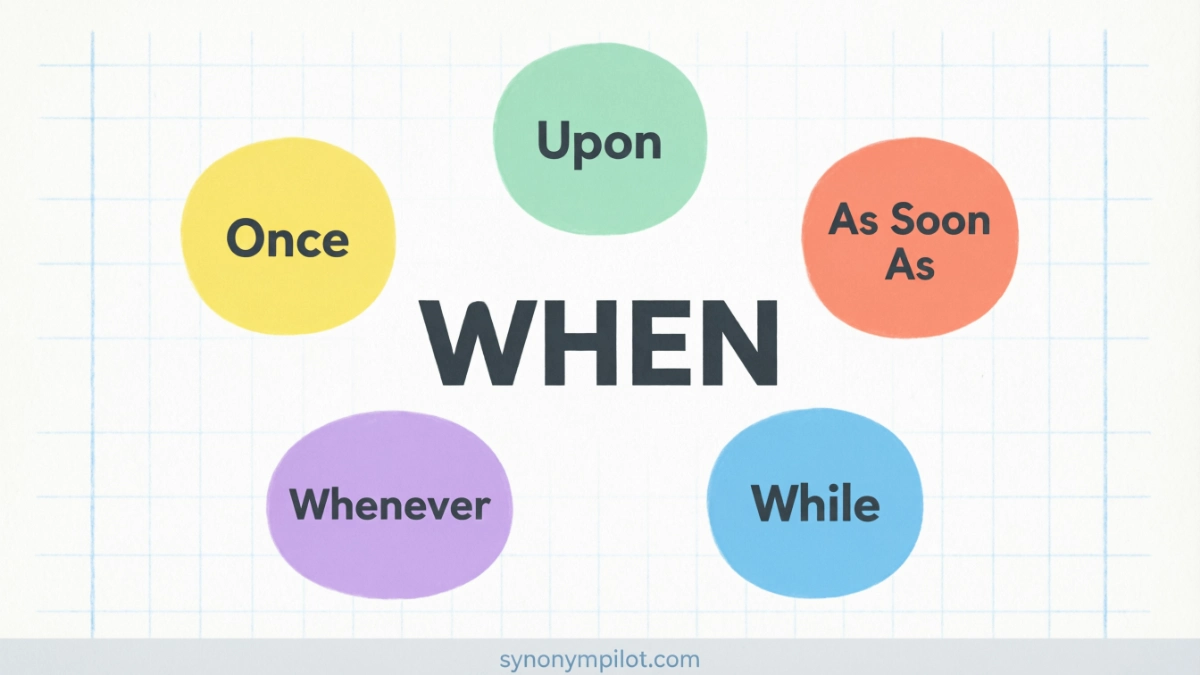
Here are the strongest, most natural alternatives depending on what you mean:
- Once after something is completed or happens
- As at the same moment something else happens
- Whenever every time; any time that
- At the time that more formal and explicit
- Upon formal; immediately after something occurs
- As soon as immediately when something happens
- While during the time that something is happening
- After following a completed event
- The moment that immediately at that specific point
- In the event that if and when something occurs (formal)
When Not to Use “When”
Avoid when when:
- The event is uncertain use if instead (“If the package arrives” not “When the package arrives” if delivery isn’t guaranteed)
- You want to emphasize immediacy as soon as or the moment that are stronger
- You’re writing formally and need more precision upon, at which point, or at the time of add clarity
- You want to show contrast while something is happening while or whereas work better
- You’re describing something that happens every single time whenever is more accurate
Words Commonly Confused With “When”
| Word | How It Differs from “When” |
|---|---|
| While | Shows two events happening at the same time over a period |
| As | Shows actions happening simultaneously or in the same moment |
| Once | Emphasizes completion before the next action begins |
| Whenever | Means “every time,” not a single specific moment |
| If | Shows uncertainty; “when” suggests expectation or certainty |
| After | Clearly shows one event happens following another |
| Until | Shows a continuous action that ends when something happens |
Best Synonym by Context (for “When”)
| Context | Best Synonym | Why It Fits |
|---|---|---|
| Two events at the same moment | As | Shows perfect simultaneity |
| One event right after another | Once, as soon as | Emphasizes sequence and immediacy |
| A repeated or habitual situation | Whenever | Indicates something happens every time |
| Formal writing or reports | Upon, at which point | Precise and professional tone |
| Instructions or directions | Once, as soon as | Clear, action-oriented language |
| Storytelling or narrative | The moment that, just as | More vivid and dramatic |
| Academic writing | At the time that, upon | Formal and explicit phrasing |
| Casual conversation | Once, while, after | Natural and commonly used |
Which Synonym Should You Choose?
Ask yourself two questions: How close together are the two events? and Does it happen once or repeatedly?
- Same exact moment → use as or just as
- Immediately after → use once or as soon as
- During a period of time → use while
- Every single time it happens → use whenever
- Formal context with a noun phrase → use upon or at the time of
- Dramatic storytelling → use the moment that or just as
- Uncertain whether it will happen → use if instead of when
The most common upgrade most writers can make: replace when with once or as soon as to add a sense of sequence and completion it instantly makes instructions and narrative sentences feel more precise.
Real Life Examples in Sentences
School:
- Once the teacher finishes explaining, raise your hand if you have questions.
- As soon as the bell rings, pack your bags quickly.
Workplace:
- Upon receipt of the signed documents, we will process your application.
- Whenever the system updates, please save your work first.
Writing:
- Just as the sun dipped below the horizon, the lights of the city began to glow.
- The moment she opened the letter, she knew everything had changed.
Conversation:
- “Call me once you get there, okay?”
- “While you were out, two packages arrived at the door.”
50 Synonyms for “When”
| Synonym | Simple Meaning | Example Sentence |
|---|---|---|
| Once | After something is complete | Once you finish, we can leave. |
| As | At the same moment | As she walked in, everyone looked up. |
| While | During the same time | While he cooked, she set the table. |
| Whenever | Every time something happens | Whenever it rains, the roof leaks. |
| As soon as | Immediately after | Call me as soon as you arrive. |
| After | Following something | After the meeting, we left. |
| Upon | Immediately after (formal) | Upon arrival, check in at reception. |
| The moment that | Exact instant something happens | The moment that he spoke, she understood. |
| Just as | At the exact same time | Just as I left, it started raining. |
| At the time that | Specific time (formal) | At the time that it happened, I was away. |
| At which point | Then / at that stage (formal) | Finish the form, at which point submit it. |
| In the event that | If something happens | In the event that it fails, retry. |
| The instant that | First exact moment | The instant that she arrived, things changed. |
| By the time | Before a point is reached | By the time you read this, I’m gone. |
| At the point when | At a specific stage | At the point when funding ended, work stopped. |
| During | Throughout a period | During the storm, they stayed inside. |
| Throughout | Entire time period | Throughout the journey, she was calm. |
| Simultaneously | At the same time | Both events happened simultaneously. |
| Concurrently | At the same time (formal) | The projects ran concurrently. |
| Each time | Every single occurrence | Each time he tries, he improves. |
| Every time | On every occasion | Every time I see her, I smile. |
| Any time | At any moment | Call me any time you need help. |
| No sooner than | Immediately after (formal) | No sooner had he left than it rained. |
| Directly | Immediately after (formal) | Directly he arrived, the meeting started. |
| Immediately after | Right after | Immediately after the speech, they applauded. |
| Following | After (formal) | Following the announcement, prices rose. |
| Subsequent to | After (very formal) | Subsequent to review, changes were made. |
| Prior to | Before | Prior to leaving, she packed her bag. |
| Before | Earlier than | Finish work before you go. |
| Until | Up to the point | Wait here until I return. |
| Till | Informal “until” | Stay here till I come back. |
| Right as | Exactly at that moment | Right as he entered, it happened. |
| Now that | Since something is true | Now that you know, act wisely. |
| Seeing that | Because | Seeing that you’re here, begin now. |
| Given that | Since / because | Given that data is ready, proceed. |
| Since | From a past time | Since she arrived, things improved. |
| Whereas | In contrast at the same time | Whereas he failed, she succeeded. |
| Meanwhile | At the same time | Meanwhile, work continued. |
| In the meantime | During the gap | In the meantime, wait here. |
| Hardly…when | Immediately after (formal) | Hardly had I arrived when it began. |
| Scarcely…when | Immediately after | Scarcely had she spoken when it stopped. |
| At what time | Asking time | At what time does it start? |
| On | Specific occasion/day | On the day he left, it rained. |
| In | During a period | In summer, we travel. |
| At | Specific moment | At midnight, everything was silent. |
| Come | Informal “when time arrives” | Come the weekend, we relax. |
Synonym Groups and Usage Differences
Formal and Academic Synonyms
Upon, at which point, subsequent to, concurrently, at the time that, in the event that
These belong in academic essays, legal documents, research papers, and formal business writing. They signal precision and professionalism. Subsequent to and concurrent with are especially common in academic and legal contexts.
Conversational and Informal Synonyms
Once, while, after, till, come, any time, every time
These feel natural in everyday speech, casual writing, and friendly messages. Till especially is a relaxed alternative to until that appears in informal British and American English.
Narrative and Literary Synonyms
Just as, the moment that, the instant that, no sooner than, scarcely…when, hardly…when
These bring immediacy and drama to storytelling. They create a sense of two events colliding which is exactly what good narrative writing needs. No sooner had she left than the storm began is far more vivid than simply when she left, the storm began.
Time Sequence Synonyms
Once, as soon as, after, following, upon, immediately after
These all emphasize that one event follows the completion of another. They’re especially useful in instructions, processes, and formal procedure descriptions.
Repetition and Frequency Synonyms
Whenever, every time, each time, any time
These replace when specifically in situations where something happens repeatedly not just once. Whenever is the most natural and widely used of this group.
Old Fashioned or Literary
Directly (British), no sooner than, scarcely…when, hardly…when
These appear in classical literature and formal older texts. Directly meaning “as soon as” is particularly British and slightly dated in everyday modern usage.
Antonyms of “When”
| Antonym | Meaning | Example Sentence |
|---|---|---|
| Never | At no time | He never calls when he says he will. |
| Before | Earlier than a point in time | Finish reading before you take the test. |
| Until then | Up to that specific point in time | Until then, we had no idea what was coming. |
| Unless | Except if; only under a condition | Unless you ask, she won’t help. |
| Prior to | Before something happens (formal) | Prior to the meeting, review the agenda. |
| Without | In the absence of something happening | Without warning, the lights went out. |
Comparison Section
When vs. While
Both refer to time, but they work differently. When points to a specific moment or trigger. While describes something happening over a stretch of time often with two things happening simultaneously throughout that period.
- When she called, I was sleeping. (She called at a specific moment.)
- While she was sleeping, I studied. (Both things happened across the same time span.)
When vs. As
As shows two events happening at the exact same instant almost like they overlap perfectly. When is slightly broader and can show a moment that triggers something else.
- As he walked through the door, the lights flickered. (Perfect overlap)
- When he walked through the door, we greeted him. (His entry triggered the greeting)
When vs. Once
Once emphasizes completion. It means “after something is fully done.” When is more neutral about whether the first event is complete.
- Once you finish the report, send it over. (Finish it completely first.)
- When you finish the report, send it over. (Similar, but slightly less emphatic about completion.)
When vs. Whenever
When refers to a specific time or event. Whenever means every single time without exception.
- When she calls, I answer. (A particular call)
- Whenever she calls, I answer. (Every single time she calls)
When vs. If
This is where many learners make errors. When assumes the event will definitely happen. If shows uncertainty or conditionality.
- When it rains, take an umbrella. (Rain is expected)
- If it rains, take an umbrella. (Rain might or might not happen)
Common Phrases and Expressions
“When the time comes”
Meaning: At the appropriate or expected future moment.
“We’ll make that decision when the time comes.”
“When all is said and done”
Meaning: In the end; after everything has happened.
“When all is said and done, the experience taught us a great deal.”
“When in Rome”
Meaning: Adapt to the customs of the place you’re in.
“I don’t usually eat street food, but when in Rome!”
“When push comes to shove”
Meaning: When the situation becomes serious or difficult.
“When push comes to shove, she always comes through for the team.”
“When the going gets tough”
Meaning: When a situation becomes very difficult.
“When the going gets tough, the tough get going.”
“When least expected”
Meaning: At a surprising or unpredictable moment.
“Good things often happen when least expected.”
“When it counts”
Meaning: At the important moment; when it truly matters.
“He always performs well when it counts.”
Common Mistakes to Avoid
Using “when” instead of “if” for uncertain events
“When you visit London” implies you definitely will. “If you visit London” shows it’s uncertain. Match the word to the level of certainty in your sentence.
Confusing “when” and “while” for simultaneous events
When points to a moment; while covers a duration. “When I was cooking” suggests a specific point. “While I was cooking” covers the whole cooking period.
Using “whenever” for a single specific time
Whenever always implies repetition. Don’t use it for something that happened just once. “Whenever she called yesterday” doesn’t make sense use when there.
Overusing “when” in formal writing
In academic and professional writing, rotating to upon, once, at which point, or following adds precision and variety. Repeatedly writing when in formal contexts signals a limited vocabulary range.
Starting every narrative sentence with “when”
In storytelling, vary your sentence openers. Start some with just as, the moment that, as, or no sooner than to create rhythm and keep readers engaged.
FAQs
What is the best synonym for “when” in formal writing?
Upon and at which point are excellent formal alternatives. For academic writing, at the time that and subsequent to also add precision. Upon completion of the form, submit it to the office sounds more formal and polished than when you complete the form.
What’s the difference between “when” and “once”?
Once emphasizes that the first action must be fully completed before the second one begins. When is more neutral about timing. “Once the download is complete, install the software” makes the sequence very clear. In many sentences they’re interchangeable, but once adds more emphasis on completion.
Can I use “as” instead of “when”?
Yes, in many cases but as specifically shows two events happening at the exact same instant. It’s particularly vivid in narrative writing. However, as sounds slightly formal in some contexts, so use it where the perfect overlap between two events is the point you want to make.
Is “whenever” the same as “when”?
Not quite. Whenever means “every time” or “any time” it implies repetition. When refers to a specific moment or trigger. “Whenever you’re ready” means any time suits you. “When you’re ready” suggests a specific upcoming moment.
What’s the most natural spoken alternative to “when” in conversation?
Once is probably the most natural conversational swap: “Call me once you’re done” sounds completely natural. While, after, and as soon as are also very common in everyday spoken English.
Conclusion
The word when does its job so naturally that it’s easy to forget better options exist. But as you’ve seen throughout this guide, alternatives like once, as soon as, upon, the moment that, and whenever each bring something slightly different more precision, more drama, more formality, or more clarity about repetition.
Start small. Next time you write a sentence with when, ask yourself: is this a specific moment or something that repeats? Does one event immediately follow the other? Is the tone formal or casual? Answering those three questions will guide you to the right word almost every time.
The more you experiment with these alternatives in your daily writing and conversations, the more natural they’ll feel. Vary your language, trust your instincts, and remember strong writing is built one better word choice at a time. Keep going you’re doing brilliantly.

Hi, I’m Theo John, a passionate word explorer who loves diving into the beauty of the English language. I write about synonyms, word meanings, and practical vocabulary tips to help readers communicate with confidence. synonympilot.com