You’re writing a leadership essay, and you’ve already used the word “power” four times in two paragraphs. It starts to feel repetitive, even a little lazy.
Or maybe you’re prepping for a job interview and want to describe your manager’s influence without sounding like you’re reading from a dictionary.
This happens to almost everyone “power” is one of those words we reach for constantly, in politics, science, sports, relationships, and everyday conversation, yet we rarely pause to think about how many shades of meaning it actually carries.
This guide breaks down the word clearly, gives you real alternatives for different situations, and shows you exactly when a synonym fits better than “power” itself.
Quick Answer
“Power” means the ability to control, influence, or act on people, situations, or things. It can describe physical strength, political authority, electrical energy, or personal influence over others. The right synonym depends entirely on which of these meanings you intend.
Meaning, Tone & Context
At its core, “power” refers to capacity the capacity to do something, to control someone, or to produce an effect. That single word covers a surprising range of ideas: a country’s political power, a bodybuilder’s physical power, a battery’s electrical power, and a celebrity’s social power are all valid, yet very different, uses.
The tone of “power” is mostly neutral. It doesn’t automatically sound positive or negative; context decides that. “She used her power to help others” feels admirable, while “He abused his power” feels critical. This flexibility is exactly why the word shows up everywhere in academic writing, casual conversation, business meetings, and news reports.
“Power” sounds most natural in contexts involving authority (governments, companies, leadership), physical capability (sports, fitness, machinery), or energy (electricity, technology). It feels slightly less natural when you’re describing a narrow skill or talent in that case, “ability” or “talent” usually fits better.
When and How to Use “Power”
Use “power” when you’re talking about control, influence, strength, or energy in a general sense. Here are realistic examples across different situations:
In politics: “The opposition party gained power after the election.”
In fitness: “Years of training gave her incredible leg power.”
In technology: “The new processor uses less power but runs faster.”
In relationships: “He realized he had given up too much power in the argument.”
Notice how the same word adapts to completely different settings without needing translation. That adaptability is useful, but it also means you should pick a more specific synonym when precision matters more than convenience.
Another Word for Power
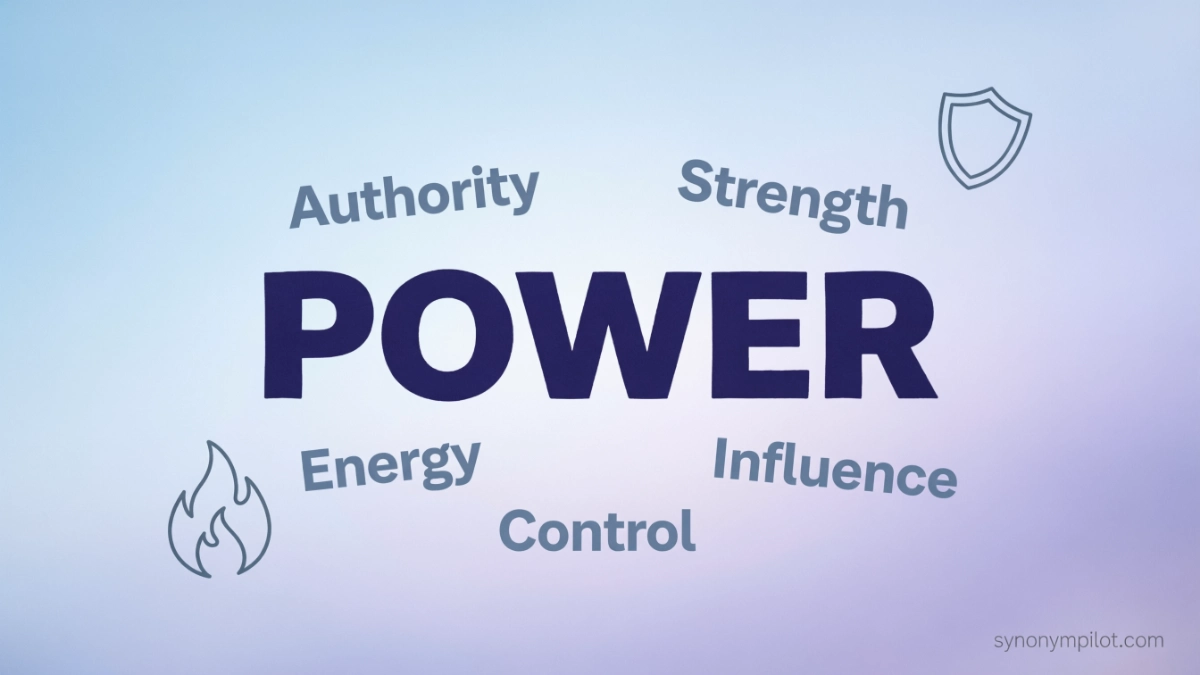
If you need one quick substitute, “authority” works well for control over people, “strength” works for physical capability, “energy” works for electricity or stamina, and “influence” works for social or persuasive power. There’s no single perfect replacement because “power” itself is a broad, multi purpose word the best alternative always depends on which meaning you’re aiming for.
When Not to Use This Word
Avoid “power” when you actually mean a narrow skill or talent. Saying “She has the power to paint beautifully” sounds odd; “ability” or “talent” fits naturally instead. Also avoid it in technical or scientific writing where precision matters physics distinguishes “power” (rate of energy transfer) from “energy” (total capacity), and mixing them up creates real confusion, not just stylistic awkwardness. Finally, in formal writing about legitimate governance, “authority” is often more accurate than “power,” since power can exist without legitimacy, while authority implies a recognized right to act.
Words Commonly Confused With Power
Strength and power often get used interchangeably, but strength describes raw physical capacity, while power describes the ability to apply that capacity to produce an effect or control an outcome.
Force and power are also frequently mixed up. Force usually implies physical exertion, often with a sense of pressure or even violence, while power is broader and doesn’t always involve physical contact at all.
Authority and power get confused too. Authority is the recognized, legitimate right to make decisions or give orders, while power is simply the capacity to do so with or without that legitimacy.
Energy and power are commonly swapped in casual speech, though technically energy is the total capacity to do work, while power measures how quickly that energy gets used or delivered.
Best Synonym by Context (for “Power”)
| Context | Best Synonym | Why It Fits |
|---|---|---|
| Physical strength | Strength, might, brawn | Directly describes bodily or physical force |
| Political or organizational control | Authority, command, dominion | Reflects formal control over people or systems |
| Electrical or mechanical energy | Energy, electricity, charge | Scientific terms used in physics and engineering |
| Social influence | Influence, clout, sway | Describes the ability to affect others indirectly |
| Dominant position or ranking | Dominance, supremacy, ascendancy | Shows superiority or top-level status |
| General ability or capacity | Ability, capability, capacity | Neutral terms for overall potential or function |
Which Synonym Should You Choose?
Start by asking what kind of power you’re describing. If it’s physical, lean toward “strength” or “might.” If it’s about controlling people or institutions, “authority” or “command” reads more precisely. If you’re talking electricity or machinery, “energy” is almost always clearer than “power” in technical writing. And if you’re describing someone’s social pull rather than formal control, “influence” or “clout” captures that better than “power” alone.
A simple test: try swapping in the synonym and see if the sentence still makes sense without sounding stretched. If it does, you’ve found the right fit.
Real Life Examples of “Power” in Sentences
School
“The teacher gave the student council more power to organize school events.”
“Our science class learned how power is measured in watts.”
Workplace
“The new manager has the power to approve budget changes without higher sign off.”
“Employees felt they had little power over decisions affecting their schedules.”
Writing
“The novel explores themes of power, corruption, and redemption.”
“Her essay argued that economic power often determines political power.”
Conversation
“Honestly, he just likes feeling like he’s in power.”
“I didn’t realize how much power that one comment had over the whole meeting.”
Synonyms for “Power”
| Synonym | Simple Meaning | Example Sentence |
|---|---|---|
| Strength | Physical capacity | He has the strength to carry heavy equipment. |
| Might | Great force or power | The might of the storm surprised everyone. |
| Force | Physical pressure or effect | The force of the wave knocked him over. |
| Energy | Capacity to do work | Solar panels generate energy for the house. |
| Authority | Right to control others | The manager has the authority to approve leave. |
| Control | Ability to direct or manage | She has full control over the project budget. |
| Influence | Ability to affect others | His influence on the team is obvious. |
| Dominance | Position of control or strength | The champion showed total dominance in the final. |
| Capacity | Ability to hold or do something | The plant increased its production capacity. |
| Ability | Skill or capability | She has the ability to solve complex problems. |
| Capability | Power to perform a task | The new engine has greater capability. |
| Vigor | Physical strength and energy | He spoke with vigor and conviction. |
| Potency | Strength or effectiveness | The medicine’s potency surprised the doctor. |
| Clout | Social or political influence | The reviewer has serious clout in the industry. |
| Sway | Influence over decisions | Her opinion holds a lot of sway in meetings. |
| Command | Authority to give orders | The general had command over the entire division. |
| Supremacy | State of being the strongest | The brand maintained market supremacy for years. |
| Domination | Control over others | Their domination of the league surprised no one. |
| Muscle | Informal strength or influence | The union has real political muscle. |
| Vitality | Energy and liveliness | Her vitality impressed everyone at the gym. |
| Stamina | Sustained physical energy | Runners need stamina to finish a marathon. |
| Leverage | Influence used for advantage | They used their leverage to negotiate better terms. |
| Hold | Strong control over someone/something | The habit had a strong hold over him. |
| Grip | Tight control | The leader’s grip on power weakened over time. |
| Sovereignty | Supreme independent authority | The nation values its sovereignty highly. |
| Jurisdiction | Legal authority over an area | The court has jurisdiction over this case. |
| Mastery | Control through skill | Her mastery of the subject impressed the panel. |
| Prowess | Exceptional skill or strength | His prowess on the field was unmatched. |
| Robustness | Strength and durability | The robustness of the design surprised engineers. |
| Toughness | Resistance and strength | The toughness of the material made it ideal. |
| Brawn | Physical strength | It takes brawn to move furniture like that. |
| Pull | Informal influence | He has some pull with the city council. |
| Weight | Importance or influence | Her words carry a lot of weight in this office. |
| Say-so | Informal authority to decide | The final say-so belongs to the director. |
| Rule | Authority to govern | The king’s rule lasted nearly four decades. |
| Reign | Period of ruling authority | Her reign as champion continues this year. |
| Dominion | Control over territory | The empire had dominion over vast lands. |
| Hegemony | Political or social dominance | The nations competed for regional hegemony. |
| Vim | Energy and enthusiasm | She tackled the project with vim. |
| Dynamism | Energetic forceful quality | The startup is known for its dynamism. |
| Drive | Motivating energy | His drive to succeed pushed him forward. |
| Charge | Stored electrical power | The battery holds a full charge. |
| Electricity | Electrical energy | The storm cut off electricity. |
| Horsepower | Engine power measurement | The truck has 300 horsepower. |
| Potential | Future capacity | The country has great economic potential. |
| Omnipotence | Unlimited power | The myth describes divine omnipotence. |
| Predominance | State of being strongest | The company’s predominance is clear. |
| Ascendancy | Rising dominant position | Their ascendancy began after the change. |
| Upper hand | Advantage in control | She gained the upper hand in negotiation. |
| Reins | Control or direction | He took the reins of the company. |
Synonym Groups & Usage Differences
Formal & Academic
Words like sovereignty, jurisdiction, dominion, hegemony, ascendancy, and predominance belong in essays, legal writing, or political analysis. They sound precise and serious, and using them in casual conversation would feel out of place.
Informal & Everyday
Muscle, pull, clout, say so, and upper hand work well in relaxed conversation or casual writing. They communicate the same ideas as the formal words above but with a friendlier, more conversational tone.
Physical Strength Words
Strength, might, force, brawn, toughness, and robustness all describe physical capability rather than control over people. Use these when talking about bodies, materials, or machinery, not politics or social influence.
Authority & Control Words
Authority, command, control, dominion, and rule describe power over people or institutions. These fit leadership, government, and workplace contexts.
Energy & Vitality Words
Energy, vigor, vim, dynamism, charge, and electricity describe physical or mechanical energy rather than control. These are essential when writing about science, fitness, or technology.
Strongest vs Milder
Domination, supremacy, and omnipotence describe an extreme, often total level of power. Ability, capacity, and capability describe a much milder, more neutral level useful when you want to avoid sounding dramatic.
Antonyms of “Power”
| Antonym | Meaning | Example |
|---|---|---|
| Weakness | Lack of strength | His weakness made it hard to lift the boxes. |
| Powerlessness | Lack of control or influence | She felt powerlessness watching the crisis unfold. |
| Helplessness | Inability to act or change things | The helplessness of the situation frustrated him. |
| Impotence | Lack of effective power | The committee’s impotence became obvious quickly. |
| Frailty | Physical weakness or fragility | Old age brought noticeable frailty to his body. |
| Incapacity | Lack of ability to do something | Financial incapacity stalled the entire project. |
| Subordination | Being under another’s control | Workers resented their subordination to the new boss. |
| Vulnerability | Exposure to harm or lack of protection | The country’s vulnerability was exposed during the storm. |
| Inability | Lack of skill or capacity | His inability to lead caused the team to struggle. |
Comparison Section
Power and strength differ mainly in scope: strength is purely physical, while power can be physical, political, social, or mechanical. “She has great strength” only describes her body; “She has great power” could mean anything from political control to social influence.
Power and force differ in intensity and intent: force usually implies physical pressure or even compulsion, sometimes with negative undertones, while power is neutral and broader. “He used force” sounds aggressive; “He used power” doesn’t necessarily.
Power and authority differ in legitimacy: authority is recognized and often official, while power can exist informally or even illegitimately. A dictator can hold power without holding legitimate authority.
Power and energy differ in technical precision: energy is the total capacity to do work, while power measures the rate at which that energy is used. In casual speech they overlap; in science writing, mixing them up is a real mistake.
Common Phrases & Expressions
“In power” means currently holding political control. Example: “The party has been in power for ten years.”
“Power play” means a strategic move to gain control or advantage. Example: “His sudden resignation was really just a power play.”
“More power to you” is an expression of encouragement or support. Example: “You’re starting your own business? More power to you.”
“Power struggle” describes ongoing conflict over control. Example: “There’s a quiet power struggle between the two department heads.”
“Power through” means to push forward despite difficulty. Example: “She powered through the exam even while feeling sick.”
“Balance of power” describes equal or stable distribution of control. Example: “The treaty helped maintain a balance of power in the region.”
Common Mistakes to Avoid
Don’t confuse “force” with “power” force often implies physical compulsion or pressure, while power is broader and more neutral. Don’t use “authority” and “power” interchangeably in formal writing, since authority specifically implies legitimacy that power doesn’t always have. Avoid overusing “power” when a more specific word fits better; repeating it across several sentences makes writing feel flat. And in any scientific or technical context, keep “power” and “energy” separate they measure different things, and swapping them creates real inaccuracy, not just stylistic weakness.
FAQs
What is the best synonym for “power”?
It depends on context. Use “authority” for political or workplace control, “strength” for physical capability, “energy” for electricity, and “influence” for social impact.
Is “power” the same as “strength”?
Not exactly. Strength is purely physical capacity, while power is broader and can include control, influence, or energy as well as physical force.
What’s the difference between “power” and “force”?
Force usually implies physical pressure or compulsion, often with a slightly negative tone, while power is neutral and can apply to politics, energy, or influence without any physical contact at all.
What is the opposite of power?
Common opposites include weakness, powerlessness, helplessness, and incapacity, depending on whether you’re describing physical, political, or personal lack of control.
Can “power” be used as a verb?
Yes. “To power” something means to supply it with energy, as in “Solar panels power the entire building.”
Conclusion
“Power” is one of those words that quietly does a lot of work in everyday English, covering everything from political control to physical strength to electrical energy.
Once you start noticing its different shades of meaning, choosing the right synonym becomes much easier and your writing instantly feels more precise and less repetitive.
Try picking one or two new words from this list and using them naturally in conversation or writing this week. Small, deliberate vocabulary choices like this build up over time, and before long, words like “authority,” “leverage,” or “vitality” will feel just as natural to you as “power” already does.
Keep practicing, stay curious about word choice, and your vocabulary will keep growing.

Hi, I’m George Philip—an English language enthusiast who enjoys uncovering the nuances of words. I write about synonyms, vocabulary, and everyday language tips so readers can improve their communication and express themselves effectively. Learning new words should be fun, practical, and inspiring! synonympilot.com