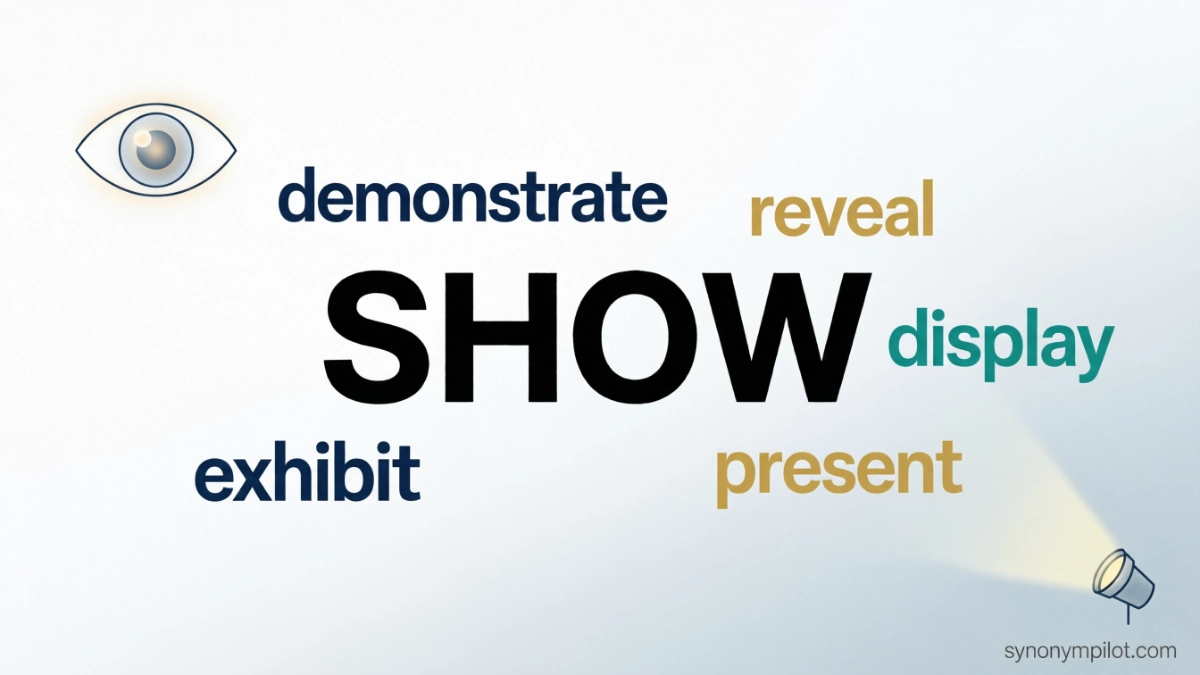
Quick Answer: “Show” means to make something visible, to prove or demonstrate something, or to guide or present something to someone. It’s one of the most flexible verbs in English, covering everything from physical display to logical proof.
Words like “reveal,” “demonstrate,” or “exhibit” can replace “show” depending on whether you mean visibility, proof, or presentation.
You’re writing a science report and you type “the data shows a clear pattern.” It’s correct, but flat. So you revise: “the data reveals a clear pattern” or “the data demonstrates a clear pattern” and suddenly your writing sounds more analytical and precise.
Or maybe you’re texting a friend: “Can you show me how to do this?” completely natural, no change needed. The trick is knowing when “show” works perfectly and when a more specific word elevates your sentence.
What Does “Show” Mean?
“Show” means to make something visible or known, to prove something through evidence, to demonstrate how to do something, or to guide someone somewhere. It’s an extremely versatile word that functions as both a verb (“show me the way”) and a noun (“we watched a show”). Because it covers so much ground, choosing the right synonym often depends entirely on which specific meaning you intend.
Meaning, Tone, and Context
At its core, “show” describes the act of making something perceivable, understandable, or known to someone else. The tone is neutral and works comfortably across nearly every context casual conversation, professional writing, academic analysis, and creative storytelling.
“Show” sounds natural in everyday speech (“show me your photos”), professional writing (“the report shows a decline in sales”), academic contexts (“the experiment shows a clear correlation”), and instructional language (“let me show you how this works”). It also functions as a noun referring to entertainment (“we’re going to a show tonight”).
Because “show” carries so many related meanings display, proof, demonstration, guidance, and entertainment it can sometimes feel vague. “The results show improvement” doesn’t specify whether the improvement is obvious, statistically proven, or simply apparent. A more specific synonym often clarifies exactly what kind of “showing” is happening.
When and How to Use “Show”
Use “show” when you want a simple, universally understood word for making something visible, proving a point, or demonstrating a process.
Here are natural examples across different situations:
- “Can you show me how to use this software?” (instructional, casual)
- “The data shows a significant increase in revenue.” (analytical, professional)
- “Her actions show how much she cares.” (interpretive, personal)
- “We’re going to a show this weekend.” (noun usage, entertainment)
When you want more precision whether you mean visual display, logical proof, step by step demonstration, or formal presentation a well chosen synonym communicates that distinction clearly.
Another Word for Show
If you need one quick, reliable alternative depending on context:
- For making something visible → reveal or display
- For proving something with evidence → demonstrate or prove
- For teaching a process → demonstrate or walk through
- For formal presentation → exhibit or present
- For casual conversation → let me see or point out
There is no single “best” replacement for “show” the right word depends on whether you mean visibility, proof, instruction, or presentation.
When Not to Use This Word
Avoid “show” in academic or scientific writing when you mean something more specific, like “demonstrate” or “indicate.” “The study shows” is acceptable, but “the study demonstrates” or “the data indicates” often sounds more precise and analytically rigorous.
Avoid “show” when you mean “reveal” something hidden or secret. “She showed her true feelings” is fine, but “she revealed her true feelings” carries a stronger sense of something previously concealed coming to light.
Avoid overusing “show” repeatedly in the same paragraph. If every sentence says the data “shows” something, the writing feels repetitive. Rotating with “reveals,” “indicates,” “demonstrates,” and “highlights” adds variety and precision.
Words Commonly Confused With Show
Show vs. Demonstrate:
“Demonstrate” implies a more deliberate, often step by step proof or instructional process frequently used in academic, scientific, or teaching contexts. “Show” is broader and more casual. “She showed me the recipe” is casual. “She demonstrated the technique” sounds more structured and instructional.
Show vs. Reveal:
“Reveal” specifically implies that something was previously hidden, secret, or unknown, and is now being made visible or known. “Show” doesn’t carry that implication of concealment. “He showed his ticket” is neutral. “He revealed his true identity” implies something was hidden before.
Show vs. Display:
“Display” focuses specifically on visual presentation often for an audience to see, sometimes in an organized or intentional way. “Show” is broader and can apply to physical objects, evidence, emotions, or processes. “The museum displays artifacts” emphasizes visual arrangement. “The museum shows artifacts” works too, but “display” feels more curated.
Show vs. Prove:
“Prove” implies establishing something as definitely true through solid evidence or logical argument a stronger, more conclusive claim than “show.” “The results show a trend” is observational. “The results prove the hypothesis” makes a stronger, more definitive claim.
Best Synonym by Context
| Context | Best Synonym | Why It Fits |
|---|---|---|
| Academic/scientific writing | Demonstrate, indicate, reveal | Sounds precise and analytical. |
| Teaching/instruction | Demonstrate, walk through, illustrate | Implies step-by-step guidance. |
| Formal presentation | Exhibit, present, display | Sounds polished and structured. |
| Evidence/proof | Prove, establish, confirm | Communicates certainty. |
| Emotional expression | Express, convey, reveal | Captures inner feeling made visible. |
| Casual conversation | Let me show you, point out, share | Natural and relaxed. |
| Entertainment (noun) | Performance, production, exhibition | Specific to the entertainment industry. |
Which Synonym Should You Choose?
Ask yourself these quick questions before picking a replacement for “show”:
1. Are you proving something or simply displaying it?
“Demonstrate” and “prove” imply evidence and logic. “Display” and “exhibit” imply visual presentation without necessarily proving anything.
2. Was something previously hidden?
If yes, “reveal” or “unveil” fits better than “show,” which is more neutral.
3. Is this instructional?
“Demonstrate,” “illustrate,” and “walk through” all suggest teaching someone how to do something step by step.
4. How formal is the context?
“Exhibit” and “present” suit formal writing. “Point out” and “share” suit casual conversation.
Real Life Examples of “Show” in Sentences
School
“The teacher will show students how to solve the equation step by step.”
“Her test scores show significant improvement since the beginning of the term.”
Workplace
“The quarterly report shows a steady increase in customer engagement.”
“Could you show me how to access the shared drive?”
Writing
“The character’s actions show his growing doubt about the mission.”
“The data shows a clear correlation between sleep and productivity.”
Conversation
“Show me that photo from last weekend!”
“His smile showed he was genuinely happy for her.”
Antonyms of Show
| Antonym | Meaning | Example Sentence |
|---|---|---|
| Hide | Keep something out of sight | She hid the gift in the closet until the party. |
| Conceal | Prevent something from being seen or known | He concealed the documents from investigators. |
| Cover | Place something over to keep it unseen | They covered the painting during renovations. |
| Suppress | Prevent information or feelings from being revealed | The company tried to suppress the report. |
| Withhold | Refuse to provide or reveal something | She withheld important details during the interview. |
| Obscure | Make difficult to see or understand | Thick fog obscured the mountain view. |
| Mask | Hide the true nature or appearance of something | He masked his disappointment with a smile. |
| Camouflage | Hide by blending into surroundings | The animal camouflaged itself among the leaves. |
| Bury | Hide or keep something from being noticed | The key evidence was buried deep in the archives. |
| Secret | Keep hidden from others | They secreted the valuables in a safe location. |
| Veil | Conceal partially or indirectly | A veil of mystery surrounded the event. |
| Shroud | Cover or hide completely | Clouds shrouded the summit all morning. |
| Cloak | Hide or disguise something | He cloaked his intentions behind polite language. |
| Disguise | Change appearance to hide identity | The spy disguised himself as a tourist. |
| Shield | Protect from view or exposure | Trees shielded the house from the road. |
| Screen | Hide from observation | The fence screened the garden from neighbors. |
| Block | Prevent from being seen | A truck blocked our view of the stage. |
| Censor | Remove or hide information from public view | Several scenes were censored before release. |
| Omit | Leave out information | The summary omitted several important facts. |
| Exclude | Deliberately leave out | The report excluded data from earlier years. |
| Deny | Refuse to admit or reveal | He denied any involvement in the incident. |
| Ignore | Fail to acknowledge or recognize | The article ignored key evidence. |
| Overlook | Fail to notice or mention | The review overlooked several major flaws. |
| Minimize | Downplay the importance of something | Officials minimized the seriousness of the issue. |
| Downplay | Make something seem less important | She downplayed her role in the project’s success. |
| Muffle | Make something less noticeable or audible | The thick walls muffled the sound. |
| Blur | Make unclear or difficult to distinguish | The rain blurred the view from the window. |
| Distort | Misrepresent or alter the true appearance | The mirror distorted his reflection. |
| Confuse | Make something difficult to understand | The complicated wording confused readers. |
| Mislead | Give a false impression | The advertisement misled consumers about the product. |
| Misrepresent | Present something inaccurately | The article misrepresented her comments. |
| Falsify | Alter information to hide the truth | He falsified records to conceal losses. |
| Cover up | Hide wrongdoing or facts | They attempted to cover up the mistake. |
| Keep secret | Prevent others from knowing | She kept the surprise party secret. |
| Bottle up | Hide emotions instead of expressing them | He bottled up his frustration for months. |
| Repress | Hold back thoughts or feelings | She repressed painful memories from childhood. |
| Stifle | Prevent expression or development | Strict rules stifled creativity. |
| Mute | Reduce visibility, expression, or impact | The colors were muted by poor lighting. |
| Silence | Prevent someone from speaking or expressing | Critics claimed the policy silenced dissenting voices. |
| Concealment | The act of hiding something | The concealment of evidence raised suspicion. |
| Invisibility | The state of not being seen | The design aimed for near invisibility. |
| Privacy | Keeping information hidden from others | She values her privacy highly. |
| Secrecy | Intentional concealment of information | The negotiations were conducted in secrecy. |
| Suppression | The act of preventing disclosure | The suppression of facts caused controversy. |
| Reticence | Reluctance to reveal information | His reticence made the interview difficult. |
| Reservation | Holding back thoughts or feelings | She expressed her reservations only privately. |
| Evasion | Avoiding direct disclosure | His answers sounded like pure evasion. |
| Silence | Absence of expression or communication | Her silence spoke louder than words. |
| Mystery | Something intentionally or naturally hidden | The disappearance remains a mystery. |
| Unknown | Not revealed or discovered | The source of the signal remains unknown. |
| Unseen | Not visible or observed | Much of the damage remained unseen for weeks. |
Synonym Groups and Usage Differences
Formal
Demonstrate, exhibit, substantiate, establish, set forth, disclose suit academic essays, formal reports, legal writing, and official documents. They communicate precision and credibility.
Informal
Point out, let me see, trot out, flaunt, parade sound natural in casual conversation and relaxed writing.
Academic
Demonstrate, indicate, establish, substantiate, evidence, reflect upon appear frequently in research papers, essays, and scholarly analysis, especially when discussing data, findings, or arguments.
Professional
Present, highlight, convey, showcase, lay out, walk through suit business presentations, reports, and workplace communication.
Emotional / Personal
Reveal, express, radiate, bare, manifest, convey carry emotional depth, useful in personal writing and creative storytelling when describing inner feelings becoming visible.
Strongest vs. Weaker
“Prove” and “establish” make strong, definitive claims about evidence. “Suggest” and “indicate” are weaker, implying possibility rather than certainty. “Show” sits comfortably in the middle, neutral in strength.
Slightly Negative Connotation
Flaunt, parade, trot out, brandish all carry a slightly negative or boastful undertone describing showing something in an excessive, attention seeking, or repetitive way. These aren’t neutral substitutes; choose them deliberately when that connotation fits.
Antonyms of Show
| Context | Best Antonym | Why It Fits |
|---|---|---|
| Keeping information secret | Conceal | Directly means hiding information from others. |
| Hiding emotions | Mask | Specifically refers to covering true feelings. |
| Official reports or documents | Withhold | Commonly used for refusing to release information. |
| Preventing public knowledge | Suppress | Implies actively stopping something from being revealed. |
| Physical visibility | Hide | The most direct opposite of making something visible. |
| Identity or appearance | Disguise | Used when hiding a person’s true identity or nature. |
| Making something difficult to understand | Obscure | Opposite of clearly showing or explaining. |
| Refusing acknowledgment | Deny | Opposite of openly admitting or showing the truth. |
Comparison: Show vs. Related Words
Show vs. Demonstrate
“Demonstrate” implies a deliberate, often structured proof or instructional process. “Show” is more casual and general. “Can you show me?” works in everyday conversation. “Let me demonstrate the procedure” sounds more formal and instructional, fitting classrooms, labs, and professional training.
Show vs. Reveal
“Reveal” carries the implication that something was previously hidden or unknown. “Show” is neutral and doesn’t require concealment beforehand. “She showed me her notes” is neutral. “She revealed her secret plan” implies something was kept hidden until that moment.
Show vs. Display
“Display” focuses on visual presentation, often intentional and organized frequently used for physical objects, art, or merchandise. “Show” is broader and applies to emotions, evidence, and processes too. “The store displays its products in the window” emphasizes visual arrangement. “The store shows its products” is correct but less specific.
Show vs. Prove
“Prove” makes a stronger, more definitive claim establishing something as conclusively true. “Show” can be more tentative or observational. “The results show improvement” suggests a trend. “The results prove the treatment works” makes a stronger, evidence backed claim.
Show vs. Indicate
“Indicate” often suggests something more subtly, through signs or data, without being completely definitive. “Show” can be more direct and obvious. “The chart indicates a possible trend” sounds cautious and analytical. “The chart shows a trend” feels more direct and confident.
Common Phrases and Expressions
“Show off”
To display something, often a skill or possession, in a way meant to impress others.
Example: “He loves showing off his new car to anyone who will look.”
“Show up”
To arrive somewhere, often used informally.
Example: “She showed up late to the meeting without any explanation.”
“Show your true colors”
To reveal your real character or intentions, often unexpectedly.
Example: “He finally showed his true colors when the pressure got intense.”
“Show someone the ropes”
To teach someone how something works, especially in a new job or task.
Example: “The senior staff member showed the new intern the ropes during her first week.”
“For show”
Done only for appearance, not for genuine purpose.
Example: “The renovation was mostly for show it didn’t actually fix the underlying problems.”
“Show willing”
To demonstrate effort or good intentions, even if the outcome isn’t perfect (British English).
Example: “He stayed late just to show willing, even though the deadline had already passed.”
Common Mistakes to Avoid
Using “show” when you mean “prove” in academic writing:
“The data shows X is true” is acceptable casually, but in rigorous academic writing, “the data demonstrates” or “the evidence establishes” sounds more precise, especially when making a strong evidentiary claim.
Confusing “reveal” and “show” when nothing was hidden:
“She revealed her shopping list” sounds odd if there was nothing secretive about it. “She showed her shopping list” is more accurate when there’s no implication of concealment.
Overusing “show” repeatedly in the same paragraph:
When every sentence in a report says the data “shows” something, the writing feels flat and repetitive. Rotating with “indicates,” “reveals,” “demonstrates,” and “highlights” creates more dynamic, professional writing.
Using “flaunt” or “parade” as neutral synonyms:
These words carry a negative, boastful connotation. Saying “she flaunted her achievements” implies she was showing off in an unappealing way not simply sharing information. Use neutral words like “shared” or “presented” if no judgment is intended.
Confusing “display” with “show” for emotions:
“Display” sounds slightly more formal and intentional. “She displayed her emotions” can sound clinical. “She showed her emotions” or “her emotions showed clearly” often sounds more natural for describing genuine, less curated feelings.
FAQs
What is the most professional synonym for “show” in a business report?
A: “Demonstrate,” “indicate,” and “reveal” are all strong professional alternatives. “The data demonstrates consistent growth” sounds analytical and confident, ideal for business and academic writing.
What is the difference between “show” and “demonstrate”?
A: “Demonstrate” implies a more deliberate, structured process often instructional or evidence based. “Show” is broader and more casual. You might “show” a friend a photo, but you would “demonstrate” a scientific process to a class.
Is “reveal” the same as “show”?
A: Not quite. “Reveal” specifically implies that something was previously hidden or secret and is now being made known. “Show” is neutral and doesn’t require that sense of prior concealment. Using “reveal” for something that was never hidden can sound slightly exaggerated.
What is a good synonym for “show” when teaching someone a skill?
A: “Demonstrate,” “walk through,” and “illustrate” all work well in instructional contexts. “Let me walk you through the process” sounds clear, friendly, and step by step, ideal for teaching or onboarding situations.
Can “show” be used as a noun?
A: Yes. “Show” as a noun refers to a form of entertainment or public display “we watched a great show last night,” or “the art show opens this weekend.” In that context, related synonyms include “performance,” “exhibition,” and “production,” depending on the type of show.
Conclusion
“Show” is one of the most versatile words in English, covering everything from simple visibility to formal proof to teaching a skill. Because it does so much work, choosing a more specific synonym “demonstrate,” “reveal,” “exhibit,” or “indicate” often makes your writing sharper, more precise, and more engaging.
This week, try paying attention to how you use “show” in your own writing and conversation. Ask yourself: am I proving something, revealing something hidden, teaching a process, or simply describing visibility? Then choose the synonym that matches exactly what you mean.
With a little practice, these word choices will feel natural, and your English will sound noticeably more confident and precise.

Hi, I’m J.D. Salinger—a language lover who enjoys uncovering the nuances of words. I write about synonyms, meanings, and vocabulary tips to help readers express themselves more clearly and confidently. My goal is to make learning new words fun, simple, and practical. synonympilot.com