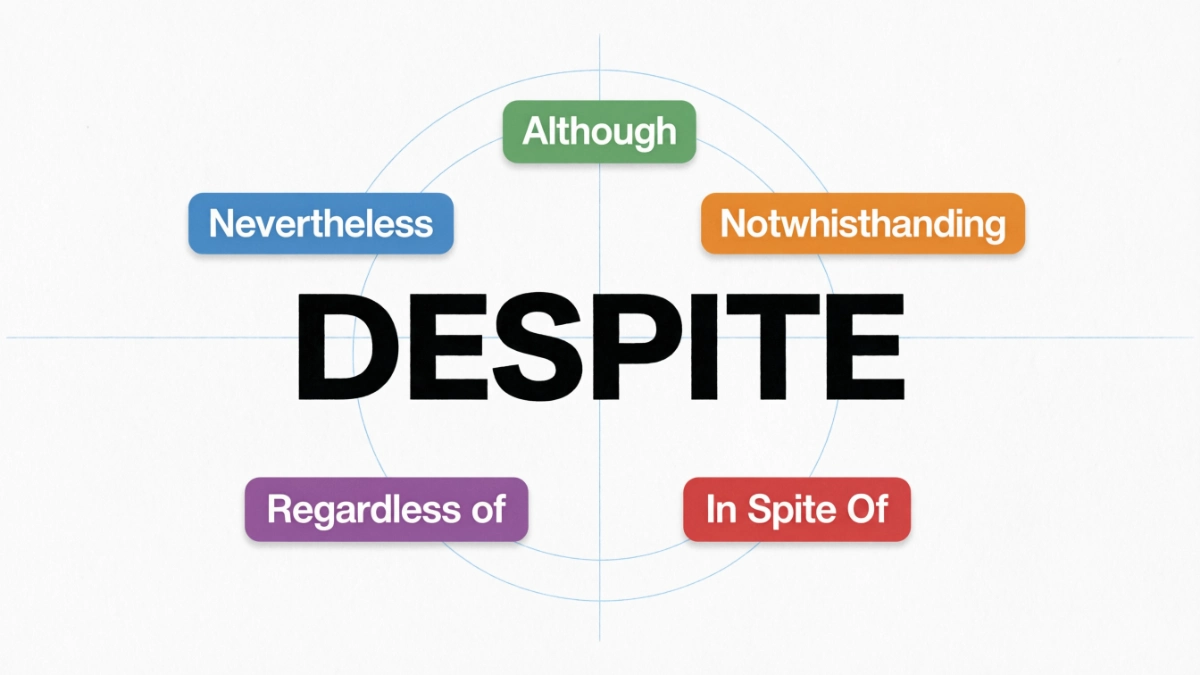
Quick Answer:
Despite is a preposition that means “even though something exists or happened, the result was not affected by it.” It shows contrast something happened even when a difficulty, obstacle, or opposing condition was present. You always use despite before a noun or noun phrase, never directly before a clause with a verb.
You’re writing an essay and you type: “Despite the rain, the match continued.” It sounds clean and confident. But then you need to express the same idea five more times throughout your essay, and suddenly every sentence starts with “despite.” Your teacher circles it in red and writes: “vary your language.”
Or maybe you’re reading a formal report and you see “notwithstanding the challenges” and you wonder whether that means the same thing as despite or something slightly different.
Both situations are incredibly common. Despite is one of those essential contrast words in English that learners use heavily sometimes correctly, sometimes not.
Knowing its best alternatives, when to swap them in, and how each one shifts the tone of your sentence makes your writing noticeably stronger.
Meaning, Tone, and Context
Despite signals contrast and concession. It tells the reader: “Here is an obstacle and here is what happened anyway.” The outcome was not stopped or changed by the difficulty.
Core meaning: In spite of / even with the presence of something
Tone: Neutral to formal. Despite works naturally in academic writing, formal essays, professional reports, journalism, and everyday writing. It rarely appears in casual conversation where people more commonly say “even though” or “but.”
Where it sounds most natural:
- Academic essays and research writing
- News articles and formal reports
- Professional emails and business writing
- Formal spoken presentations
In casual conversation, despite can actually sound slightly stiff. A friend is more likely to say “Even though it was raining, we went out” than “Despite the rain, we went out” though both are grammatically correct.
When and How to Use “Despite”
Despite always comes before a noun, noun phrase, or gerund (a verb ending in ing used as a noun). It does not directly introduce a clause with a subject and a full verb.
Correct: Despite her exhaustion, she finished the report.
Correct: Despite working long hours, he stayed cheerful.
Incorrect: Despite she was tired, she finished the report. ❌
Real life usage:
- Despite the criticism, the director stood by the film.
- She passed the exam despite missing three weeks of class.
- Despite repeated warnings, he ignored the safety rules.
- The project succeeded despite a very limited budget.
When you want to use a full clause (with a subject and verb), switch to despite the fact that or use although / even though instead.
Another Word for Despite
Here are the most natural, commonly used alternatives:
- In spite of almost identical in meaning; the most direct swap
- Although / even though used before a full clause, not a noun
- Nevertheless used at the start of a sentence to introduce contrast
- Regardless of focuses on something being irrelevant to the outcome
- Notwithstanding formal and legal; same meaning as despite
- Yet a simple, conversational contrast word
- However widely used in formal writing for contrast
- Still casual contrast, used mid sentence
- Undeterred by focuses on not being stopped by something
When Not to Use “Despite”
Avoid despite when:
- You need to introduce a full clause with a subject and verb use although or even though instead
- The tone is very casual but, still, or even so sound more natural in conversation
- You’ve already used it multiple times in the same paragraph vary with nevertheless, however, or in spite of
- You want to emphasize surprise or unexpectedness more strongly surprisingly or remarkably add that layer
Also avoid writing “despite of” this is a very common learner error. The correct phrase is simply despite (not despite of) or in spite of (not in spite).
Words Commonly Confused With “Despite”
| Word | How It Differs from “Despite” |
|---|---|
| Although | Used before a full clause (subject + verb); more conversational and flexible |
| However | A linking adverb, not a preposition; usually appears after a semicolon or at sentence start |
| Nevertheless | Stronger contrast; emphasizes unexpected continuation despite opposition |
| Regardless | Focuses on ignoring conditions or factors (“without considering” something) |
| In spite of | Very similar meaning to “despite,” but slightly more conversational |
| Yet | Simpler and more informal; often used for contrast in a single sentence |
| Though | Flexible word; can act as a conjunction or sentence adverb; softer contrast |
Best Synonym by Context (Despite)
| Context | Best Synonym | Why It Fits |
|---|---|---|
| Academic essays | Notwithstanding, in spite of | Formal, precise, and academically appropriate |
| Formal reports | Nevertheless, however | Structured and suitable for analytical writing |
| Business emails | Despite, regardless of | Clear, direct, and professional |
| Casual conversation | Even though, but, still | Natural and commonly used in speech |
| News articles | Despite, yet | Concise, punchy, and journalistic style |
| Creative writing | Though, even so, still | Flexible, expressive, and stylistically smooth |
| Legal writing | Notwithstanding | Standard formal legal connector |
Which Synonym Should You Choose?
Think about two things: what comes after the word and the formality of your writing.
- If a noun or noun phrase follows → use despite, in spite of, regardless of, or notwithstanding
- If a full clause follows → use although, even though, though, or despite the fact that
- If you’re starting a new sentence to show contrast → use nevertheless, however, even so, or yet
- If the writing is formal → choose notwithstanding, nevertheless, or despite
- If the tone is casual → choose still, but, even though, or though
That structure thinking about what follows and the tone you need will guide you correctly almost every time.
Real Life Examples in Sentences
School:
- Despite studying all week, he still found the chemistry test challenging.
- She performed well in the play even though she had stage fright.
Workplace:
- The team delivered the project on time, regardless of the technical setbacks.
- Notwithstanding the budget cuts, the department exceeded its targets.
Writing:
- The city thrived nevertheless, finding resilience in every hardship it faced.
- He smiled through the pain, undeterred by the setbacks that kept coming.
Conversation:
- “Even so, I think we should give it another try.”
- “I know it’s risky but we went ahead with it anyway.”
50 Synonyms for “Despite”
| Synonym | Simple Meaning | Example Sentence |
|---|---|---|
| In spite of | Even with the presence of something | In spite of the noise, she slept soundly. |
| Although | Even though (introduces a clause) | Although it rained, the event continued. |
| Even though | Strong contrast before a clause | Even though he was tired, he kept going. |
| Nevertheless | Despite what was just said | The task was hard; nevertheless, they finished. |
| Nonetheless | Formal “nevertheless” | She was nervous; nonetheless, she spoke clearly. |
| However | Shows contrast or opposition | The plan had flaws; however, it worked well. |
| Yet | But still; surprising contrast | He failed twice, yet he tried again. |
| Still | Even so; continuing despite difficulty | It was cold. Still, they went for a walk. |
| Though | Soft contrast (formal or casual) | Though it was late, they kept talking. |
| Even so | Despite that | The odds were low. Even so, she applied. |
| Notwithstanding | Very formal “despite” | Notwithstanding the challenges, success followed. |
| In the face of | While dealing with difficulty | She stayed calm in the face of pressure. |
| For all | Despite everything | For all his talent, he stayed humble. |
| All the same | Even so | It was risky. All the same, they agreed. |
| Even with | Despite having something present | Even with extra support, the project struggled. |
| Undeterred by | Not discouraged by | Undeterred by failure, she launched again. |
| Against | In opposition to / despite | Against all predictions, the team won. |
| Contrary to | Opposite of expectations | Contrary to expectations, the film was a hit. |
| Irrespective of | Without considering | Irrespective of age, everyone participated. |
| Albeit | Although (formal/literary) | It was a small victory, albeit an important one. |
| Granted | Accepting one fact but contrasting | Granted, it was expensive, but it worked. |
| Admittedly | Accepting before contrast | Admittedly, the plan was risky, but it worked. |
| Be that as it may | Even if true | Be that as it may, we still need a solution. |
| At any rate | Whatever happens | At any rate, the decision has been made. |
| In any case | Whatever the situation | In any case, we should prepare. |
| Whatever | No matter what | Whatever the outcome, they gave their best. |
| No matter | Regardless of | No matter the difficulty, she kept going. |
| After all | Considering everything | After all the obstacles, they succeeded. |
| Regardless | Without being affected | She went ahead regardless. |
| Setting aside | Ignoring for the moment | Setting aside the costs, the idea works. |
| Leaving aside | Not considering something | Leaving aside the risks, the benefits are clear. |
| Without regard to | Not considering something | Without regard to difficulty, she pushed forward. |
| Not deterred by | Not stopped by | Not deterred by critics, he finished the novel. |
| Unfazed by | Not disturbed by | Unfazed by pressure, she performed brilliantly. |
| In defiance of | Openly against | In defiance of the odds, they won. |
| Against the odds | Despite low probability | Against the odds, the startup succeeded. |
| Brushing aside | Ignoring deliberately | Brushing aside concerns, she moved forward. |
| But | Simple contrast | It was hard, but we managed. |
| And yet | Surprising contrast | It made no sense, and yet it worked. |
| Even if | Whether or not something is true | Even if it fails, we will learn. |
| While | Although (contrast sense) | While the budget was small, results were strong. |
| Whereas | Direct contrast | Whereas others gave up, she persisted. |
| On the other hand | Opposing viewpoint | It was expensive; on the other hand, effective. |
| Only | But (limiting contrast, informal) | The plan was perfect, only it came too late. |
| Except that | But for one fact | Everything went well, except that funding fell short. |
| Meanwhile | At the same time in contrast | The team struggled; meanwhile, she thrived. |
Synonym Groups and Usage Differences
Formal and Academic Synonyms
Notwithstanding, nevertheless, nonetheless, albeit, irrespective of, contrary to
These belong in essays, reports, legal documents, and academic writing. They signal sophistication and precision. Albeit and notwithstanding especially appear in formal and literary contexts.
Professional and Business Synonyms
Regardless of, however, in spite of, despite, notwithstanding
These work well in formal emails, business reports, and professional presentations. They keep the tone efficient and respectful.
Conversational and Informal Synonyms
But, still, even so, though, yet, all the same, anyway
These sound natural in everyday conversation and informal writing. They create contrast without sounding stiff or overly polished.
Strongest Contrast Words
Strongest: notwithstanding, in defiance of, against all odds, undeterred by
These emphasize that the obstacle was significant and the outcome was remarkable. Use them when the contrast deserves real weight.
More general: but, still, though, even so
These signal contrast softly and naturally. Choose them when the contrast is real but not dramatically unexpected.
Old Fashioned vs. Modern
Old fashioned or literary: albeit, be that as it may, for all, notwithstanding
Modern and current: regardless, even so, still, even though, however
Antonyms of “Despite”
| Antonym | Meaning | Example Sentence |
|---|---|---|
| Because of | As a result of something | Because of her training, she won easily. |
| Thanks to | Due to something (often positive) | Thanks to the team’s effort, the launch succeeded. |
| Due to | Caused by / resulting from | Due to the rain, the game was cancelled. |
| As a result of | Following and caused by something | As a result of their planning, everything ran smoothly. |
| Owing to | Because of (formal) | Owing to the delay, the meeting was rescheduled. |
| On account of | Because of something | On account of the weather, flights were grounded. |
| In light of | Considering new information | In light of new evidence, the verdict changed. |
| By virtue of | Because of a particular quality or fact | By virtue of her experience, she was promoted. |
| As a consequence of | Resulting from something | As a consequence of poor management, profits fell. |
| Because that | Formal/archaic causal form | Because that he was late, he missed the meeting. |
Comparison Section
Despite vs. In spite of
These two are nearly interchangeable. Both need a noun or noun phrase after them. In spite of feels very slightly more conversational to many native speakers, but the difference is minimal. Both are safe in formal and informal writing.
- Despite the storm, they sailed. = In spite of the storm, they sailed.
Despite vs. Although / Even though
This is the most important distinction for learners. Despite takes a noun. Although and even though take a full clause with a subject and verb.
- Correct: Despite his age, he ran fast.
- Correct: Although he was old, he ran fast.
- Incorrect: Despite he was old, he ran fast. ❌
Despite vs. Nevertheless / However
Nevertheless and however connect two separate sentences or clauses. You can’t use them before a noun phrase the way you use despite.
- The rain was heavy. Nevertheless, the match continued.
- Despite the rain, the match continued.
Despite vs. Regardless of
Regardless of suggests something was consciously dismissed or set aside. Despite simply shows contrast. “She went out regardless of the rain” implies she made a deliberate choice to ignore the rain. “She went out despite the rain” simply notes that rain didn’t stop her.
Despite vs. Whereas
Whereas shows a direct comparison between two different things or people. Despite shows contrast within one situation.
- Whereas he stayed inside, she went out in the rain.
- Despite the rain, she went out.
Common Phrases and Expressions
1. “Despite everything”
Even with all the difficulties that existed.
“Despite everything that went wrong, the event was a success.”
2. “Despite the odds”
Even when the probability of success was low.
“Despite the odds, the small team built a globally recognized product.”
3. “Despite best efforts”
Even with maximum effort applied.
“Despite their best efforts, the negotiations broke down.”
4. “In spite of everything”
A direct equivalent of “despite everything,” slightly more conversational.
“In spite of everything, she never lost her sense of humor.”
5. “Despite the fact that”
Used when you need to introduce a full clause after despite.
“Despite the fact that funding was cut, the project moved forward.”
6. “Against all odds”
When success happens even though probability strongly suggested failure.
“Against all odds, the patient made a full recovery.”
7. “Notwithstanding the above”
Formal phrase used in documents to mean “even considering what was said above.”
“Notwithstanding the above, the contract remains valid.”
Common Mistakes to Avoid
Writing “despite of”
This is the most frequent learner error. Despite of is always wrong. Use despite alone or in spite of.
Wrong: Despite of the challenges…
Correct: Despite the challenges… or In spite of the challenges…
Using despite before a full verb clause
Despite needs a noun or gerund not a subject verb clause.
Wrong: Despite she tried hard…
Correct: Despite trying hard… or Although she tried hard…
Confusing nevertheless with despite
Nevertheless connects two separate sentences. Despite opens a phrase within one sentence. Mixing their positions creates grammatical errors.
Overusing despite in formal writing
Repeating any one contrast word weakens your writing. Rotate confidently between although, however, in spite of, regardless of, and nevertheless.
Using notwithstanding in casual conversation
Notwithstanding sounds out of place in everyday speech. It belongs in legal, academic, or very formal written contexts only.
FAQs
What is the difference between despite and although?
Despite is a preposition it needs a noun or noun phrase after it. Although is a conjunction it introduces a full clause with a subject and verb. They express the same contrast but work differently grammatically. When in doubt, check what comes after the word.
Can I use “despite” and “in spite of” interchangeably?
Yes, almost always. They mean the same thing and follow the same grammatical rules. In spite of may feel very slightly more conversational, but both work in formal and informal writing without any meaningful difference.
Is “despite of” correct?
No never. Despite of is a common learner error. The correct forms are despite (alone) or in spite of. There is no “despite of” in standard English.
What’s a more formal word for despite?
Notwithstanding is the most formal alternative, widely used in legal documents and academic writing. Nevertheless and albeit also carry a formal, sophisticated tone.
Can despite start a sentence?
Absolutely. Starting a sentence with despite is grammatically correct and very common in formal writing.
“Despite repeated attempts, no agreement was reached.”
Conclusion
Despite is a small word that carries real grammatical power and once you understand exactly how it works, using it (and its alternatives) becomes second nature. The key takeaways are simple: always follow despite with a noun or noun phrase, never use “despite of,” and vary your contrast language by reaching for nevertheless, although, regardless of, or notwithstanding when the context calls for it.
Try picking two or three synonyms from this article and actively using them in your next writing task. Notice how albeit adds a formal touch, how yet creates a punchy contrast, and how even so feels warm and conversational. That active experimentation is what turns a vocabulary list into real language skill.
The more you practice, the more natural these words will feel and the more confident your writing will become.

Hi, I’m Camron White, a word lover who enjoys exploring the beauty of the English language. I write about synonyms, meanings, and everyday vocabulary to help readers express themselves more clearly and confidently. My goal is to make learning new words simple, fun, and useful in real-life conversations. synonympilot.com