You’re at your best friend’s going away party. You’re happy for her that she landed her dream job in another city but the thought of not seeing her every week makes your chest ache.
You want to describe the feeling in your journal later, but “bittersweet” feels too small for it. Or maybe you’ve already used it and need a fresh word that captures the same emotional complexity.
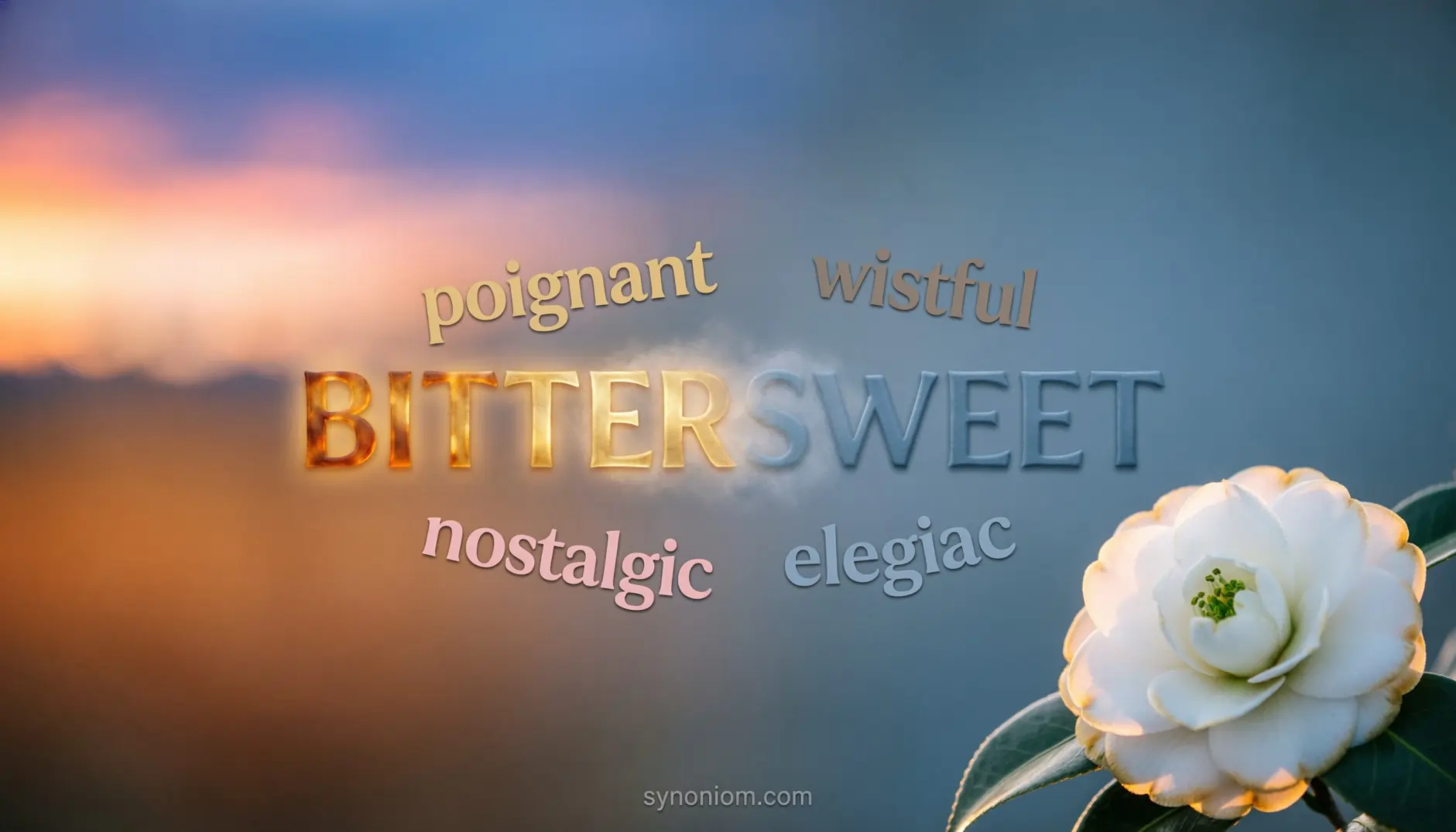
That’s the particular challenge of “bittersweet.” It describes one of the most human emotional experiences: feeling two things at once, joy and sadness braided together and yet there’s only one widely known word for it in everyday English.
The good news is that the language has more options than most people realize, from the literary and poetic to the psychological and conversational.
This guide covers 50 real synonyms, explains when and how to use each one, and helps you understand the fine emotional distinctions between them.
What Does “Bittersweet” Mean? (Featured Snippet Definition)
“Bittersweet” describes an experience, feeling, or moment that contains both happiness and sadness at the same time. It’s the emotional complexity of something that brings joy but also carries a sense of loss, longing, or pain. The word is most often used to describe endings, transitions, nostalgia, and situations where good and difficult feelings are genuinely inseparable.
Meaning, Tone, and Context
At its core, “bittersweet” names a mixed emotional state not sadness with a silver lining, and not happiness despite difficulty, but both feelings existing simultaneously and inseparably. The joy makes the sadness more acute, and the sadness makes the joy more tender.
In terms of tone, “bittersweet” sits in literary, emotional, and reflective registers. It’s not clinical or formal you wouldn’t use it in a business report. But it’s not exactly casual slang either. It occupies a warm, thoughtful middle ground that works well in:
- Personal essays and memoirs (“Graduation day felt bittersweet”)
- Fiction and poetry (“The reunion had a bittersweet quality neither of them expected”)
- Everyday emotional conversation (“It was a bittersweet goodbye”)
- Song lyrics, film descriptions, and cultural criticism
The word carries a gentle, somewhat melancholic weight. It acknowledges complexity without dramatizing it. That’s what makes it so versatile in emotional writing.
When and How to Use “Bittersweet”
“Bittersweet” works naturally when describing:
- Endings that are also beginnings graduation, retirement, a last day at a job you loved
- Reunions or partings with people you care about
- Nostalgia looking back at a happy time that can’t return
- Achievements that come with personal cost or sacrifice
- Moments where success and loss coincide (“She won the award the year her mentor passed away it felt bittersweet”)
- Films, books, or music that leave you feeling both moved and sad
One common usage note: “bittersweet” is usually used for experiences that genuinely contain both emotions not just something that is sad with a hopeful outcome, or happy with minor regrets. The emotional balance matters.
50 Synonyms for “Bittersweet”
| Synonym | Simple Meaning | Example Sentence |
|---|---|---|
| Poignant | deeply emotional, sad + warm | The ending was poignant. |
| Nostalgic | happy memories mixed with sadness | She felt nostalgic looking at photos. |
| Wistful | gently longing, slightly sad | He gave a wistful smile. |
| Melancholic | deeply reflective sadness | The music had a melancholic tone. |
| Touching | emotionally moving | The speech was touching. |
| Moving | strongly emotional | The film was very moving. |
| Tender | gentle emotional warmth + sadness | It was a tender memory. |
| Heartrending | emotionally painful | The story was heartrending. |
| Sentimental | emotional due to memories | He became sentimental. |
| Elegiac | mourning with beauty | The poem had an elegiac tone. |
| Rueful | regretful with slight humor | She gave a rueful laugh. |
| Valedictory | farewell with mixed emotion | The speech felt valedictory. |
| Ambivalent | mixed feelings | He felt ambivalent about leaving. |
| Mixed | both good and bad feelings | Her feelings were mixed. |
| Complex | emotionally layered | The relationship was complex. |
| Conflicted | torn emotions | She felt conflicted. |
| Emotional | strong mixed feelings | It was an emotional reunion. |
| Affecting | deeply emotional | The story was affecting. |
| Plaintive | gently sad | The song was plaintive. |
| Lachrymose | tearful sadness | The ending was lachrymose. |
| Tinged with sadness | slightly sad feeling | The joy was tinged with sadness. |
| Haunting | beautiful but disturbing | The memory was haunting. |
| Evocative | brings memories/emotions | The music was evocative. |
| Resonant | emotionally meaningful | His words were resonant. |
| Sorrowful | sad with depth | The farewell was sorrowful. |
| Heartfelt | deeply sincere emotion | The note was heartfelt. |
| Aching | deep emotional pain | There was an aching feeling. |
| Longing | desire for what’s gone | The story showed longing. |
| Yearning | deep emotional desire | She felt yearning. |
| Pensive | quietly thoughtful + sad | He looked pensive. |
| Reflective | thoughtful emotion | She was reflective. |
| Regretful | sadness about the past | He felt regretful. |
| Subdued | quiet mixed emotion | The mood was subdued. |
| Torn | emotionally divided | She felt torn. |
| Ambiguous | unclear emotional meaning | The ending was ambiguous. |
| Dual | two emotional layers | It had a dual feeling. |
| Mixed feelings | opposing emotions | She had mixed feelings. |
| Half happy | partly happy, partly sad | He felt half happy. |
| Sad but beautiful | painful yet lovely | It was sad but beautiful. |
| Resigned | accepting sadness | He was resigned. |
| Contemplative | deep thoughtful mood | She was contemplative. |
| Graceful sadness | dignified sorrow | It showed graceful sadness. |
| Autumnal | reflective, fading feeling | The scene felt autumnal. |
| Subdued joy | soft happiness + sadness | There was subdued joy. |
| Elegiac tenderness | mournful love | He spoke with elegiac tenderness. |
| Sorrow edged | slightly sad tone | The moment was sorrow edged. |
| Beautifully sad | painful but lovely | The film was beautifully sad. |
| Cathartic | emotional release | The movie was cathartic. |
Important Synonym Groups
Formal / Literary Synonyms
Best for essays, literary analysis, formal speeches, or published writing:
- Elegiac, Poignant, Valedictory, Plaintive, Lachrymose, Rueful, Elegiac tenderness
These carry serious literary weight. “The novel closes on an elegiac note of beauty and loss” works far better in criticism or an essay than “it was bittersweet.”
Informal / Conversational Synonyms
Natural in everyday speech, personal messages, or casual storytelling:
- Mixed feelings, Torn, Half happy, Sad but beautiful, Sentimental
“I have really mixed feelings about the whole thing” is what most people say in real life when they mean bittersweet.
Academic Synonyms
Precise and analytical, preferred in psychology, cultural studies, or research:
- Ambivalent, Conflicted, Dual, Complex, Resonant, Evocative
“The participants reported ambivalent emotional responses to the event” fits naturally in academic writing.
Professional / Workplace Context
Useful in speeches, tributes, farewell messages, or evaluations:
- Touching, Moving, Heartfelt, Reflective, Subdued, Regretful, Valedictory
These describe emotion in professional settings where “bittersweet” might feel too personal.
Emotional / Expressive Synonyms
When you want to convey depth of feeling in creative or personal writing:
- Poignant, Wistful, Aching, Haunting, Longing, Yearning, Heartrending, Tender
Each of these names a specific shade of the bittersweet emotional palette. “Haunting” lingers; “wistful” reaches; “aching” hurts quietly.
Conversational Synonyms
What people naturally say in everyday situations:
- Mixed feelings, Sentimental, Emotional, Sad but beautiful, Torn, Conflicted
Antonyms of “Bittersweet”
| Antonym | Meaning | Example Sentence |
|---|---|---|
| Purely joyful | completely happy, no sadness | The party was purely joyful. |
| Carefree | without worry or emotional weight | Those days were carefree. |
| Straightforwardly happy | simple, no mixed emotions | The win felt straightforwardly happy. |
| Blissful | perfectly happy | The honeymoon was blissful. |
| Elated | extremely happy and excited | She was elated by the results. |
| Lighthearted | cheerful and emotionally light | The movie was lighthearted. |
| Uncomplicated | simple and emotionally clear | Their friendship was uncomplicated. |
| Purely painful | only sadness, no joy | The loss was purely painful. |
| Straightforwardly sad | simple sadness, no mixed feeling | The news was straightforwardly sad. |
Comparison: “Bittersweet” vs. Similar Words
Bittersweet vs. Poignant
“Poignant” describes something that causes a sharp, tender emotional response it evokes a sting of feeling, usually beauty mixed with sadness. “Bittersweet” is broader and more everyday; “poignant” is more literary and intense. A poignant moment cuts through you. A bittersweet one wraps around you. “The final goodbye was poignant” carries more literary weight than “it was bittersweet.”
Bittersweet vs. Nostalgic
Nostalgia is specifically about longing for the past it’s directional, always looking backward. “Bittersweet” can apply to present moments, future anticipations, and past memories. All nostalgia has a bittersweet quality, but not all bittersweet feelings are nostalgic. Graduating is bittersweet in the present moment, not just in memory.
Bittersweet vs. Wistful
“Wistful” describes a gentle, slightly sad longing usually for something you know you can’t have or return to. It’s quieter and more passive than “bittersweet.” A wistful person looks out the window and sighs. A bittersweet moment is more active it involves something actually happening that is simultaneously good and sad.
Bittersweet vs. Ambivalent
“Ambivalent” is more psychological and analytical it describes holding two opposing attitudes, often uncertainty or conflicting motivations. “Bittersweet” is more purely emotional and poetic. You might feel ambivalent about a career decision (unsure which way to lean); the last day at a job you loved is bittersweet (you feel both the joy and the loss clearly).
Bittersweet vs. Melancholic
“Melancholic” describes a pervading, deep sadness with a reflective quality it’s predominantly sad, with beauty at the edges. “Bittersweet” is more balanced: the joy is genuinely present, not just a backdrop. A melancholic person is mostly sad. A bittersweet moment holds both emotions with roughly equal weight.
Common Phrases and Expressions
“A bittersweet ending”
The most common phrase used for films, books, relationships, or life events that close on mixed emotional terms. Example: “The series finale offered a bittersweet ending that felt true to life.”
“Tinged with sadness”
Describes happiness or joy that carries a faint shadow of grief or longing. Example: “The celebration was tinged with sadness as everyone thought of those who couldn’t be there.”
“Mixed feelings”
The most natural conversational way to describe bittersweet emotional states. Example: “I have genuinely mixed feelings about leaving I’m ready, but I’ll miss everyone.”
“Joy and sorrow in equal measure”
A more poetic expression for balanced emotional complexity. Example: “That final chapter delivers joy and sorrow in equal measure.”
“The sweet and the bitter”
Reversing the compound for literary emphasis, highlighting both elements separately. Example: “Life has a way of giving you the sweet and the bitter at the same time.”
“Laughing through tears”
A physical expression of bittersweet emotion feeling joy and grief simultaneously. Example: “At the retirement party, she found herself laughing through tears more than once.”
Common Mistakes to Avoid
Using “sad” when you mean “bittersweet”
“Sad” describes only one emotional dimension. “Bittersweet” requires both happiness and sadness to be genuinely present. If there’s no joy in it, it’s just sad and that distinction matters in emotional writing.
Treating “nostalgic” and “bittersweet” as identical
Nostalgia always looks backward; bittersweet can describe present or future moments. A graduation is bittersweet as it happens. A memory of graduation may later become nostalgic. The difference is in the time orientation.
Using “ambivalent” in an emotional context when “conflicted” is clearer
“Ambivalent” works better in psychological or analytical writing. In personal, emotional contexts, “conflicted” or “torn” usually sound more natural and human.
Applying “melancholic” when the joy is equally present
“Melancholic” leans toward sadness. If the positive feeling is just as strong as the sad one, “melancholic” undersells the joy. Reserve it for situations where grief genuinely dominates but has a reflective beauty.
Overusing “poignant” informally
“Poignant” is a strong literary word. Using it too casually can sound forced. Save it for genuinely moving, cutting emotional moments rather than mild mixed feelings.
FAQs
What’s the single best synonym for “bittersweet” in everyday conversation?
“Mixed feelings” is the most natural and widely understood alternative in spoken English. It’s simple, honest, and immediately clear. “Torn” and “conflicted” are also strong conversational options when the two emotions are pulling against each other.
Is there a single word in English that means exactly the same as “bittersweet”?
“Poignant” comes closest in emotional depth, though it leans more toward the sad side. “Ambivalent” covers the duality but is more cognitive than emotional. Many languages actually have single words for this state that English lacks Japanese “mono no aware” and Portuguese “saudade” describe related but distinct emotional shades. It’s worth exploring if you’re interested in emotion vocabulary across cultures.
Can “bittersweet” describe a person, or just a feeling or moment?
It most naturally describes feelings, moments, experiences, or creative works (“a bittersweet film,” “a bittersweet memory”). Using it to describe a person directly (“she is bittersweet”) is unusual and would need clear context. It’s primarily experiential, not a personality trait.
What’s the difference between “wistful” and “nostalgic”?
Nostalgia is specifically about longing for the past. Wistfulness is a broader gentle sadness or longing it doesn’t have to be about the past specifically. You can feel wistful about something you never had, something you might lose, or something just out of reach.
Is “elegiac” a good formal synonym for “bittersweet”?
Yes for literary or formal writing, “elegiac” is excellent. It describes a beautiful, mournful quality associated with loss and endings. It carries more gravity than “bittersweet” and works well in book reviews, eulogies, cultural essays, and poetry criticism. Just be aware it leans more toward the sorrowful end than toward balanced joy and sadness.
Conclusion
“Bittersweet” captures one of the most distinctly human emotional experiences the strange, beautiful fact that happiness and sadness can exist inside the same moment. Learning its synonyms doesn’t just expand your vocabulary; it helps you feel and express those mixed emotional states with much more precision and color.
If you reach for “poignant” in a literary essay, “wistful” in a personal letter, “mixed feelings” in everyday conversation, or “elegiac” in a cultural review, you’re choosing a word that fits the exact emotional truth of the moment. That’s what good vocabulary does it closes the gap between what you feel and what you can say.
Try working one or two of these words into your writing or conversation this week. The more you use them in real contexts, the more naturally they’ll come to you when you need them most.

Hi, I’m Camron White, a word lover who enjoys exploring the beauty of the English language. I write about synonyms, meanings, and everyday vocabulary to help readers express themselves more clearly and confidently. My goal is to make learning new words simple, fun, and useful in real-life conversations. synonympilot.com