Quick Answer: Hubris means extreme pride or dangerous overconfidence, the kind that makes someone believe they are above rules, consequences, or other people. It often leads to a serious downfall. Originally a Greek word, hubris is commonly used in literature, history, politics, and everyday conversation to describe arrogance taken too far.
Imagine a talented young executive who keeps dismissing advice from experienced colleagues. He tells his team, “I don’t need a second opinion, I know exactly what I’m doing.” Six months later, his project collapsed spectacularly. Everyone around him had seen it coming.
That attitude has a name: hubris. You’ve probably encountered this word in a history class, a novel, or a political discussion. But when you want to express the same idea in a different way, maybe in an essay, a speech, or a casual conversation, what word do you reach for? That’s exactly what this article covers.
By the end, you’ll have a strong set of alternatives to hubris, each with clear meanings, examples, and practical usage guidance.
Meaning, Tone, and Context
At its core, hubris describes excessive pride combined with a dangerous lack of self awareness. It’s not just confidence, it’s confidence that crosses into contempt for others and blindness to one’s own limits.
The tone of hubris is formal and literary. You’re more likely to find it in written essays, academic analysis, political commentary, or classical literature than in everyday small talk. In conversation, people tend to say “arrogance” or “ego” instead.
Hubris carries a strong negative charge. It almost always implies that a fall is coming. In Greek tragedy, hubris was specifically the fatal flaw that brought down heroes. That dramatic, consequence driven quality still follows the word today.
It sounds most natural in written English, professional critiques, literary discussions, and formal speeches.
When and How to Use Hubris
Use hubris when you want to highlight not just someone’s arrogance, but their reckless disregard for limits and the consequences that follow.
- A tech CEO who ignores safety warnings because he believes his product is perfect shows hubris.
- A general who attacks without sufficient troops because he underestimates the enemy shows hubris.
- A student who skips studying because she assumes she’ll pass easily shows a mild form of hubris.
It fits naturally in academic writing, literary criticism, political commentary, and formal essays. In everyday speech, it can sound slightly stiff, so “arrogance” or “overconfidence” often flows better in casual settings.
Another Word for Hubris
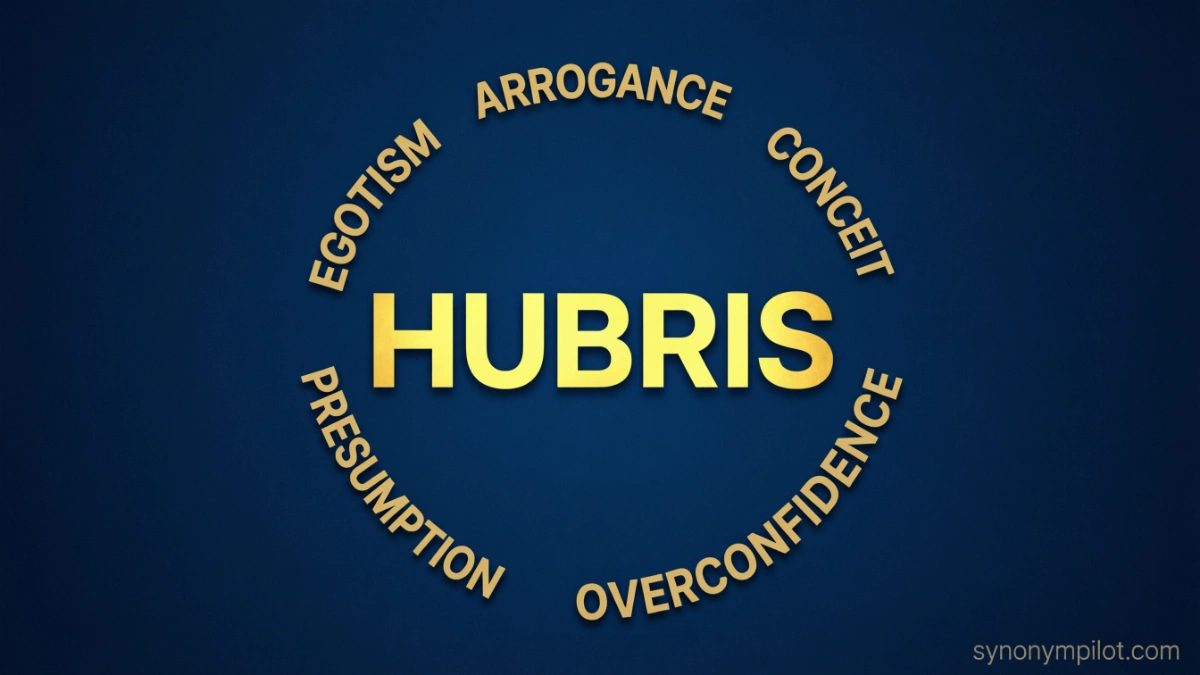
The most natural and commonly used alternatives to hubris include: arrogance, pride, overconfidence, conceit, presumption, audacity, vanity, self importance, pomposity, and egotism. Each carries a slightly different shade of meaning, which the sections below will walk you through clearly.
When Not to Use This Word
Avoid hubris when you simply mean someone is confident or proud in a healthy way. Not all pride is hubris. A parent who is proud of their child’s achievement, or an athlete who is confident before a big match, does not display hubris. The word specifically implies dangerous excess and blindness to consequences. Using it too loosely weakens its impact.
Also avoid it in casual conversation unless your audience is comfortable with formal or literary vocabulary. In everyday talk, it can come across as pretentious which would be a bit ironic.
Words Commonly Confused with Hubris
Hubris vs. Pride:
Pride is often positive. Hubris is pride that has gone too far and become destructive.
Hubris vs. Arrogance:
Arrogance is the closest everyday synonym. However, hubris specifically implies a fall or punishment waiting to happen, while arrogance doesn’t always carry that weight.
Hubris vs. Confidence:
Confidence is healthy self assurance based in reality. Hubris ignores reality entirely.
Hubris vs. Vanity:
Vanity focuses on appearance and self admiration. Hubris is about power, status, and contempt for limits.
Best Synonym by Context
| Context | Best Synonym | Why It Fits |
|---|---|---|
| Academic essay | Arrogance / Presumption | Formal, precise, and widely understood |
| Literary analysis | Hubris / Overweening pride | Classical and suited to literary discussion |
| Workplace situation | Overconfidence / Egotism | Professional and relatable |
| Casual conversation | Ego / Big-headedness | Natural, everyday language |
| Political commentary | Arrogance / Audacity | Strong and commonly used in media |
| Historical writing | Hubris / Presumption | Appropriate for a formal historical tone |
Which Synonym Should You Choose?
Choose arrogance when you need a word that almost anyone will understand immediately. Choose presumption when you want to emphasize that someone assumed too much without justification. Choose overconfidence when the focus is on misjudging one’s abilities. Choose egotism when the emphasis is on self centeredness. And stick with hubris itself when you want to convey that dramatic, consequence driven quality especially in writing.
Real Life Examples of Hubris in Sentences
School:
The student’s hubris cost him the science competition he assumed he didn’t need to practice and came completely unprepared.
Workplace:
Her hubris as a new manager led her to reject every suggestion from the experienced team, and the product launch failed badly.
Writing:
The novel’s central theme is the hubris of a king who believed no army could ever defeat him.
Conversation:
“Honestly, his hubris is exhausting. He acts like he invented the entire marketing industry.”
50 Synonyms for Hubris
| Synonym | Simple Meaning | Example Sentence |
|---|---|---|
| Arrogance | Behaving as if you’re better than others | His arrogance made collaboration impossible. |
| Pride | Excessive belief in one’s own superiority | Her misplaced pride stopped her from asking for help. |
| Overconfidence | Too much confidence, beyond what’s realistic | Overconfidence led the team to skip essential testing. |
| Conceit | Inflated self-opinion | His conceit meant he never listened to feedback. |
| Presumption | Assuming too much without basis | It was pure presumption to think she’d win without trying. |
| Egotism | Excessive focus on oneself | His egotism made every meeting about him. |
| Vanity | Excessive admiration of oneself | Her vanity extended beyond looks into her entire personality. |
| Pomposity | Acting more important than you are | The director’s pomposity lost him the respect of his staff. |
| Self-importance | Inflated sense of one’s own significance | His self-importance was obvious from the moment he walked in. |
| Audacity | Bold disregard for limits or others’ feelings | The audacity of dismissing the expert’s advice was stunning. |
| Imperiousness | Acting like royalty, expecting obedience | Her imperiousness alienated every junior employee. |
| Brazenness | Shockingly bold disrespect for norms | The brazenness of his claims left the panel speechless. |
| Bluster | Loud, empty confidence | Behind all the bluster, he had no real plan. |
| Swagger | Overconfident, showy behavior | His swagger before the match turned to silence after the loss. |
| Insolence | Rude disrespect born from arrogance | The intern’s insolence toward senior staff was unexpected. |
| Haughtiness | Cold, superior attitude | Her haughtiness made newcomers feel immediately unwelcome. |
| Disdain | Looking down on others with contempt | He treated the feedback with open disdain. |
| Condescension | Acting as if others are inferior | Her condescension during meetings demoralized the team. |
| Superciliousness | Treating others as unworthy of attention | His supercilious manner made every conversation unpleasant. |
| Narcissism | Self-absorption to a harmful degree | The leader’s narcissism blinded him to the damage he was causing. |
| Lordliness | Behaving like a ruler over others | His lordliness in the office bred silent resentment. |
| Pretension | Claiming more importance than reality | The pretension behind her speech was obvious to everyone. |
| Overweening pride | Excessive and presumptuous pride | His overweening pride made failure inevitable. |
| Grandiosity | Exaggerated belief in one’s greatness | His grandiosity led to wildly unrealistic plans. |
| Boastfulness | Excessive talking about achievements | His boastfulness drove away potential allies. |
| Self-aggrandizement | Exaggerating one’s own importance | Her presentation was more self-aggrandizement than substance. |
| Presumptuousness | Acting on unearned authority | His presumptuousness caused conflict. |
| Inflated ego | Overestimating one’s importance | An inflated ego stopped him from seeing mistakes. |
| Superiority complex | Believing one is better than others | His superiority complex made teamwork difficult. |
| Rashness | Acting boldly without caution | His rashness cost the company millions. |
| Recklessness | Taking risks out of arrogance | The pilot’s recklessness endangered everyone. |
| Peremptoriness | Expecting obedience without question | Her peremptory style exhausted staff. |
| Overreaching | Attempting more than one can handle | His overreaching ambition finally caught up with him. |
| Self-conceit | Excessive opinion of oneself | Self-conceit prevented him from improving. |
| Big-headedness | Informal excessive pride | After one win, he became unbearably big-headed. |
| High-handedness | Ignoring others’ rights or opinions | The board’s high-handedness created resentment. |
| Chutzpah | Bold, shameless confidence | It took real chutzpah to challenge the founder. |
| Imperviousness | Refusing advice or criticism | His imperviousness to feedback blocked growth. |
| Overbearing nature | Domineering behavior | Her overbearing nature stifled creativity. |
| Scorn | Open contempt for others | He treated concerns with visible scorn. |
| Domineering attitude | Desire to control everything | His domineering attitude destroyed the partnership. |
| Self-satisfaction | Smug contentment with oneself | His self-satisfaction was baffling after a mediocre performance. |
| Smugness | Irritating superiority | Her smugness won her few friends. |
| Impertinence | Bold rudeness from arrogance | His impertinence during the interview was unforgettable. |
| Ostentation | Showy display to impress others | The ostentation of his lifestyle masked insecurity. |
| Defiance | Refusal to accept limits | Her defiance of safety rules put everyone at risk. |
| Reckless ambition | Dangerous drive without caution | Reckless ambition led him to lie about qualifications. |
| Entitlement | Expecting special treatment | His entitlement made him expect promotions automatically. |
| Willfulness | Stubborn insistence on one’s own way | Her willfulness nearly broke the deal. |
| False confidence | Confidence without real ability | False confidence caused the experiment to fail. |
Synonym Groups and Usage Differences
Formal and Academic Synonyms
Words like presumption, overweening pride, grandiosity, imperiousness, and superciliousness work well in essays, academic papers, and formal critiques. They carry weight and precision. Use them when writing for an educated audience.
Professional and Workplace Synonyms
Overconfidence, egotism, self importance, high handedness, and domineering attitude fit naturally in professional feedback, business writing, and workplace discussions. They’re firm but accessible.
Conversational and Informal Synonyms
Big headedness, swagger, bluster, smugness, and ego are natural in everyday speech. They’re easier to understand and less likely to sound stiff.
Emotional and Intense Synonyms
Disdain, scorn, insolence, and contempt carry a sharp emotional charge. Use these when the attitude in question actively hurts or dismisses others.
Strongest vs. Milder Options
Strongest: arrogance, hubris, narcissism, grandiosity, overweening pride
Milder: self satisfaction, confidence, big headedness, presumptuousness
Modern vs. Old Fashioned
Modern usage favors arrogance, ego, entitlement, and overconfidence. Older or more literary texts lean on hubris, presumptuousness, imperiousness, and lordliness.
Antonyms of Hubris
| Antonym | Meaning | Example |
|---|---|---|
| Humility | Modest, accurate view of oneself | Her humility after winning the award impressed everyone. |
| Modesty | Avoiding boasting about one’s achievements | He accepted the promotion with quiet modesty. |
| Self-awareness | Understanding one’s own strengths and limits | Her self-awareness helped her grow faster than her peers. |
| Deference | Respectful submission to others’ judgment | His deference to the senior team built trust quickly. |
| Meekness | Gentle, non-assertive character | Though often underestimated, his meekness hid remarkable intelligence. |
| Restraint | Holding back from overstepping limits | Her restraint in claiming credit earned deep respect. |
| Open-mindedness | Willingness to hear and consider others | Open-mindedness turned their struggling project into a success. |
Comparison Section
Hubris vs. Arrogance:
Arrogance is the everyday word for acting superior to others. Hubris goes further; it specifically implies crossing a limit that will eventually cause a downfall. All hubris is arrogance, but not all arrogance is hubris.
Hubris vs. Vanity:
Vanity centers on appearance and self admiration. Hubris is about power, status, and defying limits. A vain person obsesses over how they look. A hubristic person believes the rules simply don’t apply to them.
Hubris vs. Audacity:
Audacity can actually be a positive word: bold, daring, admirable. Hubris is almost always negative. Context makes all the difference here.
Hubris vs. Conceit:
Conceit focuses inward an inflated self image. Hubris looks outward contempt for consequences and for others. Conceit is quieter. Hubris tends to be visible and consequential.
Common Phrases and Expressions
“A display of hubris”
Used to describe a moment of overconfident behavior. “His speech was a remarkable display of hubris; he promised results no one could deliver.”
“Hubris and nemesis”
A classical pairing meaning pride followed by punishment. “The story is a perfect example of hubris and nemesis. The higher he rose, the harder he fell.”
“Blind hubris”
Hubris so extreme that the person cannot see reality. “Blind hubris led him to dismiss every warning sign.”
“The hubris of assuming…”
A natural phrase for pointing out reckless assumptions. “The hubris of assuming the market would never shift cost them everything.”
“Sheer arrogance”
A common informal parallel to hubris. “The sheer arrogance of refusing expert advice was breathtaking.”
“Overreaching ambition”
Captures the hubris of wanting more than what is reasonable or safe. “Her overreaching ambition blinded her to serious ethical boundaries.”
Common Mistakes to Avoid
Using hubris to mean ordinary confidence. Confidence is healthy and valuable. Hubris implies a dangerous consequence inviting excess. Don’t confuse them.
Using arrogance and hubris interchangeably in all contexts. In casual writing they’re close enough, but in literary or historical analysis, hubris carries that specific sense of inevitable downfall that arrogance doesn’t always imply.
Confusing vanity with hubris. Vanity is about self image; hubris is about power and defiance of limits. They overlap but are not the same thing.
Treating audacity as always negative. Audacity can be positive, bold, pioneering, admirable. Apply hubris when the behavior is clearly excessive and harmful, not simply daring.
Overusing the word in casual conversation. Hubris sounds formal. Dropping it into everyday small talk can feel forced. In those moments, arrogance, ego, or big headedness land more naturally.
FAQs
What is the simplest synonym for hubris?
Arrogance is the most direct and widely understood synonym. It captures the sense of acting superior to others and fits in both formal writing and everyday conversation.
Is hubris always a negative word?
Yes. Hubris is almost universally negative. It describes pride so excessive that it leads to serious mistakes or a downfall. There is no positive use of hubris in standard English.
Can I use hubris in a casual conversation?
You can, but it may sound slightly formal or literary. In natural conversation, ego, arrogance, or big headedness tend to flow more comfortably.
What is the difference between hubris and overconfidence?
Overconfidence means misjudging your abilities thinking you can do more than you actually can. Hubris goes deeper: it’s about contempt for limits, rules, and other people’s perspectives, often with a sense of inevitable punishment. Overconfidence is a mistake; hubris is a character flaw.
What does “hubris and nemesis” mean?
It’s a classical Greek concept. Hubris is the dangerous pride, and nemesis is the punishment or downfall that follows it. Together they describe the cycle of overreaching and consequences, which appears in Greek tragedy and remains a powerful concept in literature and history today.
Conclusion
Hubris is one of those words that carries centuries of meaning in just two syllables and now you have dozens of strong alternatives to work with.
If you’re writing an essay, giving a speech, analyzing a novel, or simply trying to describe someone’s unearned confidence in conversation, you now have the right word for every context. Start with arrogance and conceit for everyday writing.
Reach for presumption, grandiosity, or overweening pride when the tone calls for something more formal. And keep hubris itself for moments that deserve its full dramatic weight.
The best vocabulary learners don’t just collect words, they use them. Try working two or three of these into your writing this week and notice how much more precise your language becomes.

Hi, I’m Camron White, a word lover who enjoys exploring the beauty of the English language. I write about synonyms, meanings, and everyday vocabulary to help readers express themselves more clearly and confidently. My goal is to make learning new words simple, fun, and useful in real-life conversations. synonympilot.com