Quick Answer
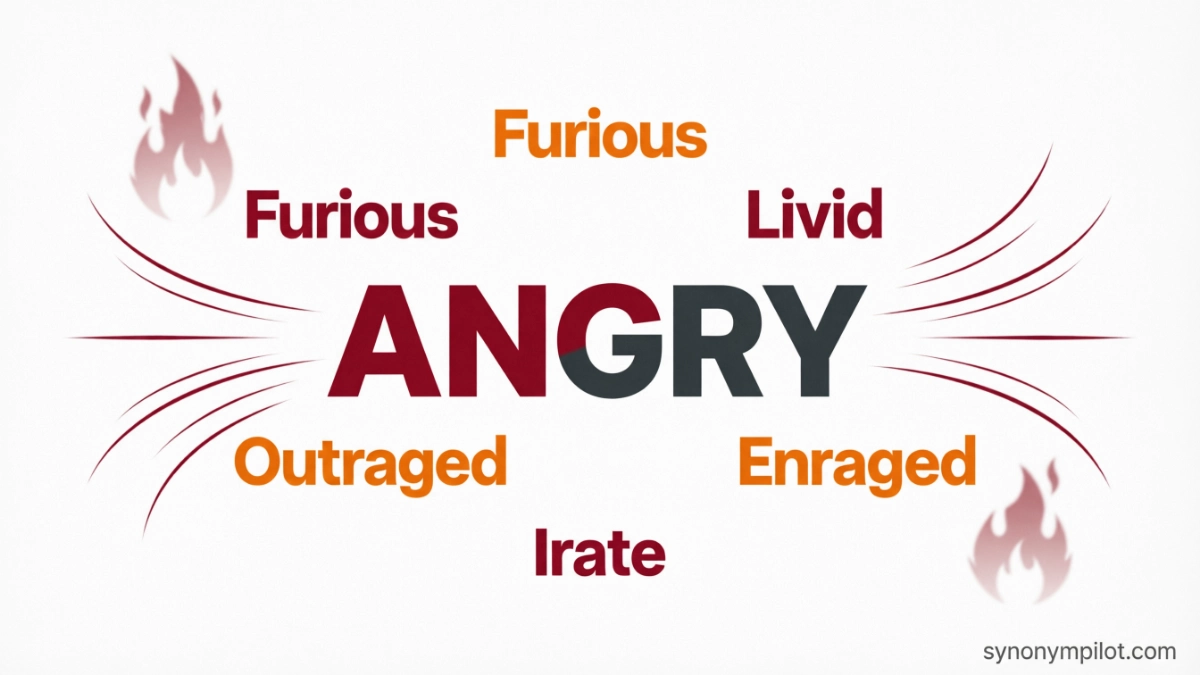
“Angry” describes a strong feeling of displeasure or hostility toward someone or something. It ranges from mild irritation to intense fury depending on how strong the emotion is. You can replace it with words like “furious,” “irritated,” “livid,” or “outraged” based on how intense the feeling is.
Have you ever felt angry but struggled to find the exact word to describe your emotions? The word “angry” is commonly used in everyday English, but it does not always capture the true intensity or type of feeling you want to express.
Sometimes you may be slightly annoyed, deeply resentful, completely furious, or even outraged by a situation. Using the right synonym can make your writing more vivid, your conversations more accurate, and your emotional expression much stronger.
In this guide, you will discover 50 powerful synonyms for angry, along with their meanings, usage differences, and real-life examples.
If you are a student, writer, English learner, or professional, these alternatives will help you expand your vocabulary and communicate your feelings with greater precision and confidence.
What Does “Angry” Really Mean?
Your friend cancels plans at the last minute again. You type your reply and almost write: “I’m so angry right now.” It gets the point across, but it feels flat. Does “angry” really capture that mix of frustration, disappointment, and fire you’re feeling? Probably not.
“Angry” is one of the most common emotion words in English, but it covers a huge emotional range. Being slightly irritated by a slow internet connection and being furious after a serious betrayal are both forms of anger yet they feel completely different. Knowing the right synonym helps you communicate exactly how you feel, If you’re writing a story, sending a message, or simply trying to express yourself more clearly.
Meaning, Tone, and Context of “Angry”
At its core, “angry” means feeling strong displeasure or hostility, often in response to something unfair, hurtful, or frustrating. It is a neutral to emotional word that works in both casual and formal contexts.
The tone shifts based on the synonym you choose. “Annoyed” is mild and everyday. “Furious” is intense and urgent. “Indignant” sounds formal and principled. “Livid” is informal and explosive.
“Angry” sounds most natural in:
- Everyday conversation “She was angry about the delay.”
- Personal writing “I felt angry and unheard.”
- News and reporting “Residents were angry over the decision.”
- Storytelling “His angry tone silenced the room.”
In academic writing, stronger or more precise words like “indignant,” “hostile,” or “resentful” tend to work better than the plain word “angry.”
When and How to Use “Angry”
Use “angry” when you want to clearly state that someone is experiencing displeasure or hostility. It pairs naturally with nouns like person, tone, response, reaction, crowd, and look.
Examples:
- “He gave an angry response to the reporter’s question.”
- “The angry crowd gathered outside the building.”
- “She tried to stay calm, but her angry expression gave her away.”
Because “angry” sits in the middle of the emotion scale, it works well as a general descriptor. However, when you want to show degree how mild or how intense the feeling is you should switch to a more specific synonym.
Another Word for Angry
Here are some of the most useful and natural replacements, depending on what you actually mean:
- Furious intense, burning anger
- Irritated mildly bothered, low level anger
- Livid extremely angry, often visibly so
- Outraged anger combined with a sense of injustice
- Annoyed slightly bothered, not deeply emotional
- Enraged wild, uncontrollable anger
- Resentful long lasting, quiet anger mixed with bitterness
- Irate formal word for strong displeasure
- Infuriated made intensely angry by something
- Exasperated frustrated to the point of losing patience
When Not to Use “Angry”
Avoid “angry” in academic writing when a more precise or formal term fits better. Saying a historical figure was “angry” in an essay sounds too casual “indignant,” “hostile,” or “resentful” will serve you better.
Also avoid it when the emotion is more specific. If someone feels betrayed and bitter over a long period, “angry” doesn’t fully capture that “resentful” or “embittered” does. Similarly, if the anger stems from a sense of moral violation, “outraged” or “indignant” is far more accurate.
In formal complaints or legal writing, “angry” sounds emotional and unprofessional. Replace it with “displeased,” “dissatisfied,” or “deeply concerned” to maintain a professional tone.
Words Commonly Confused With “Angry”
Angry vs. Upset
“Upset” is broader it covers sadness, worry, and distress, not just anger. Someone can be upset without being angry. “Angry” is specifically about displeasure or hostility.
Angry vs. Frustrated
“Frustrated” describes the feeling of being blocked or unable to achieve something. You can feel frustrated without being angry, though the two often appear together.
Angry vs. Annoyed
“Annoyed” is weaker. It describes a mild, surface level irritation something minor bothers you but doesn’t deeply affect you. “Angry” implies more intensity and emotional involvement.
Angry vs. Aggressive
“Angry” is a feeling. “Aggressive” is a behavior. Someone can be angry without acting aggressively, and some people act aggressively without feeling particularly angry.
Best Synonym by Context for “Angry”
| Context | Best Synonym | Why It Works |
|---|---|---|
| Formal writing or reports | Indignant / Irate | Sounds professional and precise |
| Personal emotional expression | Furious / Livid | Captures strong, genuine emotion |
| Mild daily irritation | Annoyed / Irritated | Natural and proportionate |
| Storytelling or fiction | Enraged / Seething | Vivid and dramatic |
| Workplace or professional setting | Displeased / Dissatisfied | Controlled and appropriate |
| Academic essays | Resentful / Hostile | Analytical and objective tone |
| Conversation with friends | Ticked off / Fed up | Casual and relatable |
Which Synonym Should You Choose?
Start by asking: How strong is the anger? Then ask: What caused it?
For mild irritation, go with “annoyed” or “irritated.” For strong, explosive anger, choose “furious,” “livid,” or “enraged.” For anger caused by unfairness or injustice, “outraged” or “indignant” fit perfectly. For a slow, simmering bitterness over time, use “resentful” or “embittered.”
Then consider your audience and tone. A text to a friend and a formal complaint email call for very different vocabulary. Match the word to the intensity of the emotion and the formality of the situation, and you will always choose well.
Real Life Examples of “Angry” and Its Synonyms in Sentences
School
- “The students were outraged when the field trip was cancelled without explanation.”
- “She felt irritated every time the class was interrupted by noise from the hallway.”
Workplace
- “The manager was visibly displeased with the team’s lack of preparation.”
- “He became irate after discovering the error in the final report.”
Writing
- “The character’s resentful silence was more powerful than any outburst could be.”
- “She wrote in her journal about the seething anger she had carried for years.”
Conversation
- “I’m so fed up with being ignored in these meetings.”
- “He was absolutely livid when he found out what had happened.”
0 Synonyms for Angry — Quick Reference
| Synonym | Simple Meaning | Example Sentence |
|---|---|---|
| Furious | Very strongly angry | She was furious when she saw the damage to her car. |
| Irritated | Mildly bothered | He felt irritated by the constant interruptions. |
| Livid | Extremely angry, often visibly | She was absolutely livid when she found out. |
| Outraged | Angry due to injustice | The community was outraged by the unfair decision. |
| Enraged | Wild, uncontrollable anger | The enraged driver got out and started shouting. |
| Irate | Formally or intensely angry | The irate customer demanded to speak to a manager. |
| Annoyed | Slightly bothered | I was annoyed that no one told me about the change. |
| Resentful | Bitter anger from past hurt | She grew resentful after years of being overlooked. |
| Infuriated | Made very angry by something specific | He was infuriated by the constant lies. |
| Exasperated | Frustrated and out of patience | She let out an exasperated sigh and walked away. |
| Incensed | Deeply angered by something offensive | He was incensed by the disrespectful comment. |
| Indignant | Angry at perceived unfairness | She felt indignant after being wrongly accused. |
| Seething | Quietly intense anger held inside | He sat seething while they argued around him. |
| Bitter | Deep, lingering anger with resentment | He was bitter about how the situation was handled. |
| Hostile | Openly unfriendly or aggressive | Her tone was cold and hostile throughout the meeting. |
| Vexed | Annoyed and frustrated | She was vexed by the lack of clear instructions. |
| Displeased | Mildly unsatisfied or unhappy | The teacher was clearly displeased with the results. |
| Aggravated | Increasingly irritated | The noise only aggravated his already bad mood. |
| Choleric | Quick-tempered | His choleric nature made him difficult to work with. |
| Cross | Slightly angry (British English) | She was a bit cross about being kept waiting. |
| Riled | Stirred up and annoyed | His rude comment really riled her up. |
| Steamed | Informally very angry | He was absolutely steamed after the argument. |
| Wrathful | Full of intense anger | The wrathful king ordered the gates closed. |
| Provoked | Made angry by someone’s actions | She felt provoked by his dismissive attitude. |
| Ticked off | Informally annoyed or angry | I was pretty ticked off when they showed up late again. |
| Fed up | Completely out of patience | She was fed up with the same excuses every week. |
| Hot under the collar | Informally angry | He got hot under the collar during the debate. |
| Heated | Emotionally intense | The discussion quickly became heated. |
| Peeved | Slightly irritated | She was peeved that no one had cleaned up. |
| Embittered | Made bitter over time | Years of disappointment had left him embittered. |
| Sullen | Silently angry or resentful | He sat in sullen silence for the rest of the trip. |
| Combative | Ready to argue or fight | Her combative response surprised everyone. |
| Rancorous | Full of deep resentment | The rancorous dispute lasted years. |
| Acrimonious | Bitterly angry in speech or tone | The negotiations became acrimonious. |
| Smoldering | Anger building beneath the surface | There was a smoldering tension between them. |
| Uptight | Tense and easily angered | He becomes uptight when plans change. |
| Stormy | Emotionally volatile | Their relationship was passionate but stormy. |
| Surly | Bad-tempered and rude | The surly receptionist barely looked up. |
| Belligerent | Aggressive and confrontational | The belligerent fan was removed from the stadium. |
| Agitated | Upset and restless | She paced the room, agitated and worried. |
| Ireful | Showing great anger (literary) | The ireful ruler rejected every proposal. |
| Nettled | Irritated by something minor | He was nettled by the constant criticism. |
| Disgruntled | Unhappy and somewhat angry | The disgruntled employees filed complaints. |
| Rankled | Continuing to cause irritation | The unfair remark rankled him for years. |
| Fuming | Visibly very angry | She was fuming when she left the office. |
| Chafed | Irritated and impatient | He chafed at the strict rules. |
| Wrought up | Emotionally upset and tense | She was completely wrought up after the argument. |
| Tempestuous | Intensely emotional and turbulent | Their tempestuous argument shook the room. |
| Flustered | Confused and irritated | He became flustered under pressure. |
| Boiling | Informally extremely angry | By the time she arrived, I was boiling. |
Synonym Groups and Usage Differences
Formal and Professional Synonyms
Words like indignant, irate, displeased, hostile, and acrimonious belong in formal writing, professional emails, academic essays, and reports. They communicate controlled, articulate displeasure without sounding emotional or unprofessional.
Example: “The board was deeply displeased with the audit findings.”
Informal and Conversational Synonyms
Ticked off, fed up, steamed, boiling, and riled are everyday words you hear in casual conversations and text messages. They feel natural, relatable, and immediate without sounding stiff.
Example: “I’m so fed up with this traffic every single morning.”
Strongest Synonyms (High Intensity)
When the anger is extreme, use furious, livid, enraged, incensed, or fuming. These leave no doubt that the feeling is intense. Use them deliberately so they retain their impact.
Example: “She was absolutely livid when she discovered the truth.”
Weaker Synonyms (Low Intensity)
For mild, surface level irritation, annoyed, peeved, vexed, nettled, and cross describe that lower level frustration without overstating it. These are especially useful when you want to be precise about emotional scale.
Example: “He was a little peeved that no one saved him a seat.”
Emotional and Personal Synonyms
Bitter, resentful, embittered, sullen, and smoldering go beyond basic anger. They carry emotional depth hurt, betrayal, and long held pain mixed into the feeling. These work especially well in storytelling and personal writing.
Example: “She had grown bitter after years of broken promises.”
Slang and Very Casual Synonyms
Ticked off, hot under the collar, steamed, boiling, and fed up work in casual speech. Among younger speakers, phrases like “so done with this” or simply “fuming” also carry heavy informal use. Avoid these in any formal or professional writing.
Antonyms of Angry
| Antonym | Simple Meaning | Example Sentence |
|---|---|---|
| Calm | Peaceful and untroubled | She remained calm throughout the disagreement. |
| Content | Satisfied and at ease | He felt content after a quiet evening at home. |
| Pleased | Happy with the outcome | She was pleased with how the event turned out. |
| Serene | Deeply peaceful and undisturbed | The serene atmosphere helped everyone relax. |
| Cheerful | Noticeably happy and positive | He was cheerful and energetic all morning. |
| Composed | In control of emotions | Despite the pressure, she stayed completely composed. |
| Delighted | Very pleased and happy | The children were delighted by the surprise. |
| Pacified | Calmed down after anger | He was finally pacified after the explanation. |
| Easygoing | Relaxed and not easily bothered | Her easygoing personality made her easy to work with. |
| Tranquil | Quiet and free from tension | The tranquil park was a welcome escape from the city. |
Comparison: Angry vs. Closely Related Words
Angry vs. Furious
Both express displeasure, but “furious” is several degrees stronger. “Angry” is a general descriptor while “furious” signals that someone is at the high end of the anger scale and may be struggling to control it.
Angry vs. Irritated
“Irritated” sits well below “angry” on the intensity scale. Being irritated means something minor is bothering you. Being angry implies a deeper emotional reaction to something more significant.
Angry vs. Outraged
“Outraged” is angry with a moral dimension. It suggests that something violated a sense of fairness or decency. You feel outraged by injustice. You feel angry when someone snaps at you.
Angry vs. Resentful
“Angry” is often immediate triggered by something happening right now. “Resentful” builds over time. It is quiet, persistent, and mixed with feelings of being wronged or undervalued.
Angry vs. Hostile
“Hostile” describes a behavioral state as much as an emotional one. Someone hostile is openly unfriendly and may act on their anger. Being angry is an internal emotion; being hostile is showing it outwardly.
Common Phrases and Expressions
“Lose your temper”
To suddenly become very angry and stop controlling your emotions.
“He rarely loses his temper, but today was an exception.”
“Blow off steam”
To release anger or frustration, often through activity or talking.
“She went for a long run to blow off steam after the argument.”
“See red”
To become so angry that you can no longer think clearly.
“When he heard what they said about her, he saw red.”
“At the end of your rope”
To be so frustrated and angry that you cannot tolerate any more.
“After three hours of delays, she was at the end of her rope.”
“Fly off the handle”
To suddenly become very angry without much warning.
“He tends to fly off the handle when things don’t go his way.”
“Hold a grudge”
To stay angry with someone for a long time over something they did.
“She doesn’t hold grudges she forgives and moves on quickly.”
Common Mistakes to Avoid
Overstating the emotion is a very frequent mistake. Using “furious” or “enraged” for mild situations makes your language feel exaggerated and less believable. Match the word to the actual intensity of the feeling.
Confusing “angry” with “upset” catches many learners off guard. “Upset” includes sadness, worry, and distress not just anger. If you specifically mean anger, use “angry” or one of its direct synonyms.
Using informal synonyms in formal writing is a tone error that stands out immediately. Writing “the client was ticked off” in a business report sounds unprofessional. Use “displeased,” “dissatisfied,” or “irate” instead.
Treating “hostile” and “angry” as the same is another subtle but important mistake. “Hostile” describes behavior; “angry” describes emotion. Someone can act hostilely without feeling angry in the moment.
Overusing “angry” itself flattens emotional writing. In a story or personal essay where anger appears repeatedly, varying your vocabulary with words like “seething,” “smoldering,” “fuming,” and “bitter” keeps the writing dynamic and emotionally true.
FAQs
What is the strongest synonym for “angry”?
“Furious,” “livid,” “enraged,” and “incensed” are among the strongest they all describe a very high level of anger, often one that is difficult to control.
What is a more formal word for “angry”?
“Irate,” “indignant,” “displeased,” and “hostile” are all more formal alternatives that work well in professional emails, reports, and academic writing.
What is the difference between “angry” and “frustrated”?
“Frustrated” describes the feeling of being blocked or unable to do something, while “angry” involves displeasure or hostility directed at someone or something. You can feel frustrated without being angry.
Is “livid” stronger than “furious”?
Both describe very intense anger, but “livid” often suggests a visible, physical reaction someone who is livid may be shaking or visibly pale with rage. Many speakers consider it at least as strong as, if not stronger than, “furious.”
Which synonym for “angry” works best in storytelling?
“Seething,” “fuming,” “smoldering,” and “enraged” all paint vivid pictures in fiction. They show the emotion rather than just naming it, which makes your characters feel more real and your scenes more engaging.
Conclusion
Anger is one of the most powerful human emotions, and your vocabulary should be strong enough to express it accurately. If someone is slightly peeved, quietly resentful, or absolutely furious, there is a word that captures it precisely.
The more you expand your vocabulary around emotions, the better you communicate in writing, in conversation, and even in your own thinking.
Start small. Next time you feel “angry,” pause and ask yourself: Is this more like irritated, or more like outraged? That one question will push you toward a more honest and expressive word choice.
Over time, this habit transforms your writing and makes your emotional communication noticeably stronger and more natural. Practice daily, and the right words will come more and more easily.

Hi, I’m Camron White, a word lover who enjoys exploring the beauty of the English language. I write about synonyms, meanings, and everyday vocabulary to help readers express themselves more clearly and confidently. My goal is to make learning new words simple, fun, and useful in real-life conversations. synonympilot.com