Quick Answer: “Diverse” means made up of many different types, backgrounds, or qualities. It describes variety within a group or category people, ideas, cultures, skills, or things. Words like “varied,” “multifaceted,” or “heterogeneous” can replace “diverse” depending on how formal or specific your writing needs to be.
You’re updating your company’s website and you want to describe the team. You type “We are a diverse team” it’s accurate, but it feels a little generic.
So you revise it: “Our team brings a wide range of perspectives, backgrounds, and expertise to every project.” Suddenly the sentence feels more specific, more real, and more convincing.
That’s the difference between using “diverse” as a vague descriptor and actually communicating what makes variety meaningful.This article helps you build exactly that kind of precision.
What Does “Diverse” Mean?
“Diverse” describes a group or collection made up of many different types, qualities, or backgrounds. It emphasizes variety and range if that refers to people (different cultures, identities, experiences), ideas (different viewpoints and approaches), or things (different types, shapes, or styles). It is one of the most commonly used words in professional, academic, and social discussions today.
Meaning, Tone, and Context
At its core, “diverse” signals variety within a group, often highlighting that the differences are meaningful or valuable. The tone of “diverse” is generally neutral to positive. In professional and academic writing, it often carries a sense of richness suggesting that the variety adds strength, depth, or value.
“Diverse” sounds most natural in professional settings (“a diverse workforce”), academic writing (“the study included a diverse sample”), social and cultural conversations (“the city has a diverse population”), and business communication (“we offer a diverse range of services”). It can also appear in casual speech, though in very informal contexts, “all kinds of” or “a mix of” often sounds more natural.
Because “diverse” has become so frequently used in professional and corporate writing, it sometimes risks feeling like a buzzword meaningful in theory but vague in practice. A more specific synonym often communicates exactly what type of variety you mean.
When and How to Use “Diverse”
Use “diverse” when you want to highlight meaningful variety within a group or collection, especially in professional, academic, or formal writing.
Here are natural examples across different situations:
- “The university attracts students from diverse backgrounds.” (academic, formal)
- “We are building a diverse team of engineers and designers.” (professional, inclusive)
- “She has a diverse set of skills, including coding, writing, and design.” (descriptive, personal)
- “The festival celebrates diverse musical traditions from around the world.” (cultural, positive)
When you want to specify exactly what type of variety you mean cultural variety, intellectual variety, or variety in kind a more precise synonym often communicates your meaning more clearly and avoids the vague, corporate feel that “diverse” can sometimes carry.
Another Word for Diverse
If you need one quick, reliable alternative depending on context:
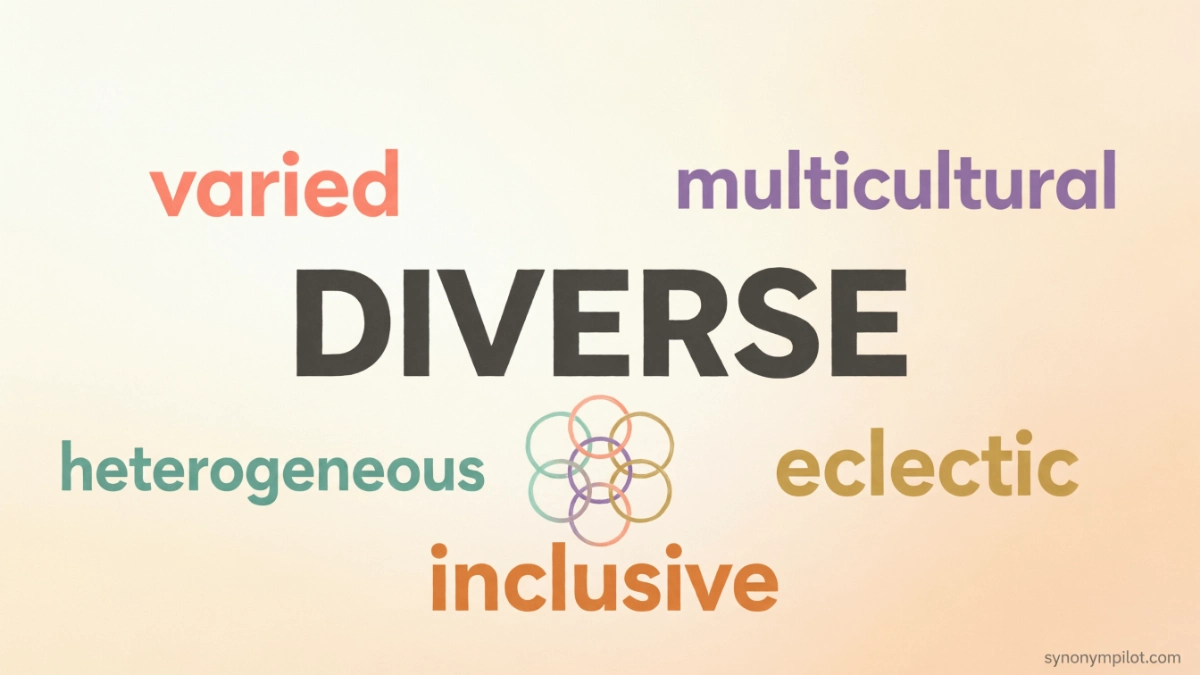
- For formal or academic writing → heterogeneous or multifaceted
- For describing variety in things or topics → varied or assorted
- For describing cultures or backgrounds → multicultural or cross cultural
- For describing skills or ideas → wide ranging or broad
- For casual conversation → all kinds of or a mix of
There is no single “best” replacement for “diverse” the right word depends on if you mean cultural variety, intellectual range, or general variety in things.
When Not to Use This Word
Avoid “diverse” when you only mean “different” in a simple, two way comparison. “These two perspectives are diverse” sounds awkward “these two perspectives are different” or “these two approaches are contrasting” fits much better. “Diverse” implies variety across many types, not just between two things.
Avoid “diverse” in very casual conversation when simpler, more natural phrasing would work better. “We had a diverse group at the party” is correct, but “there were people from all walks of life” or “it was such a mixed crowd” often sounds more natural in relaxed speech.
Avoid overusing “diverse” in professional writing to the point where it loses meaning. Repeating “diverse” in every paragraph of a business document can make the writing feel formulaic. Varying with “varied,” “inclusive,” “wide ranging,” or “multifaceted” adds precision and freshness.
Words Commonly Confused With Diverse
Diverse vs. Different:
“Different” simply means not the same it applies to any comparison between two or more things. “Diverse” implies a group made up of many different types, usually suggesting richness or range. “Their opinions are different” compares two opinions. “The team has diverse opinions” suggests a wide range of viewpoints across several people.
Diverse vs. Varied:
“Varied” describes a range of different types, often used for things, topics, or activities. It is slightly less formal and socially charged than “diverse.” “A varied menu” describes many types of food. “A diverse team” describes people with different backgrounds. “Varied” works well for things; “diverse” works better for people and communities.
Diverse vs. Miscellaneous:
“Miscellaneous” describes a collection of different items that don’t fit neatly into categories often with a slightly disorganized or catch all feeling. “Diverse” implies meaningful variety. “A miscellaneous collection of tools” suggests a random mix. “A diverse collection of art” suggests a rich, intentional variety.
Diverse vs. Inclusive:
“Inclusive” focuses on if all types of people or ideas are actively welcomed and included. “Diverse” describes the fact of variety being present. A group can be diverse without being inclusive, and efforts to be inclusive often aim to create diversity. These words are related but describe different things.
Best Synonym by Context
| Context | Best Synonym | Why It Fits |
|---|---|---|
| Academic Writing | Heterogeneous, Varied, Multifaceted | Sounds precise, formal, and analytical. |
| Business & Professional Writing | Wide-Ranging, Multifaceted, Varied | Professional alternatives that avoid overused language. |
| Cultural or Social Contexts | Multicultural, Pluralistic, Cross-Cultural | Specifically describes diversity among people and cultures. |
| Describing Skills or Interests | Wide-Ranging, Broad, Eclectic | Highlights a large scope of abilities, knowledge, or hobbies. |
| Describing a Collection of Things | Assorted, Varied, Mixed | Natural choices for objects, categories, topics, or items. |
| Academic Research (Sample Groups) | Heterogeneous, Representative | Commonly used in research and statistical discussions. |
| Casual Conversation | A Mix of, All Kinds of, Varied | Simple, natural, and easy to understand in everyday speech. |
Which Synonym Should You Choose?
Ask yourself these quick questions before picking a replacement for “diverse”:
1. Are you describing people or things? “Multicultural” and “pluralistic” apply to people and communities. “Varied” and “assorted” apply better to objects, topics, or types.
2. How formal is the writing? “Heterogeneous” suits academic and scientific writing. “Mixed” and “varied” suit professional and casual writing. “All kinds of” suits conversation.
3. Are you describing existing variety or active inclusion? “Diverse” and “varied” describe what is already present. “Inclusive” describes an active effort to welcome and involve different people.
4. Do you mean variety within one category or across many? “Multifaceted” describes something with many different sides or aspects. “Wide ranging” describes something that covers a large scope across categories.
Real Life Examples of “Diverse” in Sentences
School
“The classroom includes students from diverse cultural and linguistic backgrounds.”
“Her research draws from a diverse range of academic disciplines.”
Workplace
“Building a diverse team improves creativity and problem solving.”
“The company has invested heavily in diverse hiring practices.”
Writing
“The novel features a diverse cast of characters, each with a distinct voice.”
“The anthology brings together diverse perspectives on contemporary identity.”
Conversation
“This neighborhood has become so much more diverse over the past decade.”
“She has really diverse taste in music everything from jazz to K pop.”
Best Synonym by Context for “Diverse”
| Context | Best Synonym(s) | Why It Fits |
|---|---|---|
| Academic Writing | Heterogeneous, Multifaceted, Varied | Precise, formal, and analytical. |
| Business & Professional Writing | Wide-Ranging, Multifaceted, Comprehensive | Professional and polished alternatives. |
| Cultural or Social Contexts | Multicultural, Pluralistic, Multiethnic | Specifically describes people, cultures, and communities. |
| Education & Research | Heterogeneous, Representative, Multidisciplinary | Commonly used in academic and research settings. |
| Skills, Interests, or Experience | Eclectic, Broad, Well-Rounded | Highlights variety across abilities and knowledge areas. |
| Collections, Products, or Categories | Assorted, Mixed, Various | Natural choices for groups of items or topics. |
| International Settings | International, Cosmopolitan, Cross-Cultural | Emphasizes global reach and cultural variety. |
| Formal Reports & Analysis | Extensive, Comprehensive, Far-Reaching | Suitable for professional and analytical writing. |
| Creative or Literary Writing | Kaleidoscopic, Variegated, Mosaic-Like | Creates vivid imagery and rich descriptions. |
| Inclusive Policies & Communities | Inclusive, All-Inclusive, Universal | Focuses on welcoming and representing everyone. |
| Technical or Scientific Writing | Composite, Hybrid, Non-Homogeneous | Common in scientific and technical contexts. |
| Casual Conversation | Different, Various, A Mix Of | Simple, natural, and easy to understand. |
Synonym Groups and Usage Differences
Formal
Heterogeneous, pluralistic, manifold, pluriform, multidisciplinary suit academic essays, research papers, and formal reports. “Heterogeneous” especially appears in scientific and statistical writing when describing groups that are not uniform.
Informal
Mixed, motley, all kinds of, eclectic, a blend of sound natural in everyday conversation and casual writing. “Motley” can carry a slightly humorous or informal tone.
Academic
Heterogeneous, multidisciplinary, interdisciplinary, representative, non homogeneous appear frequently in research writing, especially when describing sample groups, methods, or analytical approaches.
Professional
Wide ranging, multifaceted, varied, inclusive, well rounded sound polished and natural in business writing, HR communication, and workplace discussions.
Conversational
Mixed, varied, a mix of, eclectic, all kinds of are the most natural choices in spoken English and informal writing.
Stronger vs. Weaker
“Kaleidoscopic” and “richly varied” describe variety with vibrancy and abundance stronger and more vivid than “diverse.” “Mixed” and “varied” are more neutral and understated.
Modern vs. Old Fashioned
“Sundry” and “manifold” sound slightly old fashioned or literary today, though they remain correct. “Wide ranging,” “multifaceted,” and “inclusive” feel modern and appear frequently in current professional and academic writing.
Antonyms of “Diverse” (Organized List)
| Antonym | Meaning | Example Sentence |
|---|---|---|
| Homogeneous | Made up of the same type or kind | The group was too homogeneous to generate genuinely different ideas. |
| Uniform | The same throughout, without variation | The policy applies a uniform standard to all departments. |
| Similar | Alike in many ways | The two proposals were too similar to require a comparison. |
| Identical | Exactly the same | The results from both groups were nearly identical. |
| Narrow | Limited in range or scope | His reading list was too narrow, covering only one genre. |
| Limited | Restricted in variety or scope | The menu is limited, with only a few options for vegetarians. |
| Exclusive | Including only one type or group | The club remained exclusive, limiting membership to certain professions. |
| Monolithic | Single, large, and undifferentiated | The company had a monolithic culture that resisted new ideas. |
Comparison: Diverse vs. Related Words
Diverse vs. Varied
“Varied” focuses on range and type, often for things, activities, or topics. “Diverse” carries a stronger social and cultural dimension, often applied to people and communities. “A varied menu” sounds perfectly natural; “a diverse menu” sounds slightly unusual because menus don’t have cultural identities. For people and groups, “diverse” fits more naturally.
Diverse vs. Multifaceted
“Multifaceted” describes something that has many different sides or aspects it focuses on complexity and depth within one thing. “Diverse” describes variety across many things or people. “She is multifaceted” means she has many different qualities. “She comes from a diverse background” means her background includes many different cultural or personal experiences.
Diverse vs. Eclectic
“Eclectic” describes a personal or aesthetic choice deliberately drawing from many different styles or sources. It often carries a positive, creative tone. “Diverse” is broader and doesn’t imply deliberate choice. “Her music taste is eclectic” suggests she intentionally enjoys many different genres. “The festival features diverse music” simply describes the variety present.
Diverse vs. Inclusive
“Diverse” describes the presence of variety. “Inclusive” describes an active effort to welcome and involve everyone. A team can be diverse (many different backgrounds present) without being inclusive (if some people aren’t heard or valued). These words often appear together in discussions about workplace culture and social equity.
Diverse vs. Heterogeneous
“Heterogeneous” is the formal or scientific equivalent of “diverse.” It appears most naturally in research, statistics, and academic writing when describing groups or samples that are not uniform. “Diverse” works across all contexts; “heterogeneous” is best reserved for formal and technical writing where precision matters.
Common Phrases and Expressions
“A diverse range of”
Used to describe a wide variety of options, types, or people within a category.
Example: “The program attracts a diverse range of students from over thirty countries.”
“Diversity of thought”
Refers to a variety of different viewpoints, approaches, or ideas often valued in professional and academic settings.
Example: “The team’s success comes from diversity of thought, not just diversity of background.”
“A rich tapestry of”
A metaphor for a community or group made up of many different elements that come together beautifully.
Example: “The neighborhood reflects a rich tapestry of cultures, languages, and traditions.”
“From all walks of life”
An idiomatic phrase describing people of many different backgrounds, professions, and experiences.
Example: “The festival draws visitors from all walks of life, united by a love of music.”
“A melting pot”
A metaphor for a place or group where many different cultures or people blend together.
Example: “New York City has long been described as a melting pot of cultures from around the world.”
“The full spectrum of”
Used to emphasize that a group or collection represents every possible type or variety.
Example: “The exhibition showcases the full spectrum of contemporary visual art.”
Common Mistakes to Avoid
Using “diverse” for just two things:
“The two candidates hold diverse opinions” sounds awkward. “Diverse” implies variety across many types, not just a difference between two things. “Different” or “contrasting” fits much better for comparisons between two items.
Confusing “diverse” with “inclusive”:
These words are related but describe different things. “Diverse” describes what is present; “inclusive” describes how welcoming or equitable a space is. Saying “we want a diverse and inclusive workplace” captures both ideas, but using them interchangeably loses important meaning.
Overusing “diverse” as a corporate buzzword:
Repeating “diverse” in every paragraph of a business document can feel hollow. Varying with “varied,” “wide ranging,” “multifaceted,” or “inclusive” adds precision and prevents the word from losing its meaning through repetition.
Using “heterogeneous” in casual conversation:
“Heterogeneous” is formal and technical. Saying “we had a heterogeneous group at dinner” sounds unnatural in casual speech. “Mixed crowd” or “all kinds of people” sounds far more natural in conversation.
Using “eclectic” when you mean “diverse”:
“Eclectic” suggests deliberate personal taste or aesthetic choice. “Diverse” describes variety within a group or collection without implying personal selection. “Her eclectic wardrobe” suggests her personal choices; “the store offers a diverse range of clothing” simply describes the variety available.
FAQs
What is the most professional synonym for “diverse” in a business document?
A: “Wide ranging,” “multifaceted,” and “varied” all sound professional and specific without the buzzword feel that “diverse” can carry in corporate writing. For HR or inclusion related content, “inclusive” or “representative” often adds important precision.
What is the difference between “diverse” and “varied”?
A: “Varied” typically describes variety in things, topics, or activities. “Diverse” is more often applied to people, communities, and groups, often carrying a social or cultural dimension. “A varied schedule” describes different activities. “A diverse team” describes people from different backgrounds.
Can “diverse” be used for things as well as people?
A: Yes “a diverse range of products,” “diverse opinions,” and “diverse ecosystems” are all natural. However, when describing variety in things (objects, options, styles), “varied” or “assorted” often sounds more natural than “diverse.”
Is “heterogeneous” the same as “diverse”?
A: They are very close in meaning, but “heterogeneous” is primarily used in formal, academic, and scientific writing to describe groups or samples that are not uniform. “Diverse” works across all contexts, from casual to formal, and often carries a positive social implication that “heterogeneous” doesn’t.
What is a good synonym for “diverse” in a college essay about personal background?
A: “Multifaceted,” “wide ranging,” “rich,” and “varied” all work well in personal writing. “I come from a multifaceted background” or “my experiences have been wide ranging” both sound thoughtful and specific without relying on an overused word.
Conclusion
“Diverse” is a genuinely useful and meaningful word, but it works best when used precisely and purposefully. Once you know if you mean cultural variety, intellectual range, or general variety in things, choosing a more specific synonym becomes straightforward.
“Varied” for objects and topics, “multicultural” for cultural communities, “heterogeneous” for formal research, “eclectic” for personal taste each one says something slightly different and more specific than “diverse” alone.
This week, try noticing how “diverse” appears in articles, reports, and conversations around you. Then experiment with more specific alternatives from this article. With practice, you’ll find yourself choosing words that communicate variety with far more clarity, depth, and impact.

Hi, I’m George Philip—an English language enthusiast who enjoys uncovering the nuances of words. I write about synonyms, vocabulary, and everyday language tips so readers can improve their communication and express themselves effectively. Learning new words should be fun, practical, and inspiring! synonympilot.com