Quick Answer
“Special” means something is different from the ordinary more important, more meaningful, or more valued than usual. It can describe a person, moment, event, or thing that stands out in a positive way.
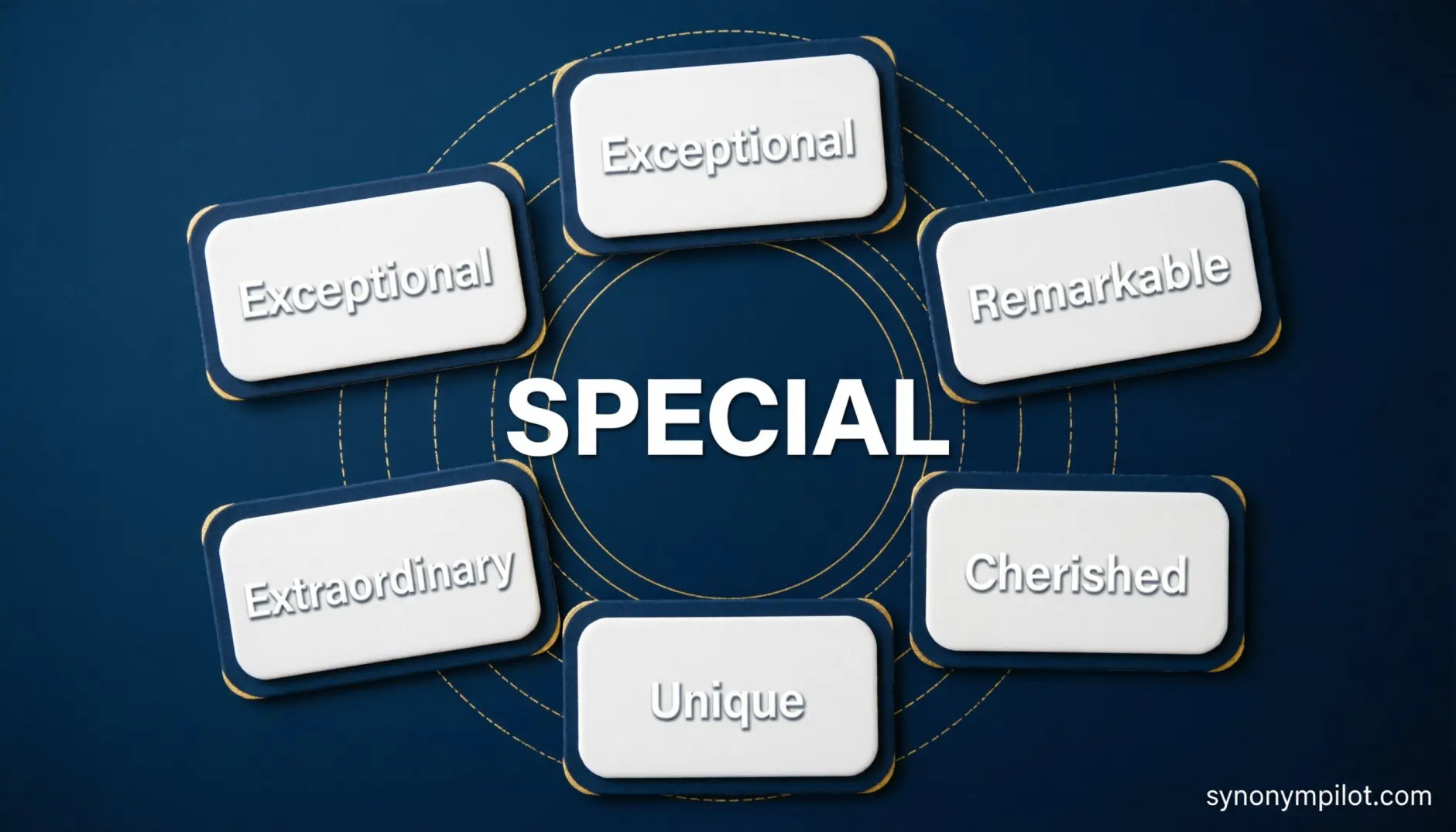
Depending on your context, you can replace it with words like “unique,” “extraordinary,” “remarkable,” or “exceptional.”
What Does “Special” Really Mean?
You’re writing a birthday message for your best friend and you type: “You are so special to me.” It feels right, but also a little plain. You want something with more impact, more emotion, more color. That’s exactly where knowing the right synonyms helps.
“Special” is one of those words we use every day in text messages, speeches, emails, and conversations. It carries a warm, positive meaning. But because we use it so often, it can start to feel ordinary. The good news is English gives you dozens of stronger, more vivid alternatives that say the same thing only better.
Meaning, Tone, and Context of “Special”
At its core, “special” means set apart from the ordinary in a way that deserves attention or appreciation. It suggests value, uniqueness, or distinction.
The tone depends entirely on the situation. In personal conversations, “special” feels warm and emotional. In professional writing, it can sound vague or overused. In academic contexts, it may feel too casual. This is why choosing the right synonym matters each word carries its own tone, strength, and fit.
“Special” works naturally in:
- Everyday conversation “This is a special day.”
- Personal writing “She has always been special to me.”
- Marketing language “A special offer just for you.”
- Formal announcements “A special ceremony will be held…”
However, in academic essays, professional reports, or persuasive writing, stronger and more precise alternatives will almost always serve you better.
When and How to Use “Special”
Use “special” when you want to express that something or someone holds more value, meaning, or importance than the average. It pairs naturally with nouns like occasion, person, place, moment, bond, and talent.
Examples:
- “Today is a very special occasion for our family.”
- “She has a special talent for connecting with people.”
- “We reserved a special table for the guests of honor.”
Since “special” is versatile and emotionally neutral, you can use it in casual texts, greeting cards, speeches, and even in mild professional communication. Just avoid overusing it when everything is “special,” nothing feels special anymore.
Another Word for Special
Looking for a better word than “special”? Here are some of the strongest alternatives based on meaning and context:
- Unique for something one of a kind
- Exceptional for something above the average standard
- Remarkable for something worth noticing or talking about
- Extraordinary for something well beyond the ordinary
- Distinctive for something with a clearly different quality
- Significant for something that carries importance or meaning
- Cherished for something deeply valued emotionally
- Noteworthy for something deserving of recognition
- Outstanding for something that clearly stands above the rest
- Irreplaceable for someone or something that cannot be substituted
When Not to Use “Special”
Avoid “special” when your writing calls for precision or when the word might come across as vague. In academic papers, using “special” without explanation weakens your argument. In a business report, saying a strategy is “special” tells your reader almost nothing useful.
Also avoid it when the emotional weight you need is stronger. If you want to describe something truly rare or breathtaking, “special” undersells it. In those situations, reach for “extraordinary,” “unparalleled,” or “remarkable” instead.
Additionally, be careful in professional feedback. Telling a colleague their work is “special” may confuse them do you mean it’s high quality, or just different? Choose a clearer word.
Words Commonly Confused With “Special”
Special vs. Unique
“Unique” means one of a kind there is nothing else like it. “Special” means above ordinary but does not suggest there is only one. A snowflake is unique; a family dinner can be special.
Special vs. Specific
These two sound similar but mean very different things. “Specific” means particular or exact “I need a specific file.” “Special” refers to exceptional value “This file has special meaning.”
Special vs. Peculiar
“Peculiar” also means different, but it often carries a strange or odd connotation. Calling someone “peculiar” is not a compliment the way “special” is.
Special vs. Exceptional
“Exceptional” is stronger and more formal. Use it when you want to highlight outstanding performance or quality rather than personal meaning.
Best Synonym for “Special” by Context
| Context | Best Synonym | Why It Works |
|---|---|---|
| Personal relationships | Cherished / Beloved | Adds emotional warmth and affection. |
| Academic writing | Significant / Notable | Precise, formal, and widely accepted in scholarly writing. |
| Business / Professional | Exceptional / Outstanding | Clearly communicates high quality and excellence. |
| Creative writing | Extraordinary / Remarkable | Vivid, expressive, and impactful. |
| Everyday conversation | Wonderful / Lovely | Sounds natural, friendly, and conversational. |
| Describing a rare thing | Unique / Rare / Irreplaceable | Emphasizes rarity and one-of-a-kind value. |
| Formal speech | Distinguished / Noteworthy | Polished, respectful, and professional in tone. |
Which Synonym Should You Choose?
The right choice depends on three things: your audience, your tone, and your purpose.
If you’re writing a heartfelt personal message, lean toward emotionally warm words like “cherished,” “beloved,” or “treasured.” If you’re writing a professional email or report, use precise words like “exceptional,” “notable,” or “significant.” For creative or literary writing, more vivid words like “extraordinary,” “remarkable,” or “unparalleled” will give your sentences more power.
A quick test: read the sentence aloud. Does the synonym feel natural? Does it match the emotion or formality you need? If yes, you have found your word.
Real Life Examples of “Special” and Its Synonyms in Sentences
School
- “She received an award for her exceptional performance in science.”
- “This is a significant milestone in your academic journey.”
Workplace
- “He brought a distinctive approach to the project that impressed the whole team.”
- “Her outstanding contributions made a lasting difference.”
Writing
- “The novel captured an extraordinary moment in human history.”
- “There was something remarkable about the way she told stories.”
Conversation
- “You are truly irreplaceable to me.”
- “That trip was genuinely one of a kind I’ll never forget it.”
50 Synonyms for Special
| Synonym | Simple Meaning | Example Sentence |
|---|---|---|
| Unique | One of a kind | Her singing voice is completely unique. |
| Exceptional | Above average quality | He showed exceptional skill in the interview. |
| Remarkable | Worth noticing | The team made remarkable progress this month. |
| Extraordinary | Far beyond ordinary | It was an extraordinary performance by any measure. |
| Distinctive | Clearly different in character | She has a distinctive writing style. |
| Significant | Having great meaning or importance | This is a significant moment for our company. |
| Outstanding | Standing clearly above the rest | His outstanding work earned him a promotion. |
| Cherished | Deeply loved and valued | These photos are among my most cherished possessions. |
| Noteworthy | Deserving attention | The article raised several noteworthy points. |
| Irreplaceable | Cannot be replaced | A good mentor is truly irreplaceable. |
| Rare | Not common; hard to find | Finding a friend like her is rare. |
| Precious | Of great value, often emotional | These memories are precious to us. |
| Particular | Standing out for a specific reason | He has a particular talent for solving problems. |
| Uncommon | Not typical or ordinary | It was an uncommon act of generosity. |
| Wonderful | Causing wonder or delight | We had a wonderful evening together. |
| Memorable | Worth remembering | The ceremony was truly memorable. |
| Unparalleled | Without equal | The craftsmanship was unparalleled. |
| Priceless | Too valuable to put a price on | Her advice has been priceless. |
| Singular | The only one of its kind; unique | He has a singular dedication to his craft. |
| Select | Carefully chosen; of high quality | Only a select few were invited to attend. |
| Distinguished | Recognized for excellence | She is a distinguished professor in her field. |
| Gifted | Having natural talent | He is a gifted musician. |
| Exquisite | Extremely beautiful or refined | The painting was absolutely exquisite. |
| Admirable | Deserving respect and praise | Her patience is truly admirable. |
| Stellar | Excellent; of the highest quality | The team delivered a stellar presentation. |
| Elevated | Raised above the standard | The restaurant offered an elevated dining experience. |
| Superior | Of higher quality or rank | This material is superior in durability. |
| Refined | Developed to a high standard | He has a refined taste in literature. |
| Beloved | Deeply loved | This is her beloved hometown. |
| Treasured | Kept with great care and affection | The bracelet is a treasured family heirloom. |
| Prized | Highly valued | Her prized collection of vintage books filled the room. |
| Unmatched | Without comparison | His dedication remains unmatched. |
| Elite | Among the best in a group | They trained with an elite team of coaches. |
| Choice | Of the highest quality; carefully selected | She picked a choice spot for the picnic. |
| First-rate | Of the highest quality | The service was absolutely first-rate. |
| Prime | Of the best possible quality | This is prime real estate. |
| Hallowed | Greatly respected and honored | The stadium was hallowed ground for football fans. |
| Revered | Regarded with deep respect | She is a revered figure in her community. |
| Incomparable | So good it cannot be compared | The view from the summit was incomparable. |
| Phenomenal | Extraordinarily impressive | She gave a phenomenal speech at the gala. |
| Standout | Clearly noticeable as better | It was a standout moment in the film. |
| One of a kind | Completely unique | This handmade bag is one of a kind. |
| Paramount | Of the greatest importance | Safety is of paramount importance here. |
| Exclusive | Limited to a select group | Members receive exclusive access to the library. |
| Invaluable | Extremely useful; beyond ordinary value | Her experience proved invaluable to the team. |
| Coveted | Greatly desired by many | Winning that award is a coveted achievement. |
| Meaningful | Full of significance or purpose | They shared a meaningful conversation. |
| Inspiring | Encouraging admiration and motivation | His story is truly inspiring. |
| Magnificent | Impressively beautiful or grand | The view from the mountain was magnificent. |
| Sacred | Treated with the highest respect | Family time is sacred to her. |
Synonym Groups and Usage Differences
Formal and Professional Synonyms
Words like exceptional, distinguished, outstanding, superior, and significant work well in business emails, formal reports, academic writing, and speeches. They sound polished and credible.
Example: “The board recognized her exceptional contribution to the project.”
Informal and Conversational Synonyms
Wonderful, lovely, one of a kind, standout, and stellar sound natural in everyday speech and casual text messages. They feel friendly and approachable without sounding stiff.
Example: “That dinner was absolutely wonderful thank you!”
Emotional and Personal Synonyms
When you want to express deep affection or personal value, reach for cherished, treasured, beloved, precious, and irreplaceable. These words carry genuine emotional weight.
Example: “You are the most treasured person in my life.”
Academic and Neutral Synonyms
For essays or research writing, notable, significant, distinctive, and remarkable strike the right balance between precision and formality without sounding cold.
Example: “The study produced remarkable results across all test groups.”
Strongest Synonyms
If you want maximum impact, use extraordinary, unparalleled, incomparable, phenomenal, or unmatched. These leave no doubt about how impressive something is.
Modern vs. Old Fashioned
Words like stellar, standout, and one of a kind feel modern. Words like hallowed, singular, and prime have a more classical, literary feel. Both have their place, but choose based on your audience and context.
Antonyms of “Special”
| Antonym | Meaning | Example Sentence |
|---|---|---|
| Ordinary | Not different from the usual | It was just an ordinary afternoon. |
| Common | Happening frequently; not rare | Colds are common in winter. |
| Average | Typical; at the middle standard | His performance was average at best. |
| Mediocre | Below a satisfactory standard | The food at that restaurant was mediocre. |
| Unremarkable | Not worthy of attention | The speech was pleasant but unremarkable. |
| Generic | Lacking individual character | The design felt generic and uninspired. |
| Forgettable | Not worth remembering | Sadly, the film was quite forgettable. |
| Routine | Done as a regular habit; not exciting | It was a routine checkup—nothing unusual. |
| Insignificant | Of little value or importance | The error was insignificant in the final result. |
| Replaceable | Easily substituted | No employee is truly replaceable, but some are easier to train. |
Comparison: Special vs. Closely Related Words
Special vs. Unique
“Special” means above ordinary. “Unique” means there is only one. Every snowflake is unique. Not every unique thing is special a broken umbrella is unique, but not special.
Special vs. Exceptional
“Exceptional” implies a measurable difference from a standard. It is more formal and often used in evaluation contexts. “Special” is warmer and more personal.
Special vs. Remarkable
“Remarkable” suggests something that causes others to remark or take notice. It has a slightly more objective feeling you’d use it when describing something to others, not just expressing your own feelings.
Special vs. Extraordinary
“Extraordinary” literally means “outside the ordinary” and is much stronger in tone. Use it for truly rare moments or achievements, not for everyday compliments.
Special vs. Significant
“Significant” focuses on importance or meaning often in terms of impact. “Special” focuses on value and emotional worth. A significant event changes things. A special event is simply deeply meaningful.
Common Phrases and Expressions with “Special”
“A special place in my heart”
Used to describe someone or something you hold with deep affection.
“This city will always have a special place in my heart.”
“Special occasion”
Refers to an event that is more important than a regular day.
“We only open this wine on a special occasion.”
“Nothing special”
Used to downplay something or say it is ordinary.
“It was nothing special just a quiet dinner at home.”
“Special treatment”
When someone receives more attention or better service than others.
“The VIP guests received special treatment throughout the event.”
“Feel special”
To feel valued, appreciated, or singled out positively.
“She always knows how to make people feel special.”
“Special mention”
Recognition given to someone who deserves acknowledgment even without winning.
“A special mention goes to the volunteers who made this possible.”
Common Mistakes to Avoid
Overusing “special” is the most common mistake. When you call everything special every email, every event, every product the word loses its meaning. Save it for moments that genuinely deserve it, or choose a more specific synonym.
Confusing “special” with “specific” is a grammar slip that many learners make. These words are not synonyms. “I need a special pen” means a pen with particular value. “I need a specific pen” means a particular pen you have in mind.
Using “unique” and “special” interchangeably can also cause confusion. Not everything special is unique. Use “unique” only when there is truly nothing else like it.
Choosing emotional synonyms in formal writing is another error. Words like “cherished” or “beloved” belong in personal contexts. In a business report, they sound unprofessional. Stick with “exceptional” or “significant” in formal settings.
FAQs
What is the best synonym for “special” in a professional email?
“Exceptional” or “notable” works best in professional emails because they sound clear and credible without being too emotional or informal.
What is a more formal word for “special”?
“Distinguished,” “exceptional,” “significant,” and “outstanding” are all strong formal alternatives depending on If you are describing a person, event, or achievement.
What is the difference between “special” and “unique”?
“Special” means above ordinary in value or importance, while “unique” means one of a kind there is nothing else exactly like it. Something can be special without being unique, and vice versa.
Can I use “extraordinary” instead of “special”?
Yes, but “extraordinary” is much stronger. Use it when something truly goes far beyond the ordinary, not for everyday compliments or mild praise.
What are some emotional synonyms for “special”?
“Cherished,” “treasured,” “beloved,” “precious,” and “irreplaceable” all carry strong emotional warmth and work beautifully in personal messages, cards, and heartfelt writing.
Conclusion
The word “special” is a great starting point, but your vocabulary does not have to stop there. If you are writing a heartfelt message, a professional report, or a creative story, there is always a more precise and powerful word waiting to do the job.
Words like “exceptional,” “remarkable,” “cherished,” or “extraordinary” can take your writing from ordinary to genuinely memorable.
The best way to build this habit is to practice daily. When you catch yourself writing “special,” pause for just a moment and ask: Is there a better word for what I really mean?
Over time, choosing the right word becomes natural and your writing becomes far more expressive, clear, and impactful. Keep a small list of your favorite synonyms nearby and try using one new word every day. Your readers will notice the difference.

Hi, I’m George Philip—an English language enthusiast who enjoys uncovering the nuances of words. I write about synonyms, vocabulary, and everyday language tips so readers can improve their communication and express themselves effectively. Learning new words should be fun, practical, and inspiring! synonympilot.com