A project manager sends a message to her team the night before a big client presentation: “Please make sure you bring the essential documents tomorrow without them we cannot proceed.”
Clear, direct, and serious. But what if she had written “Please bring the critical documents” or “the indispensable materials”? Each version communicates urgency in a slightly different way, and each one lands with a different level of weight.
Essential is one of those words that appears constantly in professional writing, academic work, everyday instructions, and formal communication.
It gets the job done reliably. However, because it covers such broad ground from “absolutely necessary” to “fundamentally important” it can sometimes feel generic. Knowing when to use vital instead of essential, or when indispensable fits better than necessary, gives your writing and speech a precision that essential alone cannot always achieve.
This article walks you through 50 accurate, natural synonyms for essential, with clear explanations, real examples, and practical guidance on how to choose the right one every time.
Quick Answer: What Does “Essential” Mean?
Essential means absolutely necessary, critically important, or forming the most fundamental part of something. It describes things that cannot be removed or ignored without causing serious problems or failure. Words like vital, crucial, and indispensable are strong synonyms for essential, but each carries a slightly different tone, urgency level, and best fit context.
The Core Meaning, Tone, and Context of “Essential”
At its core, essential comes from the word essence the fundamental nature of something. When you call something essential, you are saying it forms the core of what is needed. Without it, the whole thing breaks down, fails, or becomes something lesser.
In terms of tone, essential sits in a formal to neutral range. It works comfortably in academic writing, professional communication, instructional guides, formal speeches, and serious everyday conversation. It is not casual, but it is also not so elevated that it sounds stiff or old fashioned. Because of this versatility, essential appears across almost every domain of English medicine, law, business, education, and everyday life.
Where “Essential” Sounds Most Natural
Essential feels most natural in contexts where you are establishing priority, making a clear argument, giving instructions, or setting out requirements. “Good communication is essential in any relationship” works in a self help book. “Adequate hydration is essential for athletic performance” suits a health article. “Clear documentation is essential for project success” fits a business report perfectly. In all three cases, essential signals seriousness and non negotiability without feeling overly dramatic.
When and How to Use “Essential” in Real Life
Use essential when you want to clearly communicate that something is not optional it is a genuine requirement, not merely a good idea.
In school: “Strong reading habits are essential for academic success at every level.” At work: “Clear communication between departments is essential if we want to deliver this project on time.” In writing: “The author argues that empathy is essential to effective leadership in the modern workplace.” In conversation: “If you are hiking in that heat, sunscreen and water are absolutely essential don’t skip them.”
Essential also pairs naturally with several useful noun phrases worth knowing: essential skills, essential services, essential oils, essential nutrients, essential reading. These combinations appear widely across professional, health, educational, and marketing contexts, and recognizing them naturally expands your range.
Another Word for Essential
These are the strongest and most widely used alternatives, each carrying a clear and distinct character.
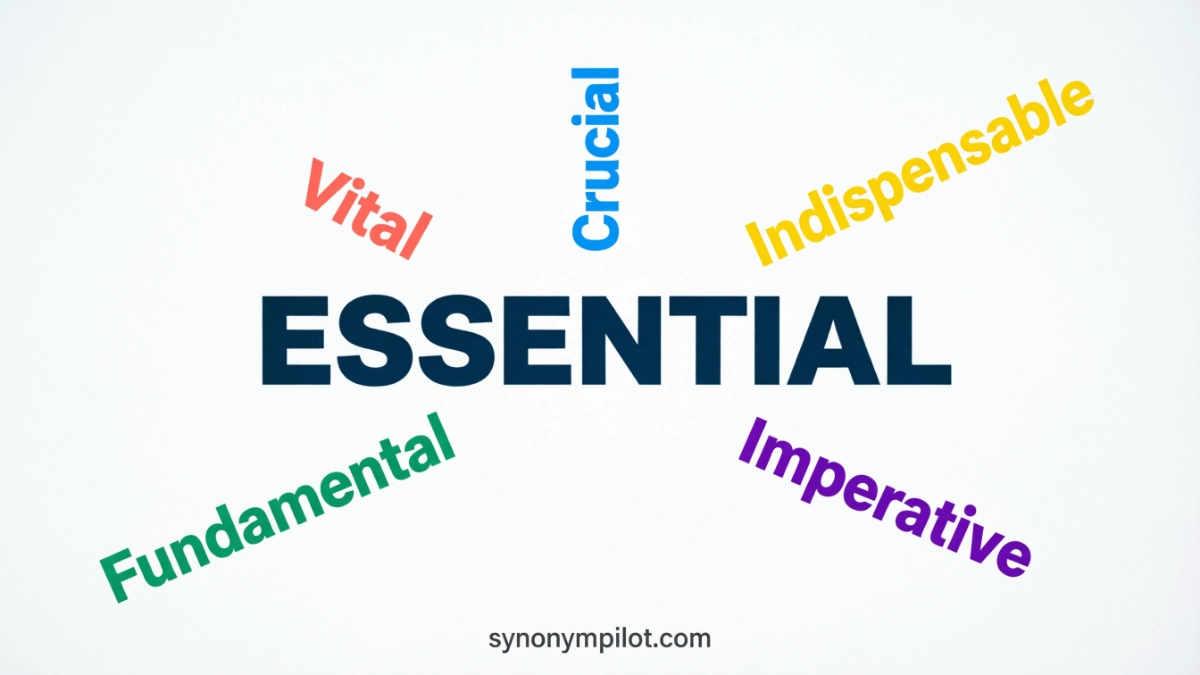
Vital means critically important in a way connected to life, health, or survival it carries the highest urgency. Crucial means decisive and of critical importance at a key moment or turning point. Indispensable means so necessary that things cannot function without it impossible to do without. Necessary means required by circumstance, rule, or logic. Fundamental means forming the foundation or most basic part of something. Critical means of the highest importance, especially where the outcome depends on it. Imperative means urgently and absolutely required, often with a sense of command. Key means the single most important element that unlocks everything else. Core means forming the central and most important part of something. Prerequisite means something that must exist or happen first before something else can follow.
When Not to Use “Essential”
Avoid essential when you mean merely helpful, recommended, or useful. Essential signals that something is non negotiable. Using it for things that are simply beneficial waters down the word and makes your other uses of it less credible. If something is a good idea but not strictly required, beneficial, advisable, or recommended is more honest and accurate.
Also avoid essential when a more emotionally specific word better captures the stakes. In medical contexts, vital carries more weight. In legal or policy contexts, mandatory or requisite is more precise. In personal or emotional contexts, indispensable feels more human and heartfelt than essential.
Furthermore, avoid overusing essential in a single piece of writing. When every point in a list or argument is called essential, the word stops doing any real work. Rotate in vital, crucial, key, and fundamental to keep your language varied and your priorities clear.
Words Commonly Confused With “Essential”
Essential vs. Vital
Vital traces its roots to the Latin word for life vita. Consequently, it carries a stronger sense of urgency and a closer connection to survival, health, and critical function. Essential is broader and more versatile. “Vital signs” in medicine refers to measurements of life itself. “Essential skills” in a job description means the skills required for the role. When the stakes are life or death or the highest possible priority, vital is the stronger and more powerful choice. For general requirements and fundamental needs, essential works perfectly.
Essential vs. Crucial
Crucial emphasizes a decisive turning point it describes something critical at a specific moment of significance or decision. Essential is more static and ongoing. “This meeting is crucial to the outcome of the entire negotiation” implies a single pivotal moment. “Trust is essential in any long term relationship” describes an ongoing, foundational requirement. Use crucial when the timing or moment matters. Use essential when something is consistently and fundamentally required.
Essential vs. Indispensable
Indispensable is slightly stronger than essential and carries a more personal, relational quality. Something indispensable is not just necessary its absence would be actively felt and would leave a real gap. “She became indispensable to the team” says more than “She became essential to the team” because indispensable implies that no one else could fill her role. Use indispensable when you want to highlight irreplaceability rather than just necessity.
Essential vs. Necessary
Necessary is broader and more neutral than essential. It means required by circumstance or logic, without necessarily implying high stakes or fundamental importance. Essential carries more weight and seriousness. “It is necessary to bring your ID to the appointment” is a procedural requirement. “Strong foundations are essential to any lasting structure” expresses something more fundamental and qualitative. Necessary suits rules and requirements; essential suits core importance.
Best Synonym by Context
| Context | Best Synonym | Why It Works |
|---|---|---|
| Medical or Health Writing | Vital / Critical | Conveys urgency and life significance |
| Academic or Research Writing | Fundamental / Integral | Precise, formal, and structurally grounded |
| Business and Professional Writing | Key / Indispensable | Direct, impactful, and results-focused |
| Legal or Policy Documents | Mandatory / Requisite | Formal, strict, and legally precise |
| Educational Materials or Guides | Necessary / Core | Clear, simple, and level-appropriate |
| Personal or Emotional Contexts | Indispensable / Irreplaceable | Human, warm, and deeply meaningful |
| Instructions or Checklists | Required / Obligatory | Direct, practical, and unambiguous |
| Formal Speeches or Presentations | Imperative / Paramount | Elevated, strong, and persuasive |
Which Synonym Should You Choose?
Ask yourself two clear questions before choosing.
First, what type of necessity are you describing? Is it a matter of survival or the highest urgency use vital or critical. Is it a foundational requirement use fundamental or core. Is it a requirement at a decisive moment use crucial. Is it about irreplaceable value use indispensable. Is it simply required use necessary or required.
Second, what is your tone and audience? Formal and academic use fundamental, integral, or indispensable. Professional and business focused use key, critical, or imperative. Conversational and accessible use necessary, important, or must have. Legal or official use mandatory, requisite, or obligatory.
Real Life Examples of “Essential” and Its Synonyms in Sentences
School
Critical thinking is a fundamental skill that students need to develop long before they reach university level. The teacher made it clear that attendance at the final review session was mandatory for all students preparing for the exam.
Workplace
Her ability to manage multiple stakeholders simultaneously made her truly indispensable to the organization during the restructuring period. The project manager identified three key deliverables that were critical to meeting the launch deadline without compromise.
Writing
The author argues that mutual respect is the cornerstone of any functional and lasting professional relationship. The report concludes that adequate funding is integral to the long term success of the public health initiative.
Conversation
“Honestly, a good pair of walking shoes is an absolute must if you are planning to spend three days exploring that city on foot.” “Sleep is non negotiable when you are training at that intensity your body simply needs it to recover.”
Best Synonym by Context
| Context | Best Synonym | Why It Works |
|---|---|---|
| Business / Professional | Critical / Key / Core | Emphasizes importance for success or systems |
| Academic Writing | Fundamental / Crucial / Central | Sounds analytical and structured |
| Medical / Health | Vital / Life-critical / Indispensable | Conveys survival or urgent importance |
| Legal / Formal | Mandatory / Obligatory / Required | Reflects rules or official necessity |
| Technical / Systems | Integral / Built-in / Core | Shows part of a functioning system |
| Decision-making | Pivotal / Decisive / Key | Suggests turning point or outcome impact |
| Everyday Conversation | Important / Needed / Must-have | Simple and widely understood |
| Emotional / Personal | Meaningful / Valuable / Indispensable | Reflects personal significance |
| Education / Learning | Foundational / Basic / Prerequisite | Indicates base-level necessity |
| Emergency / High urgency | Critical / Urgent / Pressing | Signals immediate action required |
Synonym Groups and Usage Differences
Formal and Academic Synonyms
Fundamental, integral, indispensable, paramount, and inherent belong in academic essays, research papers, formal reports, and scholarly writing. These words signal careful, structured thinking and analytical depth. Consequently, they carry far more credibility in formal contexts than essential alone, which can start to feel repetitive in dense academic writing.
Professional and Business Synonyms
Key, critical, pivotal, high priority, and non negotiable are strong choices in business emails, strategic plans, performance documentation, and client facing communication. They communicate seriousness, urgency, and clear prioritization in a tone that professional audiences expect and respect.
Legal and Official Synonyms
Mandatory, compulsory, obligatory, and requisite belong in legal documents, official guidelines, compliance materials, and policy writing. These words carry the weight of authority and rule they signal that something is required by law, regulation, or official standard, not simply recommended.
Conversational and Informal Synonyms
Must have, non negotiable, top priority, and needed feel natural and accessible in everyday speech and informal written communication. They carry the same core meaning as essential but with a more direct, approachable energy that fits casual contexts without sounding overly formal.
Strongest vs. Weaker Synonyms
Vital, imperative, indispensable, and paramount sit at the highest end of the urgency and importance scale. Use them only when the stakes are genuinely high and the requirement is truly absolute. Necessary, needed, and required sit at the gentler and more neutral end perfectly accurate for everyday requirements without overstating the stakes.
Antonyms of “Essential”
| Antonym | Meaning | Example Sentence |
|---|---|---|
| Optional | Available as a choice, not required | The extra modules are optional. |
| Unnecessary | Not needed; serves no purpose | The explanation was unnecessary. |
| Dispensable | Can be removed without harm | Some tasks are dispensable under pressure. |
| Inessential | Not important or required | He removed inessential details from the report. |
| Trivial | Very unimportant or minor | The issue was considered trivial. |
| Redundant | No longer needed due to duplication | Several steps were redundant. |
| Peripheral | Not central or important | The topic was peripheral to the discussion. |
| Superfluous | Excess and not needed | The report contained superfluous content. |
| Avoidable | Can be left out or prevented | The mistake was avoidable. |
| Non-essential | Not required in the situation | Non-essential spending was reduced. |
| Unimportant | Of little significance | The detail is unimportant. |
| Minor | Small in importance | It was a minor issue. |
| Extra | Additional, not required | The service includes extra features. |
| Unneeded | Not required | The step is unneeded. |
| Expendable | Can be sacrificed or removed | Some resources are expendable in emergencies. |
Common Phrases and Expressions With “Essential”
Essential skills describes the core abilities a person must have to perform a role or function effectively. “The job listing clearly stated that strong written communication is one of the essential skills for the position.”
Essential reading describes books, articles, or documents that are considered fundamental and highly important in a field. “Her debut book on behavioral economics has become essential reading for anyone studying modern consumer decision making.”
Essential services refers to services so important to daily life that they continue operating even during emergencies or shutdowns. “During the lockdown, essential services including hospitals, pharmacies, and grocery stores remained open for the public.”
The bare essentials describes the absolute minimum set of things needed to function or survive in a situation. “She packed only the bare essentials for the three day wilderness survival course.”
Essential oils refers to concentrated plant based compounds used in aromatherapy, skincare, and natural health. “She diffused lavender essential oil in the bedroom every evening to promote relaxation before sleep.”
Essentially speaking means in the most fundamental and simplified terms at its core. “Essentially speaking, the problem comes down to a lack of clear leadership at the top of the organization.”
Common Mistakes to Avoid
The most common mistake is using essential for things that are merely useful, helpful, or recommended. Essential signals a non negotiable requirement. Overusing it for optional benefits weakens every genuine use of the word in the same piece of writing. If something is a good idea but not strictly required, use beneficial, advisable, or recommended instead.
Many learners also confuse vital and essential. While both describe high importance, vital carries a stronger biological and survival linked urgency. Do not use vital for organizational preferences or administrative requirements save it for contexts where health, safety, or critical function are genuinely at stake.
Another frequent mistake involves treating crucial and critical as fully interchangeable with essential. Crucial emphasizes a decisive moment or turning point. Critical emphasizes high stakes and dependency on a specific outcome. Essential emphasizes ongoing, foundational necessity. All three are related, but each one points to a different dimension of importance.
Furthermore, avoid mixing very formal synonyms like sine qua non or requisite with casual language in the same document. The tonal inconsistency will immediately undermine the credibility of your writing.
Finally, do not repeat essential or any single synonym too many times in one document. Rotating across vital, key, fundamental, and critical not only keeps your writing varied and engaging but also allows you to signal different levels and types of importance across different points.
FAQs
What is a stronger word than essential?
Vital, imperative, and indispensable are all stronger and more specific than essential, with vital carrying the highest urgency through its connection to life and survival, and indispensable emphasizing that something cannot be replaced or removed without real and lasting damage.
What is the difference between essential and crucial?
Essential describes something fundamentally and consistently required as a core part of something, while crucial focuses on a specific decisive moment where the outcome depends on a particular element essential is ongoing and foundational, while crucial is moment specific and pivotal.
Can I use essential in a formal essay?
Yes, essential works well in formal writing, though rotating in synonyms like fundamental, integral, and indispensable keeps your academic writing more varied and precise, particularly when you need to distinguish between different levels or types of importance throughout a single document.
Is vital the same as essential?
Vital and essential are closely related but not identical vital carries a stronger sense of urgency and is more closely connected to survival, health, and life critical function, while essential is broader and suits a wider range of contexts from everyday requirements to professional and academic priorities.
What is a good conversational alternative to essential?
Must have, non negotiable, and key are the most natural informal alternatives “that skill is a total must have for this field” or “sleep is absolutely non negotiable when you are training hard” both communicate the same core meaning as essential while sounding warm and natural in everyday conversation.
Conclusion
Essential is a reliable, versatile, and genuinely useful word that belongs firmly in your vocabulary. However, the moment you start choosing between vital, crucial, indispensable, fundamental, and imperative based on what you actually mean the specific type of necessity, the level of urgency, the tone of your audience your writing and speech immediately become sharper, more credible, and more compelling.
Start today by picking two or three synonyms from this article that feel genuinely new to you. Use vital the next time you are describing something connected to health or survival. Try fundamental the next time you write about the core of something.
Reach for indispensable the next time you want to highlight true irreplaceability. Each deliberate choice like this is a small step toward a genuinely stronger vocabulary and a stronger vocabulary is always an essential tool for clear, confident communication.

Hi, I’m Theo John, a passionate word explorer who loves diving into the beauty of the English language. I write about synonyms, word meanings, and practical vocabulary tips to help readers communicate with confidence. synonympilot.com