You’re in a meeting and someone explains a new process, and you say “I understand” for the third time that hour. Or you’re texting a friend who just explained why they’re upset, and “I understand” feels a little too flat for how much you actually get it. This happens all the time in both writing and speech.
“Understand” is reliable and clear, but English offers many ways to express the same idea with different levels of depth, formality, and emotional warmth. Knowing a few solid alternatives helps your communication sound more natural and less repetitive.
QUICK ANSWER
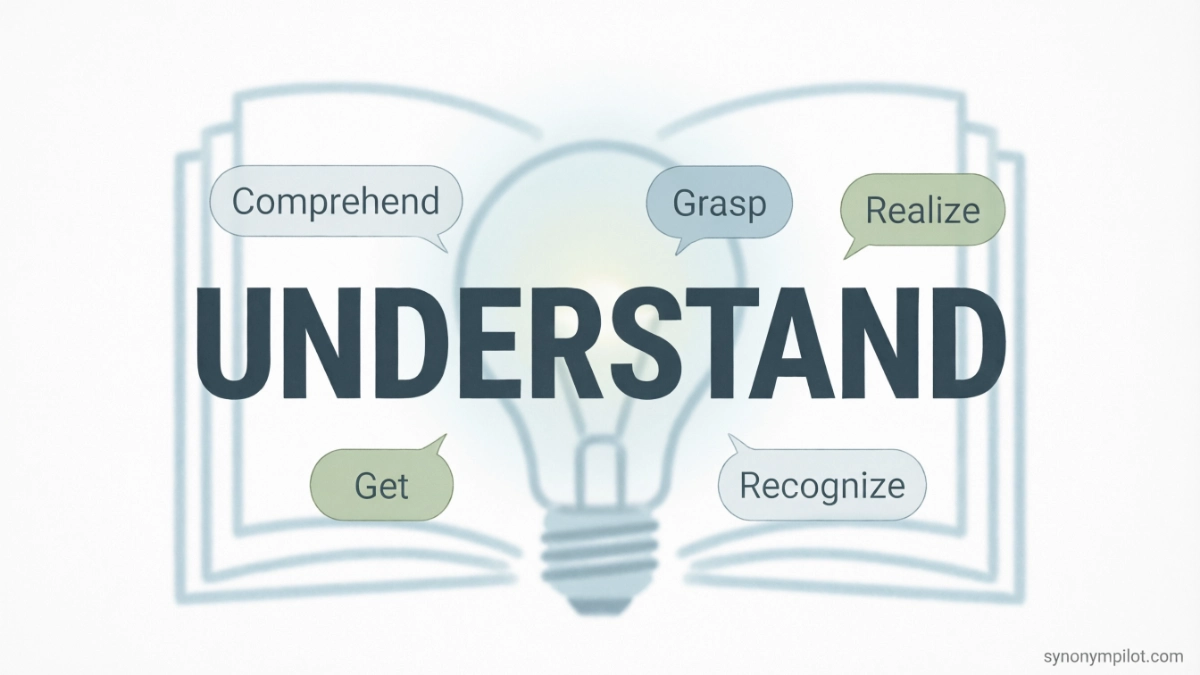
“Understand” means to grasp the meaning, nature, or reasoning behind something, if it’s information, a feeling, or a situation. It can refer to intellectual comprehension or emotional awareness. Common synonyms include comprehend, grasp, follow, realize, and recognize.
MEANING, TONE & CONTEXT
At its core, “understand” means to mentally process and make sense of something, if that’s a concept, an instruction, a person’s feelings, or a complicated situation. It covers both logical comprehension and emotional empathy.
The tone of “understand” is neutral and flexible. It works in formal writing, academic contexts, professional communication, and everyday conversation without sounding too stiff or too casual. It’s one of those rare words that fits almost anywhere.
“Understand” sounds most natural when confirming comprehension, expressing empathy, or describing the process of learning something. It works equally well in a classroom, a workplace, a personal conversation, or a written explanation.
WHEN & HOW TO USE “UNDERSTAND”
Use “understand” when you want to confirm that you’ve grasped information, instructions, or someone’s perspective.
In academic or professional writing, it works well for describing comprehension of complex material: “Students must understand the underlying theory before attempting the experiment.”
In conversation, it often expresses empathy or agreement: “I understand why you’re frustrated; that situation would upset anyone.”
In instructional contexts, it confirms clarity: “Do you understand the steps, or should I walk through them again?”
ANOTHER WORD FOR UNDERSTAND
If you need a quick, everyday alternative, “get” is the closest match in casual speech. It carries the same basic meaning but feels more relaxed and conversational, making it perfect for texting, informal chats, or quick verbal confirmations rather than formal writing.
WHEN NOT TO USE THIS WORD
Avoid “understand” when you specifically mean “agree.” Saying “I understand your point” doesn’t mean you accept it, so using it in place of agreement can create confusion in negotiations or debates.
It’s also a poor fit for describing surface level awareness without real comprehension. Saying you “understand” a topic you’ve only briefly skimmed can overstate your actual knowledge; “I’m familiar with” fits that situation more honestly.
WORDS COMMONLY CONFUSED WITH UNDERSTAND
People often confuse “understand” with “know.” Knowing something means having information stored in your memory, while understanding implies you’ve made sense of how or why something works, not just that you’re aware of it.
“Understand” also gets mixed up with “agree.” You can fully understand someone’s argument without agreeing with their conclusion, since understanding is about comprehension, not approval.
Finally, “understand” is sometimes confused with “recognize.” Recognizing something means identifying it as familiar, while understanding involves grasping its meaning or reasoning, which goes a step further than simple recognition.
Best Synonym by Context for Understand
| Context | Best Synonym | Why It Fits |
|---|---|---|
| Academic/technical content | Comprehend, Grasp | Suggests deep intellectual processing |
| Casual conversation | Get, Follow | Sounds natural and relaxed |
| Emotional support | Empathize, Relate to | Conveys emotional connection, not just logic |
| Sudden realization | Realize, Click | Captures the moment comprehension occurs |
| Professional communication | Recognize, Appreciate | Sounds polished and respectful |
| Confirming instructions | Follow, Get the gist of | Confirms clarity without sounding formal |
| Learning new concepts | Comprehend, Absorb | Emphasizes gaining knowledge |
| Business meetings | Acknowledge, Recognize | Professional and concise |
| Academic writing | Interpret, Comprehend | Precise and scholarly |
| Research and analysis | Discern, Interpret | Focuses on deeper meaning |
| Problem solving | Figure out, Grasp | Emphasizes finding understanding |
| Customer service | Appreciate, Recognize | Shows attentiveness and respect |
| Personal relationships | Relate to, Empathize | Highlights emotional understanding |
| Storytelling or literature | Perceive, Realize | Fits narrative and character development |
| Giving feedback | See your point, Appreciate | Respectful and constructive |
| Training or education | Learn, Master | Focuses on acquiring knowledge and skill |
WHICH SYNONYM SHOULD YOU CHOOSE?
Start by asking if you’re describing intellectual comprehension or emotional connection. For grasping facts, instructions, or technical material, words like “comprehend” or “grasp” fit better. For connecting with someone’s feelings or experience, “empathize” or “relate to” capture that emotional dimension more accurately.
Next, consider how sudden or gradual the comprehension was. “Realize” or “click” suggest a quick moment of clarity, while “grasp” or “comprehend” suggest a more deliberate, built up understanding over time.
REAL LIFE EXAMPLES OF “UNDERSTAND” IN SENTENCES
School: “It took a few examples before the class could fully understand the concept of probability.”
Workplace: “I understand the new policy, but I think we should clarify the deadline with the team.”
Writing: “She didn’t fully understand the weight of her decision until years later.”
Conversation: “I understand you’re upset, and honestly, I would be too.”
Antonyms of Understand
| Antonym | Simple Meaning | Example Sentence |
|---|---|---|
| Misunderstand | Understand incorrectly | He misunderstood the instructions and assembled the chair backward. |
| Misinterpret | Give the wrong meaning to something | She misinterpreted his silence as anger. |
| Confuse | Fail to understand clearly | The technical terms confused many readers. |
| Overlook | Fail to notice or understand something important | They overlooked a critical detail in the report. |
| Ignore | Deliberately pay no attention to | He ignored the warning signs and continued driving. |
| Miss | Fail to notice or grasp | She missed the point of the presentation entirely. |
| Misread | Interpret incorrectly | The investor misread the market trends. |
| Misjudge | Form an incorrect understanding or opinion | He misjudged the difficulty of the project. |
| Forget | Fail to retain understanding or information | I forgot how the process worked after several months. |
| Disregard | Pay no attention to | The committee disregarded expert advice. |
| Neglect | Fail to give proper attention to | They neglected to understand the customer’s concerns. |
| Doubt | Be uncertain about understanding or truth | She doubted whether she understood the instructions correctly. |
| Question | Be uncertain or skeptical about meaning | He questioned the reasoning behind the decision. |
| Be unaware of | Lack knowledge or understanding | Many people were unaware of the policy change. |
| Misconceive | Form a mistaken understanding | The public misconceived the purpose of the new law. |
| Be puzzled by | Not understand something | Students were puzzled by the complex equation. |
| Be baffled by | Be completely unable to understand | The sudden change baffled everyone. |
| Be bewildered by | Feel confused and unable to understand | She was bewildered by the conflicting information. |
| Be mystified by | Be unable to explain or understand | Scientists were mystified by the unusual results. |
| Be perplexed by | Feel uncertain or confused | He was perplexed by the unexpected outcome. |
SYNONYM GROUPS & USAGE DIFFERENCES
Formal
Words like “comprehend,” “discern,” and “apprehend” suit academic writing, legal language, and formal reports. They sound precise without feeling overly casual.
Informal
“Get,” “catch on,” “twig,” and “get one’s head around” fit everyday conversation, texting, and casual speech. They sound relaxed and natural among friends or coworkers.
Academic
“Comprehend,” “discern,” and “internalize” appear often in educational and research writing, where precision about depth of understanding matters.
Professional
“Recognize,” “appreciate,” and “take on board” suit workplace communication, especially in feedback, meetings, or written reports.
Conversational
“Get,” “see,” and “get the gist of” work comfortably in daily speech, where exact precision matters less than natural flow.
Strongest vs. Weaker
“Master” and “fathom” suggest a deep, thorough level of understanding, while “get the gist of” and “make out” suggest a more general or partial understanding.
Emotional vs. Neutral
“Empathize with,” “relate to,” and “sympathize with” carry emotional warmth and connection. “Comprehend,” “process,” and “grasp” stay more neutral, focused on intellectual understanding rather than feeling.
Antonyms of Understand
| Antonym | Meaning | Example |
|---|---|---|
| Misunderstand | Understand something incorrectly | He misunderstood her tone and thought she was upset. |
| Confuse | Fail to understand clearly, often mixing things up | The instructions confused most of the new employees. |
| Misinterpret | Understand the meaning of something incorrectly | She misinterpreted his silence as disagreement. |
| Be baffled by | Be completely unable to understand something | The technician was baffled by the strange error message. |
| Be puzzled by | Be confused or unable to make sense of something | I was puzzled by the sudden change in the schedule. |
| Be confused about | Lack clear understanding of something | He was confused about which form to submit first. |
| Be unaware of | Lack knowledge or awareness of something | She was unaware of the changes made to the contract. |
| Be ignorant of | Lack knowledge or understanding of something | He admitted he was ignorant of the local customs. |
| Misjudge | Form an incorrect understanding or opinion | She misjudged the complexity of the task. |
| Overlook | Fail to notice or understand something important | They overlooked a key detail in the proposal. |
| Miss | Fail to grasp or notice | He completely missed the point of the discussion. |
| Doubt | Be uncertain about understanding or truth | She doubted whether she understood the instructions correctly. |
| Question | Be uncertain or skeptical about meaning | He questioned the purpose of the new policy. |
| Disregard | Ignore or pay no attention to | The team disregarded the expert’s advice. |
| Neglect | Fail to give proper attention to | They neglected to understand the customer’s concerns. |
| Misconceive | Form a mistaken understanding | Many people misconceived the goal of the project. |
| Be bewildered by | Be very confused by something | She was bewildered by the conflicting reports. |
| Be mystified by | Be unable to explain or understand | Scientists were mystified by the unexpected results. |
| Be perplexed by | Feel uncertain or confused about something | He was perplexed by the sudden decision. |
| Fail to grasp | Not succeed in understanding | Some students failed to grasp the main concept. |
COMPARISON SECTION
Understand vs. Know
“Know” refers to having information stored in memory, while “understand” implies you’ve made sense of how or why something works. Example: “I know the rule” simply states awareness, while “I understand the rule” suggests you grasp the reasoning behind it.
Understand vs. Realize
“Realize” often implies a sudden moment of awareness, frequently about something previously overlooked. “Understand” can describe either gradual or sudden comprehension, without that same emphasis on surprise. Example: “I realized I’d made a mistake” suggests a sudden discovery, while “I understand the mistake” simply confirms comprehension.
Understand vs. Empathize
“Empathize” specifically involves emotionally connecting with someone’s feelings or experience, while “understand” can apply to both emotional and purely logical comprehension. You can understand a tax policy without empathizing with anyone, but empathizing always involves emotional understanding.
Understand vs. Agree
“Agree” means accepting or supporting an idea, while “understand” simply means comprehending it. Example: “I understand your concern” doesn’t necessarily mean “I agree with your concern,” which is a common source of miscommunication in disagreements.
COMMON PHRASES & EXPRESSIONS
“Get the picture”
Means to understand a situation fully, often after explanation. Example: “Once she showed the diagram, I finally got the picture.”
“See where someone is coming from”
Means to understand someone’s perspective or reasoning. Example: “I see where you’re coming from, even though I’d handle it differently.”
“Make sense of something”
Means to understand something confusing by working through it. Example: “It took a while to make sense of the new tax form.”
“Read between the lines”
Means to understand an implied or hidden meaning. Example: “If you read between the lines, the email clearly suggests budget cuts.”
“Wrap your head around something”
Means to fully understand something difficult or surprising. Example: “I’m still trying to wrap my head around the merger announcement.”
COMMON MISTAKES TO AVOID
Don’t use “understand” interchangeably with “agree,” since comprehending an idea doesn’t mean accepting it. Avoid confusing “understand” with “know,” as understanding involves grasping reasoning, not just having information. Be careful not to overstate comprehension by saying you “understand” something you’ve only briefly encountered; phrases like “I’m somewhat familiar with” are more honest in that case. Finally, remember that informal synonyms like “get” or “twig” don’t fit formal writing, so match your word choice to your context.
FAQs
What’s a formal way to say understand?
“Comprehend,” “discern,” and “apprehend” all sound more formal, making them suitable for academic writing, legal documents, or professional reports.
What’s a casual way to say understand?
“Get,” “catch on,” and “get my head around” work well in everyday conversation and texting, where a relaxed tone fits better.
What’s the difference between understand and comprehend?
“Comprehend” usually implies a deeper, more deliberate level of understanding, often involving complex or detailed material, while “understand” is more general and can apply to simple or complex situations alike.
How do you say “I understand” more naturally in conversation?
Phrases like “I get it,” “that makes sense,” or “I see what you mean” sound more natural and conversational than repeating “I understand” directly.
Can “understand” describe feelings, not just facts?
Yes. “Understand” can describe emotional awareness, as in “I understand why you’re upset,” which overlaps closely with words like “empathize” or “relate to.”
CONCLUSION
Expanding your vocabulary around words like “understand” helps your communication sound clearer and more genuine, if you’re explaining something complex or responding to someone’s feelings.
Each alternative carries its own shade of meaning, from the quick clarity of “realize” to the emotional depth of “empathize.” Paying attention to context, formality, and if you’re describing logic or emotion will help you choose words that fit naturally.
Try using a few new synonyms the next time you’re confirming comprehension or connecting with someone, and notice how much more precise your communication becomes. Small vocabulary shifts like these make everyday conversations feel more thoughtful and clear

Hi, I’m George Philip—an English language enthusiast who enjoys uncovering the nuances of words. I write about synonyms, vocabulary, and everyday language tips so readers can improve their communication and express themselves effectively. Learning new words should be fun, practical, and inspiring! synonympilot.com