Quick Answer:
Expertise means a high level of skill or knowledge in a specific area, gained through experience, training, or dedicated study. It suggests that someone is not just good at something they are exceptionally capable and reliable in that field. You can use it in professional, academic, and everyday contexts to describe deep competence.
Your manager just praised you in a meeting: “Thanks to Sarah’s expertise in data analysis, we delivered the project two weeks early.” Everyone nodded. That one word expertise carried real weight. It said more than “she’s good at her job.” It said she’s the person you go to when it truly matters.
But what if you’re writing a resume, a cover letter, or an email and you keep repeating the word expertise? Or what if the tone feels too formal for the situation?
That’s exactly where a solid vocabulary upgrade helps. Knowing the right synonym for expertise can make your writing sharper, your speech more natural, and your communication more powerful.
In this article, you’ll find 50+ strong, natural alternatives to expertise organized by context, tone, and situation so you always choose the right word at the right moment.
Meaning, Tone, and Context
Expertise comes from the French word expert and carries a tone of earned authority. It’s not just about knowing something it implies years of practice, real world application, and a level of mastery others recognize and trust.
Tone: Formal to semi formal. It works equally well in professional emails, academic writing, job applications, and serious conversations.
Where it sounds most natural:
- Workplace settings (“Her expertise in cybersecurity is unmatched.”)
- Academic or research contexts (“The study draws on the expertise of leading scientists.”)
- Formal introductions or recommendations (“We hired him for his expertise in contract law.”)
It sounds slightly stiff in casual everyday conversation. If a friend asks why you’re good at cooking, saying “I have considerable expertise in culinary arts” feels unnatural. That’s where knowing your synonyms becomes genuinely useful.
When and How to Use “Expertise”
Use expertise when you want to highlight deep, proven, and recognized skill not just basic ability. It works best when:
- Describing a professional’s specific area of strength
- Writing formally about qualifications or credentials
- Highlighting what someone brings to a team or project
Examples:
- “The hospital brought in a specialist for her expertise in cardiac surgery.”
- “His expertise helped the startup secure three major investors.”
- “We need someone with expertise in environmental law for this case.”
Avoid it when the level of skill is modest or still developing. Calling a beginner an “expert” undermines the word’s weight.
Another Word for Expertise
Looking for another word for expertise? Here are the strongest natural alternatives depending on your situation:
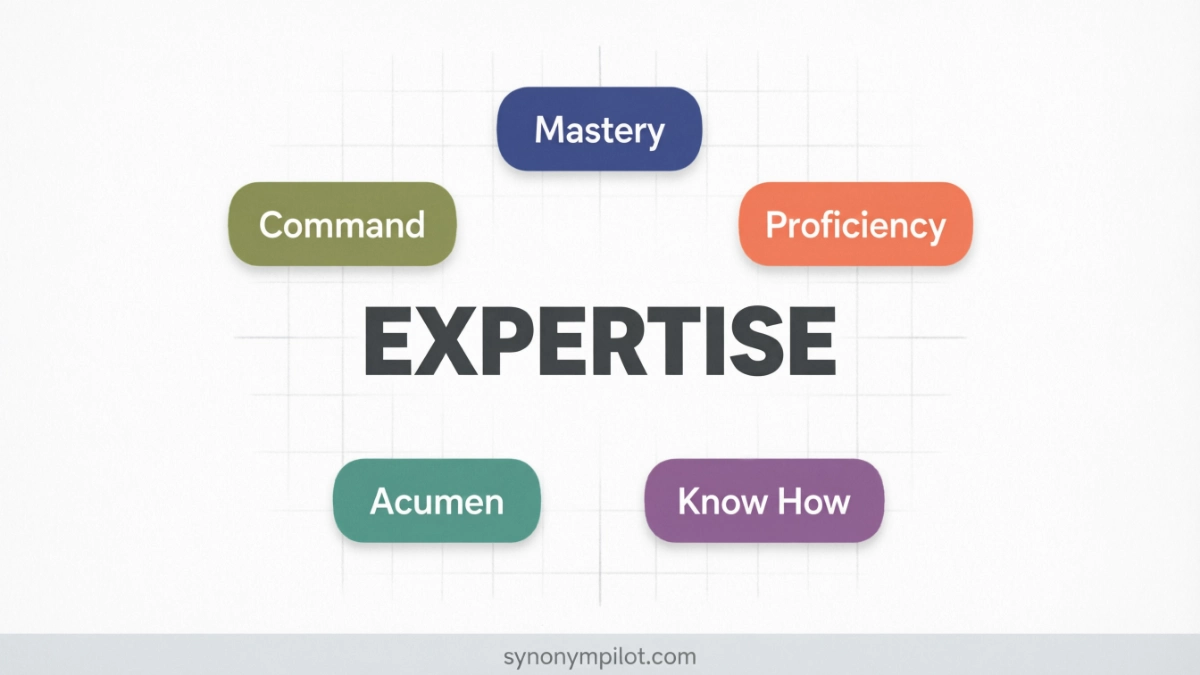
- Proficiency great for skills and technical ability
- Mastery when someone has truly dominated a subject
- Competence more neutral, useful for formal evaluations
- Know how casual and conversational, perfect for everyday speech
- Skill simple, clear, and universally understood
- Command excellent when someone controls a subject deeply (“a strong command of French”)
- Savvy modern and slightly informal (“business savvy”)
- Specialization when the focus is on a narrow, specific field
When Not to Use This Word
Avoid expertise when:
- The skill level is basic or moderate use ability or competence instead
- The tone should be casual use know how or skill in conversation
- You’re being modest expertise sounds confident and assertive, which can come across as arrogant in humble contexts
- You’re describing a general interest, not a deep specialization
Words Commonly Confused With Expertise
| Word | How It Differs from Expertise |
|---|---|
| Knowledge | What you know mentally; expertise includes applying that knowledge skillfully |
| Experience | Time spent doing something; expertise focuses on depth and quality, not just time |
| Talent | Natural ability; expertise is usually developed through effort and practice |
| Skill | A specific ability; expertise suggests a deeper, broader, and more advanced level |
| Qualification | A formal certificate or credential; expertise is proven ability in real performance |
Best Synonym by Context
| Context | Best Synonym | Why It Fits |
|---|---|---|
| Resume or CV | Proficiency, Mastery | Formal and impressive |
| Job interview | Competence, Command | Professional and confident |
| Casual conversation | Know-how, Savvy | Natural and relaxed |
| Academic writing | Specialization, Acumen | Precise and scholarly |
| Creative writing | Artistry, Craft | Expressive and vivid |
| Technical fields | Capability, Aptitude | Accurate and specific |
| Business settings | Expertise, Acumen | Polished and credible |
Which Synonym Should You Choose?
Here’s a simple rule: match the word to the situation and relationship.
- Writing to your professor? Use proficiency or competence.
- Talking to a friend? Use know how or skills.
- Describing a surgeon or lawyer? Use mastery or command.
- Writing a LinkedIn profile? Use expertise or specialization.
- Pitching a business idea? Use acumen or capability.
The goal is always to sound natural not impressive. The right word fits the moment so well that no one notices you even chose it.
Real Life Examples in Sentences
School:
- “Her proficiency in mathematics earned her a scholarship.”
- “The teacher’s mastery of the subject made even hard topics clear.”
Workplace:
- “His technical know how saved the team three days of troubleshooting.”
- “We hired her for her competence in project management.”
Writing:
- “The author’s command of language is evident on every page.”
- “His craftsmanship in woodworking is truly remarkable.”
Conversation:
- “She really knows her stuff when it comes to nutrition.”
- “He’s got serious savvy in the music industry.”
50 Synonyms for Expertise
| Synonym | Simple Meaning | Example Sentence |
|---|---|---|
| Proficiency | High ability in a specific skill | She showed proficiency in three languages. |
| Mastery | Complete control or dominance of a subject | His mastery of chess took years to develop. |
| Competence | Being capable and reliable | The job requires basic competence in Excel. |
| Know-how | Practical knowledge of how to do something | He has the know-how to fix any engine. |
| Skill | A trained ability | Her writing skill improved every semester. |
| Command | Deep control over a subject | She has a strong command of Spanish grammar. |
| Savvy | Smart, practical knowledge | His business savvy impressed the investors. |
| Specialization | Deep focus in one area | Her specialization is in pediatric neurology. |
| Acumen | Sharp judgment, especially in business | Her financial acumen saved the company. |
| Capability | The ability to do something well | They hired him for his leadership capability. |
| Aptitude | Natural or developed ability | He showed a clear aptitude for coding. |
| Dexterity | Skillful use of hands or mind | The surgeon’s dexterity was extraordinary. |
| Craft | Skill in a creative or technical area | Her craft as a novelist is widely admired. |
| Artistry | Creative skill and talent | The painter’s artistry drew large crowds. |
| Fluency | Easy, natural ability | His fluency in German helped close the deal. |
| Adroitness | Quick, clever skill | Her adroitness in negotiation was impressive. |
| Talent | Natural or learned ability | He has real talent for public speaking. |
| Finesse | Delicate, refined skill | She handled the situation with great finesse. |
| Prowess | Superior ability or skill | Her athletic prowess earned national attention. |
| Genius | Exceptional natural intellectual ability | The child showed early signs of mathematical genius. |
| Knowledge | Information and understanding | Her knowledge of history is remarkable. |
| Wisdom | Deep understanding from experience | His wisdom came from decades in the field. |
| Experience | Practical learning over time | Years of experience shaped her leadership style. |
| Sophistication | Advanced refinement and understanding | Her approach showed great sophistication. |
| Intelligence | Ability to understand and reason | Her intelligence made problem solving easy. |
| Sharpness | Mental quickness | His sharpness in debates impressed peers. |
| Qualification | Formal training or credential | His qualifications made him the top candidate. |
| Authority | Recognized knowledge or power | She speaks with authority on climate policy. |
| Specialty | Focused professional excellence | Cardiology is his medical specialty. |
| Discipline | Structured area of study or practice | She trained in her chosen discipline. |
| Technique | Specific method of doing something | His painting technique took years to refine. |
| Execution | Skillful performance of a task | The team’s execution impressed the client. |
| Insight | Deep understanding | Her insight into consumer behavior was valuable. |
| Resourcefulness | Ability to find solutions | His resourcefulness under pressure was remarkable. |
| Efficiency | Skill with minimal waste | The engineer’s efficiency improved production. |
| Precision | Exactness and accuracy | The watchmaker’s precision was extraordinary. |
| Training | Structured skill development | His training gave him strong discipline. |
| Accomplishment | Successfully developed ability | Playing violin is one of her greatest accomplishments. |
| Excellence | Very high standard of ability | The team was recognized for excellence. |
| Ability | General capacity to do something | She demonstrated strong analytical ability. |
| Knack | Natural talent for something | He has a knack for making people comfortable. |
| Flair | Stylish, natural skill | She has a flair for interior design. |
| Gift | Natural talent | Teaching seems to be his natural gift. |
| Competency | Measurable ability | The test measured core competencies. |
| Virtuosity | Extremely high technical skill | Her virtuosity on piano earned applause. |
| Credibility | Proven ability and trust | His credibility is well established. |
| Familiarity | Working knowledge of something | Her familiarity with software helped the team. |
| Background | Prior experience and training | Her background in finance made her ideal. |
| Capacity | Potential and actual ability | He showed great capacity for leadership. |
Synonym Groups and Usage Differences
Formal Synonyms
Mastery, proficiency, competence, acumen, specialization, virtuosity
Use these in professional emails, academic papers, cover letters, and official documents. They signal seriousness and credibility.
Informal and Conversational Synonyms
Know how, knack, flair, savvy, gift
These feel natural in everyday conversation, casual writing, or friendly emails. They’re warm and approachable without sounding stiff.
Academic Synonyms
Discipline, specialization, competency, aptitude, capacity
These appear frequently in research papers, educational assessments, and scholarly writing. They’re precise and objective.
Professional and Business Synonyms
Acumen, capability, credibility, competence, execution
These work best in business proposals, performance reviews, and leadership contexts. They focus on results and reliability.
Strongest vs. More General
Strongest: mastery, virtuosity, prowess, genius
More general: ability, skill, talent, knack
Use stronger words when the level of ability is genuinely exceptional. Overusing them weakens their impact.
Modern vs. Old Fashioned
Modern: savvy, know how, capability, execution
Old fashioned: adroitness, dexterity, finesse (though finesse is still common in writing)
Best Synonym by Context Expertise
| Context | Best Synonym | Why It Fits |
|---|---|---|
| Resume / CV | Proficiency, Mastery | Strong, impressive, skill-heavy terms |
| Job interview | Competence, Command | Confident and professional tone |
| Casual conversation | Know-how, Savvy | Natural, simple, everyday language |
| Academic writing | Specialization, Acumen | Formal and analytical |
| Creative writing | Craft, Artistry | Expressive and skill-oriented |
| Technical fields | Capability, Aptitude | Precise and functional |
| Business settings | Expertise, Acumen | Credible and professional |
Comparison Section
Expertise vs. Knowledge
Knowledge is what lives in your head. Expertise is knowledge in action. You can have knowledge without being able to apply it skillfully. Expertise means you’ve proven it through real world performance.
Expertise vs. Experience
Experience is time spent doing something. Expertise is the quality developed from that time. Twenty years of doing something poorly doesn’t create expertise deliberate, effective practice does.
Expertise vs. Talent
Talent is often natural and innate. Expertise is deliberately built. A talented person may have a head start, but expertise requires consistent effort regardless of natural ability.
Expertise vs. Competence
Competence means you can do the job adequately. Expertise means you do it exceptionally well. Competence is the floor; expertise is much closer to the ceiling.
Expertise vs. Proficiency
These two are close. Proficiency is often used for measurable, testable skills (like language levels). Expertise implies broader mastery and is less easily quantified.
Common Phrases and Expressions
1. “Area of expertise”
The specific subject someone knows best.
“Her area of expertise is international trade law.”
2. “Bring expertise to the table”
To contribute specialized knowledge to a group or project.
“We need someone who brings real expertise to the table.”
3. “Deep expertise”
A high level of knowledge going far beyond surface understanding.
“He has deep expertise in machine learning algorithms.”
4. “Leverage your expertise”
To use your specialized knowledge to gain an advantage.
“You can leverage your expertise to negotiate a higher salary.”
5. “Domain expertise”
Expertise within a specific professional or academic domain.
“The consultant brought domain expertise in supply chain management.”
6. “Expertise in X”
The most common phrase structure always followed by “in.”
“She developed expertise in conflict resolution over ten years.”
7. “Widely recognized expertise”
When others in the field acknowledge your level of skill.
“His widely recognized expertise led to a keynote invitation.”
Common Mistakes to Avoid
Using “expertise” for basic skills
Don’t say someone has expertise if they’re still learning the basics. Use ability or familiarity instead.
Confusing “expertise” with “experience”
Years spent doing something doesn’t automatically equal expertise. Make sure the word fits the actual level of skill, not just the time invested.
Overusing “expertise” in casual writing
In a friendly email or text, it sounds stiff. Switch to know how or skills for a warmer tone.
Mixing up “expertise” and “expert”
Expertise is a noun referring to the quality of skill. Expert is a noun for the person. Don’t use them interchangeably: say “her expertise is impressive” not “her expert is impressive.”
Choosing the wrong synonym by formality
Using savvy in an academic paper or competency in casual chat both feel off. Always match your synonym to the tone of the situation.
FAQs
What is the best synonym for expertise in a resume?
Proficiency and mastery work very well on resumes. They’re formal, strong, and widely understood by hiring managers. For technical roles, competency and capability are also excellent choices.
Is “expertise” formal or informal?
It’s primarily formal to semi formal. It works beautifully in professional and academic writing. In casual speech, words like know how, skills, or savvy feel more natural.
What’s the difference between expertise and proficiency?
Proficiency is often tied to measurable skill levels (like language tests), while expertise implies broader, deeper mastery developed over time. Proficiency shows you can do something well; expertise shows you’ve mastered it.
Can I say “expertness” instead of “expertise”?
Expertness is technically a real word, but it’s rarely used in modern English and sounds awkward. Stick with expertise it’s the natural, widely accepted form.
What’s an informal word for expertise?
Know how is the most common informal alternative. Savvy, knack, and flair are also popular in casual conversation and informal writing.
Conclusion
Expanding your vocabulary around a single word like expertise does more than help you avoid repetition. It helps you communicate with precision, adapt your tone to different situations, and express exactly what you mean whether you’re writing a cover letter, giving a presentation, or just chatting with a colleague.
Start small. Pick two or three synonyms from this list that fit your daily life and try using them this week. Write them in a sentence. Use one in an email. Say one out loud. That’s how vocabulary actually sticks not from memorizing lists, but from using words in real moments.
The goal is never to sound smarter. The goal is to be understood more clearly, connect more naturally, and express yourself with genuine confidence. You already have that ability. Now you have more words to show it.

Hi, I’m Theo John, a passionate word explorer who loves diving into the beauty of the English language. I write about synonyms, word meanings, and practical vocabulary tips to help readers communicate with confidence. synonympilot.com