Quick Answer
Kindness is the quality of being warm, gentle, and caring toward others showing concern for their feelings and wellbeing without expecting anything in return. It describes both a personality trait and specific acts of generosity, consideration, or compassion.
You can use it to talk about a person’s nature, a specific gesture, or the overall tone of a relationship. Imagine you are writing a thank you card to a neighbor who brought you soup when you were sick.
You want to say something more meaningful than just “thank you for being kind.” You might write, “Your kindness truly meant the world to me during a difficult week.”
That single word kindness carries warmth, sincerity, and depth. But what if you are writing a school essay, a professional email, or a social media post and want a fresher, more precise word? That is exactly where synonyms for kindness become essential tools in your vocabulary.
Meaning, Tone, and Context
At its core, kindness means the genuine desire to do good for others through words, actions, attention, or presence. It is a noun that describes both a character trait and a category of behavior. “She showed great kindness” and “His kindness never went unnoticed” are both natural uses.
The tone of kindness is warm, positive, and emotionally generous. It suits almost every register from casual conversation to formal writing which makes it one of the most versatile words in English. However, because it is so common, writers and speakers often reach for more specific or expressive alternatives depending on the situation.
In everyday speech, kindness feels natural and unforced. In formal or academic writing, words like “benevolence,” “compassion,” or “altruism” can add precision and weight. In emotional or personal contexts, “tenderness,” “warmth,” or “gentleness” feel closer to the heart.
When and How to Use “Kindness”
Use “kindness” when you want to name the quality itself the overall pattern of caring behavior a person shows. It works beautifully in thank you notes, personal essays, speeches, character descriptions, and everyday conversation.
Here are natural examples:
- “The teacher’s kindness made a lasting impression on every student she taught.”
- “Small acts of kindness can completely change someone’s day.”
- “We were overwhelmed by the kindness of strangers during our time of need.”
- “He is remembered most for his quiet, consistent kindness toward everyone around him.”
Notice that kindness usually describes an ongoing quality rather than a single moment. When you want to describe one specific caring act, words like “gesture,” “favor,” or “act of generosity” often work more naturally alongside it.
Another Word for Kindness
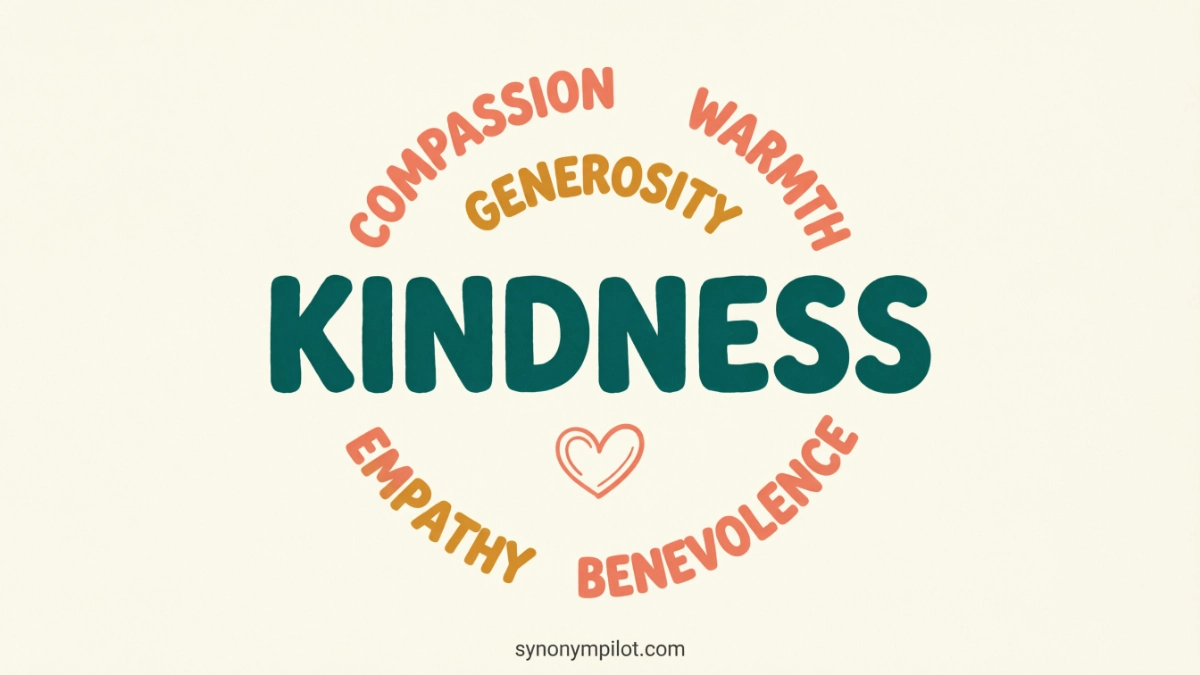
The most widely used synonyms for kindness are compassion, generosity, warmth, and goodwill. Each one emphasizes a slightly different aspect of caring behavior. “Compassion” focuses on understanding someone’s pain. “Generosity” highlights giving freely. “Warmth” captures the emotional tone of kindness. “Goodwill” describes a friendly, cooperative attitude. Choosing the right one depends on what exactly you want to highlight in your writing or speech.
When Not to Use This Word
Avoid using “kindness” when you specifically mean a single helpful action in that case, “favor,” “gesture,” or “act of generosity” is more precise. Also, do not use “kindness” in contexts that call for a more professional or clinical tone. In a business report or legal document, “goodwill,” “consideration,” or “benevolence” typically reads more appropriately. Additionally, “kindness” can occasionally feel too soft or vague in contexts that demand strength or urgency for example, in describing humanitarian work, “compassion” or “altruism” carries more gravity.
Words Commonly Confused With Kindness
Many learners confuse “kindness” with “politeness,” but they are meaningfully different. Politeness follows social rules and norms holding a door open or saying “please.” Kindness comes from genuine care and goes beyond social expectation. You can be polite without being kind, and kind without being formally polite.
“Sympathy” and “kindness” are also confused. Sympathy means feeling sorry for someone’s situation. Kindness means acting on that care. Similarly, “charity” technically falls under kindness but specifically refers to giving to those in need, often in a more organized or institutional sense.
Best Synonym by Context
| Context | Best Synonym | Why |
|---|---|---|
| Academic essay | Benevolence | Formal, abstract, and suitable for philosophical or analytical writing. |
| Workplace email | Goodwill | Professional, neutral, and appropriate for business communication. |
| Personal letter | Warmth | Intimate, heartfelt, and emotionally natural. |
| Social media | Compassion | Modern, widely understood, and emotionally clear. |
| Creative writing | Tenderness | Literary, expressive, and emotionally rich. |
| Leadership context | Empathy | Skill-focused, professional, and valued in leadership roles. |
| Describing a donation | Generosity | Action-based, clear, and directly connected to giving. |
| Describing a personality | Gentleness | Soft, character-focused, and naturally descriptive. |
Which Synonym Should You Choose?
Start by asking what aspect of kindness you most want to highlight. If you mean giving freely, use “generosity.” If you mean understanding pain, use “compassion” or “empathy.” If you mean a gentle, loving nature, use “tenderness” or “warmth.” For formal or philosophical writing, “benevolence” or “altruism” give more weight and precision. For professional communication, “goodwill” stays neutral while still conveying positive intent. In casual writing or conversation, “warmth,” “care,” or “thoughtfulness” feel the most natural and unforced.
Real Life Examples of “Kindness” in Sentences
School:
“The principal praised the students for showing exceptional kindness to the new classmates who joined mid year.”
Workplace:
“The team’s kindness during my mother’s illness reminded me why I love working here.”
Writing:
“Throughout the novel, the author explores how small acts of kindness quietly reshape the lives of everyone around the protagonist.”
Conversation:
“I don’t know what I would have done without your kindness last month it genuinely carried me through.”
50 Synonyms for Kindness
| Synonym | Simple Meaning | Example Sentence |
|---|---|---|
| Compassion | Deep care for suffering others | The nurse showed great compassion for patients. |
| Generosity | Willingness to give freely | His generosity helped many families. |
| Warmth | Friendly emotional care | Her warmth made everyone feel welcome. |
| Goodwill | Friendly intentions toward others | The deal was signed in goodwill. |
| Benevolence | Desire to do good | The leader was known for benevolence. |
| Tenderness | Gentle loving care | She spoke with tenderness to the child. |
| Empathy | Understanding others’ feelings | Empathy is key in counseling. |
| Thoughtfulness | Careful attention to others | His thoughtfulness was appreciated. |
| Gentleness | Soft and careful behavior | She treated the animal with gentleness. |
| Consideration | Thinking about others’ feelings | Show consideration for your teammates. |
| Charity | Help to those in need | The charity supports poor families. |
| Altruism | Selfless concern for others | Her altruism inspired many people. |
| Graciousness | Kind and polite behavior | She accepted praise with graciousness. |
| Humaneness | Treating others with dignity | The policy promotes humaneness. |
| Clemency | Merciful treatment | The judge showed clemency. |
| Magnanimity | Forgiving and generous spirit | He showed magnanimity after winning. |
| Sympathy | Feeling concern for others | She expressed sympathy for the loss. |
| Affection | Warm love and care | The teacher showed affection for students. |
| Decency | Honest and kind behavior | He is known for basic decency. |
| Courtesy | Polite behavior | Basic courtesy costs nothing. |
| Hospitality | Friendly treatment of guests | Their hospitality was amazing. |
| Patience | Calm tolerance | Teaching needs patience. |
| Forbearance | Tolerant restraint | He showed great forbearance. |
| Grace | Elegant kindness | She handled it with grace. |
| Mercy | Forgiving behavior | The officer showed mercy. |
| Care | Attention to wellbeing | She showed care for others. |
| Humanity | Compassion for people | It restored faith in humanity. |
| Goodness | Moral kindness | Her goodness was admired. |
| Liberality | Generous giving | His liberality supported schools. |
| Philanthropy | Charity for society | His philanthropy built hospitals. |
| Tenderheartedness | Easily moved by feelings | Her tenderheartedness was clear. |
| Leniency | Gentle judgment | The teacher showed leniency. |
| Open-handedness | Very generous giving | Their open-handedness helped many. |
| Amiability | Friendly nature | His amiability made him popular. |
| Amicability | Friendly behavior | The talks ended in amicability. |
| Solicitousness | Caring concern | Her solicitousness helped new staff. |
| Beneficence | Doing good deeds | The group’s beneficence is known. |
| Civility | Polite behavior | Treat others with civility. |
| Indulgence | Gentle tolerance | She showed indulgence to children. |
| Munificence | Great generosity | The museum was built by munificence. |
| Helpfulness | Willingness to assist | Her helpfulness saved time. |
| Support | Giving help or strength | He offered emotional support. |
| Understanding | Sympathetic awareness | We need understanding in hard times. |
| Goodheartedness | Naturally kind nature | Her goodheartedness is rare. |
| Softness | Gentle attitude | There was softness in her voice. |
| Friendliness | Warm and approachable nature | His friendliness impressed everyone. |
| Sweetness | Pleasant gentle nature | Her sweetness won hearts. |
| Cordiality | Warm polite behavior | They spoke with cordiality. |
| Thoughtful gesture | Kind act toward others | The note was a thoughtful gesture. |
| Sociability | Friendly interaction with others | His sociability made him popular. |
Synonym Groups and Usage Differences
Formal and Academic Synonyms
Words like “benevolence,” “altruism,” “magnanimity,” “beneficence,” and “humaneness” belong in essays, research papers, speeches, and philosophical discussions. They add intellectual weight and signal a precise, thoughtful vocabulary.
Professional and Workplace Synonyms
“Goodwill,” “consideration,” “civility,” “graciousness,” and “courtesy” work well in business emails, performance reviews, workplace policies, and professional references. They convey warmth while maintaining appropriate distance.
Emotional and Personal Synonyms
“Tenderness,” “warmth,” “affection,” “care,” and “tenderheartedness” suit personal letters, creative writing, eulogies, and intimate conversations. These words carry emotional depth and feel natural in heartfelt contexts.
Conversational Synonyms
“Thoughtfulness,” “friendliness,” “sweetness,” “helpfulness,” and “support” work beautifully in everyday speech. They feel genuine and warm without sounding academic or distant.
Strongest vs. Softer Synonyms
Strongest in intensity: “altruism,” “magnanimity,” “philanthropy,” “benevolence.” Softer and more everyday: “warmth,” “sweetness,” “friendliness,” “courtesy.” The stronger words imply greater sacrifice or nobility; the softer ones describe ordinary daily goodness.
Old Fashioned vs. Modern Synonyms
“Clemency,” “forbearance,” “liberality,” and “munificence” have an old fashioned or literary quality they appear more often in historical texts, formal speeches, or classic literature. Modern equivalents like “empathy,” “compassion,” and “thoughtfulness” feel more current and widely understood.
Antonyms of Kindness
| Antonym | Meaning | Example Sentence |
|---|---|---|
| Cruelty | Deliberately causing pain or suffering | The cruelty he showed left lasting emotional scars. |
| Harshness | Severe, rough, or unkind behavior | His harshness in criticism discouraged the team. |
| Indifference | Lack of care or concern | Her indifference to their struggle was upsetting. |
| Coldness | Emotionally distant and unfriendly behavior | His coldness made the conversation uncomfortable. |
| Malice | Intent to harm or hurt others | The accusation was made with clear malice. |
| Selfishness | Focusing only on oneself | His selfishness affected everyone around him. |
| Meanness | Small-minded or unkind behavior | There was unnecessary meanness in her comments. |
| Ruthlessness | No concern for others’ suffering | The leader’s ruthlessness shocked everyone. |
Comparison Section
Kindness vs. Compassion
Kindness is a general quality of being caring and good natured. Compassion specifically means feeling and responding to someone else’s suffering. You can show kindness by baking cookies for a neighbor. You show compassion when you sit with a grieving friend and truly feel their pain. Compassion carries deeper emotional weight and implies a shared experience of difficulty.
Kindness vs. Generosity
Generosity focuses specifically on giving time, money, attention, or resources. Kindness is broader and includes emotional warmth, gentle words, and considerate behavior. A generous person gives a lot. A kind person makes you feel seen and cared for. Someone can be generous without being particularly warm, and kind without being financially generous.
Kindness vs. Empathy
Empathy is the ability to understand what another person is feeling from the inside. Kindness is the act of treating them well. Empathy is a skill or capacity; kindness is a behavior or trait. In professional settings especially healthcare, education, and counseling empathy is increasingly discussed as a specific learnable skill, while kindness describes the overall quality of caring behavior.
Kindness vs. Sympathy
Sympathy means feeling sorry for someone from a distance recognizing their difficulty without fully entering it. Kindness means actively doing something caring in response to that awareness. You can express sympathy in a card without truly knowing the person. Kindness requires more genuine connection and personal investment.
Common Phrases and Expressions
Act of kindness
A specific moment of caring behavior. Example: “Paying for a stranger’s coffee is a small act of kindness that can completely shift someone’s morning.”
Repay someone’s kindness
To thank someone through action after they helped you. Example: “I hope I can repay your kindness someday what you did truly made a difference.”
Out of the kindness of one’s heart
Doing something purely for others, without personal gain. Example: “She stayed late to help me out of the kindness of her heart she had nothing to gain from it.”
Kindness goes a long way
Even small kindness has a big and lasting effect. Example: “In customer service, a little kindness goes a long way toward building loyalty.”
Show kindness
To actively demonstrate care toward others. Example: “Teachers who show kindness consistently create safer, more engaged classrooms.”
Random act of kindness
An unexpected, unplanned kind gesture toward a stranger. Example: “Leaving an encouraging note on a coworker’s desk is a simple random act of kindness.”
Common Mistakes to Avoid
Do not use “kindness” when you mean politeness alone. Holding a door open is polite; staying to help someone carry heavy bags is kind. The difference matters in how your writing feels emotionally.
Avoid using “charity” as a direct synonym in all contexts. “Charity” has a specific organizational and financial meaning today, and using it too broadly can confuse readers or sound outdated.
Many learners also overuse “compassion” when they mean general kindness. Compassion belongs specifically in contexts involving pain, suffering, or hardship not every positive interaction requires it.
Be careful with “sympathy” and “empathy.” These are related to kindness but describe feelings and capacities, not behaviors. Do not use them interchangeably with kindness itself.
Finally, do not confuse “benevolence” and “beneficence.” Benevolence is the desire or intention to do good. Beneficence is the actual act of doing good. Both are formal, but they describe different stages of kindness.
FAQs
What is a more formal word for kindness?
“Benevolence” is the most common formal synonym. You will see it in philosophical writing, formal speeches, and academic essays. “Altruism” works well when emphasizing selflessness, and “magnanimity” fits situations involving forgiveness or nobility.
What is the difference between kindness and goodness?
Goodness refers to overall strong moral character being honest, fair, and virtuous in all areas of life. Kindness is more specifically about how you treat others emotionally and practically. A person can have goodness without being particularly warm, but truly kind people almost always have goodness at their core.
Can kindness be used as a verb?
No, kindness is a noun. The related adjective is “kind,” and you can say “to be kind to someone” or “to treat someone kindly.” There is no standard verb form of kindness in modern English.
Is “warmth” the same as kindness?
Warmth overlaps with kindness but focuses specifically on emotional tone the friendly, approachable feeling someone gives off. Kindness includes warmth but also extends to actual helpful actions and decisions. Someone can be warm in personality without always following through with kind behavior.
What word for kindness works best in a professional email?
“Goodwill” is the safest and most widely accepted choice in business writing. “Consideration” and “courtesy” also work well. Avoid overly emotional synonyms like “tenderness” or “sweetness” in formal professional contexts, as they can feel out of place.
Conclusion
Learning synonyms for kindness does far more than improve your vocabulary it helps you express genuine human care with more precision, beauty, and impact.
If you reach for “compassion” in a heartfelt essay, “goodwill” in a professional email, or “tenderness” in a personal letter, each word adds a different color to the same essential quality.
The best way to make these words truly yours is to start using them in small, real moments. Try writing one sentence today using “benevolence,” “warmth,” or “empathy.” Notice how each one feels different in your mouth and on the page.
Vocabulary grows through use, not just study. And sharing that kind of attention with your own language is, in itself, a quiet act of care for everyone who reads your words.

Hi, I’m Camron White, a word lover who enjoys exploring the beauty of the English language. I write about synonyms, meanings, and everyday vocabulary to help readers express themselves more clearly and confidently. My goal is to make learning new words simple, fun, and useful in real-life conversations. synonympilot.com