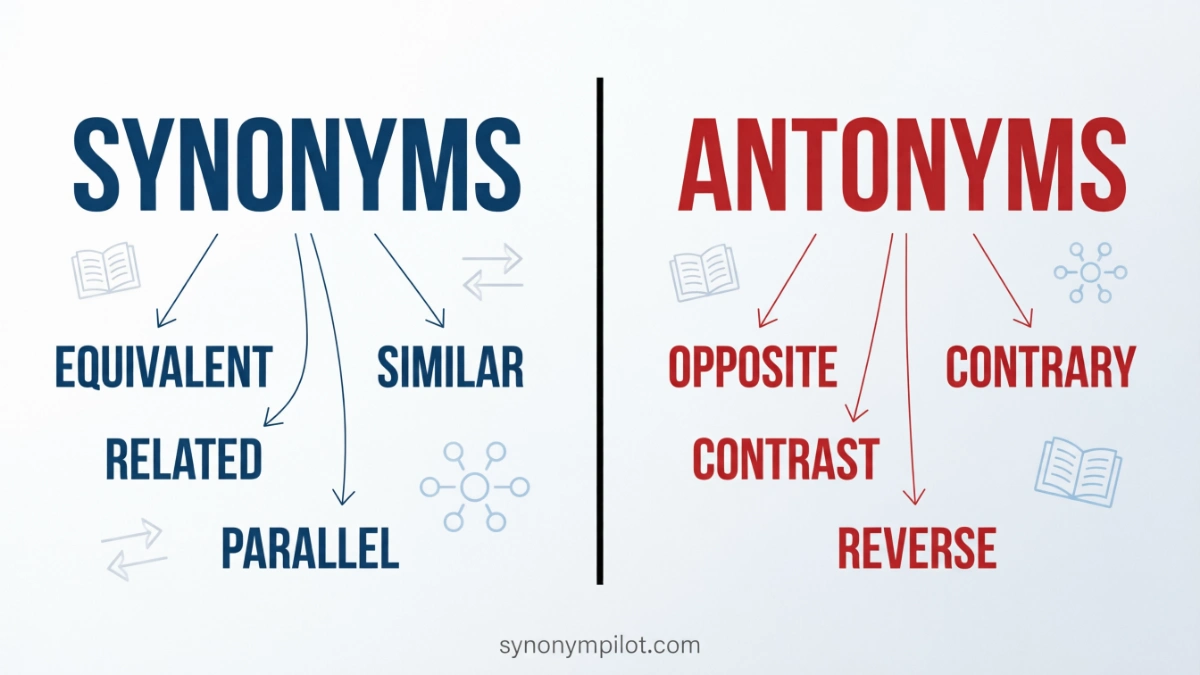
Quick Answer : Synonyms are words that share the same or very similar meanings like “happy” and “joyful.” Antonyms are words with opposite meanings like “happy” and “sad.” Together, these two vocabulary tools help you express ideas more precisely, avoid repetition, and understand the full range of meaning a word carries.
Your English teacher hands back your essay with a note: “You used the word ‘good’ eleven times. Try using synonyms.” You nod, but quietly wonder what exactly is a synonym, and how is it different from an antonym?
If that moment sounds familiar, you are in exactly the right place.Understanding synonyms and antonyms is one of the most practical vocabulary skills you can build.
It helps you sound more natural in conversation, write more varied sentences, and understand the subtle differences between words that seem similar on the surface.
What Are Synonyms? Meaning and Core Concept
A synonym is a word that means the same or nearly the same as another word. For example, “begin,” “start,” and “commence” all describe the act of initiating something. They are synonyms of each other.
However, true synonyms that are perfectly interchangeable in every context are actually quite rare. Most synonyms share a core meaning but differ in tone, formality, or emotional weight. “Begin” is neutral and everyday. “Commence” is formal and often used in official announcements. “Kick off” is informal and energetic. All three mean roughly the same thing, but you would not use them in the same situations.
This is why learning synonyms goes beyond memorizing word lists you also need to understand the tone each word carries.
What Are Antonyms? Meaning and Core Concept
An antonym is a word with the opposite meaning of another word. “Hot” and “cold” are antonyms. So are “fast” and “slow,” “love” and “hate,” and “success” and “failure.”
Antonyms help you understand the full spectrum of meaning around a concept. When you know that the antonym of “generous” is “stingy,” you understand both ends of the scale and every shade in between.
There are three main types of antonyms. Complementary antonyms are absolute opposites with no middle ground “alive” and “dead,” for example. Gradable antonyms exist on a scale “hot,” “warm,” “cool,” and “cold.” Relational antonyms describe two sides of a relationship “teacher” and “student,” or “give” and “receive.”
Why Both Concepts Matter Together
Most people learn synonyms to avoid repeating words. They learn antonyms to understand opposites. But actually, synonyms and antonyms work together to map out the meaning landscape of any word.
Take the word “brave.” Its synonyms include “courageous,” “bold,” “daring,” and “fearless.” Its antonyms include “cowardly,” “timid,” and “fearful.” Knowing this full picture tells you not just what “brave” means it tells you the full emotional and descriptive range around the concept of courage.
This is exactly why vocabulary teachers encourage learning words in groups, not in isolation.
When and How to Use Synonyms in Real Life
Use synonyms when you want to avoid repetition in writing, add variety to your speech, or choose a word that fits the exact tone of your situation.
In academic writing, for instance, instead of writing “the results show” three times in one paragraph, you might alternate with “the findings indicate,” “the data reveals,” and “the evidence suggests.” Each phrase is a synonym in context, and together they make your writing flow far more naturally.
In conversation, synonyms help you express degrees of feeling. “I am a little annoyed” versus “I am furious” both relate to anger, but the synonym choice completely changes how your emotion lands.
When and How to Use Antonyms in Real Life
Antonyms are especially useful when you want to create contrast, make a comparison, or define something by showing what it is not.
Teachers use antonyms constantly: “The opposite of ‘humble’ is ‘arrogant.'” Writers use them to create tension: “He was warm in public but cold behind closed doors.” Marketers use them to highlight value: “Not complicated simple. Not expensive affordable.”
Furthermore, antonyms help learners understand vocabulary more deeply. If you are unsure what “frugal” means, knowing that its antonym is “wasteful” immediately gives you a clearer picture.
Synonyms vs. Antonyms: Key Differences at a Glance
| Feature | Synonyms | Antonyms |
|---|---|---|
| Core relationship | Same or similar meaning | Opposite meaning |
| Purpose in writing | Avoid repetition, vary tone | Create contrast, show opposites |
| Example pair | Happy / Joyful | Happy / Sad |
| Complexity | Rarely perfectly interchangeable | Some are absolute, some are gradable |
| Best used for | Word variety, precision | Comparisons, definitions, contrast |
Common Words Confused With Synonyms and Antonyms
Many learners confuse these terms with related vocabulary concepts. Here is a quick comparison.
Synonyms vs. Homonyms
Homonyms are words that sound the same but have different meanings like “bank” (river bank) and “bank” (financial institution). Synonyms share meaning; homonyms share sound or spelling. These are completely different concepts, and mixing them up is one of the most common mistakes beginners make.
Synonyms vs. Homophones
Homophones are words that sound alike but differ in spelling and meaning “there,” “their,” and “they’re.” Again, these relate to sound, not meaning. Synonyms relate to meaning only.
Antonyms vs. Contronyms
A contronym is a single word that can mean two opposite things depending on context. “Sanction” can mean to approve something or to penalize it. Contronyms are not antonyms they are the same word wearing two opposite hats.
50 Synonyms Related to the Concept of Synonyms and Antonyms
| Synonym/Related Term | Simple Meaning | Example Sentence |
|---|---|---|
| Equivalent | A word or thing equal in value or meaning | “Big” and “large” are rough equivalents. |
| Alternative | Another option with a similar role | Choose an alternative word to avoid repetition. |
| Substitution | Replacing one word with another | The substitution of “happy” for “glad” works here. |
| Parallel term | A word used in a similar way | Joyful is a parallel term to cheerful. |
| Near synonym | A word with a very close but not identical meaning | “Slim” and “slender” are near synonyms. |
| Related word | A word connected in meaning or category | Angry, irritated, and furious are related words. |
| Word pair | Two words often compared or contrasted | Hot and cold are a classic word pair. |
| Opposite | A word with a completely different meaning | The opposite of “generous” is “stingy.” |
| Contrary | In direct opposition | Bold and timid are contrary in meaning. |
| Contrast | A difference shown by comparing two things | The contrast between love and hatred is sharp. |
| Converse | The reversed form of a relational word | “Give” and “receive” are converses of each other. |
| Contradictory | A term that directly denies another | “True” and “false” are contradictory terms. |
| Reverse | The opposite direction in meaning | “Advance” and “retreat” are reverses. |
| Inverse | The logical opposite, often in direction | “Ascend” and “descend” are inverse terms. |
| Complementary | Words that complete each other as a pair | “Question” and “answer” are complementary words. |
| Mirror word | A word reflecting the opposite perspective | “Buy” and “sell” are mirror words. |
| Word meaning | The definition or sense of a word | Understanding word meaning helps you use synonyms correctly. |
| Denotation | The literal dictionary meaning of a word | The denotation of “home” is a place of residence. |
| Connotation | The emotional or cultural meaning of a word | “Home” has a warm connotation beyond its literal meaning. |
| Polysemy | When a word has multiple related meanings | Polysemy explains why some words have several definitions. |
| Lexical field | A group of words related by topic | Joy, happiness, and delight share a lexical field. |
| Word family | Words sharing the same root | Happy, happiness, and unhappy form a word family. |
| Gradable adjective | An adjective that exists on a scale | Hot, warm, and lukewarm are gradable adjectives. |
| Absolute adjective | An adjective that cannot be graded | Dead and unique are absolute adjectives. |
| Semantic field | The range of meaning a word covers | The semantic field of cold includes chilly and freezing. |
| Register | The level of formality in language | Choosing synonyms requires awareness of register. |
| Formality | The degree of official language | Commence has higher formality than begin. |
| Nuance | A subtle difference in meaning or tone | There is a nuance between slim and skinny. |
| Tone | The emotional quality of a word | The tone of demanding is stronger than requesting. |
| Usage | How and where a word is naturally used | Usage determines which synonym fits the sentence. |
| Vocabulary | The total set of words a person knows | Building vocabulary includes learning synonyms and antonyms. |
| Diction | Word choice in writing or speech | Good diction means choosing precise words. |
| Precision | Exact accuracy in word choice | Precision helps avoid misunderstandings. |
| Clarity | Clear and easy-to-understand expression | Synonyms improve clarity by avoiding repetition. |
| Variation | Using different words to express the same idea | Variation in word choice makes writing more engaging. |
| Word choice | The decision of which word to use | Strong word choice improves writing quality. |
| Paraphrase | Restating meaning in different words | She paraphrased the paragraph using synonyms. |
| Emphasis | Highlighting an idea for effect | Antonyms create emphasis through contrast. |
| Definition | The exact meaning of a word | Every antonym helps clarify the definition of its pair. |
| Context | The situation in which a word is used | Context determines which synonym is most appropriate. |
| Implication | A meaning suggested but not directly stated | Similar synonyms may carry different implications. |
| Rhetorical contrast | Using opposites for persuasive effect | Speakers use rhetorical contrast to highlight differences. |
| Juxtaposition | Placing contrasting ideas side by side | Antonyms work perfectly in juxtaposition. |
| Gradation | A scale of differences between related words | Gradation moves from cool to cold to freezing. |
| Specificity | How precise or detailed a word is | Superior has more specificity than good. |
| Intensifier | A word that strengthens meaning | Certain synonyms act as intensifiers. |
| Word relationship | How two words connect in meaning | Understanding word relationships builds vocabulary. |
| Lexicon | The full vocabulary of a language or person | A rich lexicon includes mastery of synonyms and antonyms. |
| Etymology | The origin and history of a word | Etymology explains why some synonyms differ in formality. |
| Language register | The style of language suited to a context | Language register guides whether you choose “commence” or “begin.” |
Synonym and Antonym Groups by Usage
Academic and Formal Usage
When writing essays, research papers, or formal reports, words like “equivalent,” “converse,” “semantic field,” “denotation,” and “lexical field” demonstrate academic precision. These terms belong in scholarly writing and professional language analysis.
Everyday Classroom Usage
Words like “opposite,” “related word,” “word pair,” “word meaning,” and “word choice” are the natural language of classrooms. Teachers use these constantly, and students encounter them in every grammar exercise and reading comprehension task.
Professional Writing and Editing
Editors and writers work with “nuance,” “tone,” “register,” “diction,” “variation,” and “precision.” These terms reflect a sophisticated understanding of how language works beyond the surface level of meaning.
Conversational Usage
In everyday speech, people simply say “the opposite of,” “another word for,” “sounds the same as,” or “means the same thing.” These informal expressions do the same job as their technical counterparts but feel natural in casual conversation.
Antonyms of Key Concepts
| Antonym Pair | Meaning | Example |
|---|---|---|
| Synonym / Antonym | Same meaning vs. opposite meaning | “Fast” and “quick” are synonyms; “fast” and “slow” are antonyms. |
| Similarity / Difference | How alike vs. how unlike | Synonyms show similarity; antonyms reveal difference. |
| Agreement / Contrast | Things that match vs. things that oppose | Agreement in meaning defines synonyms; contrast defines antonyms. |
| Equivalent / Opposite | Equal in meaning vs. reversed in meaning | An equivalent shares meaning; an opposite reverses it. |
| Related / Unrelated | Connected in meaning vs. not connected | Synonyms are related words; unrelated words may have no semantic connection. |
Comparisons With Closely Related Concepts
Synonyms vs. Homophones
Homophones sound identical but carry completely different meanings “flower” and “flour,” for instance. Synonyms share meaning, not sound. Confusing these two concepts is extremely common among beginner learners, especially when studying English as a second language. The key is to remember: synonyms are about meaning, homophones are about sound.
Synonyms vs. Homographs
Homographs are spelled the same but mean different things “lead” (the metal) and “lead” (to guide). Once again, these relate to form, not meaning. Synonyms connect by meaning, not by spelling or pronunciation.
Antonyms vs. Negations
A negation simply adds “not” to a word “happy” and “not happy.” An antonym is a completely different word carrying the opposite meaning “happy” and “miserable.” Negations are grammatical tools; antonyms are vocabulary relationships. Using “not happy” is correct but far less expressive than “miserable” or “dejected.”
Gradable vs. Absolute Antonyms
Gradable antonyms allow for degrees you can be “a little cold” or “very cold.” Absolute antonyms do not allow degrees something is either “unique” or it is not. This distinction matters because it affects how you use intensifiers like “very” or “slightly” with antonyms.
Common Phrases and Expressions
“The opposite of”
This is the most natural and direct way to introduce an antonym in conversation or writing. Example: “The opposite of patience is impatience and this situation is testing mine.”
“Another word for”
This phrase introduces a synonym naturally in teaching or writing. Example: “Another word for ‘difficult’ is ‘challenging’ and it sounds slightly more professional in a work email.”
“Means the same as”
Used to confirm a synonym relationship. Example: “In this context, ‘purchase’ means the same as ‘buy,’ but ‘purchase’ sounds more formal.”
“On the opposite end of the scale”
Used to describe gradable antonyms. Example: “Kind is on the opposite end of the scale from cruel.”
“Two sides of the same coin”
Used informally to describe relational antonyms. Example: “Teaching and learning are two sides of the same coin you cannot really have one without the other.”
“Worlds apart”
Used to emphasize how different two antonyms feel in meaning or tone. Example: “Calling someone ‘frugal’ versus ‘cheap’ those two words are worlds apart in how they land.”
Common Mistakes to Avoid
Many beginners assume that synonyms are always interchangeable. They are not. “Thin” and “scrawny” both relate to body size, but “scrawny” carries a negative, almost critical tone that “thin” does not. Always check the connotation of a synonym before substituting it.
Another frequent mistake involves antonym selection. Not every word has a single clear antonym. “Happy” could be followed by “sad,” “unhappy,” “miserable,” or “depressed” and each one carries a different emotional weight. The best antonym depends on how strongly you want to express the opposite.
Furthermore, people often confuse “antonym” with “homonym.” An antonym is an opposite. A homonym is a word that sounds or looks like another word but means something different. These are completely unrelated concepts, and mixing them up in conversation or writing signals a vocabulary gap worth closing.
Finally, do not overload your writing with rare synonyms just to sound impressive. If a reader has to stop and look up a word, you have broken the flow of communication. The best synonym is the one your reader understands immediately.
FAQs
What is the simplest way to remember the difference between synonyms and antonyms? Think of it this way synonyms walk in the same direction, antonyms walk in opposite directions. Or try this: “syn” sounds like “same,” and “anti” means “against.” That little memory trick helps most learners lock in the difference instantly.
Can a word have more than one synonym or antonym? Absolutely most words have multiple synonyms and antonyms. “Happy” has synonyms like joyful, content, pleased, and elated. Its antonyms include sad, unhappy, miserable, and gloomy. The richness of English means few words stand alone with just one counterpart.
Are synonyms exactly the same in meaning? Rarely. Most synonyms share a core meaning but differ in tone, formality, or emotional strength. “Angry” and “furious” both describe the same emotion but “furious” is far more intense. This is why context always matters when you choose between synonyms.
Do all words have antonyms? Not necessarily. Concrete nouns like “table” or “pencil” do not have natural antonyms. Antonyms work best with adjectives, some verbs, and certain nouns that describe qualities or states like “success,” “courage,” or “kindness.”
Why should I bother learning antonyms if I already know the base word? Because antonyms deepen your understanding of the word itself. Knowing that the antonym of “generous” is “stingy” tells you that generosity involves giving freely and its absence involves holding back. That context makes the original word more meaningful, not just the opposite.
Conclusion
Synonyms and antonyms are not just grammar rules to memorize for a test they are practical tools you use every time you write a sentence or choose how to say something. When you know that “commence” is more formal than “begin,” or that “furious” is stronger than “angry,” you start making smarter, more confident language choices.
You do not need to learn every synonym and antonym at once. Instead, try picking one word each week and exploring its synonyms, antonyms, and shades of meaning. Keep a small notebook or phone note where you jot down interesting word pairs you discover.
Over time, this habit transforms your vocabulary from something you study into something you genuinely use and that is when real communication confidence begins to grow.

Hi, I’m Camron White, a word lover who enjoys exploring the beauty of the English language. I write about synonyms, meanings, and everyday vocabulary to help readers express themselves more clearly and confidently. My goal is to make learning new words simple, fun, and useful in real-life conversations. synonympilot.com