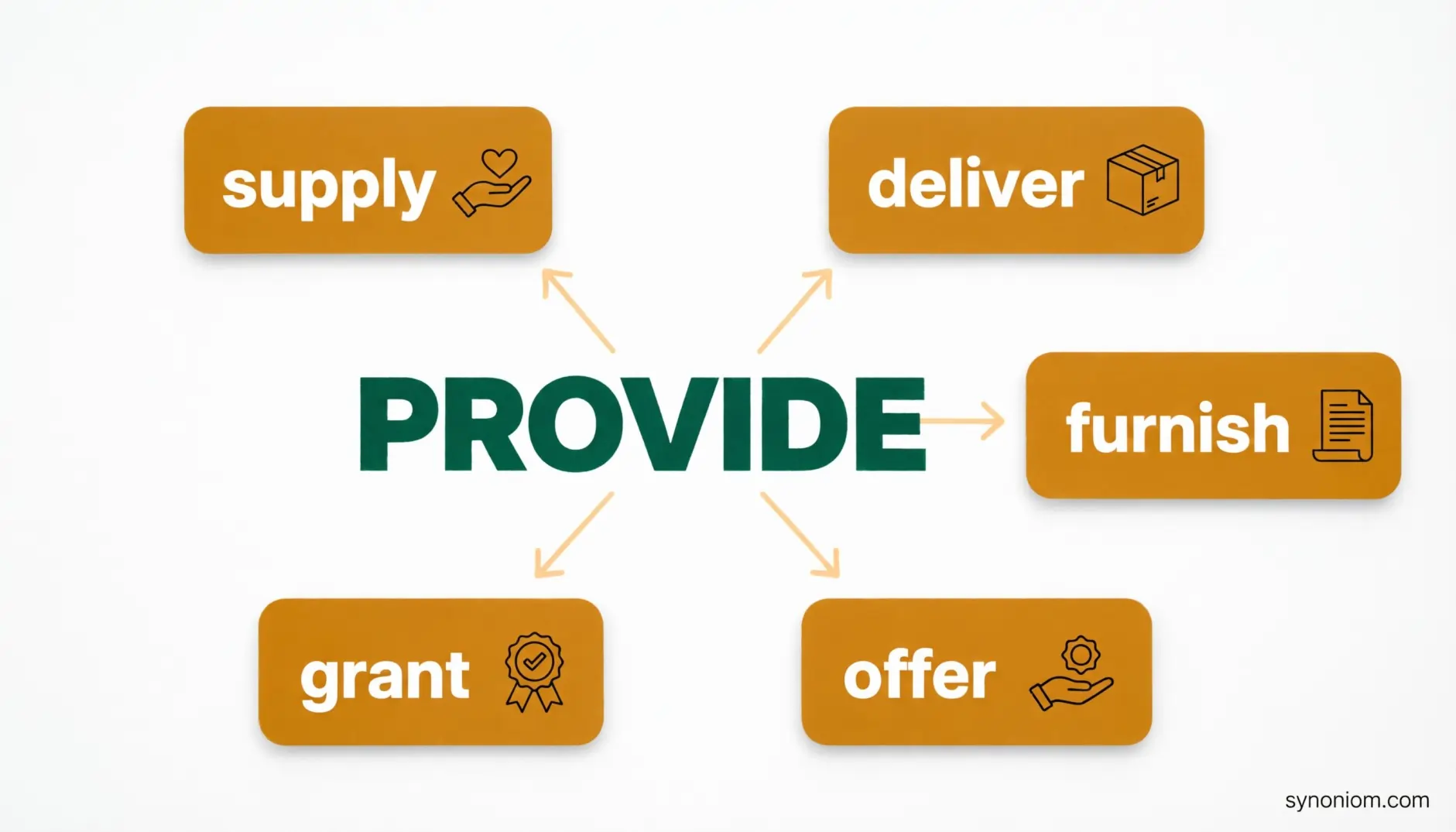
You are writing an email to a client and you type: “Please provide the documents by Friday.” Then you write the next sentence: “We will provide feedback within two days.” And the one after that: “Our team will provide full support throughout the process.” By the third sentence, you can feel it. Something is off.
The word is doing all the work, but it is doing it badly.That is the moment every writer, student, and professional faces.
“Provide” is reliable, but it is also flat. It tells your reader almost nothing about how something is given, who benefits, or what emotion or intent sits behind the action. Swapping it for a more precise word changes everything. So let us build your vocabulary around this one common verb today.
What Does “Provide” Mean?
“Provide” means to give, supply, or make something available to someone who needs it. You use it when a person, organization, or system makes resources, information, services, or support accessible to others. It works across nearly every context, from casual conversations to formal legal documents.
Meaning, Tone, and Context of “Provide”
At its core, “provide” is a neutral, action oriented verb. It focuses on the act of making something available, without telling you much about the manner, emotion, or relationship behind that act. That neutrality is both its strength and its weakness.
In terms of tone, “provide” sits comfortably in formal and professional writing. You find it constantly in business emails, government documents, legal contracts, and academic reports. In casual conversation, however, it can sound a little stiff. Most people naturally say “give me the number” rather than “provide me with the number” when talking to a friend.
“Provide” sounds most natural when someone in a position of responsibility delivers something to someone who depends on it. A company provides services. A school provides education. A doctor provides care. The word implies a structured relationship where one party has something and deliberately makes it available to another.
Furthermore, “provide” works as a transitive verb, meaning it almost always takes an object. You provide something to someone, or you provide someone with something. Knowing this helps you choose the right synonym for each sentence pattern.
When and How to Use “Provide”
You reach for “provide” in professional, formal, and structured contexts where you want to describe a deliberate act of giving or supplying.
In business writing: “The vendor will provide installation support within 48 hours.”
In academic writing: “The study aims to provide a comprehensive overview of current treatment options.”
In formal requests: “Could you please provide your contact details for our records?”
In legal or official documents: “The contract requires the employer to provide a safe working environment.”
Notice that “provide” works well here because all these situations involve a clear, deliberate transfer of something from one party to another. However, whenever the act feels more personal, generous, or emotionally meaningful, a different verb will almost always feel more natural and powerful.
50 Synonyms for Provide
| Synonym | Simple Meaning | Example Sentence |
|---|---|---|
| Give | To hand something over | She gave him the information. |
| Supply | Make available in quantity | The company supplies raw materials. |
| Offer | Present for acceptance | They offered free training. |
| Deliver | Bring to a recipient | He delivered the report. |
| Furnish | Equip or supply | The office furnished the staff with laptops. |
| Grant | Formally give | The school granted permission. |
| Present | Give formally | She presented the results. |
| Extend | Offer something (support/credit) | The bank extended credit. |
| Contribute | Give part to a whole | Everyone contributed ideas. |
| Allocate | Assign resources | Funds were allocated to research. |
| Distribute | Spread among many | Food was distributed to families. |
| Issue | Officially release | The agency issued guidelines. |
| Yield | Produce result | The investment yielded profit. |
| Administer | Deliver officially | Nurses administer vaccines. |
| Render | Provide a service | They rendered assistance. |
| Impart | Give knowledge/info | He imparted wisdom. |
| Equip | Supply tools/skills | The course equips learners. |
| Endow | Give a lasting gift | The foundation endowed the university. |
| Bestow | Give as honor | The award was bestowed on her. |
| Confer | Officially give title | Degree was conferred on him. |
| Assign | Give task | She assigned duties. |
| Lend | Give temporarily | The library lends books. |
| Afford | Provide opportunity | The view affords peace. |
| Share | Give part of something | She shared her notes. |
| Donate | Give freely | They donated supplies. |
| Hand over | Transfer possession | He handed over the files. |
| Pass on | Transfer information | Please pass on the message. |
| Put forward | Present idea | She put forward a plan. |
| Make available | Allow access | Resources were made available. |
| Set up | Prepare for use | IT set up the system. |
| Feed | Supply data/info | Sensors feed data. |
| Spare | Give from limited supply | Can you spare a minute? |
| Advance | Give ahead of time | Funds were advanced. |
| Produce | Generate output | The factory produces goods. |
| Generate | Create | The system generates reports. |
| Communicate | Deliver information | He communicated the plan. |
| Relay | Pass information | She relayed the update. |
| Submit | Present formally | He submitted the form. |
| Tender | Offer formally | The company tendered a bid. |
| Cater | Provide for needs | The service caters to clients. |
| Accommodate | Provide for needs | The hotel accommodates guests. |
| Outfit | Equip fully | Teams were outfitted. |
| Pitch in | Contribute help | Everyone pitched in. |
| Chip in | Contribute money/help | They chipped in for the gift. |
| Hook up | Connect/provide informally | He hooked me up with contacts. |
| Pour into | Invest resources | They poured funds into research. |
| Deliver up | Hand over formally | He delivered up the documents. |
| Throw in | Add extra | They threw in free delivery. |
| Make known | Provide information | They made changes known. |
Important Synonym Groups
Formal Synonyms
These belong in official documents, legal writing, academic papers, and professional correspondence.
- Render
- Bestow
- Confer
- Administer
- Furnish
They signal authority, deliberate action, and professional distance. They elevate your writing without sounding forced in the right context.
Informal and Conversational Synonyms
These feel natural in everyday speech, casual emails, and friendly messages.
- Give
- Share
- Pass on
- Spare
- Throw in
They are warm, direct, and immediately clear to any reader or listener.
Academic Synonyms
These suit research papers, essays, and scholarly writing where precision matters.
- Yield
- Contribute
- Impart
- Allocate
- Generate
They describe the act of providing in a way that signals analytical thinking and structured reasoning.
Professional Synonyms
These work well in business emails, reports, presentations, and workplace communication.
- Deliver
- Extend
- Issue
- Communicate
- Submit
They sound organized, action oriented, and professional without being overly stiff.
Emotional Synonyms
Use these when the act of giving carries personal warmth, generosity, or deep significance.
- Bestow
- Impart
- Donate
- Endow
- Share
These words suggest that the giver offers something meaningful from the heart, not just out of obligation.
Conversational Synonyms
These fit naturally in spoken English and relaxed written exchanges.
- Hand over
- Pass on
- Make available
- Chip in
- Pitch in
Slang / Very Casual
- Hook up (informal American English meaning to connect someone with what they need)
- Throw in (casual, implies a bonus or extra)
- Chip in (relaxed, implies collective contribution)
Antonyms of Provide
| Antonym | Meaning | Example |
|---|---|---|
| Withhold | To deliberately keep something back | The manager withheld key information from the team. |
| Deny | To refuse to give or allow something | The request was denied due to missing documents. |
| Deprive | To take away something needed | Poor planning deprived the project of resources. |
| Refuse | To clearly decline to give | He refused to share the contract details. |
| Retain | To keep instead of giving | The company retained all customer data. |
| Conceal | To hide information or resources | The report concealed important findings. |
| Withstand | To resist giving or yielding | She withstood pressure to release files. |
Comparison: “Provide” vs. Similar Words
Several words sit close to “provide” in meaning but carry very different tones and uses. Here is how to tell them apart.
Provide vs. Give
“Give” is warmer, simpler, and more personal. It describes almost any act of transfer between people and works perfectly in casual and emotional contexts. “Provide” is more formal and implies a structured or obligatory supply. Your friend gives you advice; your insurance company provides coverage. The relationship and context make the difference.
Provide vs. Supply
“Supply” emphasizes volume, logistics, and the ongoing availability of goods or resources. It works best in commercial, industrial, or operational contexts. “Provide” focuses on the act itself, regardless of quantity. So a factory supplies raw materials, but a teacher provides guidance. One is about flow and quantity; the other is about a single, deliberate act of making something available.
Provide vs. Offer
“Offer” implies choice. When you offer something, the other person can accept or decline. “Provide” implies delivery without necessarily suggesting the recipient had a choice. So a company offers a discount, but a government provides public services. The key distinction is If acceptance is optional.
Provide vs. Deliver
“Deliver” focuses on the act of getting something to its destination successfully. It often implies a process with a clear end point. “Provide” focuses on the act of making something available, without emphasizing the journey. So a courier delivers a package, while a report provides evidence. Use “deliver” when the movement or transfer process matters.
Provide vs. Grant
“Grant” carries a sense of authority and permission. Someone in power grants a request, a right, or access. “Provide” is more neutral and does not suggest the giver has special authority over the recipient. A judge grants bail; a teacher provides feedback. One involves power dynamics; the other simply involves giving.
Common Phrases and Expressions
Provide for This means to supply the basic needs of someone who depends on you, especially financially. Example: “He works two jobs to provide for his family.”
Provide with This means to equip or supply someone with a specific thing they need. Example: “The company provided every remote worker with a laptop and headset.”
Provide access to This means to make something available for someone to use or enter. Example: “The platform provides access to over ten thousand courses.”
Provide feedback This widely used professional phrase means to give your evaluation or response about someone’s work. Example: “The supervisor agreed to provide feedback within five working days.”
Provide support This means to offer assistance, resources, or encouragement to someone facing a challenge. Example: “The helpline provides support to people experiencing financial difficulties.”
Provide evidence Used in academic, legal, and research contexts, this means to present facts or proof. Example: “The prosecution failed to provide sufficient evidence to support the claim.”
Common Mistakes to Avoid
Using “provide” in casual conversation when “give” sounds more natural Saying “Can you provide me your phone number?” to a friend sounds oddly formal. In everyday speech, simply say “Can you give me your phone number?” Save “provide” for professional and formal situations.
Confusing “offer” and “provide” Remember that “offer” always implies a choice. If you write “the program offers free meals,” you suggest participants can choose to take them. If you write “the program provides free meals,” you suggest they are simply made available, without implying a choice. Using them interchangeably weakens your precision.
Using “grant” when you mean “provide” “Grant” implies authority and a power relationship. Using “grant” in a flat, neutral context sounds over the top. Say “the team provided resources” rather than “the team granted resources” unless someone in authority is formally approving something.
Overloading a paragraph with “provide” This is the exact problem the introduction described. Rotate between synonyms based on context. If one sentence uses “provide,” let the next one use “deliver,” “offer,” or “share” instead. Variety makes your writing readable and engaging.
Using emotional synonyms like “bestow” in casual business emails “Bestow” carries ceremonial weight. Writing “we will bestow you with login credentials” in a standard onboarding email sounds theatrical. Match the emotional register of your synonym to the context you are writing in.
FAQs
What is the most professional synonym for “provide” in a business email?
“Deliver,” “furnish,” and “supply” all work well in professional emails. Choose based on what you are giving: “deliver” for outputs and results, “furnish” for documents and data, and “supply” for resources or materials.
What is the difference between “provide” and “offer”?
“Offer” implies the recipient has a choice to accept or decline. “Provide” simply means making something available without suggesting a choice. Use “offer” when options are involved and “provide” when something is directly given or supplied.
Can I use “give” instead of “provide” in formal writing?
You can, but “give” sounds less formal. In academic or professional documents, “provide,” “furnish,” or “supply” typically sound more appropriate. However, “give” works perfectly in formal contexts when followed by a strong noun, such as “give a detailed account” or “give clear instructions.”
What is a good synonym for “provide” in an academic essay?
“Contribute,” “yield,” “impart,” and “generate” all suit academic writing well. They suggest a structured, deliberate act of producing or sharing something valuable within a scholarly context.
Is “bestow” a good synonym for “provide”?
Only in ceremonial or highly formal contexts. “Bestow” implies giving something precious, honorable, or rare, so it suits awards, honors, or significant gifts. In standard business or academic writing, it sounds too elevated and theatrical.
Conclusion
Every time you replace a flat, overworked verb with a precise alternative, your writing takes a step forward. “Provide” does its job reliably, but words like “furnish,” “impart,” “deliver,” and “extend” each carry a specific shade of meaning that “provide” simply cannot match.
The goal is not to avoid “provide” entirely; it is to use it consciously and reach for something better when a better word exists. Start by noticing where “provide” appears in your own writing this week.
Then ask yourself: am I simply making something available here, or am I delivering, sharing, granting, or contributing? That small question will sharpen your vocabulary faster than any word list alone.
Practice one new synonym per day, and within a month your writing will sound noticeably more confident, varied, and clear.

Hi, I’m Camron White, a word lover who enjoys exploring the beauty of the English language. I write about synonyms, meanings, and everyday vocabulary to help readers express themselves more clearly and confidently. My goal is to make learning new words simple, fun, and useful in real-life conversations. synonympilot.com